

Kardium Secures $115 Million Funding for Its Innovative Globe Mapping and Ablation System in Atrial Fibrillation Treatment

Kardium
Atrial Fibrillation Treatment Device Developer

T. Rowe Price
Venture Capital Firms in the Technology Startup Sector

Fidelity Investments
Financial Services Institutions
Atrial Fibrillation (AF, commonly referred to as AFib) is most commonly characterized by persistent arrhythmia.
With advancing age, the incidence of atrial fibrillation continues to rise, reaching as high as 10% in individuals aged over 75 years. During an episode of atrial fibrillation, the atrial rate ranges from 300 to 600 beats per minute, and the ventricular rhythm is characterized by a rapid and irregular heartbeat.
In atrial fibrillation, impaired atrial contraction predisposes to blood stasis within the atria and thrombus formation. These thrombi can travel through the bloodstream to various parts of the body, causing multi-organ embolism and leading to conditions such as cerebral embolism, pulmonary embolism, coronary artery embolism, renal artery embolism, and peripheral arterial embolism.
Furthermore, the stroke incidence in patients with atrial fibrillation is more than five times that of the general population, and the mortality rate is more than double.
For the treatment of atrial fibrillation, electrocardiogram (ECG) monitoring is the first step. In 2018, Apple launched the Apple Watch with ECG monitoring capabilities. The device incorporates electrodes into its sapphire crystal and digital crown; users can complete an ECG reading by simply placing a finger from their other hand on the crown to form a detection circuit. This feature has received clearance from the U.S. Food and Drug Administration (FDA). Notably, atrial fibrillation is the only cardiac condition for which the Apple Watch has been approved for detection in the United States.
Just like the Apple Watch, tech companies can do more to detect atrial abnormalities using devices, but treating atrial fibrillation requires professional medical institutions and healthcare enterprises that have been deeply involved in the field of atrial fibrillation treatment for many years.
Kardium is a developer of treatment solutions for atrial fibrillation. Founded in 2007 and headquartered in Vancouver, Canada, Kardium’s core team consists of engineers, medical researchers, and manufacturing personnel responsible for developing and producing mapping and ablation systems for the treatment of atrial fibrillation.

Kardium Core Team Members (Image source: Kardium official website)
VCBeat has learned that Kardium has recently completed a new round of financing amounting to $115 million, led by Fidelity Management & Research Company, with T. Rowe Price Associates participating as a co-investor.
Kardium’s official website revealed that as early as February 2019, Kardium had received financing support from T. Rowe Price Associates, with the specific amount undisclosed.
It is reported that the new round of financing will be used to accelerate the commercial development of the company’s Globe system in Europe and to conduct clinical studies for U.S. FDA approval.
With years of deep expertise in the field of atrial fibrillation treatment, Kardium has developed an advanced system for treating atrial fibrillation: the Globe Mapping and Ablation System (hereinafter referred to as the “Globe System”).
The Globe system integrates mapping and ablation catheters. It consists of a precision catheter equipped with a 122-electrode array and accompanying software. This software enables rapid pulmonary vein isolation, high-definition electroanatomic mapping, and ablation at any location within the left atrium.
In May 2018, in the first-in-human study using the Globe multi-electrode array catheter ablation system, complete pulmonary vein isolation (PVI) was achieved in over 99% of patients.
In addition to providing rapid ablation for pulmonary vein isolation (PVI), the Globe system is also capable of real-time monitoring of potentials in the pulmonary vein antrum during ablation. To date, Globe is the only product that continuously records and displays atrial potentials.
In June 2020, the Globe System received CE Mark approval, launching the Globe Mapping and Ablation System in Europe and successfully deploying the new Globe Positioning System (GPS™) 3D mapping and navigation module.

Globe Mapping and Ablation System (Image source: Kardium official website)
In summary, compared with other atrial fibrillation treatment solutions, the Globe mapping and ablation system offers three major advantages:
Pulmonary Vein Isolation (PVI) is currently the cornerstone of ablation therapy for paroxysmal atrial fibrillation.
The Globe system primarily employs pulmonary vein isolation to interrupt unstable electrical signals around the pulmonary veins, thereby restoring normal cardiac rhythm. Utilizing a 122-electrode array, the Globe system enables rapid pulmonary vein isolation (reducing the procedure time from approximately 4 hours to about 1 hour) and provides real-time electrophysiology (EP) monitoring.
The Globe system records and displays tissue contact, temperature, and electrical potentials within the atria, enabling electrophysiologists (EPs) to monitor and confirm tissue contact, ablation, and potential changes in real time during intracardiac procedures, thereby indicating procedural success.
The Globe system integrates ablation and mapping technologies. By combining the rapid pulmonary vein isolation of an ablation balloon catheter, the flexibility of a single-tip catheter, and the high-definition electroanatomic mapping capabilities of a multi-electrode catheter, it enables simultaneous mapping and ablation without the need for catheter exchange.
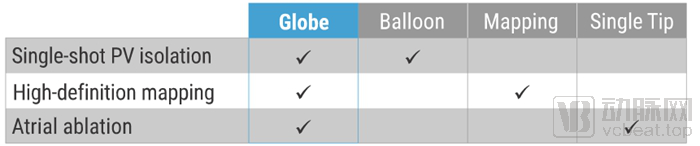
Three Major Advantages of the Globe System (Image Source: Kardium Official Website)
Dan Gelbart, the founder of Kardium, holds multiple titles and has received numerous honors.
He is a brilliant inventor. According to incomplete statistics, Dan Gelbart holds 135 U.S. patents, with inventions ranging from package tracking technology to atrial fibrillation treatment.
He is a professor of electrical engineering. Dan Gelbart holds a master’s degree in electrical engineering from the Technion – Israel Institute of Technology and has received the British Columbia Science Council Gold Medal, the Printing Industries Association Gold Medal, as well as honorary doctorates from Simon Fraser University and the University of British Columbia. In recent years, he has also taught graduate courses on industrial sensors and actuators at the University of British Columbia.
He is an entrepreneur with a pioneering spirit. In 1984, Dan Gelbart co-founded Creo, a laser technology company, with Dr. Ken Spencer, serving as its President and Chief Technology Officer. By 2005, when Creo was acquired by Kodak for $1 billion, the company had more than 4,000 employees.
Subsequently, Dan Gelbart founded the biotechnology company Rapidia and launched a complete 3D printing system. Rapidia’s two-step 3D printing technology, developed over several years, made its debut in 2019 as the first technology to enable hydraulic-setting metal and ceramic parts to go directly from the printer into the furnace without requiring a debinding step.
Kardium was co-founded in 2007 by Dan Gelbart, Doug Goertzen, and Dr. Lichtenstein to address existing challenges in the treatment of cardiovascular diseases, particularly atrial fibrillation.
According to Kardium’s research, there are 500,000 catheter ablation procedures performed globally each year, with the catheter ablation market estimated at $6 billion. It was precisely in response to this unmet market demand that Kardium was founded.
Like Dan Gelbart, Doug Goertzen also has a background in electrical engineering. Prior to joining Kardium, he spent 12 years working at Kodak and Creo.
Dr. Lichtenstein formerly served as the Head of the Division of Cardiovascular Surgery at the University of British Columbia (UBC). A renowned cardiovascular surgeon and researcher, he made significant contributions to cardiac surgical techniques throughout his career.

Kardium Founders: Dan Gelbart, Doug Goertzen, Lichtenstein (from left to right, image source: Kardium official website)
AtriCure shares the same vision as Kardium: to provide more advanced and comprehensive solutions for patients with atrial fibrillation.
AtriCure, founded in 2000 and headquartered in Ohio, USA, is a provider of innovative technologies for the treatment of atrial fibrillation and related conditions, offering world-class solutions to electrophysiologists and cardiothoracic surgeons worldwide.
After more than two decades of development, AtriCure holds 138 issued patents in the United States, with over 200,000 devices sold to more than 80 countries. Its technologies are used by cardiothoracic surgeons and electrophysiologists to treat atrial fibrillation and reduce related complications, having served cumulatively more than 350,000 patients with atrial fibrillation.

Image source: AtriCure official website
AtriCure’s atrial fibrillation solutions consist of three core components: open surgical ablation, minimally invasive surgical ablation, and left atrial appendage closure management.
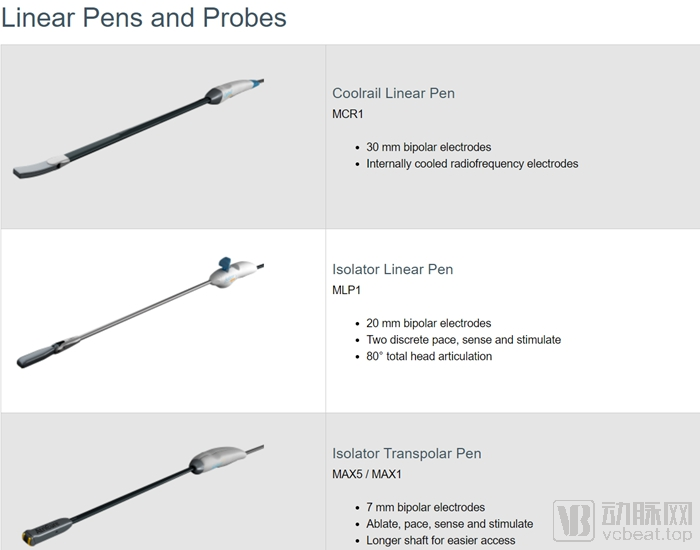
At this stage, AtriCure has established a robust product portfolio in tissue ablation, including surgical bipolar radiofrequency ablation systems, suction-based radiofrequency devices, as well as linear pens and probes.
Among them, the Isolator Synergy ablation system is AtriCure’s flagship product, available in three models:
Isolator Synergy OLL2/OSL2 is indicated for the treatment of patients with persistent atrial fibrillation requiring pharmacological or electrical cardioversion, as well as for patients with long-standing persistent atrial fibrillation (duration >1 year) who are undergoing open coronary artery bypass grafting and/or valve replacement or repair.
The Isolator Synergy EML2/EMR2 delivers Synergy RF technology, a system that responds to specific tissue characteristics by adjusting energy output and duration accordingly. It enables customized columnar lesions based on tissue length, width, and composition, and displays distinct ablation power and time curves tailored to the specific requirements of varying tissue components and thicknesses.
The Isolator Synergy EMT1 is an isolator-compatible access clamp, representing an ideal combination of leading synergistic ablation technology and access-driven capabilities.
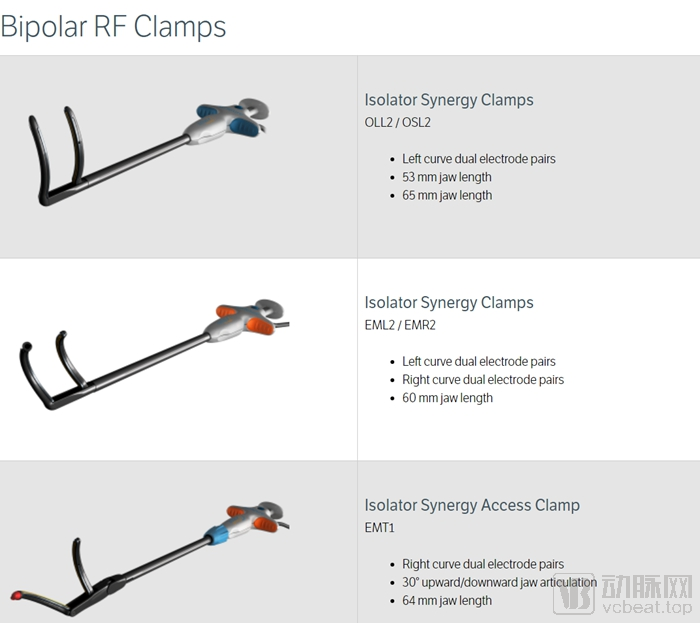
Three Models of the Isolator Synergy Ablation System (Image Source: AtriCure Official Website)
1. Thoracic Closed Ablation System
EPi-Sense utilizes VisiTrax technology to coagulate cardiac tissue via thoracoscopic, endoscopic, and laparoscopic surgical techniques, enabling electrophysiologists and cardiothoracic surgeons to sense and record cardiac signals.
The Subtle Cannula is designed for laparoscopic or general surgical procedures. It enables surgeons to access the pericardial space through a one-inch abdominal incision via the cannula, introducing an endoscope and coagulation device to reach the posterior surface of the heart for coagulation of epicardial cardiac tissue.
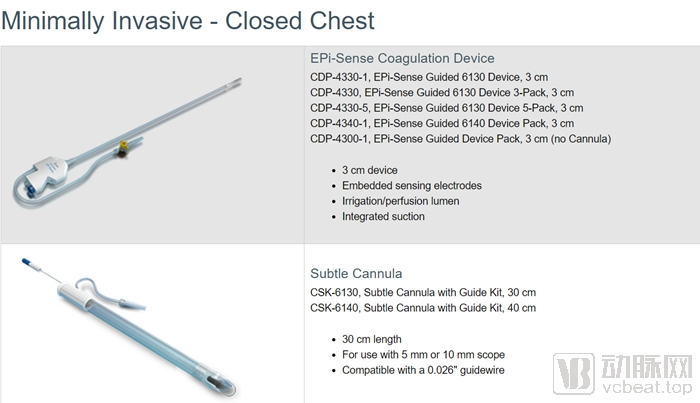
Thoracic Closed Ablation System (Image source: AtriCure official website)
2. Cryoablation Probe
The cryoICE Cryoablation Probe is AtriCure’s flagship product in cryoablation technology. It was the first cryoablation probe commercially available in the United States, indicated for the treatment of cardiac arrhythmias and for temporary ablation of peripheral nerves to block pain.
The cryoICE Cryoablation Probe is available in two models: CRYO2 and CRYO3. The sole difference between the two lies in their flexibility; the CRYO2 features a malleable probe, while the CRYO3 utilizes an enhanced malleable probe that reduces bending force by 25% compared to the CRYO2.
cryoFORM Cryoablation Probe, indicated for the cryosurgical treatment of arrhythmias. The probe is compatible with various surgical ablation procedures.
Cryoablation Probe (Image source: AtriCure official website)
AtriCure’s primary products for left atrial appendage management are the AtriClip series, which comprises two main products: AtriClip and AtriClip PRO.
1.AtriClip
The AtriClip portfolio comprises four products: the AtriClip Standard Device, the AtriClip Long Device, the AtriClip FLEX•V Device, and the AtriClip FLEX Device.
In 2010, the AtriClip Left Atrial Appendage Exclusion System was first launched in the United States for occluding the left atrial appendage under direct visualization in conjunction with other open-heart surgical procedures. By 2017, global sales had exceeded 100,000 units, reaching a significant milestone. In 2018, the AtriClip FLEX•V device was introduced to improve the placement of thoracotomy clips.
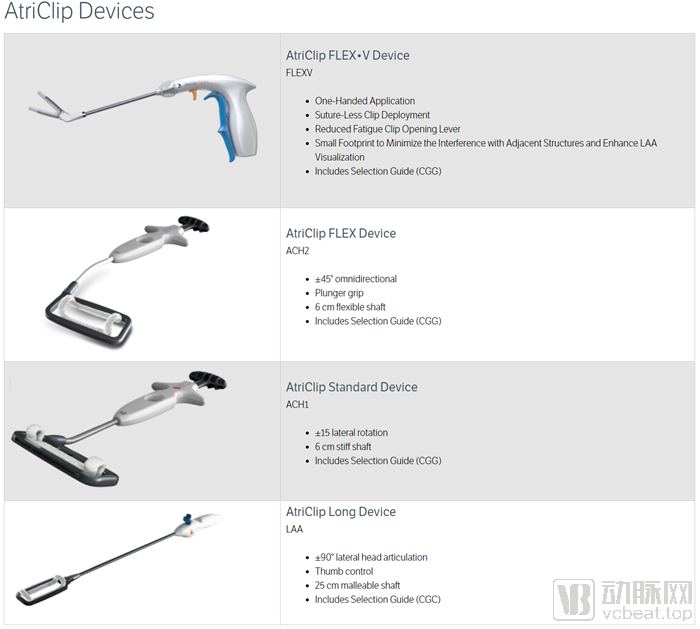
AtriClip Series Products (Image source: AtriCure official website)
2.AtriClip PRO
In 2016, the next-generation AtriClip device, AtriClip PRO, was launched in the U.S. and European markets. This new device enhanced the ability to occlude the left atrial appendage during minimally invasive cardiac surgery. In 2017, the AtriClip PRO•V device was introduced in the U.S. market. The new device incorporated several modifications to facilitate easier navigation and placement in minimally invasive surgical settings.
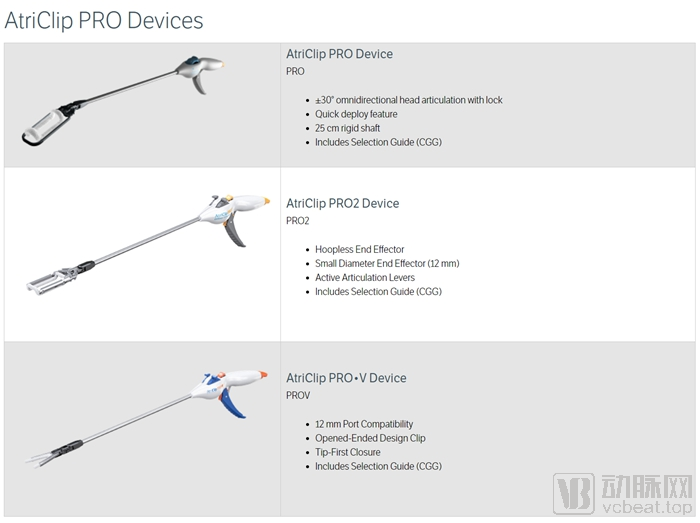
AtriClip PRO Series Products (Image source: AtriCure official website)
Over the past two years, foreign companies have made frequent moves in the field of atrial fibrillation treatment and have achieved phased results.
In August 2020, Conformal Medical, a medical device company focused on reducing stroke risk in patients with atrial fibrillation, announced the completion of an $85 million Series C financing round. The proceeds will be used to support pivotal trials of its novel CLAAS® technology in the United States.
In September 2020, Coremap, a developer focused on identifying drivers of atrial fibrillation, completed a $10.5 million Series A financing round. The funds will be used to accelerate product development and future regulatory submissions.
In December 2020, the pivotal trial evaluating FARAPULSE’s pulsed field ablation system for the treatment of atrial fibrillation received conditional approval from the FDA. In early 2021, the pulsed field ablation system obtained CE certification. FARAPULSE became the first company globally to commercialize a cardiac PFA system.
In contrast to the significant strides made in atrial fibrillation treatment abroad, companies in the domestic market remain largely focused on exploratory efforts in preclinical testing and diagnosis.For example, Nanjing Xijian has launched a handheld ECG monitor to meet the needs of atrial fibrillation patients in the mobile internet era. Nanjing Shuchuang Medical, on the other hand, leverages AI-based ECG monitoring to assist in the diagnosis of atrial fibrillation.
China’s Baiyang Pharmaceutical Group intends to expand into clinical therapies for atrial fibrillation, but constrained by high technical barriers, it has chosen to enter the market through partnerships with foreign companies.
U.S. medical device company AtriCure has been selling surgical ablation devices for atrial fibrillation in China for over a decade. In 2018, Baiyang Pharmaceutical Group entered into a strategic partnership with AtriCure, under which its subsidiary, Qingdao Baiyang Pharmaceutical Co., Ltd., became the exclusive distributor of AtriCure’s surgical ablation medical devices for atrial fibrillation in China.
By 2019, after six years of exploration, the Chinese developer of minimally invasive cardiovascular devices, Kangfeng Bio, had developed two major cryoablation technologies: a Cardiac Cryoablation System for the treatment of paroxysmal atrial fibrillation, and the Cryofocus Cryoablation System for patients with hypertension that is difficult to control with medication.
Kangfeng Bio’s innovative cryoablation technology has broken the monopoly held by foreign companies in atrial fibrillation treatment, marking a milestone achievement.
We look forward to breakthroughs in technological bottlenecks in atrial fibrillation treatment in China, leading to the development of more independently innovative products that will benefit a larger number of patients with atrial fibrillation.