

Syapse Files for IPO After Raising Nearly $200 Million Across 8 Funding Rounds to Advance Real-World Evidence in Oncology Precision Medicine

Syapse
Healthcare Information Technology Solution Developer
In February this year, Syapse, which is dedicated to providing real-world evidence (covering data on patient genotypes, lifestyle habits, treatment methods, and medications) and collaborates with health systems, life sciences companies, and regulatory agencies to improve cancer patient outcomes, announced the completion of a new $68 million funding round. This marks its eighth financing round in the past decade.
Why has it remained so popular? This is closely tied to its chosen market segment and its sustained, in-depth focus.
Eight Rounds of Financing Over a Decade, Raising Nearly $200 Million
Syapse was founded in 2008 in San Francisco, California, USA. In fact, it secured its initial round of financing in January 2011, only then coming into the spotlight of the investment community. Since then, the company has raised capital almost continuously, completing a new funding round every one to two years, with the amount raised steadily increasing.
As of February this year, it had completed eight rounds of financing, with cumulative funding reaching $187.6 million.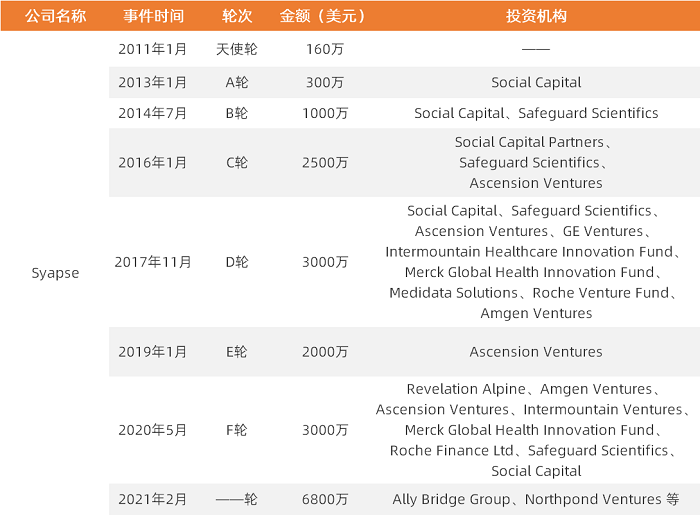
Among its investors are Nasdaq-listed companies, such as Safeguard Scientifics. Even Amgen Ventures, the venture capital arm of Amgen—one of the world’s largest biopharmaceutical companies—has joined the investment roster.
As a company that has secured multiple rounds of financing, its team has been undergoing continuous turnover and renewal. Its former CEO and co-founder, Glenn Winokur, earned a Bachelor’s degree in Business Administration and Marketing from the University of Illinois at Urbana-Champaign. He previously served as Co-founder and Chief Operating Officer of NetIQ Corporation, where he oversaw the supply of security, systems management, and web analytics software. Earlier in his career, he also gained relevant experience in the healthcare industry.
Its Chief Technology Officer and Co-Founder, Tony Loeser, earned a Master’s degree in Computer Science and a Ph.D. in Physics from Stanford University, as well as a Bachelor’s degree from Harvard University. He previously served as Vice President of Engineering at Tumri.
Ken Tarkoff is the current CEO of Syapse. He holds an MBA from Northwestern University and a degree in Psychology from Amherst College. He joined Syapse in April 2017. Prior to that, he spent decades working at RelayHealth, a provider of solutions for pharmacies.
Its Chief Medical Officer, Thomas Brown, is a graduate of Rice University and possesses extensive experience in the healthcare industry, with over 20 years of professional practice in the medical field, particularly in oncology. Vinod Subramanian, Chief Data and Product Development Officer, previously served as Vice President of Cloud Business at Saba, where he was responsible for service reliability. It can be said that as Syapse has grown and secured continuous financing, it has undergone successive rounds of leadership renewal.
Dedicated to Becoming an Accelerator for Precision Medicine
Syapse’s favorable outlook is largely attributable to its strategic focus on the field of “real-world evidence.”
The world is currently undergoing a historic transformation in cancer patient care, as we revolutionize the diagnosis and treatment of cancer. Today’s patients have access to more comprehensive molecular profiles that largely elucidate the uniqueness of each individual’s tumor. When receiving novel therapies, patients are treated with targeted interventions based on their molecular characteristics, while effectively leveraging their own immune systems. The continuous market introduction of these innovative therapies is largely attributable to insights derived from real-world data on previous cancer treatments.
It offers better treatment options for more patients, but currently benefits only a small fraction of them. This is because the current U.S. healthcare system is not built around the unique characteristics of each cancer patient.
Syapse aims to establish a precision medicine framework through comprehensive data sharing. Precision medicine enables more granular patient stratification, matching appropriate treatments to patient populations based on their clinical and molecular characteristics. To identify optimal therapies in complex clinical settings, it is essential to build large-scale datasets that share real-world experiences of cancer patients across the entire healthcare system. Data sharing can address these challenges by expanding the data pool and overcoming geographic barriers faced by community health systems in implementing precision medicine.
In this process, the participation of health systems and other entities is crucial. Syapse is also collaborating with Ascension, Banner Health, Inova Health, LSU Health, OhioHealth, and others to continuously expand its sharing network.
In fact, the establishment of real-world evidence (RWE) in oncology as a testing ground is driven by several factors: consistency and predictable outcomes (such as limited spontaneous recovery); patient-urgent needs driving rapid innovation; and the relatively long history of common data models. These factors largely determine its priority for development in oncology. However, its potential extends far beyond this scope. There are many other applications it can serve. For instance, during the pandemic, Syapse attempted to collaborate with the FDA on research related to COVID-19. This represents only a fraction of what real-world evidence can achieve.
Solving Real-World Problems, Building a Massive Data-Sharing Network
Ken Tarkoff, the current CEO of Syapse, once shared a personal experience that may help illustrate the general public’s strong desire for precision diagnosis and treatment. Tarkoff stated that more than a decade ago, his father was diagnosed with stage IV colon cancer, which carries a five-year survival rate of less than 10%. In the following years, his mother-in-law passed away from lung cancer. He has also witnessed friends and their families succumb to cancer.
It was also this sense of empathy that fueled his strong desire for advancements in cancer treatment technologies. With community development and the emergence of precision medicine, he saw the potential to improve cancer care and achieve long-term survival with cancer. However, much remains to be done to realize this goal. He was deeply moved by the fact that his father, a physician, had survived through personalized treatment approaches despite limited resources.
In February 2018, the renowned business media outletFast Company’s 2018 “World’s Most Innovative Companies” list featured Syapse as one of the ten companies in the biotechnology sector. The reasons for its inclusion underscore its value and significance:
In cancer care, genomic testing has become an essential component, with physicians utilizingTo tailor pharmacological therapies, it is essential to characterize the genetic mutation profiles of patients’ tumors. However, formulating a treatment plan requires physicians to access data from similar cases. When medical institutions are small or patients present with rare cancers, physicians must conduct searches beyond their own institutional systems.
The Syapse Data Sharing Network, launched by Syapse in 2017, aggregates medical information from multiple U.S. hospital systems, including anonymized electronic health records, pathology reports, and DNA sequencing data. Through this platform, physicians can identify similar patients to develop personalized treatment plans for their own patients.
In reality, the challenges involved in this process are far more complex than commonly assumed. Significant obstacles remain in leveraging real-world evidence to encourage pharmaceutical manufacturers to develop effective drugs. Current electronic health records (EHRs) in the United States fail to meet the demands of precision medicine, as most EHR systems are designed to standardize patient care workflows rather than manage and analyze complex molecular data for improved clinical decision-making. Furthermore, data sharing remains insufficient.
Beyond existing shortcomings, the early therapeutic benefits of precision medicine have gained patient acceptance and recognition, driving further growth in future demand. More diagnosed patients will seek highly targeted, personalized care. This also necessitates a transformation within health systems to embrace shared networks and fully leverage the insights offered by precision medicine.
In fact, it is clear that Syapse’s target audience consists of B-end users, enabling better services for cancer patients. Syapse serves health systems, life sciences companies, regulatory agencies, and other stakeholders. Physicians and nurses can share and learn which cancer treatment modalities to select, gaining insights into approaches that have yielded positive outcomes in similar patient cases. Researchers can leverage real-world clinical, molecular, therapeutic, and outcomes data. By integrating these data into the Syapse Learning Health Network™, Syapse has established one of the world’s largest networks providing real-world evidence to advance drug development and precision diagnosis and treatment.
To address public concerns about private data, Syapse has de-identified the data and established a Learning Health Network that complies with federal and state privacy protection regulations. It has also obtained HITRUST certification, which audits healthcare organizations for privacy compliance, among other requirements.
Partners include Amgen, Pfizer, Roche, and the FDA, among others.
Over the past few decades, Syapse has continuously expanded its business and currently maintains connections with leading pharmaceutical companies worldwide. This is largely due to the optimism of pharmaceutical giants regarding the development of the oncology sector, where Syapse provides crucial support for drug research and development.
Roche partnered with Syapse in early 2018 to establish a specialized oncology knowledge hub. Since then, Roche has continued its aggressive expansion: in February 2018, it acquired Flatiron Health, an oncology big data company, for $1.9 billion; and in June of the same year, it made a major move by acquiring Foundation Medicine, a cancer genomic monitoring company, for $2.4 billion. Looking further back, at the end of 2017, Roche had already acquired Ignyta, a developer of precision therapies for rare tumors, for $1.7 billion.
The partnership was largely driven by Roche’s recognition of Syapse’s strengths in this field. In fact, Flatiron’s business shares similarities with that of Syapse. Daniel, CEO of Roche, once stated, “Standardized real-world data sources and modeling capabilities are crucial for accelerating the development of cancer treatment technologies and new drugs.” The acquisition of Flatiron was motivated by its role as an oncology big-data company capable of providing Roche with foundational technologies and data modeling services for future pharmaceutical R&D. This also indirectly highlights the promising prospects of this sector.
In 2018, Medidata, a global leading provider of cloud solutions and data analytics for life sciences clinical research under Dassault Systèmes (formerly listed on NASDAQ), also entered into a partnership with Syapse. In 2018, when the collaboration was established, Medidata was providing clinical trial technology solutions to 18 of the top 25 pharmaceutical companies worldwide, while Syapse was delivering precision medicine solutions to nearly 300 hospitals across 25 states in the United States.
The collaboration between the two parties primarily focuses on “helping clinical trial sponsors develop appropriate inclusion and exclusion criteria, determining primary healthcare information systems suitable for clinical trials, and assisting oncologists and medical teams in more conveniently selecting patients eligible to participate in cutting-edge clinical trials.”
Amgen, one of the world’s largest biopharmaceutical companies, had its venture capital arm, Amgen Ventures, participate in Syapse’s investment rounds as early as 2017, including Series D and Series F. In May 2019, the two parties announced a collaboration to leverage real-world data for insights that support cancer drug development. Under the agreement, Amgen and Syapse jointly developed observational study analytics to evaluate treatment outcomes in oncology.
In July 2019, Syapse also entered into a collaboration with Pfizer. The two parties have also conducted related research in the field of oncology.
In August 2019, Syapse finalized a research collaboration agreement with the Oncology Center of Excellence (OCE) under the U.S. Food and Drug Administration (FDA). In fact, the FDA had already engaged with Syapse and established a partnership as early as 2015. The 2019 collaboration focused on leveraging real-world evidence (RWE) to support regulatory decision-making. Through this partnership, key regulatory issues concerning testing and treatment paradigms, dosing, safety, and oncology efficacy were addressed, with a central emphasis on precision medicine.
The focus of the collaboration between the two parties lies in the adoption of real-world data from multiple source systems, including clinical data from electronic health records (EHRs) and registries, as well as molecular data from testing laboratories. Fundamentally, this effort aims to identify indicators of regulatory applicability tailored to the nature of the U.S. Food and Drug Administration (FDA).
Dr. Sean Khozin, then Deputy Director for Oncology Regulatory Science and Informatics at the FDA’s Office of Clinical Evaluation (OCE), stated, “Real-world evidence derived from well-designed studies that meet appropriate data quality standards helps inform decision-making and provides insights into the impact of new therapies on real-world patient populations, particularly those underrepresented in clinical trials. This is especially important for precision medicine.”
In fact, Syapse initiated collaborations across Asia at an early stage. The company established an early partnership with Seoul National University Hospital in South Korea, which was renewed in 2019. In July 2020, Syapse announced a multi-year agreement with Ajou University Hospital. As the first academic hospital in South Korea to establish a Department of Hospital Information, Ajou University Hospital serves more than 6,300 cancer patients annually across its ten cancer centers. This collaboration will accelerate Ajou University Hospital’s advancements in precision medicine, while enabling Syapse to build regional partnerships throughout the Asia-Pacific region.
How Can Real-World Evidence Further Influence Nursing Care?
In fact, for the CEO of Syapse, there is still much to be done to fully unlock the potential of real-world evidence in improving cancer treatment. He has distilled this into three key points:
1. Ensure that the underlying real-world data can answer the most critical questions;
In the view of Syapse’s CEO, disruptions to various testing and medical interventions during the pandemic may lead to a surge in both late-stage cancer cases and the population of cancer survivors. Driven by a value-oriented approach to putting cancer data into practice, they are committed to extracting actionable insights, ultimately transforming the healthcare ecosystem and delivering better treatment options for patients through precision medicine. This mission is particularly critical for Syapse.