

HIFI Genomics Advances into the Multi-Billion-Dollar Cancer Early Screening Market with Industry-Leading Clinical Data

Berry Genomics
High-throughput Gene Sequencing Technology Developer
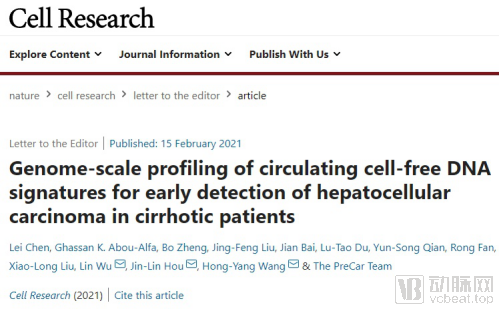
Recently, Huirui Gene, a subsidiary in which Berry Genomics (000710.SZ) holds an equity stake, jointly published clinical research findings on the HIFI technology for early cancer screening in the prestigious international journal Cell Research (Impact Factor: 20.5). This study was conducted in collaboration with Academician Wang Hongyang’s team at the National Center for Liver Cancer/Shanghai Eastern Hepatobiliary Surgery Hospital, Professor Hou Jinlin’s team at Nanfang Hospital of Southern Medical University in Guangzhou, and other institutions. The authoritative publication of this report fully demonstrates that HIFI technology holds significant academic importance, clinical value, and application prospects in the field of genetic testing for early cancer screening.
Even more promising is that, by leveraging HIFI technology and Berry Genomics’ capabilities, the liver cancer product can be successfully replicated across other major cancer types, such as lung cancer. This significantly accelerates the implementation of the goal to “establish early screening for China’s major high-risk, high-incidence cancers within the next 3–5 years and deliver a comprehensive early cancer screening solution for China,” thereby helping Berry Genomics capture the trillion-yuan blue ocean market of early cancer screening.
The market for early cancer screening holds immense potential, making it a favored R&D focus for companies both in China and abroad. According to data cited in a Guosen Securities research report, the global NGS-based oncology market is projected to grow at a compound annual growth rate (CAGR) of 27%, reaching $75 billion by 2035, driven by the accelerated expansion of cancer testing applications and increased coverage among paying populations. Within this market, early cancer screening represents the largest segment, estimated to grow at a CAGR of 75% and reach a covered population of 150 million individuals.
Herui Genomics pioneered the launch of the PreCar project in 2018, ahead of its peers. This initiative represents the largest nationwide, multi-center, prospective screening program in China for ultra-early warning biomarkers of hepatocellular carcinoma, involving tens of thousands of participants. To date, the PreCar project stands as the largest and most rapidly advancing study of its kind globally.
HIFI technology was developed based on the PreCar project. Clinical studies have demonstrated that HIFI is the most accurate next-generation sequencing (NGS)-based early screening test for hepatocellular carcinoma (HCC) in China’s clinical practice to date, effectively distinguishing individuals with HCC from those without. This technology demonstrates excellent performance across the entire disease course of HCC, from very early to advanced stages. Compared with other large-sample, multicenter HCC early screening technologies of similar scale, HIFI achieves a sensitivity of 95.42% and a specificity of 97.91%, representing globally leading performance.
Compared with traditional screening methods, HIFI technology also demonstrates outstanding performance. It offers superior detection capability, higher precision, and a higher detection rate. For individuals positive for liver cancer, HIFI’s detection capability is three times that of concurrent AFP testing and 70% higher than that of PIVKA-II, enabling stable and accurate detection in very early-stage and early-stage liver cancer. This meets the dual clinical requirements for an early screening time window and technical accuracy. Among liver cancer patients who test negative on traditional serological screening, HIFI achieves detection rates as high as 93.9% and 90.9%, respectively.
The international recognition of HIFI technology for early cancer screening has enabled NextCode Health to accelerate the commercialization of its mature products and rapidly capture market share. In August 2020, NextCode Health launched its first new liver cancer early screening product based on HIFI technology—"Leisining." Leisining is used to distinguish between cirrhosis and early/very early-stage liver cancer, providing a 6-12 month earlier warning compared to traditional detection methods, thus securing a valuable time window for effective clinical intervention.
Laisening targets high-risk populations in China, including approximately 90 million hepatitis patients and around 7 million liver cirrhosis patients. It not only assists in early screening and diagnosis of liver cancer, differentiating between benign and malignant liver nodules, but also monitors recurrence and enables dynamic postoperative surveillance. Currently, Helio Genomics has collaborated with multiple tertiary hospitals to implement its product. The company expects to formally submit an application for its early screening and diagnostic kit in 2021, marking the final stage of the National Science and Technology Major Project during the 13th Five-Year Plan period undertaken by Helio. From the perspective of the current domestic oncology market landscape, Laisening has provided Helio Genomics with a first-mover advantage of at least two years. According to research reports from Industrial Securities, the long-term market share is expected to stabilize at around 40%, with peak sales reaching approximately RMB 3.15 billion by 2030.
Huirui Genomics is actively leveraging this platform to develop early screening solutions for various types of cancer. The pilot study on early lung cancer screening is currently in its final stages and is poised to enter prospective clinical validation. HIFI technology can significantly accelerate R&D progress for Huirui Genomics’ multi-cancer early screening products, reduce time costs, and expedite its entry into the trillion-yuan market for early cancer detection.
Zhou Jun, CEO of Huirui Gene, stated that the publication of these academic achievements marks a significant milestone for Huirui Gene in the field of early cancer screening. It demonstrates the correctness of the company’s strategic direction in tumor early screening and is bound to accelerate R&D progress in early screening for lung cancer and other high-risk, high-incidence tumors prevalent in China. This development provides clear guidance for the company’s strategic plan to “establish early screening programs for major high-risk, high-incidence cancers in China within the next 3–5 years and deliver comprehensive early cancer screening solutions for the Chinese market.”