

ND Fit: Unlocking a Billion-Dollar Blue Ocean in Medical-Grade Weight Management Beyond Meal Replacements and Gyms [GBA Top 50]
Milk tea, sugary sodas... Unhealthy dietary patterns characterized by high sugar and high calorie intake, coupled with a sedentary lifestyle where exhausted individuals prefer binge-watching TV shows at home over exercising after a long day’s work, have allowed obesity to spread through the population like an incurable disease. By the time people took notice, the number of overweight individuals in China had already surpassed that of the United States, ranking first in the world.
Along with the rising numbers, the rate of increase in obesity has also climbed. A report titled “Surveillance Data on Chronic Diseases and Their Risk Factors,” released by the Chinese Center for Disease Control and Prevention, showed that in 2017, the national obesity rate was 11.9%, and the overweight rate was 30.1%.
Correspondingly, among the top ten global causes of death, obesity-related ischemic heart disease ranks first, and stroke ranks second. Diabetes, which ranks sixth, is also closely associated with obesity. Obesity is accompanied by various complications, and controlling obesity can significantly reduce the incidence of conditions such as polycystic ovary syndrome, obstructive sleep apnea syndrome, hypertension, and cardiovascular diseases. When BMI (kg/m²) decreases from 30 (obesity, defined as >28 in some contexts) to below 24 (normal range), many obesity-related complications show significant improvement.
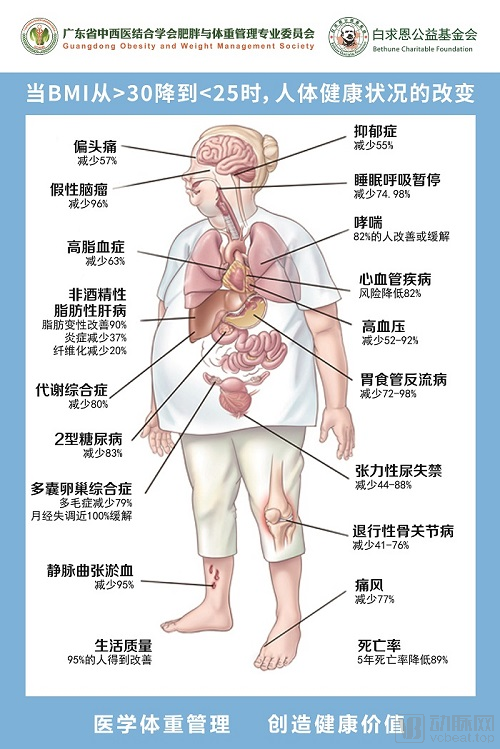
Image provided by Nandafei
As shown in the figure, patients with obesity-related complications derive significant benefits from a reduction in Body Mass Index (BMI). However, this cannot be adequately addressed by meal replacements, beauty salons, or fitness centers. There is an urgent need for a medical-grade, safe, effective, and trustworthy treatment solution.
In 2013, when the American Medical Association classified obesity as a disease for health management purposes, Nandafei (Guangzhou Nandafei Nutrition and Health Consulting Co., Ltd.) moved quickly to follow suit and was officially established in 2014. While the domestic weight management market was characterized by fierce competition among meal replacements and fitness centers, Nandafei entered a new blue ocean: medical-grade weight management.
Starting from the Hospital Obesity Clinic
Yin Hui, founder of Nandafei, graduated in 2002 from the First Military Medical University with a major in Clinical Medicine and previously worked in the Department of Internal Medicine at the Guangdong Second Provincial General Hospital. He later pursued undergraduate studies in Business Administration at Zhejiang University and completed an EMBA program at Peking University HSBC Business School. After eight years at Novartis, he founded Nandafei.
Guangzhou Nandafei Medical and Health Technology Co., Ltd. has appointed Jiang Jianrong, former Director of the Health Department of the Southern Theater Command, as its Chief Advisor, and boasts a team of multiple experts from the medical field. Its key partners have all achieved notable accomplishments in their respective domains. Currently, the company’s team comprises over 70 members, including more than 60 professional health managers.
Since 2015, Nandafei has gradually entered Grade A tertiary hospitals, assisting more than 40 such institutions in establishing and operating obesity clinics. Its partner hospitals are primarily located in Guangdong, Jiangsu, Shanghai, and other regions. The decision to focus on Grade A tertiary hospitals stems from their specific challenges: obesity patients are often scattered across various departments, and there is a lack of effective follow-up management. Even when outpatient departments aim to provide diagnosis and treatment, they frequently lack appropriate tools to do so effectively.
Historically, when patients with obesity sought medical care, physicians often merely advised them to increase physical activity without providing specific guidance. Meanwhile, lifestyle interventions were largely lacking. In the United States, the management of obese patients typically involves a multidisciplinary team comprising physicians, dietitians, exercise specialists, and psychological counselors, who collaborate to provide professional guidance. The AACE/ACE clinical practice guidelines further emphasize that lifestyle intervention is a key component in the treatment of obesity. Guangzhou Nandafei Medical and Health Technology Co., Ltd. has effectively integrated this concept with the current healthcare landscape in China.
In assisting hospitals with the establishment of obesity clinics, Nandafei has implemented a standardized DEHP lifestyle intervention system through a collaborative management model involving three types of specialists. This approach provides experts with optimized diagnostic and treatment plans by offering professional Medical Nutrition Therapy (MNT) protocols, a nutritional intervention follow-up system (via APP and mini-programs), and a diverse range of weight-loss support products. Under this model, clinicians are only required to provide disease diagnoses and prescriptions for patients with obesity, while Nandafei’s health managers assist in establishing health records, conducting obesity assessments, and providing customized dietary plans. Furthermore, exercise instructors deliver guidance on physical activity and psychological behavioral interventions, as well as patient education. The coordinated efforts of these three specialist roles ultimately achieve effective patient management.
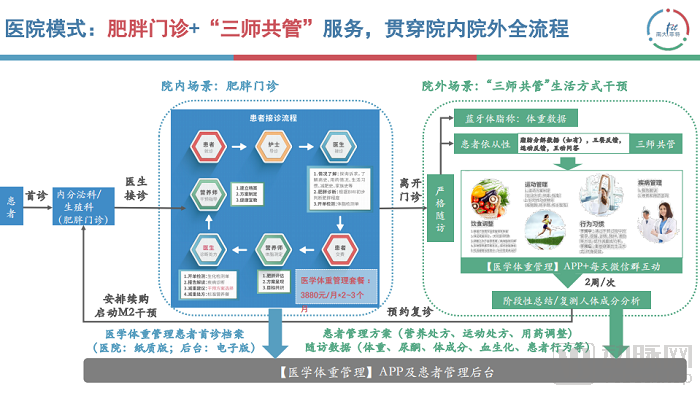
Image courtesy of Nandafei; Schematic diagram of the three-party collaborative management model
Patients need only register at the hospital and receive treatment in the obesity clinic. Without increasing the workload of outpatient physicians, Nandafei provides patients with a practical solution aligned with clinical practice guidelines. Currently, Nandafei has established obesity clinics in 16 of the 21 prefecture-level cities in Guangdong Province.
The New Blue Ocean of Medical-Grade Weight Management
For Nandafei, medical-grade weight management represents a blue-ocean market with higher barriers to entry, with the total addressable market expected to approach RMB 100 billion. In contrast, the lower-barrier weight management segment—whether in meal replacements or fitness centers—has become a highly competitive “red ocean.”
In 2020, six departments—including the National Health Commission, the Ministry of Education, the State Administration for Market Regulation, the General Administration of Sport of China, the Central Committee of the Communist Youth League of China, and the All-China Women’s Federation—jointly issued the Implementation Plan for the Prevention and Control of Obesity in Children and Adolescents. Using the average annual increase in overweight and obesity rates from 2002 to 2017 as a baseline, and taking into account the targets and requirements set forth in relevant international and domestic documents, the plan established an overall goal to reduce the average annual increase in overweight and obesity rates among children and adolescents aged 0–18 years by 70% below the baseline level during the period from 2020 to 2030.
As society places greater emphasis on obesity, an increasing number of people have recognized the urgency of obesity management. However, for Guangzhou Nandafei Medical and Health Technology Co., Ltd., this is far from sufficient. Public awareness of the hazards of obesity as a disease remains inadequate, necessitating further promotion and education by professionals.
It is also due to insufficient awareness that, although some hospitals have already established obesity clinics, the growth rate has not been significant. Guangzhou Nandafei Medical and Health Technology Co., Ltd. stated that Guangdong Women and Children’s Hospital currently adopts its protocol as the first-line treatment for obese patients with polycystic ovary syndrome (PCOS), which can increase the natural conception rate by 30–40% and help fulfill their desire to have healthy babies.
For Yin Hui, the demand for weight management will gradually increase in the future, driven by growing societal emphasis and shifting public perceptions. Current trends corroborate this view, with a surge of companies entering the weight management sector. Guangzhou Nandafei Medical and Health Technology Co., Ltd. aims to set an industry benchmark and has been consistently working toward this goal in recent years.
It has not only focused on market expansion but also made substantial contributions to the field of obesity. With the support of Nandafei, obesity societies have been established in Guangdong and Jiangsu provinces. Organizations where Yin Hui holds positions, such as the Guangdong Provincial Preventive Medicine Association, the Guangdong Health Management Association, and the Jiangsu Provincial Preventive Medicine Association, are continuously advancing the standardized management of obesity. In 2019, data from a multicenter clinical study centered on the Nandafei protocol—investigating the effects of short-term low-carbohydrate and calorie-restricted diets on weight loss in overweight/obese populations—was accepted for publication in the proceedings of the American Diabetes Association (ADA) Scientific Sessions. Furthermore, Nandafei is participating in the development of clinical screening and management pathways (expert consensus) for overweight and obesity. Through these initiatives, Nandafei is building a competitive moat for medical-grade weight management.
In terms of channel strategy, Guangzhou Nandafei Medical and Health Technology Co., Ltd. has adopted a dual-track approach, advancing simultaneously in both online and offline arenas. Offline, the company facilitates patient conversion through collaborations with partners such as Meinian Onehealth Healthcare and Grade A tertiary hospitals. Online, it works with UCB to convert digital traffic from obesity patients. Whether partnering with Meinian Onehealth or Youjiankang, these collaborations aim to enhance satisfaction among individuals undergoing health check-ups, thereby fostering a positive feedback loop.
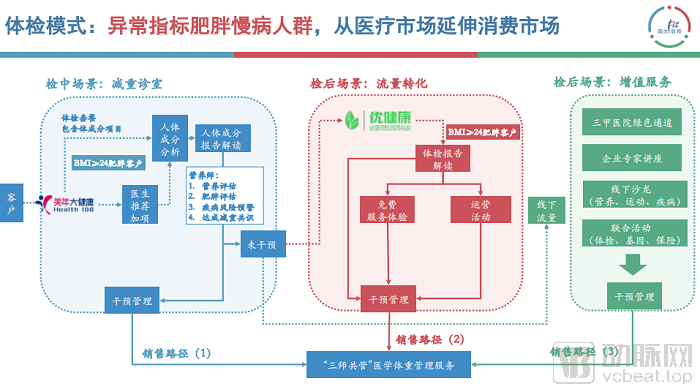
Image provided by Nandafei, Schematic Diagram of Physical Examination Channels
In terms of hospital market expansion, Nandafei has devised distinct strategies for tertiary (Grade A) hospitals and non-tertiary hospitals. For tertiary hospitals, Nandafei plans to implement its comprehensive medical solutions through fission marketing or investment promotion models. For non-tertiary hospitals, given their smaller scale, Nandafei may leverage internet-based fission strategies—utilizing platforms such as Weidian and WeChat Mall—to recruit partners for medical system management. For instance, in county-level hospitals, it aims to facilitate resource deployment by establishing affiliated associations.
To improve personnel efficiency, Nandafei is also developing its own mini-program product, providing service support to patients through remote dietitians and health managers. Nandafei stated that it will not be content with a labor-intensive medical system but aims to build a technology-driven healthcare system.
Build a Company That Addresses Societal Pain Points and Meets Public Needs
In fact, Nandafei is striving to establish its own medical-grade brand and gradually expand its reach. For Nandafei, the goal is to become the leading brand in medical weight management within the next three to five years. Going forward, it will continue to iterate on related data and introduce new features into its mini-program. Its e-commerce platform will further convert private-domain traffic, positioning itself as a health-focused marketplace offering a diverse range of health products.
In addition to providing services for patients with obesity-related complications such as polycystic ovary syndrome (PCOS), Nandafei is also developing a blood glucose management product specifically designed for diabetic patients—the “365-Day Annual Blood Glucose Control Service.” The launch of this product is based on data from its intervention cohort of 15,000 patients, among whom nearly one-third (approximately 4,000 cases) were individuals with both obesity and diabetes. Through medical-grade weight management, Nandafei has helped some patients transition from medication-based treatment to lifestyle interventions.
In 2020, despite the impact of the pandemic, Nandafei still achieved a revenue of RMB 15.22 million and reached break-even. For Nandafei, it will further deepen its presence in this field and focus on the control and management of obesity-related complications. In the field of diabetes, Nandafei aims to establish it as a specialized discipline to achieve integrated management both within and outside hospitals.
Guangzhou Nandafei, which has successfully achieved self-sustaining operations, stated that it does not rule out the possibility of raising financing. The company plans to go public within the next three to five years. In 2021, its focus will be on achieving province-wide coverage in Guangdong and assisting Meinian Onehealth, a listed company, in managing obesity and chronic diseases following health check-ups. Nandafei aims for a 60% year-on-year revenue growth in 2021 and plans to further replicate and expand its business model in 2022. By 2025, the company expects to partner with 200 hospitals and 100 Meinian health check-up centers, achieve annual revenue of RMB 150 million, and prepare for its initial public offering.
For Yin Hui, the goal is for Nandafei’s image as a benchmark for medical-grade weight management to attract more patients and deliver higher-quality services. He also emphasized that chronic disease management is a field requiring long-term commitment, expressing his hope that more practitioners in this sector will demonstrate resilience, perseverance, and confidence, continuously exploring solutions to address patients’ critical needs. “In this process, only by staying true to our original aspiration and keeping our mission firmly in mind can we better align with patient needs and benefit a broader population of patients.”
On the Selection of the Top 50 Biotechnology Innovation Enterprises in the Guangdong-Hong Kong-Macao Greater Bay Area (3rd Edition)
The “Top 50 Biotech Innovation Enterprises in the Guangdong-Hong Kong-Macao Greater Bay Area” selection campaign was co-hosted by Zhongchuang Industry Research Institute and KPMG China, and organized by Guangdong Medical Valley. The selection covered three sectors: medical devices, biopharmaceuticals and technology, and healthcare services. It comprehensively evaluated participating enterprises’ technological innovation and future development prospects from three dimensions: innovative technology, market application, and capital. A panel of expert judges, comprising representatives from government agencies, third-party research institutions, professional investment firms, and medical institutions, conducted in-depth on-site visits and due diligence to compile an authoritative list of innovative enterprises. Launched in July 2020, the four-month campaign attracted keen attention from both government bodies and industry stakeholders, with active participation from biotech enterprises within and outside the Greater Bay Area.