

Has China's First Domestic Gene-Editing Therapy Entering Clinical Trials Marked a Missed Investment Window?
The development of the gene therapy industry, following the emergence of gene editing technologies, has diverged into two distinct camps based on their technological characteristics. One camp is built upon relatively mature viral delivery technologies, such as adeno-associated virus (AAV) vectors, and focuses on supplementing genes that are missing or functionally impaired in patients (Hereinafter referred to as gene therapy); another school of thought employs CRISPR gene editing to directly repair the genomes of a subset of patient cells (Hereinafter referred to as gene editing therapy)。
The gene therapy sector has recently faced turbulence. Bluebird Bio, a global leader in the field, was forced to halt Phase 1/2 (HGB-206) and Phase 3 (HGB-210) clinical studies of its drug after patients with sickle cell disease (SCD) participating in the Phase I LentiGlobin trial developed acute myeloid leukemia (AML) and myelodysplastic syndromes (MDS). Meanwhile, sales of Zynteglo, which had previously been approved, have also been suspended due to potential safety concerns arising from its use of the same lentiviral vector as LentiGlobin.
In early 2021, China’s gene editing field reached a new milestone.On January 18, 2021, ET-01, the first gene-editing therapeutic product developed by Bioray Laboratories for the treatment of “transfusion-dependent β-thalassemia,” officially received clinical trial approval.The approval of this registered clinical trial marks another step forward in the development of China’s gene editing field.
In the clinical field,In July 2020, Bonano Bio announced that two patients with severe β-thalassemia who received its gene-editing therapy had been cured and discharged from the hospital.This event represents a breakthrough achievement in the clinical research of gene-editing therapies in China.
On the scientific research front, numerous “pioneers” in the field of gene editing have entered the industrial sector.A typical example is Reforgene, co-founded by Dr. Huang Junjiu, which is gradually emerging as a new force in the field of gene-editing therapies.
Thanks to the follow-up of extensive basic research and the establishment of efficient industrial transformation mechanisms, gene editing technology has become one of the hottest tracks in the primary market. The temporary setback of gene therapy has also helped attract more attention to gene editing treatments.
Yet, alongside the excitement, we have also observed certain “weaknesses” exposed within this industry. The most advanced products currently in development appear to be targeting thalassemia, the most common genetic disorder worldwide. As an increasing number of high-caliber professionals enter this emerging field to embark on their entrepreneurial journeys, a pressing reality has come into sharp focus: Can the thalassemia market truly accommodate so many companies competing simultaneously?
The gene therapy industry has achieved significant progress in recent years, with multiple products approved abroad. Typical examples include Spark Therapeutics’ Luxturna for congenital amaurosis and Bluebird Bio’s ZYNTEGLO for β-thalassemia.
China’s development in the field of gene therapy has been relatively slower than that of other countries, with many therapeutic areas only just entering registered clinical trials domestically. For instance, in the field of ophthalmic gene therapy, the Investigational New Drug (IND) application for NR082, submitted by the leading enterprise Nuofus Biopharma, was just accepted by the Center for Drug Evaluation (CDE) on January 20. Compared to the approval of products abroad, there is indeed a certain gap. Nevertheless, as a relatively mature industry, gene therapy undoubtedly holds significant growth potential in China. Meanwhile, gene editing, as a latecomer, is gradually catching up with gene therapy in terms of progress within the country.
Gene editing therapies primarily utilize CRISPR gene-editing technology, which was awarded the 2020 Nobel Prize in Chemistry and has attracted significant attention since 2013. The patent dispute between Jennifer Doudna and Feng Zhang has now been resolved, and companies founded by these pioneers have begun to yield substantial outputs in industrial translation in recent years. For instance, in December 2018, Editas Medicine, co-founded scientifically by Feng Zhang and others, successfully obtained approval for the first registered clinical trial of an in vivo CRISPR gene-editing therapy. Meanwhile, in December 2020, CRISPR Therapeutics announced research findings from early-stage clinical trials of its CTX001, covering all seven casesAll patients with transfusion-dependent beta-thalassemia (TDT) were free from transfusion dependence at their most recent follow-up after receiving CTX001 treatment,Three patients with severe sickle cell disease (SCD) experienced no vaso-occlusive crises (VOCs) after receiving CTX001 treatment.
From the perspective of development prospects, gene editing technology has a broader range of applications. Although current industrial translation is still focused on monogenic genetic diseases, the fundamental principles of the technology have the potential to address more complex disease types.
As positive developments continue to emerge in the field of gene therapy, domestic capital has turned its attention to this sector, which has long been a global hotspot. Investment enthusiasm in recent years has continued to rise.
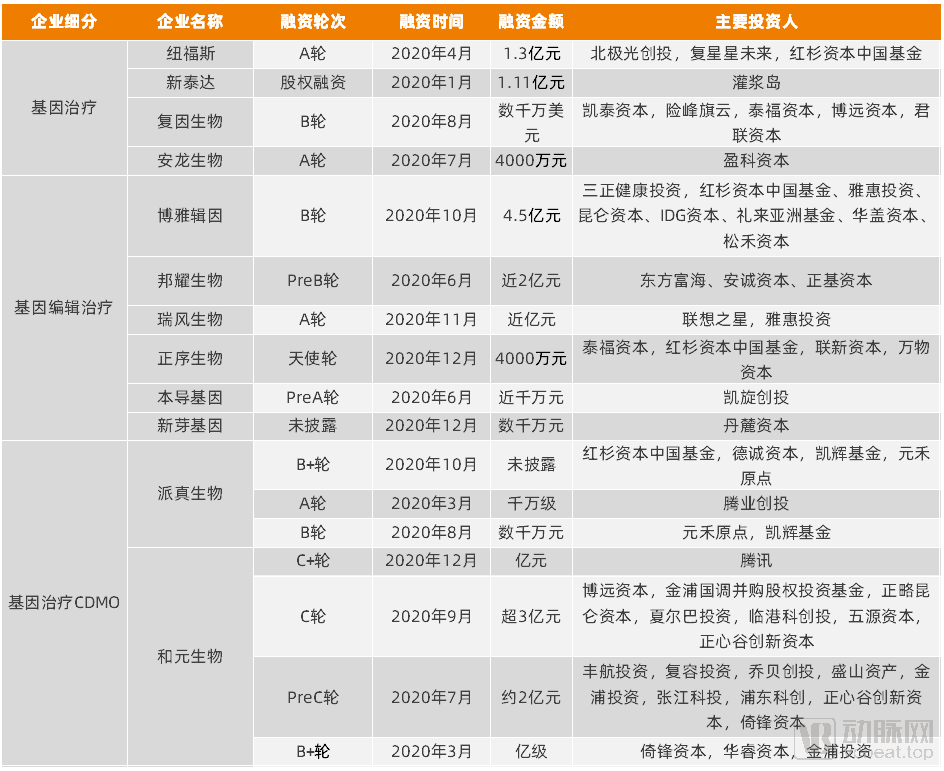
Gene Editing Companies That Secured Financing in 2020
Both the gene therapy and gene editing therapy sectors saw substantial financing in 2020. Companies such as Edigene, Biocytogen, Reforgene, and Nuofo Therapeutics each secured single-round funding exceeding RMB 100 million. Notably, Edigene raised RMB 450 million from several prominent investment firms in its latest Series B round. For an industry just entering the clinical stage, such investment levels represent significant support from the capital market.
In addition to direct investments in the gene therapy industry, the contract development and manufacturing organization (CDMO) sector related to gene therapy has also experienced remarkable growth in the past two years. In 2020, Obio Technology and PackGene Biotech both completed multiple rounds of financing. Other leading domestic CRO/CDMO enterprises, such as WuXi AppTec, Pharmaron, Porton Pharma Solutions, and Joinn Laboratories, have gradually built up their service capabilities in the field of gene therapy.
The rapid growth of this industry is likely driven more by the swift development of domestic cell therapy products. Nevertheless, it undoubtedly presents significant benefits for the gene therapy sector, as the demands for product research and development (R&D) and manufacturing can be met by corresponding service providers, thereby indirectly accelerating the R&D efficiency of gene therapy products.
Let us turn our attention back to the domestic market in China. As a major branch of gene therapy that has gradually matured in recent years, gene editing technology faces numerous concerns regarding the initiation of clinical trials, primarily because it has not yet been sufficiently validated by robust clinical data. Conversely, if clinical trials are not conducted solely due to these concerns, the efficacy and safety of the technology will never be verified. These two opposing aspects appear to form a paradox, which can only be resolved through breakthrough policy innovations.
Thus, we see that,The “Technical Guidelines for Pharmaceutical Research and Evaluation of Gene Therapy Products (Draft for Comments),” issued in September 2020, set forth specific regulatory requirements for CRISPR-Cas9.
Policy Excerpt: For gene therapy products involving editing tools such as CRISPR-Cas9, given the current limitations in understanding and detection capabilities, studies should provide more comprehensive safety assessment information. This includes safety considerations in upstream construction, such as selection of the editing system and sequence design; evaluation of potential off-target sites and confirmation of detection data; screening risks for cell pro-tumorigenic or tumorigenic effects associated with the editing technology; and immunogenicity of the editing system components. Corresponding safety control strategies and detection methods should be established to address potential risks.
For an industry that previously lacked a regulatory framework, the introduction of this policy provides critical guidance for subsequent corporate registration and filing. Gene therapy products utilizing gene-editing technology in China will gradually embark on commercialization explorations under the regulatory system. Shortly after the release of this "Draft for Comment," the first company to brave the new terrain—EdiGene, as mentioned at the beginning of this article—began its push toward registering clinical trials.
On January 18, 2021, ET-01, the first gene-editing therapeutic product developed by IASO Biotherapeutics for the treatment of “transfusion-dependent β-thalassemia,” officially received clinical trial approval.“We often joke that we are building the plane while flying it,” Dr. Wei Dong, CEO of Edogene, quipped in an interview with VCBeat.
Wei Dong continued the conversation by discussing regulatory registration and filing matters: “The National Medical Products Administration (NMPA) has a profound understanding of the gene editing field. During our communications with the Center for Drug Evaluation (CDE), we could sense that their primary concerns are twofold: product quality and product safety. This aligns largely with our expectations.”
Since Wei Dong returned to China in 2018, Boya Ji Yin has been preparing for its Investigational New Drug (IND) pathway. At that time, no CRISPR gene-editing therapeutic product had entered registered clinical trials globally. During the product development process, the most critical issues were manufacturing and quality control. Hematopoietic stem cells are highly sensitive—much more so than somatic cells. It is extremely challenging to establish a Good Manufacturing Practice (GMP) system that ensures successful genomic editing of hematopoietic stem cells while preserving their stemness.
“We actually have two aspects: cell therapy and gene therapy, so the GMP process controls on both sides serve as a mutual reference. In addition, communication and exchanges with the CDE have provided us with significant inspiration and assistance regarding quality control of raw materials throughout the entire process, how to test changes at each step of product manufacturing, and what methods and data should be used to demonstrate these changes and their impact on quality and safety,” said Wei Dong.
In terms of method selection, Boya Edigene’s ET-01 utilizes an electroporation system.AAV (adeno-associated virus) or LNP (lipid nanoparticle) vectors have gained significant popularity in the biotechnology sector in recent years; however, from the perspective of industrializing in vitro cell therapies, electroporation systems represent a mature, safe, and effective delivery method.
“Electroporation systems are now a relatively common ex vivo delivery method. In terms of development maturity, products utilizing electroporation tend to advance more rapidly. Some of the leading gene-editing products are based on electroporation technology,” Liang Junbin, CEO of Ruifeng Bio, told us.
Although Boya Ji Yin has only recently obtained its clinical trial approval for registration, several domestic enterprises and research institutions have already launched investigator-initiated trials (IITs). The findings from these IITs have been gradually disclosed in recent years, yielding encouraging results.
For example, in 2019, Professor Deng Hongkui’s research group at Peking University, together with collaborators, published a paper in the New England Journal of Medicine (NEJM) describing CCR5 gene editing in human adult hematopoietic stem cells using gene-editing technology. In patients with HIV/AIDS and acute lymphoblastic leukemia who received the treatment, acute lymphoblastic leukemia achieved complete morphological remission; the patients’ T cells exhibited a certain degree of resistance to HIV infection; and no off-target effects or adverse side effects were observed.
In 2020, Professor Lu You’s team from the Department of Thoracic Oncology at West China Hospital published a paper in *Nature Medicine*, reporting the results of a clinical trial involving CRISPR/Cas9-mediated editing of the PD-1 gene in T cells from patients with non-small cell lung cancer. Among the 12 patients who ultimately received treatment, the median progression-free survival was 7.7 weeks, and the median overall survival was 42.6 weeks. All treatment-related adverse events were grade 1 or 2, and next-generation sequencing confirmed that the median mutation frequency of off-target effects was only 0.05%.
When it comes to clinical outcomes, we must mention another leading enterprise in China’s gene editing field—Bioray Laboratories.In 2020, Biocytogen achieved a major breakthrough in the clinical application of gene editing technology. According to reports, two patients with severe β-thalassemia who received Biocytogen’s gene editing therapy were cured and discharged from the hospital.To date, both patients have been free from transfusion dependence for over nine months, with their total hemoglobin levels having returned to the normal range; they are currently under follow-up observation. This marks the first application of gene-editing technology for the treatment of thalassemia in Asia, and the first successful case worldwide of treating β0/β0 severe thalassemia using CRISPR gene-editing technology.
Dr. Wu Yuxuan, co-founder of Bioray Laboratories, laid the foundation for the company’s gene editing and hematopoietic stem cell technology platform. Xi Zaixi, CEO of Bioray Laboratories, told VCBeat: “Bioray’s most advanced gene therapy candidate for thalassemia is based on the research and patents developed by Professor Wu at Boston Children’s Hospital, affiliated with Harvard Medical School in the United States. We have also established a pipeline of multiple additional gene therapy products.”
Xi Zaixi continued, “In addition, we have achieved significant breakthroughs in UCART clinical development. By leveraging our gene-editing technology, we can precisely integrate the CAR (chimeric antigen receptor) into desired genomic loci, resulting in superior efficacy, enhanced safety, and clear cost advantages. This approach represents an upgraded version of conventional lentiviral vector-based CAR-T therapy.”
Bioray Laboratories’ first CAR-T product achieves site-specific integration of the CAR sequence into the PD-1 locus without using viral vectors. This approach enables simultaneous expression of the CAR and suppression of PD-1 expression, thereby endowing the final T-cell product with the combined effects of CAR-T therapy and PD-1 inhibition. In an ongoing clinical trial evaluating this non-viral, PD-1 site-specific integrated CAR-T therapy for non-Hodgkin lymphoma, four patients achieved complete remission (CR) within one month post-treatment. The therapy demonstrated a favorable safety profile, with no incidence of cytokine release syndrome (CRS) grade 2 or higher. Related findings from this trial will be published in a leading international journal.
The publication of a series of achievements actually signifies that China’s gene editing industry is flourishing, with an emerging trend of catching up with global advancements.We initially intended to use “Overtaking on a Bend” as the title to convey this development trajectory. However, several leading figures in the gene-editing industry believe that “Running Neck and Neck” is a more appropriate term, particularly in the realm of basic research on gene-editing technologies.
Research abroad naturally began earlier than in China. The patent dispute among Nobel laureate Jennifer Doudna, Dr. Feng Zhang of the Broad Institute, and gene-editing pioneer George Church seems as if it happened only yesterday.
The rise of CRISPR/Cas9 technology coincided with the surge in accelerated scientific research development in China. Consequently, upon its publication, basic research in China rapidly pivoted toward this promising field. Current published findings indicate that, in certain aspects, China’s progress is on par with that of the United States.
In terms of basic editing techniques, a 2017 paper published in Nature by Dr. Yang Hui from the Institute of Neuroscience, Chinese Academy of Sciences, revealed numerous unexpected gene mutations in two mice edited with CRISPR, sparking a broad discussion on the potential off-target effects of CRISPR. Subsequently, Yang’s research group published another article in Science, in which they designed a novel off-target detection method and discovered that BE3 (Base Editor 3), a single-base editing approach widely considered safe at the time, caused substantial off-target effects.
As early as 2015, Huang Junjiu’s team at Sun Yat-sen University conducted pioneering explorations into the translational feasibility of using CRISPR gene-editing technology for thalassemia treatment, marking the first such application worldwide. This achievement earned Huang a place among Nature magazine’s “Ten People Who Mattered” in 2015. In 2017, his team was the first to demonstrate a strategy for perfectly repairing thalassemia-causing point mutations using single-base editors. Notably, last year, Huang’s team successfully achieved lipid-lowering therapeutic effects in mice through single-base editing of PCSK9. This finding, coupled with the recently published long-term data on gene-edited cholesterol reduction in monkeys in Molecular Therapy—developed by James M. Wilson, a professor at the University of Pennsylvania and a pioneer in gene therapy—has once again drawn attention to the clinical application prospects of this technology in cardiovascular disease treatment.
Yang Hui and Huang Junjiu, two Chinese “pioneers” in the field of gene editing, have both embarked on industrial ventures, translating their years of research accumulation into commercial applications. Dr. Yang Hui’s company, Huida Gene (Huida Genomics), has already gained a notable reputation in the gene editing sector and completed an RMB 100 million Series A financing round at the end of 2019. Meanwhile, Ruifeng Bio, co-founded by Dr. Huang Junjiu, started slightly later but also secured an RMB 100 million Series A financing round by the end of 2020.
In addition to Dr. Huang Junjiu, the co-founders of RayWind Biosciences include Dr. Liang Junbin, who has many years of experience in the field of genetics. Dr. Liang previously worked at the Guangdong Institute of Microbiology, Chinese Academy of Sciences, and BGI Shenzhen. As a serial entrepreneur, Dr. Liang co-founded Annoroad Gene Technology. His current entry into the gene-editing sector represents his latest entrepreneurial venture, marking a transition from “reading” genes to “editing” them.
“The foundational technical logic of the gene industry lies in the discovery, development, and iteration of core molecular biology tools, which are essentially about understanding and applying humanity’s most fundamental genetic code. When we were conducting genetic testing, we were frequently asked, ‘Can you provide a solution after detecting an issue?’ For chromosomal abnormalities and genetic disorders, we could only regretfully answer no. The emergence of CRISPR technology has rewritten that answer,” said Liang Junbin.
In 2019, Liang Junbin and Huang Junjiu joined forces to establish RayWind Bio, a pharmaceutical innovation company centered on gene-editing technology.RuiFeng Bio is grounded in gene-editing technology, with involvement in the hematopoietic system, ophthalmology, and other systems. It has achieved pioneering results, particularly in the treatment of diseases such as thalassemia and inherited eye disorders.
Ruifeng Biologics’ product pipeline includes both ex vivo therapeutic approaches and in vivo drugs.
In vivo drugs involve the direct local injection or infusion of vectors loaded with gene-editing systems into the human body for therapeutic purposes. “Take the eyes, for example. They play a core role in human vision, yet many ophthalmic diseases remain untreatable with conventional drugs. The unique characteristics of the eye—such as being an immune-privileged site, having a small organ volume, and requiring low dosing—make it particularly well-suited for gene-editing therapies. Ophthalmology is therefore a key focus area for our in vivo initiatives,” said Liang Junbin.
Ex vivo therapeutic strategies involve harvesting patient cells for in vitro processing, followed by reinfusion into the patient after gene editing is completed. Currently, multiple products utilizing electroporation systems, such as the thalassemia therapies launched by EditoGene and Biocytogen (Bangyao Bio) mentioned earlier, adopt ex vivo therapeutic approaches. As the indication with the most rapid progress, three representative companies are currently making every effort to advance the development of these products.
At first glance, China’s gene editing industry appears somewhat crowded, with indications heavily concentrated in the field of thalassemia. However, several industry leaders have once again corrected our perception: the thalassemia market only seems saturated, while in reality, it still holds substantial room for growth.
“Take, for instance, the three leading gene-editing companies in the U.S. and the two gene therapy firms specializing in lentiviral-modified hematopoietic stem cells—their initial indications were also beta-thalassemia and sickle cell disease. Therefore, regardless of how many companies enter this space, we believe that patients with thalassemia will ultimately be the beneficiaries, even amid competition,” said Wei Dong.
According to relevant statistics from 2016, China has approximately 300,000 patients with intermediate and severe thalassemia, and over 30 million thalassemia gene carriers, predominantly concentrated in South China. Given this substantial patient population, there is robust domestic demand for thalassemia treatment regimens, and the large number of patients facilitates the conduct of clinical trials. Therefore, in light of such a vast patient base, the thalassemia therapeutic sector in China is far from being saturated.
Liang Junbin discussed the current state of the thalassemia market from another perspective: “Current thalassemia therapies are all autologous cell infusions, rather than off-the-shelf products. The entire treatment process requires close coordination between hospitals and patients. From admission to the transplantation unit to completion of the full myeloablative conditioning and cell infusion procedures, the process takes approximately one month. This means that the number of patients who can receive treatment simultaneously is constrained by hospital infrastructure.”
Therefore, in summary, after several years of development, gene-editing technology has finally reached its new inflection point for explosive growth.
Based on the current landscape and China’s domestic advantages, we can boldly predict several key development trends for the gene editing industry.
The emergence of CRISPR/Cas9 coincided with the golden age of scientific research development in China. In the field of gene editing technology, China has kept pace with international counterparts across basic research (such as technological breakthroughs by Dr. Liu Mingyao, Dr. Li Dali, and Dr. Yang Hui), in vivo experiments (Dr. Huang Junjiu’s translational explorations), and clinical trials (with results already published from multiple investigator-initiated clinical trials).
With a substantial body of scientific achievements already accumulated in the gene-editing sector, the next focal point must inevitably be industrial translation. Some keenly aware scientists have already taken steps toward commercialization, such as those behind RayBiotech and Huida Genomics. Startups founded with deep scientist involvement, like these, are likely to emerge in large numbers over the next two years.
The 2020 draft guidelines served as the starting gun for the gene editing sector. Following Boya Edigene’s successful Investigational New Drug (IND) application approval, other leading companies in the gene editing track will gradually enter the phase of registration clinical trials, at which point the advantage of China’s large patient population will be fully realized. Conducting registration clinical trials requires substantial financial support; therefore, gene editing will remain a hot topic in the primary market, with single-round financing amounts likely to continue reaching new highs.
Alongside the rise of gene-editing therapies, the upstream sector of gene editing is also experiencing growth. Although these CROs/CDMOs currently have relatively limited capabilities in empowering the gene therapy industry, they are likely to become more deeply involved in the development of gene editing, particularly to ensure product supply during clinical trial stages.
Monogenic genetic disorders represent a key area of advantage for gene-editing technologies. Therefore, the next phase of focus for gene editing will continue to center on monogenic genetic disorders, with thalassemia serving merely as the initial entry point. Compared with gene therapies represented by adeno-associated virus (AAV) vectors, gene editing offers greater potential and is increasingly intersecting with other fields. In the treatment of major diseases not caused by single-gene defects, including chronic degenerative diseases and malignant tumors, several early-moving companies such as Biocytogen, EditoRna, and Reforgene Therapeutics have already established their strategic presence.
In the process of expanding into disease areas, more support from delivery technologies is also needed.Overseas, Beam Therapeutics, founded by Feng Zhang and David Liu, recently announced the completion of its acquisition of Guide Therapeutics, a developer of lipid nanoparticles (LNPs), for up to $440 million.Although electroporation technology is highly mature, its current applications are primarily confined to the field of hematologic diseases. In line with Beam’s strategy, lipid nanoparticle (LNP)-based delivery systems will be employed for the treatment of liver diseases, while adeno-associated virus (AAV) vectors will be utilized for ophthalmic indications.
Of course, these trends do not necessarily mean that gene-editing companies must enter the market directly. For instance, collaborating with immune cell therapy companies for joint development is also an excellent option. “The field of cancer treatment indeed requires gene-editing tools. Currently, we have no immediate plans to develop CAR-T products. Each company has its own strategic considerations and core competencies. However, we can promote the development of other immune cell therapies through collaborative efforts in early-stage research and concept validation,” said Liang Junbin.