

From Local Pharmacy to $700M Digital Health Unicorn: How Alto Transformed the Prescription Experience
Alto
Patient-Centered Digital Pharmacy
In November 2020, Amazon officially announced its entry into the prescription drug retail business and launched an online store offering home delivery services for prescription medications. Amazon’s decision to enter this sector was largely driven by the substantial market value of the pharmacy industry and the surge in user demand spurred by the COVID-19 pandemic.
According to Healthcare Weekly, the current market size of the U.S. pharmacy business is approximately $312 billion, with nearly all of its 3% annual growth driven by increases in online pharmacies and delivery services.
Over the past year, the digital pharmacy market has witnessed frequent financing activities, drawing significant attention from both the market and investors.
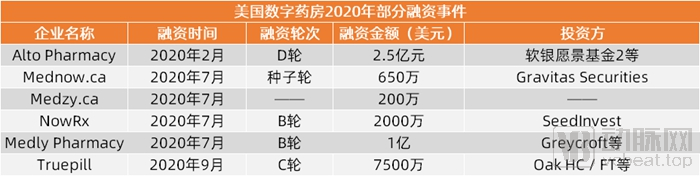
In terms of funding rounds and amounts raised, Alto Pharmacy (hereinafter referred to as “Alto”) is undoubtedly in the lead. Since its establishment in 2015, Alto has completed six rounds of financing, with total funds raised exceeding $350 million. Last February, Alto announced the completion of a $25,000 Series B financing round. Following this round, Alto’s market valuation successfully surpassed $700 million.

From an operational data perspective, Alto’s achievements also reflect patient and market recognition of its services. Currently, Alto’s Net Promoter Score (NPS)—a metric that gauges users’ likelihood to recommend a product or company—stands at 86, far exceeding the scores of conventional pharmacies. To date, Alto has successfully fulfilled more than 1.5 million prescriptions, improved the lives of over 125,000 patients, and helped customers save more than $40 million in medication costs.
What Makes Alto’s Services Stand Out in Creating So Much Value for Customers?
An examination of the professional backgrounds of Alto’s three founders reveals that all of them have worked for renowned global corporations. Similarly, none of the three founders had prior experience in the healthcare industry before establishing Alto.
Mattieu Gamache-Asselin, Co-founder & CEO of Alto, worked at Parse in 2012. The company was acquired by Facebook in 2013, and he subsequently joined Facebook as an engineer. Driven by a vision to help patients and improve the pharmaceutical supply chain, Mattieu Gamache-Asselin chose to enter the healthcare industry and founded the brick-and-mortar pharmacy ScriptDash in 2015.
Like Mattieu Gamache-Asselin, Alto’s CTO Jamie Karraker also worked as a software engineer at Facebook before founding Alto. This shared professional background made them colleagues and facilitated their discussions on the pharmacy market.
Vlad Blumen, another co-founder of Alto, has extensive work experience at companies such as Dell and Cisco Systems, along with entrepreneurial experience. Over the years, Vlad Blumen has primarily focused on business development, accumulating rich experience in developing and maintaining channel partners.
Although their entrepreneurial goals were clear, it is undeniable that none of the three founders had prior experience in the healthcare industry. To gain a deep understanding of the pharmacy market, they chose to work at a family-owned pharmacy for an extended period, immersing themselves in every aspect of operations—including medication procurement, prescription delivery, and insurance negotiations—thereby laying the foundation for the subsequent establishment of ScriptDash.
For the logistics industry, although "last-mile" delivery is the final link in the logistics system, it holds significant importance as the only stage that enables face-to-face interaction with customers. With societal development, consumer demands have gradually expanded beyond mere home delivery to include requirements for delivery timeliness and various value-added services. This phenomenon is also prevalent in the U.S. pharmacy industry.
The U.S. healthcare system operates under a model that separates medical practice from pharmaceutical dispensing. Physicians in hospitals are responsible solely for examining patients and prescribing medications based on their diagnoses, while patients must fill these prescriptions at pharmacies. This separation has fostered a highly developed pharmacy market in the United States. From the perspective of consumer demand, major U.S. pharmacy retailers offer mail-order medication services. In recent years, many companies have also launched same-day delivery and on-demand delivery options. Alto’s rapid growth is largely attributable to its free same-day medication delivery service.
Alto’s predecessor, ScriptDash, was a community pharmacy that primarily provided medication purchasing and delivery services to local residents. Through prolonged engagement and communication with community patients, ScriptDash recognized that, compared to simple medication sales, patients preferred maintaining long-term relationships with pharmacists. This ongoing connection enables pharmacists to better understand patients’ individual needs, price sensitivity, and preferences.
Building on this foundation, ScriptDash gradually expanded its offerings beyond prescription dispensing and sales to include services such as discounted medication lookup, insurance coordination, free medication delivery, and prescription recommendations. As its business grew and its service market expanded, ScriptDash was officially renamed Alto in 2017.
The word “Alto” means “high” in Latin, and the company’s decision to rebrand as Alto signals its determination to expand into new markets. Alongside the name change, Alto has begun building an open platform to facilitate collaboration between physicians and pharmacies, gradually shifting its brand positioning from a community pharmacy to a digital pharmacy.
For patients, accessing Alto’s services is straightforward. First, after receiving a prescription, the patient and physician can either upload the prescription directly to the Alto platform or convey their needs via phone. Second, upon order acceptance, Alto verifies whether applicable discounts are available for the medication. Once all information is confirmed accurate, Alto promptly arranges courier delivery of the medication. Patients can maintain real-time communication with pharmacists through the Alto app, as well as monitor drug pricing and delivery status. Throughout this process, patients incur no additional fees beyond the cost of the medication itself.
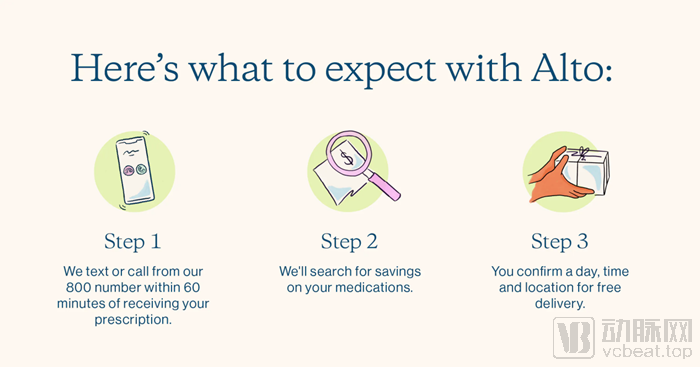
Patient Service Access Steps
Throughout the entire medication purchasing process, free same-day delivery is clearly the top priority. To ensure rapid drug delivery, Alto has expanded its geographic coverage by establishing its own offline pharmacies and distribution centers, while also building a comprehensive network of couriers. It is reported that a single Alto offline distribution center can cover an area equivalent to that of 400 pharmacies.
By offering services tailored to user needs, such as discounted medication searches and free drug delivery, Alto has accumulated a substantial patient base. Building on this foundation, it has gradually established partnerships with healthcare providers, insurance companies, and pharmaceutical manufacturers.
Healthcare Service Providers
For healthcare providers and physicians, Alto helps address insurance prior authorization issues and other insurance-related matters during patient consultations.
Unlike in China, the majority of the U.S. population is covered by commercial health insurance. Consequently, when patients seek certain types of medical services, physicians are required to submit documentation to insurers to demonstrate the medical necessity of the proposed treatment plan. If prior authorization and approval are not obtained from the insurer, the insurer reserves the right to deny reimbursement for the claim. Typically, when conducting prior authorization reviews, insurers primarily consider the following aspects:
1. Whether the treatment regimen includes any medications with potential for abuse and adverse effects;
2. Whether the prescription contains newly launched drugs that are not yet covered by insurance;
3. Whether the drug's indications include the patient's condition;
4. Assess the necessity of this treatment for the patient.
For service types requiring prior authorization, regulations vary by insurance plan; however, most insurers universally mandate pre-authorization for non-emergency inpatient admissions and surgical procedures. The timeframe for obtaining prior authorization is variable: while patients may sometimes receive approval before leaving the physician’s office, it typically takes several days, and in certain cases, may require a wait of several weeks.
A survey conducted by the American Medical Association (AMA) of 1,000 practicing physicians revealed that most doctors believe prior authorization leads to delays in patient care, while cumbersome paperwork exacerbates their professional burden. Nevertheless, prior authorization remains a critical component for securing insurance approval for patients.
With Alto, physicians are no longer burdened by prior authorization issues. Alto can proactively submit authorization request documents to insurance companies based on physicians’ needs, and physicians can check the application status at any time through the platform. In addition to handling insurance-related matters, Alto provides follow-up disease monitoring and care services for patients under physicians’ management, leveraging its professional team of pharmacists and nurses. Currently, Alto offers a range of specialized care services to patients, including diabetes management, fertility care, and cardiopulmonary disease management.
For Alto, partnerships with healthcare providers enable it to acquire more patient users, thereby driving greater revenue. It is reported that in the San Francisco area alone, over 40 clinics have chosen Alto as their prescription delivery pharmacy for patients.
Pharmaceutical Manufacturing Sector
The substantial accumulation of users and data also provides a foundation for its collaboration with pharmaceutical manufacturers. By leveraging user medication purchase data and usage feedback provided by Alto, pharmaceutical manufacturers can gain a clearer understanding of the market landscape for their drugs and make appropriate adjustments accordingly.
Insurance Sector
To some extent, patient medication adherence has a more direct impact on treatment outcomes than the treatment regimen itself. However, survey data indicate that after one year of medication, fewer than 50% of patients still strictly adhere to their prescribed regimens. Low medication adherence directly leads to increased healthcare costs, wastage of resources, and worsening of patients’ health conditions.
In August 2017, Alto publicly announced the completion of its acquisition of Round Health, a startup specializing in smart pill bottles. The smart pill bottles developed by Round Health remind patients to take their medication through timed push notifications via a mobile app and visual alerts from the bottle’s lighting system.
Through this acquisition, Alto has integrated Round Health’s technological assets into its own services and platform, which helps improve patient medication adherence and enables healthcare providers to stay informed about patients’ medication usage in a timely manner.
According to information on Alto’s official website, patient medication adherence has increased to 71% after using Alto’s medication reminder service. This figure also indicates that insurers can reduce overall payment costs by partnering with Alto.
Currently, Alto’s services cover the San Francisco Bay Area, Las Vegas, Seattle, and Denver. In February this year, Alto launched market expansion initiatives in New York, Dallas, and Houston. Moving forward, Alto will remain committed to its patient-centric philosophy, continuously providing more users with faster, more convenient, and more affordable access to medications.