

CosMED Enters China's $240 Million Microneedle Market as Industry Pioneer, Files IPO Prospectus

CosMED Pharmaceutical
Transdermal Therapeutic System Researcher, Soluble Microneedle Technology Developer
In September 2020, a study titled “Paper-Based Microneedle Patches for Blood Glucose Monitoring” was published in the journal Medical Devices & Sensors.
Research Introduction: Scientists at the University of Tokyo in Japan have combined microneedle patches with affordable, disposable paper-based biomedical diagnostic tools to create a paper-based microneedle patch capable of measuring patients' blood glucose levels.
When such a patch is applied to the skin, its microneedles painlessly penetrate the superficial layer of the skin and draw in interstitial fluid surrounding skin cells, providing samples for subsequent analysis. Since biomarker levels in this fluid correspond to those in blood, microneedle patches can typically replace hypodermic needles for obtaining actual blood samples.
According to foreign media reports, researchers stated that with further development, this paper-based microneedle patch would enable users to monitor for prediabetes at home using an affordable, disposable, biodegradable, and biocompatible device. Furthermore, by employing paper substrates sensitive to biomarkers other than glucose, this technology could also be adapted for testing other conditions.
Microneedles have long been sought after by international pharmaceutical companies and academic institutions due to their advantages, such as being painless and minimally invasive, easy to use, and posing a low risk of accidental needlestick injuries, as well as their broad market prospects. This research undoubtedly further expands the application scope of microneedle technology.
With the advancement of microfabrication technology and increased investment in pharmaceutical research in China, related research and applications of microneedle drug delivery systems are continuously increasing, thereby promoting the development of China's microneedle drug delivery industry to a certain extent.
How Has the Microneedle Industry Evolved Step by Step? In this emerging sector, which industry giants have already secured key resources? What product portfolios and business models have propelled them to the forefront? Meanwhile, which innovative startups are poised to capture market share with cutting-edge technologies and novel business approaches? These questions await answers.
Oral and injectable routes are the two most common methods of drug administration. Oral tablets are convenient to administer but are not suitable for young children. Furthermore, all oral tablets are absorbed through the gastrointestinal tract, subjecting them to the hepatic first-pass effect, which results in low bioavailability and significant adverse effects on the liver and other organs. Injections, while allowing direct delivery into human tissues or blood vessels, have drawbacks such as considerable pain and poor patient compliance.
With the advancement of science and biomedical technology, a novel therapeutic approach has emerged—microneedle drug delivery.
In 1976, Gerstel and Place proposed the concept of using hollow microneedle arrays for transdermal drug delivery, employing needle-shaped arrays with lengths ranging from 5 μm to 100 μm to penetrate the stratum corneum. This array utilizes hollow needles, wherein the drug is loaded into the hollow lumen and delivered into the stratum corneum. This novel transdermal drug delivery technology, which combines the advantages of conventional transdermal patches and tablet administration, is known as “microneedles.”
Microneedles can be defined as needles measuring 10–2000 μm in height and 10–50 μm in width. The device with significance for drug delivery is the microneedle array, wherein numerous microneedles are arranged in an array pattern on a drug delivery carrier. Microneedle lengths range from hundreds of micrometers to several millimeters; they can precisely penetrate the stratum corneum without reaching pain-sensing nerves, thereby creating drug delivery channels on the skin surface. This allows drugs to reach specified depths within the skin and enter the subcutaneous capillary network for absorption, promoting drug permeation while avoiding pain and skin damage. Consequently, microneedles help improve drug delivery efficiency and enhance patient compliance.
Due to technological limitations, such microstructured devices only became a reality in the 1990s with the advent of high-precision semiconductors and microelectronic equipment.
The most significant advantage of microneedles lies in their ability to facilitate the penetration of macromolecules through the stratum corneum. Compared with injectable administration, microneedle delivery is virtually non-invasive and painless, akin to subcutaneous administration, thereby enhancing patient acceptance. Furthermore, microneedle-based drug delivery offers stable and controllable dosing. The experience of using a microneedle patch is comparable to applying a bandage to the face, causing no discomfort to the patient. Consequently, microneedles are regarded as a revolutionary new dosage form and drug delivery method. Topical medications, cosmetics, biologics, and certain small-molecule chemical drugs can all be adapted into microneedle patch formulations, presenting a substantial market opportunity. According to a report by Grand View Research, transdermal drug delivery products oriented toward microneedles and mechanical arrays hold the greatest growth potential, with mechanical array transdermal delivery systems projected to grow at a profit margin exceeding 12.5%.
The rapid development of the microneedle industry is also evident from the number of patent applications. Starting in 2001, ALZA and BD (Becton, Dickinson and Company) launched large-scale microneedle patenting activities, triggering the first phase of accelerated microneedle patent filings. After 2012, companies such as 3M, Hisamitsu Pharmaceutical, and Toppan Printing became increasingly active in the microneedle field. Since 2015, new companies have emerged in large numbers, accompanied by a surge in microneedle-related patent applications.
Microneedle-based transdermal drug delivery is widely used for the transdermal administration of small molecules, biologics, vaccines, and intracellular DNA/RNA. Currently, the primary research focuses on microneedles are in the fields of vaccines, diabetes, dermatological diseases, and medical aesthetics.
Currently, the world’s leading microneedle drug delivery systems are offered by prominent international companies such as ALZA (a subsidiary of Johnson & Johnson), 3M, Zosano, BD (Becton, Dickinson and Company), LG, and CosMED Pharmaceutical.
ALZA was a global pioneer in drug delivery technologies and was acquired by Johnson & Johnson in 2001 for $12.3 billion. ALZA developed seven drug delivery technologies, including Macroflux transdermal delivery technology, STEALTH Liposomes technology, OROS osmotic technology, and the DUROS implantable osmotic delivery system, enabling sustained delivery of biologically active macromolecules and small-molecule complexes with therapeutic effects lasting from several days to one month. The company also collaborated with the Canadian biopharmaceutical firm Theratechnologies to conduct clinical studies on thyroxine microneedles. The results indicated that the pharmacokinetic profile of microneedle delivery was similar to that of subcutaneous injection, suggesting that thyroxine microneedle formulations have the potential to replace injectable formulations.
Zosano is a clinical-stage biopharmaceutical company that utilizes its proprietary intradermal microneedle patch system for the systemic administration of therapeutic agents and other bioactive molecules. M207, Zosano’s lead product candidate, is a novel formulation of zolmitriptan for the treatment of migraine.
3M collaborates with pharmaceutical and biotechnology companies to jointly develop products leveraging its 3M hollow Microstructured Transdermal System (hMTS) technology and conduct clinical trials. According to the 3M official website, 3M’s reservoir-type microstructured transdermal delivery technology offers advantages including reproducible intradermal delivery, proven capability to deliver up to 2 mL of formulations with varying viscosities, and benefits dependent on the active pharmaceutical ingredients. 3M primarily focuses its research on hollow microneedles, solid microneedles, and drug delivery devices, with its developed hMTS technology having achieved relatively mature applications.
Given the lengthy research, development, and commercialization cycles for pharmaceuticals and vaccines, many companies are shifting their focus to markets with shorter development timelines. Consumer healthcare, for instance, is a sector where microneedle technology is widely applied, with common applications including microneedle-based hair transplantation and aesthetic treatments.
Keonis is a star brand in the application of microneedle technology in the field of medical aesthetics, belonging to the Japanese company CosMED Pharmaceutical.
In 2001, Fumio Kamiyama, Professor of Pharmaceutics at Kyoto Pharmaceutical University, and his multidisciplinary research team jointly established CosMED Pharmaceutical to research, develop, and commercialize products based on TTS (Transdermal Therapeutic System) technology, dedicating themselves to developing solutions for transdermal drug delivery systems, cosmetics, and medical adhesive products.
Fumio Kamiyama, who holds a Ph.D. in Engineering from Kyoto University, has devoted more than 40 years to the research and development of polymers, clinical laboratory systems, drug delivery systems (DDS), and transdermal absorption formulations, earning him recognition as a “pioneer and leader in global non-invasive transdermal absorption technology.”
At its inception, CosMED primarily focused on researching alternative drug delivery systems for high-molecular-weight therapeutics, such as influenza vaccines and insulin, to alleviate the pain and risk of skin lesions associated with repeated syringe injections. As its research and development of microneedle technology deepened, the company discovered that this technology could also yield desirable outcomes in the field of medical aesthetics.
Materials used to manufacture microneedles primarily include metals, silicon, silica, and biodegradable polymers. Microneedles made from different materials possess distinct characteristics and applications. Prior to 2006, microneedles were mostly fabricated from hard materials such as metals and silicon, which posed risks of fracture and retention in the skin, resulted in poor drug absorption, and had not yet achieved commercialization. CosMED introduced the concept of “dissolving microneedles” manufactured from substances that can dissolve within the skin, such as hyaluronic acid and collagen.
Subsequently, CosMED commenced research on dissolving microneedles.
Soluble microneedles are a drug delivery system (DDS) that safely and effectively facilitates the penetration of drugs and active ingredients into the body. CosMED uses high-biocompatibility polymeric hyaluronic acid as the base material, forming the mixture of pharmaceutical agents and active ingredients into a sheet-like array composed of fine needles ranging from tens to hundreds of micrometers in length, tailored to specific applications and purposes. By adhering to the skin, the needles directly penetrate into the dermis, where they dissolve and release their contents. Consequently, compared with topical application of pharmaceutical agents, soluble microneedles can deliver a greater amount of active ingredients into the body more efficiently.

After two years of exploration, CosMED has successfully developed a "soluble microneedle" technology (DDS, Drug Delivery System) that enables drug crystallization within ultra-fine needles, which are nearly invisible to the naked eye and composed of hyaluronic acid and collagen—components naturally found in the skin. By applying these microneedles, made from hyaluronic acid naturally present in the skin, onto the skin surface, high-molecular-weight ingredients can be delivered into the skin.
CosMED applied this technology to cosmetics with shorter research, development, and launch cycles, and in 2008 became the first in the world to establish an industrialized manufacturing process, successfully achieving commercialization. In the same year, CosMED launched the premium cosmetics brand Quanis. In November, the world’s first microneedle cosmetic product was brought to market. In August 2014, CosMED began selling Quanis-branded cosmetics. That year, the Quanis series product Micro-Needle Infusion Crystals started being sold in China.
In 2017, Lebao Health, a subsidiary of Baiyang Pharmaceutical Group, entered into a strategic cooperation agreement with CosMED to introduce the world’s first non-invasive dissolvable microneedle injection technology. Lebao Health became the exclusive distributor for CosMED’s dissolvable microneedle patches in China.
According to CosMED’s official website, the company is jointly developing microneedle-based pharmaceutical products with Osaka University and Kyoto Pharmaceutical University. These include “drug-delivery patches” that enable transdermal administration of medications for hepatitis C and diabetes, as well as “adhesive vaccines” capable of delivering influenza vaccination.
Guided by the three keywords “drug,” “skin,” and “penetration,” CosMED has continuously explored methods to deliver pharmaceutical agents into the body in a painless, simple, and effective manner, and has now established two business lines: medical and cosmetic.
CosMED’s medical business is primarily divided into four segments: pharmaceutical formulation development, medical device development and manufacturing, contracted skin permeability testing, and TTS research devices.
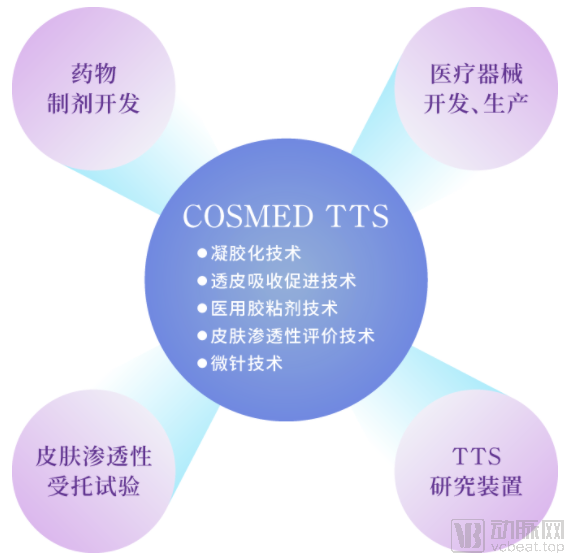
Pharmaceutical Formulation Development:By collaborating with original API manufacturers, we conduct contracted and joint research across all stages, including exploratory studies on transdermal absorption and formulation development using our proprietary TTS technology. Currently, CosMED’s T101 patch and hydrophilic adhesive matrix patch have both been approved in Japan; the anti-inflammatory and analgesic patch F201, developed by the company, received clinical trial approval in China in 2008.
Medical Device Development and Manufacturing:CosMED’s medical adhesive technology is a composite technology for therapeutic applications, premised on adhering medications to the skin. Leveraging this technology, the company engages in OEM and ODM production of skin-friendly, low-irritancy, highly moisture-permeable, and repositionable medical tapes, bandages, dressings, and related products.
Skin Permeability Entrusted Test:CosMED utilizes an in-house developed TTS research apparatus to evaluate the skin penetration of active ingredients in cosmetics and pharmaceuticals. The system supports evaluations using various skin models, including artificial membranes, cultured skin, and human skin. It enables the measurement of ingredient penetration levels within the stratum corneum, epidermis, and dermis, as well as transdermal permeation. Additionally, it facilitates visual assessment of skin penetration behavior through microscopic imaging, such as in transdermal penetration tests for pharmaceutical formulations.
TTS Research Device:CosMED manufactures and sells various equipment for supporting transdermal absorption testing and pilot production, such as Trans View (transdermal absorption testing device), Trans Coat (coating machine), and TransTack (rolling ball tack tester).
CosMED’s cosmetics business encompasses the development and manufacturing of OEM and ODM products; commissioned testing and evaluation reports; operation of original brands; and overseas market expansion.
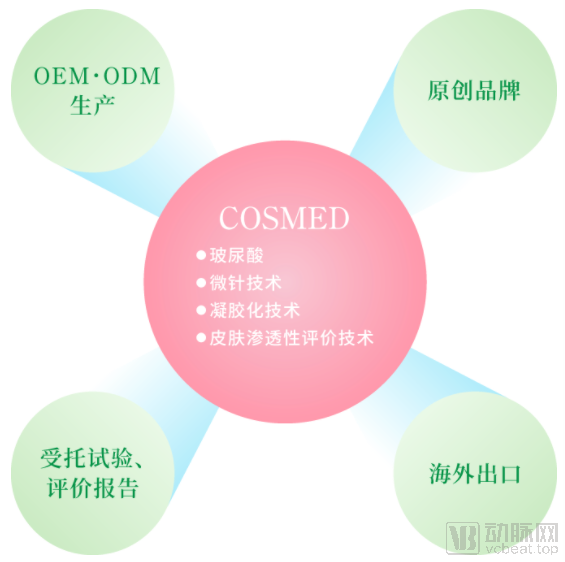
OEM and ODM Manufacturing:CosMED leverages gelation technology to undertake the development and manufacturing of OEM and ODM cosmetic products, featuring microneedle-based formulations such as hyaluronic acid implant masks, thermofusing masks, oil-based jelly masks, and V-skin.
Gelling technology is a process that incorporates plasticizers into high-molecular-weight polymers with proven performance in dermal applications to induce gelation. Typical oleogels are formulated by incorporating substantial amounts of natural plant oils and mineral oils into skin-compatible polymeric materials, followed by gelling; they serve as novel functional bases for pharmaceutical and skincare applications.
Commissioned Trial and Evaluation Report:CosMED leverages in-depth knowledge and technology of transdermal absorption to accept commissions for evaluating the skin permeability of transdermal drugs and cosmetics, including cosmetic skin permeation tests and penetration-enhancement evaluation tests for beauty devices.
Original Brand:CosMED Pharmaceutical operates its own brands, led by microneedle products, as well as various cosmetics and hair growth treatments. Currently, the company owns the CosMED comprehensive e-commerce website, the Keonis line of basic skincare products, the fa:sa series of hair growth products, the MOTTO LAB. brand, and the Kyoyakujo patch-type cosmetic series.
After 20 years of development, building upon its Kyoto main factory, CosMED successively established its second factory, “Katsura,” in 2017 and its third factory, “Kissho,” in 2020. This expansion has enhanced production line efficiency across its three manufacturing bases—the headquarters factory, the Katsura factory, and the Kissho factory—increased production capacity, and further strengthened its supply chain system.
China's development of microneedle drug delivery started relatively late.
According to the “In-depth Market Research and Investment Strategy Recommendations Report on the Microneedle Drug Delivery System Industry, 2019–2023” released by the New Thinking Industry Center, microneedle drug delivery system products in the Chinese market are currently dominated by foreign brands. Medical-grade microneedle drug delivery systems are primarily from Europe and the United States, while cosmetic-grade microneedle drug delivery systems are mainly represented by Japanese and South Korean brands.
In light of the market void and demand, a number of innovative entrepreneurs have flocked to this space in succession, striving to become pioneers in the field.
In 2004, Researcher Gao Yunhua from the Technical Institute of Physics and Chemistry, Chinese Academy of Sciences (TIPC, CAS), undertook a major MEMS special project under the National “863” Program, which officially initiated the project on single-crystal silicon microneedle transdermal drug delivery technology. Four years later, TIPC, CAS collaborated with enterprises to achieve the industrialization of the single-crystal silicon microneedle project.
Founded in 2007, Natong Bio is a pioneer in China’s microneedle industry. Its core product, the nanocrystal chip, is crafted from high-purity monocrystalline silicon using nanotechnology, with needle tips measuring less than 80 nm in diameter—approximately one-thousandth the thickness of a human hair. Natong’s proprietary SPE nanocrystal chip patent technology is dedicated to providing safe, gentle, precise, and on-demand controlled permeation enhancement tools and methods, enabling skincare products to be absorbed more accurately and effectively, with permeability increased by approximately 10–20 times. As the pinnacle of international bionanotechnology, SPE products have unprecedentedly transformed skin absorption of skincare formulations.
Founded in Shanghai in 2016, Lanwei Medical is a platform-based company specializing in microneedle transdermal drug delivery. Its core business focuses on the independent development of soluble and insoluble microneedles, as well as collaborative R&D through CRO/CDMO partnerships. Leveraging its MEMS (Micro/Nano Electro-Mechanical Systems) technology platform for both silicon and non-silicon microneedle array molds, the company possesses high-precision microfabrication capabilities, enabling the arrangement of over 10,000 microneedles per square centimeter. This significantly enhances drug loading capacity and the number of drug delivery channels.
Zhongke Microneedle was established in 2018, originating from the technology commercialization team led by Researcher Gao Yunhua at the Technical Institute of Physics and Chemistry, Chinese Academy of Sciences. Its independently developed next-generation polymer microneedle drug delivery platform has officially entered the market, primarily serving the medical aesthetics and pharmaceutical industries. Furthermore, Zhongke Microneedle has overcome the most challenging aspect of microneedle patches—mass production—and has achieved fully automated annual production capacity of tens of millions of patches. It has built the world’s largest manufacturing facility for microneedle-based drug delivery systems. Application areas include vaccines aimed at enhancing immune responses and vaccination coverage, immunotherapeutic drugs requiring improved targeting, biologic drugs necessitating repeated injections, pediatric medications, and dermatological treatments.
Qinglan Biologics, established in July 2020, has built three production lines with a single-line capacity of 4 million patches per month, resulting in an annual output of nearly 150 million microneedle drug delivery patches. The company also possesses the capability to rapidly expand its production and product lines in response to market demand. Currently, it has pioneered the global mass production of dissolvable microneedle weight-loss patches and dissolvable microneedle hair-growth patches.
Although domestic manufacturers have entered the field, their application scenarios are predominantly focused on medical aesthetics, lacking a solid foundation in drug delivery. However, with continuous technological maturation and the relentless exploration by Chinese entrepreneurs, what does the future hold for the microneedle drug delivery market? Time will tell.
Reference Links:
China Intellectual Property News: Attention, Medical Aesthetics Enthusiasts! An Overview of the Development of Microneedle Patent Technology
NewSight: Microneedle Drug Delivery Sees Rapid Growth in Medical and Aesthetic Industries, with Significant Potential in the Domestic Market
Baiyang Pharmaceutical Group Official Website: Baiyang Pharmaceutical Group Reaches Strategic Cooperation Agreement with Japan’s CosMED
CosMED Official Website