

National Pilot Expansion Unlocks Nearly $4.5 Billion Market: Is Spring Finally Here for Internet-Based Home Nursing Services?
On December 14, 2020, the National Health Commission issued the "Notice on Further Advancing the Pilot Program for 'Internet Plus Nursing Services'," proposing that, building upon the original six pilot provinces and municipalities, the scope of the "Internet Plus Nursing Services" pilot be expanded nationwide effective January 1, 2021. This document introduced adjustments and updates regarding the pilot scope, service supply, and other aspects. From a regulatory perspective, this policy also affirms the pilot experience gained in 2019.
It has been two years since the National Health Commission designated six provinces and municipalities as pilot regions for internet-based nursing services in January 2019. How have these pilots been implemented on the ground? Which internet nursing enterprises are involved? What uncertainties remain in the field of internet-based nursing? To explore these questions, we spoke with several industry participants.
According to data from the National Bureau of Statistics, by the end of 2019, China’s population aged 60 and above reached 254 million, accounting for 18.1% of the total population, while those aged 65 and above numbered 176 million, representing 12.6%. Among them, more than 40 million elderly individuals were partially or fully disabled. The growing number of disabled, very old, and empty-nest seniors has created a substantial and inelastic demand for professional medical nursing, rehabilitation, and home-based care services.
In recent years, the Central Committee of the Communist Party of China and the State Council have issued documents such as the Outline of the “Healthy China 2030” Plan, Several Opinions on Promoting the Development of the Health Service Industry, and Several Opinions on Accelerating the Development of the Elderly Care Service Industry, explicitly calling for the active development of the nursing service industry and the accelerated promotion of healthy aging. In June 2018, the National Health Commission, together with 11 other departments including the National Development and Reform Commission, the Ministry of Education, the Ministry of Civil Affairs, and the Ministry of Finance, issued the Guiding Opinions on Promoting the Reform and Development of the Nursing Service Industry, aiming to increase the supply of nursing services and drive the rapid development of the nursing service industry.
With the deep integration of internet information technology and healthcare services, “on-demand nurses” have begun to emerge. In essence, this represents an “Internet Plus Nursing Service” model, which leverages internet and other information technologies to enable nurses to provide home-based nursing care to the public through a process of “online application and offline service delivery.”
To further implement the “Opinions of the General Office of the State Council on Promoting the Development of ‘Internet + Healthcare’,” the National Health Commission issued the “Notice on Launching Pilot Programs for ‘Internet + Nursing Services’” in January 2019, designating Beijing and five other provinces and municipalities to carry out pilot programs for “Internet + Nursing Services.” These initiatives primarily provide medical nursing services to individuals with limited mobility, including the elderly of advanced age or with disabilities, post-discharge patients, patients in rehabilitation, and those in end-stage care.
The notice sets forth multiple measures to promote “Internet + Nursing Services,” designates six pilot provinces and municipalities, clarifies the service providers, target populations, service items, and conduct standards for “Internet + Nursing Services,” and strengthens the management of internet-based information technology platforms.
Subsequently, multiple pilot regions followed suit, introducing corresponding implementation plans tailored to local conditions.
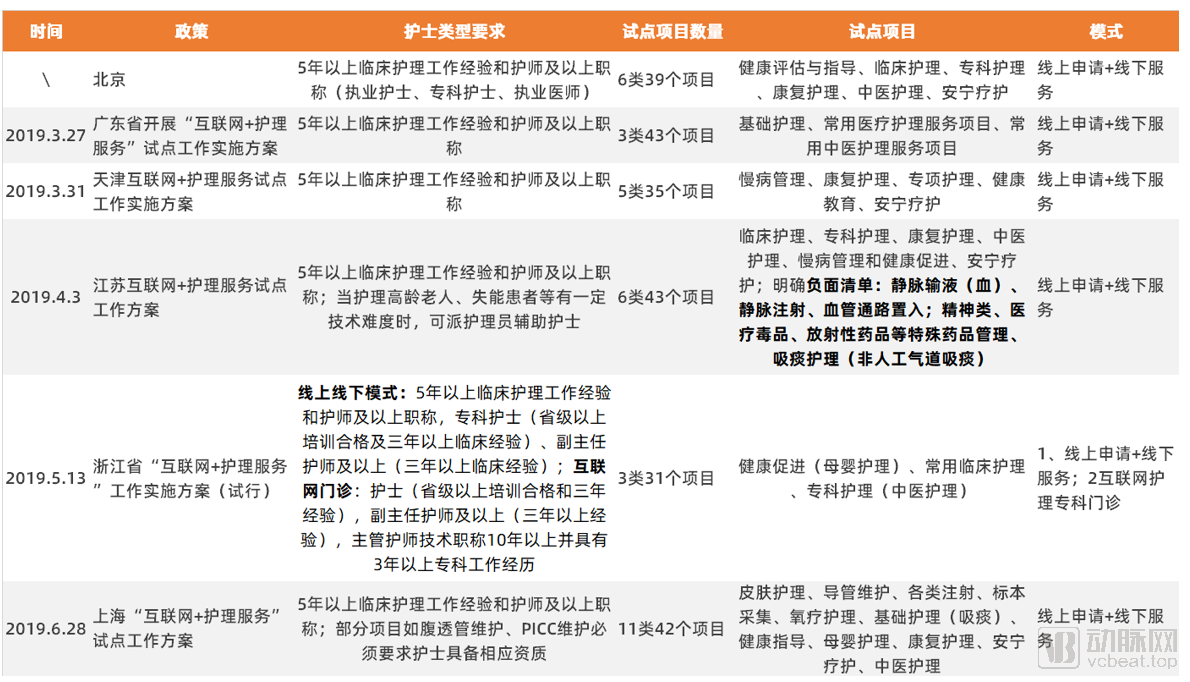
Six provinces and municipalities have further refined the scope and implementation guidelines for “Internet + Nursing” services in accordance with the notice issued by the National Health Commission.
Regarding multi-site practice for nurses, as early as May 2015, the Guangdong Provincial Health and Family Planning Commission’s “Key Work Plan for Continuously Improving Nursing Services in Guangdong Province” mentioned the gradual implementation of regional nurse practice registration and encouraged eligible areas to explore initiatives such as multi-site practice for nurses and nurses providing rotating or part-time care at nursing homes and long-term care facilities. Beijing, meanwhile, issued the “Notice on Implementing Regional Registration for Nurses” in 2017, announcing the implementation of “multi-site practice for nurses” effective August 1, 2017.
Since August 1, 2017, the “Place of Practice” field in the Nurse Practicing Certificate for nurses registering in Beijing has been listed as “Beijing.” This regulation means that nurses are no longer restricted to a single practicing institution, making “moonlighting” a legal and compliant practice. It has opened up policy channels for specialist nurses from large hospitals to provide high-quality nursing services at grassroots levels and in privately run medical institutions. Tianjin and Shanghai have also launched pilot programs successively. The promotion of multi-site practice for nurses will foster deeper collaboration between home-based nursing services, community health service centers, and hospitals at all levels, exploring solutions for the “last mile” of post-treatment home care.
An investigative article titled “Survey and Analysis of Nurses’ Perceptions of Multi-Site Practice,” jointly published by the School of Nursing at Capital Medical University and the Nursing Department of Tiantan Hospital in the Chinese Journal of Nursing in January 2017, indicated that the majority of nurses welcome multi-site practice. Among the 1,010 nurses surveyed, 78.5% supported multi-site practice for nurses, with most believing that it could increase their income, enhance their self-worth, and improve their professional skills.
In addition to adhering to the basic requirement of “more than five years of clinical nursing experience and a professional title of Nurse Practitioner or above,” some regions have raised the qualifications for nurses. Beijing, considering the division of labor and collaboration between medical and nursing staff, has included registered nurses and licensed physicians within the scope of service providers for “Internet + Nursing Services.” Tianjin, on the other hand, requires that nurses possess specific credentials for certain procedures, such as peritoneal dialysis catheter maintenance and PICC line maintenance. Raising the qualification threshold for registered nurses not only demonstrates responsibility for patients’ health and safety but also helps proactively mitigate potential risks, providing a basis and channel for resolving disputes and issues should they arise.
In terms of service models, Zhejiang has added “Internet-based specialized nursing outpatient clinics” to its existing “online application + offline service” model, providing nursing guidance and health consultations for elderly patients, those with chronic or special diseases, pregnant women, and other target groups.
In the pilot programs, Jiangsu and Guangdong are the regions with the largest number of pilot service items. Jiangsu has marked items that can be conducted simultaneously online and offline, clarified the negative list, and imposed restrictions on high-risk procedures such as intravenous infusion and arterial blood sampling. Although Tianjin, Shanghai, Zhejiang, and Guangdong have not established negative lists, most of the relevant items are not included in their pilot programs. Guangdong Province explicitly prohibits the provision of services involving anesthesia, psychotropics, narcotic drugs, and intravenous infusions.
In addition to the pilot provinces and municipalities, some non-pilot cities have also actively responded to this policy. For instance, in November 2019, Shanxi Province clarified a “negative list,” specifying that services for patients with complex or unstable conditions, management of special medications (such as psychotropic drugs), innovative nursing procedures, and home-based medical aesthetic treatments are unsuitable for internet-based nursing services.
Following the release of the new “Notice,” Henan Province responded swiftly by issuing an implementation plan for the pilot program of “Internet + Nursing Services” in January 2021, designating Zhengzhou City and the Jiyuan Demonstration Zone as provincial pilot areas to explore internet-based nursing services.
Depin Medical stated that there are three key differences between the 2019 Notice and the 2020 Notice. First, the 2020 Notice raised the standards for management systems, service specifications, and technical requirements, facilitating the summarization and refinement of previously developed service processes. Second, it encourages leveraging the capabilities of third-party social medical institutions to establish efficient and rapid tiered diagnosis and treatment services, thereby meeting the public’s multi-level and diverse healthcare needs. Third, the 2020 policy specifically highlighted significant favorable developments regarding health insurance reimbursement, noting that “only by providing genuine convenience and tangible benefits to the public in settlement processes can the ‘Internet + Nursing Services’ sector truly usher in its spring.”
During the specific implementation phase, progress has varied across different regions.
On December 16, 2020, Shunyi District in Beijing launched its first batch of “Internet + Nursing Services” projects, becoming the fourth district to offer such services after Dongcheng District, Chaoyang District, and Shijingshan District. On December 17, 2020, Xinhua News Agency reported that 15 primary care hospitals in Tianjin had already enabled “Internet + Nursing Services” on the Tianjin Primary Care Digital Health Supply Platform. As of September 2020, the Ningbo Cloud Hospital Platform had partnered with 50 medical institutions, registered 6,079 nurses, offered 36 offline service items, and provided a cumulative total of 7,975 home-visit nursing services.
Wang Zhong, General Manager of the Enterprise Development Department at Zhongpuda, introduced that, based on Zhongpuda’s market data, Guangdong was the region with the broadest coverage in the first batch of national pilot programs. Currently, the first phase of hospital construction in the Greater Bay Area has basically concluded, and expansion to hospitals outside the Greater Bay Area is accelerating rapidly. In Beijing, Tianjin, and Shanghai, due to the high concentration and large scale of hospitals, resources are stretched thin, resulting in a relatively limited adoption rate. Zhejiang Province has adopted a model where large internet companies build internet-based nursing platforms for hospitals free of charge, implementing construction at the prefecture-level city level, with ongoing efforts to refine practical operational implementation. Jiangsu Province, by contrast, has focused primarily on individual hospital construction; since the end of 2020, it has pursued comprehensive construction at the district and county levels, yielding initial positive results. For example, at Zhangjiagang First People’s Hospital, the service coverage rate within individual departments exceeds 30% of discharged patients, and nurses’ income from internet-based nursing services accounts for 30% of their total income, demonstrating strong growth momentum and a gradually expanding range of service types.
Wang Zhong, General Manager of the Enterprise Development Department at Zhongpuda, noted that the development of internet-based nursing services varies significantly across regions. This disparity is attributable to differences in policy enforcement by hospitals and superior health commissions, as well as variations in local nursing resource supply. For the sustainable long-term development of internet-based nursing services, it is essential to expand from single-purpose nursing care to quantified health guidance, thereby enriching service offerings. Furthermore, this expansion requires coordinated support from medical devices, pharmaceuticals, and commercial insurance sectors.
Depin Medical also noted that many valuable experiences have been summarized during the pilot programs across various regions. Expanding the scope of these pilots to allow more areas to take the lead will enable the development of implementation strategies better suited to local conditions, building upon the existing best practices.
According to statistics from Analysys, the scale of China’s internet nursing market in 2019 was approximately RMB 2.96 billion, accounting for about 5.7% of the overall internet healthcare market. With advancements in internet technology and expanding demand for out-of-hospital care services, the number of internet-based nursing service offerings has continued to grow. Based on data from VCBeat, we compiled a list of 40 companies providing “Internet + Nursing” services and conducted an analysis across dimensions such as business model types and regional distribution.
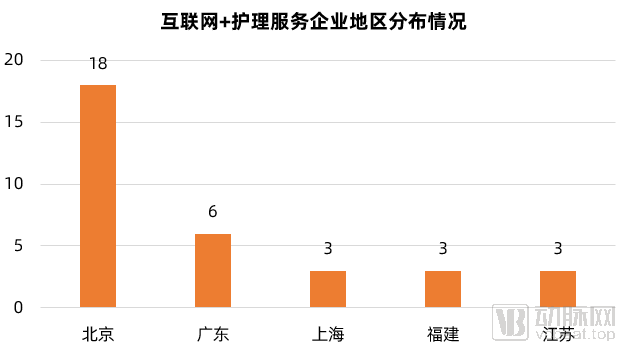
By project location, Beijing takes the lead, followed closely by Guangdong, while Shanghai, Fujian, and Jiangsu are on par with each other. According to the latest provincial GDP data, Guangdong and Jiangsu rank first and second, respectively, in total GDP. Although the total GDP of Beijing, Shanghai, and Fujian is not particularly high (ranking 12th, 10th, and 7th, respectively), their per capita GDP ranks 1st, 2nd, and 4th, respectively, leaving no doubt about their affluence. Currently, China has not established a unified market pricing mechanism for internet-based nursing services. Compared with in-hospital nursing care, these services are priced higher, posing a certain financial burden on patients. Therefore, the development of internet-based nursing services is highly correlated with local economic levels.
Furthermore, regions such as Beijing and Guangdong were early pioneers in exploring internet-based nursing services. For instance, in September 2015, the Guangdong Family Doctors Association developed “U Hu,” the first professional mobile application platform in China dedicated to home-based medical care, nursing, and daily living assistance. In December 2016, Beijing introduced six new favorable policies for medical insurance, which included covering home visit medical services and the establishment of home hospital beds under medical insurance reimbursement. As early as 2016, Jiangsu Province Hospital launched pilot programs for “on-demand nurse” home visit services in selected wards.
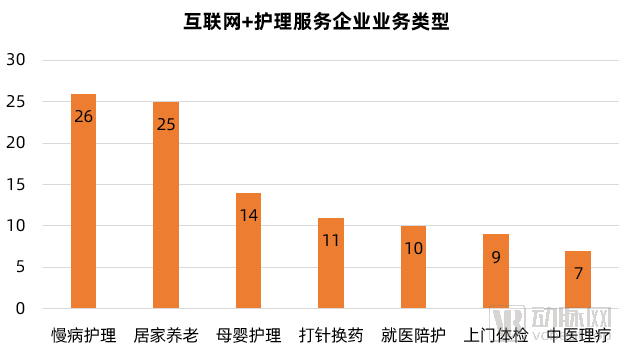
We have categorized the specific business activities of enterprises into seven major application scenarios, enabling a detailed analysis of their current status and development potential. It is important to note that since enterprises often engage in more than one type of business, the total number of cases exceeds 40.
From the perspective of specific application scenarios, enterprises involved in chronic disease care and home-based elderly care are the most numerous, each accounting for more than half. The chronic disease management category encompasses a wide range of scenarios, including nasogastric feeding, urinary catheterization, sputum suction, and postoperative rehabilitation, whereas home-based elderly care primarily focuses on daily living assistance for the elderly. Meanwhile, from the standpoint of service recipients, those receiving chronic disease care and home-based elderly care services are mainly individuals with disabilities, semi-disabled patients, and the elderly, which also aligns with the national policy requirements regarding the scope of internet-based nursing services.
Amid the growing prevalence of disability and semi-disability, coupled with an increasingly severe aging population, the volume of chronic disease management and home-based elderly care services is large and expanding rapidly. This underscores the empowering role of internet-based nursing services in these two application scenarios and confirms that they remain the core areas of focus within the internet nursing sector.
Notably, the application scenarios for injections and dressing changes encompass all skin-penetrating nursing procedures, such as intravenous injection, venous/arterial blood sampling, and PICC catheterization. Currently, national policies adopt a prudent stance regarding the provision of higher-risk nursing services through “home-based care,” with certain regions having explicit regulations on their applicability; consequently, the volume of such services remains limited.
Overall, physicians and nurses serve as the primary providers of internet-based medical services. Current market practices are predominantly centered around physician services, establishing them as the core decision-makers in healthcare delivery. With numerous market participants, the competitive landscape has largely taken shape. As an integral component of healthcare services, nursing care is experiencing rapid growth in both clinical demand and market need. Furthermore, given the diverse scenarios and multifaceted value of nursing services, their market growth prospects are promising.
From the perspective of operational models, internet-based nursing service enterprises can be broadly categorized into three types: community-based home care services, service networks anchored in physical hospitals, and direct collaboration with nurses.
Community-Based Home Care Services: Third-party platforms collaborate with communities to establish care stations, creating a tripartite “hospital-community-home” integrated cooperation model. Smart terminal devices with data transmission capabilities, such as intelligent vital signs monitoring points and nurse visit kits, are deployed within communities. When community patients exhibit abnormalities, nursing staff provide prompt in-home assessments based on proximity.
Service Network Based on Physical Hospitals: Third-party internet platforms collaborate with hospitals to leverage the internet, creating a tripartite linkage among medical institutions, licensed nurses, and discharged patients, thereby extending nursing care services into the home.
Collaborate Directly with Nurses: Nurses register on the platform in their individual capacity, submitting relevant documentation such as their nursing practice certificates. The platform verifies these materials and provides training and assessment; upon successful completion, nurses are authorized to accept service orders.
However, both the 2019 and 2020 versions of the “Notice” explicitly stipulate that medical institutions shall serve as the providers of “Internet + Nursing Services.” This means that nurses cannot offer “on-demand” services in their individual capacity; such services must be dispatched by medical institutions.
This requirement is justified for two reasons: first, it enables physical hospitals to accommodate greater medical demand following the provision of nursing services; second, by establishing a comprehensive service standard system, physical hospitals can mitigate the risks associated with “illegal practice,” ensure consistency between online and offline services, and thereby play a significant role in promoting the development of the internet-based nursing service industry.
However, in reality, there are numerous platform-based nurses who provide “on-demand” services in their individual capacity.
Wu Yuxiong, Executive Vice President of the Guangdong Family Association, stated in an interview with Southcn.com that there are two primary reasons why nurses provide “online-hailed” nursing services without their employers’ knowledge: both hospital administrators and nurses have significant concerns about such services. On one hand, they worry about violating national laws, regulations, and industry management measures; on the other hand, they fear that their regular duties may be affected and that their professional title promotions could be hindered.
Although internet-based nursing services enjoy favorable policy support and strong market demand, several challenges persist in their practical implementation, primarily concentrated in two areas:
Medical Safety Is the Paramount Consideration
First, the professional qualification review of service personnel.This involves two key issues: How to screen for qualified nurses who meet the eligibility criteria? And how to eliminate risks such as nurses using other people’s credentials for registration and having others impersonate them to provide services after accepting orders?
Currently, major platforms rely on verifying nurses’ qualifications and restricting their scope of practice to mitigate medical safety risks. Xie Qi, founder of Chengyi Health, stated that the 2019 version of the “Notice” explicitly requires nurses providing internet-based nursing services to have at least five years of clinical nursing experience and hold a professional title of Nurse Practitioner or higher. “The ‘five-year experience’ requirement effectively disqualifies 50%–60% of nurses on some platforms.”
Implement tiered, specialty-specific in-depth training for nurses. As nurses transition from hospital settings to providing home-based care, there are heightened demands for their ability to deliver effective medical interventions under constrained conditions, necessitating enhanced awareness and competence in emergency resuscitation during home visits.
Second, qualification review of “service recipients.”The scope of nursing services provided during home visits by nurses must be clearly defined, and patients requesting such services must undergo an assessment. It is recommended to sign community-based home healthcare service agreements and informed consent forms with the community health centers nearest to the patient’s residence. Physicians or nurses must complete home visit assessment forms and initial consultation records, ensuring that documentation is retained at every step and that each procedure is fully traceable. Furthermore, while patient needs should be met, potential risks must be standardized and mitigated in advance, with established mechanisms and channels for resolving disputes and issues. This approach safeguards both patient safety during nursing care and the safety of nursing staff.
The establishment of standardized processes not only enhances the legal and regulatory compliance of nurse home-visit service platforms, thereby mitigating medical, legal, and personal accident risks, but also provides a fundamental safeguard for future integration with insurance services.
Depin Medical stated that current policy requirements and procedural standards for specialized nursing services remain stringent, and the complexity of care delivery is further increased when performed in home settings. Companies can leverage information technology to implement features such as real-time nurse positioning, video intercom, one-touch emergency alerts, and comprehensive documentation of the entire service process during home visits. These measures help mitigate medical risks, ensure full traceability, safeguard the personal safety of both nurses and patients, and provide robust support for the safe and effective delivery of “Internet + Nursing Services.”
Charging and Payment Mechanisms to Be Established
“Currently, pilot regions are setting prices for medical services based on local supply and demand realities, but have yet to establish pricing and corresponding payment assurance mechanisms. Public hospitals, as the primary entities piloting ‘Internet + Nursing Services,’ essentially provide these as public welfare services. However, they have overlooked the market-oriented nature underlying such personalized services, resulting in a situation where the services are well-received in principle but fail to attract sufficient uptake. In addition, nurses in some regions are not yet permitted to practice at multiple sites, making it impossible to serve patients who live far from the hospital,” said Xie Qi, founder of Chengyi Health.
From the patient’s perspective, nursing care costs are higher than in-hospital care due to the inclusion of nurses’ transportation and time costs. However, at present, the vast majority of “Internet-based nursing services” are not covered by medical insurance reimbursement.
However, some regions have already begun to explore new models. Starting in the second half of 2016, Hongkou District in Shanghai adopted a government-purchased service model, introducing professional social organizations to launch “elderly care service packages” for home-based care of disabled and dementia-afflicted seniors. In December 2016, Beijing introduced six new favorable medical insurance policies, which included covering home healthcare services and the establishment of home hospital beds under medical insurance payment. In July 2017, after the General Office of the State Council issued the Several Opinions on Accelerating the Development of Commercial Pension Insurance, Guangzhou began piloting a long-term care insurance system from August 1 of that year. Employees covered by basic medical insurance who meet relevant conditions and have completed procedures at designated institutions can be reimbursed for basic daily living care expenses and medical nursing costs.
On May 6, 2020, the National Healthcare Security Administration released the “Guiding Opinions on Expanding the Pilot Program of the Long-Term Care Insurance System (Draft for Comments).” The document proposed expanding the number of pilot cities for the long-term care insurance system from the original 15 to 29. Furthermore, the policy explicitly stated that social forces should be introduced to participate in the administration and services of long-term care insurance. From a regulatory perspective, this policy affirms the pilot experience accumulated over the previous four years and establishes a development tone for the long-term care insurance system based on the combination of social and commercial mechanisms.
On November 8, 2020, the Standing Committee of the Shenzhen Municipal People’s Congress promulgated the Regulations on Elderly Care Services in the Shenzhen Special Economic Zone, stipulating that long-term care insurance, known as the “sixth social insurance,” would be officially implemented citywide starting March 1, 2021, making Shenzhen the first city in China to launch such a scheme. On January 7, 2021, the Shanghai Municipal Healthcare Security Administration, in conjunction with the Civil Affairs Bureau and the Health Commission, issued the Regulations on Elderly Care Services in Shanghai, initiating a pilot program for the extended settlement of long-term care insurance expenses for Shanghai elderly residents admitted to elderly care institutions in the Yangtze River Delta region.
“Long-term care insurance and ‘Internet+ nursing services’ offer complementary service contents. ‘Internet+ nursing services’ involve greater complexity and higher demands for professional expertise, making them more targeted and essential for the beneficiaries of long-term care insurance—individuals aged 65 and above with disabilities or partial disabilities—by addressing their specialized medical and nursing needs,” stated Depin Medical. “In terms of payment settlement, long-term care insurance holds an advantage due to its unified fiscal subsidy model. In contrast, home-based care under current ‘Internet+ nursing services’ is not yet covered by medical insurance reimbursement and generally requires out-of-pocket payment by residents, thereby posing challenges related to consumer habits and household income levels.”
There is already some international experience in the area of payment for home-based nursing care. In 1909, the Henry Street Settlement partnered with Metropolitan Life Insurance Company to include home nursing costs in users’ health insurance policies. Currently, the United States has incorporated home healthcare costs into Medicare, covering items such as short-term skilled nursing care, physical therapy, and speech-language therapy. However, expenses related to 24-hour home care, shopping, cleaning, and assistance with bathing and dressing provided by caregivers are not covered by insurance. Japan also integrates home medical care with its insurance system. Physician visits and certain nursing visits are covered by health insurance, while other services are funded by long-term care insurance.
Furthermore, Wang Zhong, General Manager of the Enterprise Development Department at Zhongpuda, stated, “As the current regulatory framework requires continuous refinement, certain issues remain undefined, such as practice locations, practice environments, and clinical workflows. These aspects need to be continuously improved under the new normal to adapt to market demands and healthcare requirements.”
In summary, a robust framework of safety and standardization guidelines is crucial for the development of every industry, including internet-based nursing services. Effective implementation of these policies requires not only strong promotion by relevant authorities but also active support from platforms and industry stakeholders. The development of internet-based nursing services remains a significant and long-term endeavor.
We thank the following expert guests for their support of this article (listed in no particular order):
Colleagues at Depin Medical
Xie Qi, Founder of Chengyi Health
Wang Zhong, General Manager of the Enterprise Development Department at Zhongpuda
References:
Interpreting New Trends in the Nursing Care Market in the New Era: A Special Analysis of China’s Internet Nursing Care Market in 2020
2020 White Paper on China's Post-Consultation Internet Healthcare Industry
Nurses’ Home-Visit Industry: Serving the Nation; Global Market Value to Reach $349.8 Billion, While China’s Market Remains Untapped