

From Poverty-Stricken County to China’s $10B Medical Consumables Hub: Changyuan’s Rise as a Future Healthcare Innovation City
In early 2020, when the epidemic broke out across China, in addition to Wuhan, the “heroic city” on the front lines of the fight against the outbreak, another place was also in a race against time: Changyuan City, Henan Province, the “rear supply center” for the epidemic prevention and control efforts.
On January 20, 2020, the 26th day of the twelfth lunar month, with less than a week remaining until the Lunar New Year, major manufacturing enterprises in Changyuan City had successively suspended operations. Workers who had toiled throughout the year began preparing to return to their hometowns for family reunions. However, the sudden outbreak of the epidemic disrupted the original pace of life in this small central plains city.
Early the next morning, senior executives of medical supply companies in Changyuan convened an emergency meeting, announcing that operations would resume at the earliest opportunity and that every effort would be made to mobilize workers to return to their factories.
By New Year's Eve, a total of 42 protective equipment manufacturing enterprises in Changyuan City had resumed normal operations, with 3,590 workers on rotating shifts and 1,620 machines running around the clock, increasing production capacity to 30 times the usual level. Before the New Year bells rang, Changyuan City urgently packed and dispatched 200,000 medical surgical masks, 2 million disposable medical masks, 500,000 medical caps, and 200,000 pairs of medical gloves, among other protective supplies, in consolidated shipments to Wuhan.
Under the impact of the pandemic, Changyuan, usually somewhat quiet, suddenly became bustling, and the entire trading market presented a scene of prosperity. However, unexpectedly, these medical supply companies, working overtime, were basically operating at a loss. Due to the sudden outbreak, medical supplies became increasingly scarce, production costs continued to rise, and since the companies were unwilling to raise prices, each unit produced resulted in a loss. Even so, major medical supply enterprises in Changyuan remained determined not to halt production, standing firmly alongside healthcare workers on the front lines of the fight against the epidemic, and ensuring robust “logistical support” for China’s nationwide epidemic prevention and control efforts.
Enterprises have taken the lead in ramping up efforts, with corresponding support measures being progressively strengthened. To ensure the supply of materials, Changyuan City has implemented unified government procurement, centralized storage, and coordinated allocation of raw materials. It has also established specialized procurement teams and dedicated procurement funds, significantly enhancing production scheduling capabilities.
In terms of funding, upon learning of the urgent need for efficient, low-cost financing support among medical supply manufacturers in Changyuan, the Henan Branch of China Development Bank and Zhongyuan Bank promptly established dedicated task forces, streamlined credit approval and disbursement processes, and ensured the full availability of RMB 300 million within a single day. Additionally, the Henan provincial finance system allocated RMB 20 million in special fiscal funds. With the support of the Henan Bureau of the China Banking and Insurance Regulatory Commission, multiple financial institutions extended a combined credit line of RMB 768 million to Changyuan’s medical supply manufacturers in the shortest possible time, effectively alleviating enterprises’ concerns about maintaining quality and quantity while ramping up production capacity.
United from top to bottom, we ensure the maximum supply of medical materials to the front line. This is the state of Changyuan’s fight against the “epidemic”. And in this process,The selfless dedication of Changyuan’s medical supply enterprises, which spared no effort in production despite their own financial losses to deliver protective materials to the front lines, has demonstrated to the entire nation the social responsibility and patriotic commitment of Changyuan as a national-level industrial cluster.
Catalyzed by the pandemic, Changyuan, a previously obscure small county, surged to nationwide prominence overnight, garnering significant social attention and simultaneously sparking public curiosity:What is the background of this “Capital of Chinese Medical Consumables”? How did it evolve from an impoverished county into China’s largest production base for medical devices and sanitary materials? What insights can its success model offer for the development of domestic medical industrial parks, and how can it be replicated?All these questions remain to be answered.
In Henan, there is a popular saying: “For the private economy, look to the ‘Two Changs’—Changge in the south and Changyuan in the north.” But just how poor are the resource conditions in these two regions? Henan Daily once described them as follows: “No surface resources, no underground mineral deposits, barren land, and frequent natural disasters.”
While this may sound somewhat bleak, the reality is even more severe. Changyuan City (which was officially upgraded from a county to a county-level city on September 28, 2019) is located in the northeastern region of Henan Province, covering a total area of 1,051 square kilometers, and faces Lankao County in Henan Province and Dongming County in Shandong Province across the Yellow River.Changyuan suffers from scarce resources; not only does it lack natural mineral wealth, but it is also situated adjacent to the “Tofu Waist” section of the Yellow River, which experiences flooding in nine out of every ten years.According to official records, the Yellow River breached its banks within Changyuan County 124 times before 1949, averaging once every 19 years, and repeatedly caused substantial economic losses.
Under such unfavorable inherent conditions, it was by no means easy for Changyuan, a small county with humble origins, to achieve development. However, heaven never bars one’s way. Relying on the innovative spirit and industrious hands of its people, Changyuan, starting from scratch, forged a strategic breakthrough path out of nothing.
How, exactly, was this path successfully navigated?
In the late 1970s, as China’s reform and opening-up policy was just being launched, the people of Changyuan County, driven by the imperative to change their fate and alleviate poverty through economic development, discovered that medical cotton swabs required low initial investment, were simple to manufacture, and enjoyed high market demand. Consequently, they initiated the production and sale of medical cotton swabs.
Having long suffered from poverty, the people of Changyuan naturally seized every opportunity to change their fate. Soon, some villagers in Dingluan Town, Changyuan County, beganCotton swabs made from locally produced cotton were sold to nearby village clinics and school hospitals through peer-to-peer mentoring among fellow villagers., and quickly achieved scale locally by leveraging its cost advantage.
After tasting initial success, the people of Changyuan resumed the production of low-value medical consumables such as rubber stoppers and medical brushes. Small family-run workshops rapidly expanded from just over a dozen to more than a thousand. As product diversity and production capacity gradually matured, Changyuan’s medical supplies industry took off, progressively extending its market coverage and services throughout Henan Province and its surrounding regions.
After a decade of trials and tribulations, Changyuan has formed an industrial cluster with family workshops as the primary productive force., but sustained development still relies on the continuous optimization of the industrial structure. Recognizing this issue, Changyuan did not rest on its laurels; instead, it took Wenzhou, Zhejiang as its benchmark, began to prioritize the development of private enterprises, and aspired to become the “Little Wenzhou of the North.”
In the early 1990s, as national policies were relaxed, merchants in Changyuan began to proactively seize various business opportunities. Leveraging capital accumulated over many years and their rich experience, they embarked on paths of independent entrepreneurship. This gave rise to Changyuan’s first cohort of entrepreneurs and a socially oriented marketing workforce primarily composed of professional agents and distributors.
In the early 21st century, the Changyuan medical device industrial cluster entered its peak period, with various medical device companies emerging rapidly, such as Huaxi Medical Materials and Lantian Medical Devices. In particular, after the SARS outbreak in 2003, Changyuan’s medical device manufacturers experienced explosive growth, with more than 50% of the existing enterprises established during this period. Their products gradually shifted toward higher technological content and higher classification categories.
Nevertheless, driven by economic interests, Changyuan still has a significant number of family-run workshops. These entities primarily focus on the production of basic medical supplies as their entry point and compete for market share against local enterprises by leveraging low prices. However, given that medical supplies and devices are critical to the life and health of patients and healthcare workers, they are subject to stringent quality requirements. Clearly, such household-style workshop production cannot guarantee quality.
In June 2004, media exposure revealed the prevalence of clandestine family workshops in Dingluan Town, a major hub for medical hygiene material production in Changyuan. Deep-rooted issues such as unsanitary and disordered conditions, along with the manufacture and sale of counterfeit products, gradually came to light. Overnight, Dingluan Town—and even Changyuan City—gained notoriety across China, leading to a nationwide ban on Changyuan’s hygiene materials and medical devices.
Fortunately, the local government did not engage in protectionism. In the aftermath of the incident, the Henan Provincial Government responded promptly by dispatching a supervisory team composed of relevant authoritative agencies to Changyuan. Guided by the principle of “resolutely shutting down family-run workshops and transitioning toward industrialized, large-scale production,” the government initiated a phased rectification of various non-compliant practices.
Under the concentrated rectification efforts by local authorities, the “family workshops” that once carved out a niche for Changyuan in the medical hygiene materials sector have officially exited the historical stage, replaced by scaled-up enterprise clusters.It is precisely because of this “upgrading and replacement” that Changyuan Weicai’s social image has gradually improved, regaining the market’s trust.
It was also at this time that Changyuan, having learned from past experiences, embarked on a new round of market deployment.The focus has gradually shifted toward group-based development, where a series of preferential policies have been introduced to cultivate a cohort of highly representative large-scale medical device manufacturers, including Yadu Group, Tuoren Group, Yu'an Group, and Piao'an Group.
Building on its established production foundation, and bolstered by government-led rectification efforts and targeted support, the medical device industry in Changyuan County has once again entered a period of significant growth dividends.
By the end of 2011, Changyuan County’s sanitary materials and medical device industry comprised more than 100 manufacturing and trading enterprises. Its product portfolio spanned over 70 series and 1,600 varieties across four major categories: medical sanitary materials, consumer sanitary materials, medical devices, and new environmentally friendly nonwoven materials. These products accounted for 70% of the national market share, underscoring the industry’s pivotal position within China’s domestic sector. It was also in this year thatChangyuan has been officially designated as the “China Health Materials Production Base” by the China National Association of Health Industry Enterprises, marking Changyuan’s entry into a new stage of development.
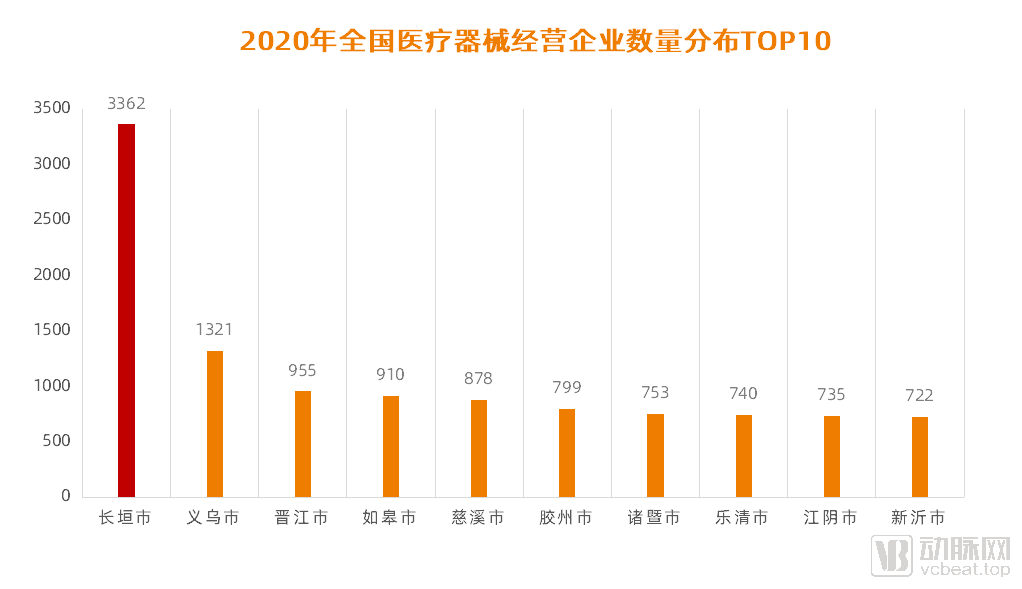 Data source: Zhongcheng Medical Device Big Data Platform; chart by VCBeat
After a development cycle spanning 40 years, the medical device and medical materials industry has become one of Changyuan’s four leading industries, primarily distributed across towns and townships in northern Changyuan, including Dingluan, Zhangsanzhai, Mancun, Chengguan, and Shejia. According to Xinhua News Agency,Currently, Changyuan is home to more than 70 manufacturers of various medical hygiene materials and over 3,000 trading enterprises, employing more than 60,000 people. It accounts for over 50% of national sales volume and achieves a coverage rate exceeding 75% among major hospitals across China. The saying, “When Changyuan sneezes, the entire Chinese medical device market catches a cold,” truly underscores Changyuan’s pivotal position in the national market for medical hygiene materials.
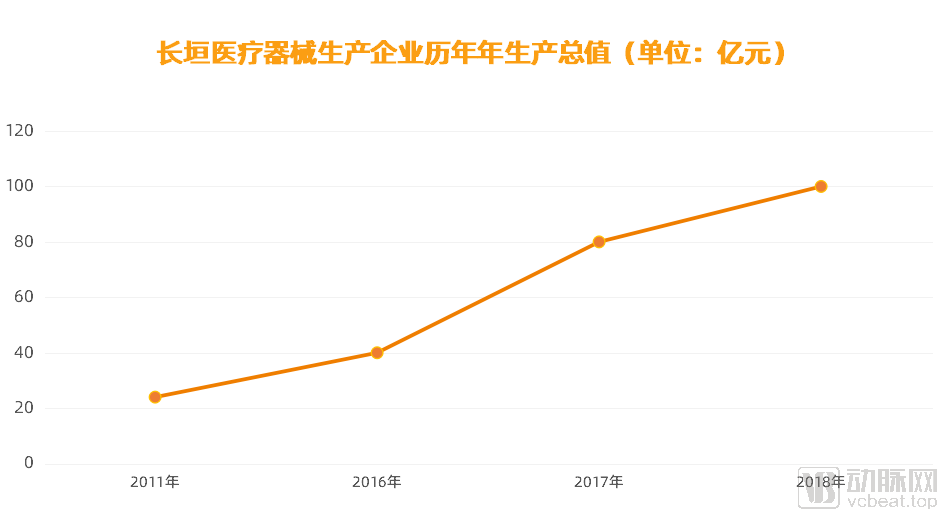
In terms of industrial scale, Changyuan has made significant strides. According to official data, in 2017, the annual gross output value of medical device manufacturers in Changyuan City was approximately RMB 8 billion, representing a year-on-year increase of 100%.In 2018, it surpassed RMB 10 billion for the first time, truly forming a multi-billion-yuan industrial cluster., keep in mind that the total annual gross domestic product of the entire Changyuan County reached only RMB 14 billion in 2010.
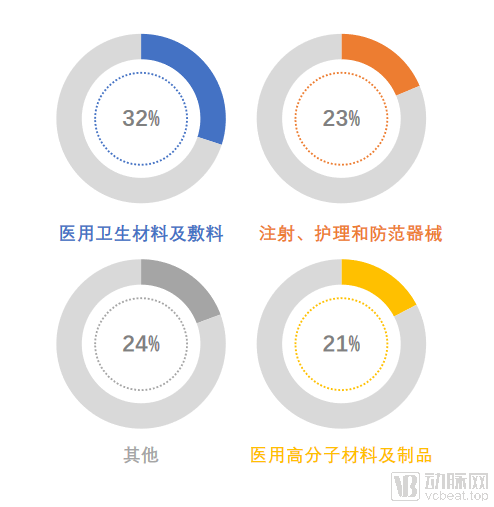
In specific sub-sectors, according to statistics from Huoshi Chuangzao,Currently, Changyuan City holds a total of 2,169 medical device product registration certificates, covering 20 major categories of medical devices such as injection and puncture instruments. Among these, approvals for medical sanitary materials and dressings account for 32.3% of the total, infusion, nursing, and protective devices account for 23.1%, and medical polymer materials and products account for 20.5%.
With its high market share, substantial industrial scale, and large-scale operational system, Changyuan has become a major production base and product export hub for medical consumables both in China and internationally. It is precisely on this basis thatIn February 2019, the China Association of Medical Equipment awarded Changyuan the title of “China’s Capital of Medical Consumables.”
Tracing the Roots: How Did Changyuan Successfully Transform and Expand Its Industry?
On the one hand, there is government macroeconomic regulation.To support the development of the medical device industry, the Changyuan County Party Committee and County Government successively issued the "Opinions of the Changyuan County People's Government on Further Supporting the Upgrading and Development of the Medical Device Industry" and the "Administrative Measures for Regulating the Development of the Medical Device Industry in Changyuan County." These policies focus on cultivating and developing health industries such as high-end medical devices, biopharmaceuticals, and wellness and healthcare. In addition, the Changyuan County Health Industrial Park and the Tuoren Medical Device Industry New City have been planned and constructed to leverage cluster advantages and drive the overall industry toward high-quality, high-efficiency, and high-standard development.
On the other hand, leading enterprises drive development through their radiating influence.For any industrial cluster, leading enterprises constitute a critical link in its relational chain and will, to a certain extent, influence the future development of the entire cluster. From the perspective of Changyuan, vigorous support has been provided to cultivate a batch of leading enterprises. Subsequently, a series of incentive mechanisms have been introduced to encourage these leading enterprises to adopt various approaches to restructure and upgrade upstream and downstream supporting companies. This leverages the agglomeration and driving effects of leading enterprises, thereby enhancing the competitive advantage of the entire industrial cluster.
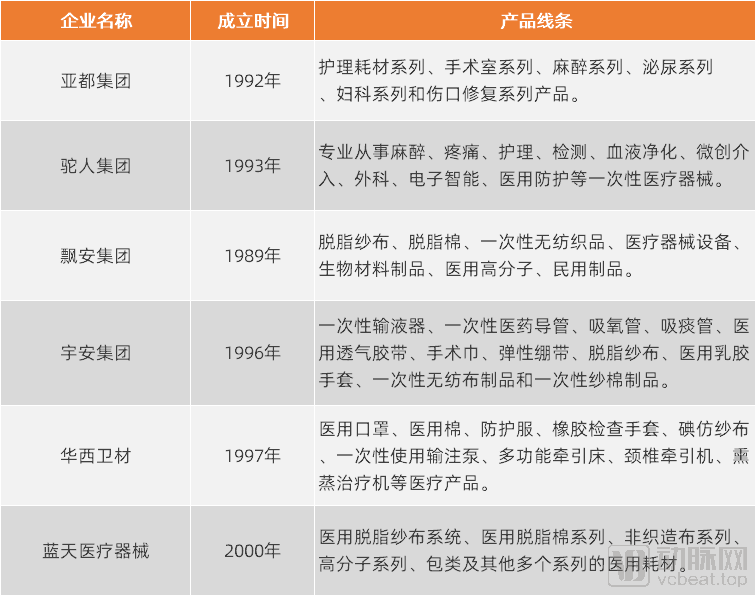
Introduction to Leading Enterprises in Changyuan
Yadu GroupEstablished in 1992, Henan Yadu Medical Devices Co.,Ltd. is a leading medical consumables industrial group in China. With a core focus on the manufacturing and R&D of medical consumables, the Group operates three modern production facilities covering nearly 1,000 mu and employs over 3,000 staff. Its main product lines include nursing care consumables, operating room supplies, anesthesia products, urology series, gynecology series, and wound care solutions. The Company’s products are distributed across all 31 provinces, municipalities, and autonomous regions in China and exported to overseas markets including Europe, the Americas, and the Middle East.
Henan Yadu Medical Devices Co.,Ltd. prioritizes technological innovation, having successively established a Henan Provincial Engineering Laboratory and an Engineering Technology Research and Development Center. While providing impetus for the company’s growth, these initiatives have enhanced the market visibility of the industrial cluster and generated significant social impact, thereby creating greater market resources for other innovative enterprises.
Tuoren GroupFounded in 1993, and with strong support from Party committees and governments at all levels, the company has now developed into a modern enterprise group integrating R&D, production, sales, service, and corporate culture. It specializes in the manufacturing and marketing of disposable medical devices for anesthesia, pain management, nursing, testing, blood purification, minimally invasive interventional procedures, surgery, electronic intelligence, and medical protection. To date, the group comprises 55 subsidiaries engaged in production, R&D, and business operations, and has established sales subsidiaries in all 31 provinces across China.
In addition to its role as a manufacturer, Tuoren Group also shoulders the mission of incubating innovative enterprises. In 2018, the Changyuan Municipal Party Committee and Municipal Government leveraged Tuoren Group as a platform to plan and construct the Tuoren Medical Device Industry New City. This initiative primarily provides resident enterprises with shared resources such as sterilization, testing, product design, mold processing, automated mechanical manufacturing, product registration, and marketing channels, representing a novel exploration of Changyuan City’s “industry-city integration” model.
It is reported that the construction of the Tuoren Medical Device Industrial New City will span five years, with a total investment of RMB 6 billion. Construction commenced in January 2019, and the core area of the industrial new city is scheduled to be completed by December 31, 2024. The project is functionally zoned into an industrial production area, a medical device trade and commerce area, residential living quarters, and supporting service facilities. Preliminary estimates indicate that upon full completion, the Tuoren New City will achieve an annual output value exceeding RMB 30 billion.
Overall,Changyuan has systematically cultivated and strengthened leading enterprises to drive industrial agglomeration, establishing two major industrial clusters: the Changyuan County Health Industrial Park and the Tuoren Medical Device Industry New City. While developing its own capabilities, the region has also focused on introducing external expertise and intelligence. Through continuous independent innovation, it has enhanced the technological content of its products and improved production efficiency, striving to promote the transformation and upgrading of traditional sanitary materials and medical devices toward high-value consumables, medical equipment, and biopharmaceuticals.
During the severe phase of the COVID-19 epidemic in China, expanding production capacity became the top priority for Changyuan, known as the “Capital of Medical Consumables in China.” Through coordinated efforts among various stakeholders, employees at local medical protective equipment companies worked overtime with all production lines fully operational, supplying over 100 million units of epidemic prevention and control materials for allocation both within and outside the province during the most critical period.
As time passed, epidemic prevention and control entered a normalized phase, with domestic demand for masks and other protective supplies gradually declining and stabilizing. On the supply side, however, a nationwide issue of “overcapacity” emerged.
How Will Local Enterprises in Changyuan City Develop After the Fierce Competition?
First, expand foreign trade channels to absorb excess production capacity.To optimize production capacity and strengthen the economic support chain for enterprises, the Changyuan Municipal Party Committee and Municipal Government have actively communicated with commerce departments to secure inclusion of more local enterprises on the “white list,” thereby leveraging foreign trade channels to absorb excess capacity. According to data provided by the Changyuan Municipal Bureau of Commerce, from March 1 to June 28 this year, 15 export-oriented enterprises in Changyuan exported 30 million N95 respirators, 200 million other types of face masks, and 70,000 sets of protective clothing to 37 countries and regions, including Algeria, Australia, Brazil, Belgium, Poland, Germany, and France.
Second, product transformation and upgrading to continuously consolidate emerging markets.During the period when masks were in critically short supply, demand outstripped supply, and expanding production capacity was the primary contradiction that needed urgent resolution. Today, however, overcapacity has emerged, domestic market demand has declined rapidly, and masks have moved beyond the stage where mere functionality suffices. Consumers now place greater emphasis on quality and brand reputation. In response, medical material manufacturers in Changyuan have comprehensively upgraded their products. In addition to ensuring filtration efficacy, they now prioritize comfort, breathability, and aesthetics, complemented by elegant new packaging. Despite being priced higher than comparable products, these masks remain in high demand.
Third, prioritize addressing raw material “shortfalls” and improve the layout of the entire industrial chain.At the onset of the COVID-19 outbreak, Changyuan’s citywide production capacity for melt-blown fabric was merely a few hundred kilograms. This critical material became a bottleneck for local manufacturers of medical protective equipment. To address this pressing concern, Changyuan had already begun strategic planning. According to data provided by the Changyuan Municipal Administration for Market Regulation, as of June 6, 2020, twelve non-woven fabric manufacturing enterprises had commenced operations in Changyuan, achieving a daily production capacity of 95 metric tons. Additionally, six melt-blown fabric manufacturers had started production, with a daily output reaching 13 metric tons.Based on the calculation that one ton of melt-blown fabric can produce 1 million face masks, the melt-blown fabric produced in Changyuan on that day was sufficient to manufacture 13 million medical face masks.
In addition, within the “Three Bases and Three Centers” prioritized in Changyuan’s strategic planning—namely, the National Medical Protective Supplies Production Base, the National Medical Protective Supplies Storage Base, the National Medical Protective Supplies Import and Export Base, the National Medical Protective Supplies R&D Center, the National Medical Protective Supplies Allocation Center, and the Changyuan National Medical Device Center—the production base serves as the core. In accordance with its overall planning and deployment, Changyuan City will strengthen every link in the value chain, from raw material production and component supply to the R&D and sales of manufacturing equipment, thereby attracting more upstream and downstream enterprises to establish operations in Changyuan and striving to achieve full-industry-chain development in the medical hygiene materials sector.
Fourth, cultivate innovative talents and enhance core competitiveness.Talent is the driving force behind the continuous advancement of an industrial cluster, and thus holds immense value. As a major production hub for medical hygiene materials in China, Changyuan attaches great importance to talent development,Annual investment of nearly 300 million yuan, we are committed to building an innovative public platform, cultivating and attracting diverse talents, thereby forming a team of high-level R&D professionals in the Changyuan region to support technological innovation and industrial development.
Amid intensifying competition in industrial development, the trend toward differentiated regional growth has become a significant direction for China’s biopharmaceutical industry. This has given rise to numerous regionally distinctive industrial clusters that have carved out unique development paths by focusing on specific niche sectors as their entry points and strategic priorities.
In specific sub-sectors, medical devices represent a typical high-tech industry characterized by extensive interdisciplinary integration and the convergence of technologies. Compared with pharmaceuticals, they require more complex industrial supporting facilities and services.Therefore, for regional industries—particularly prefecture-level cities, counties, districts, and townships that lack the policy and resource advantages of first- and second-tier cities—entering through niche segments may be more conducive to establishing competitive advantages within those specific fields.
Changyuan is undoubtedly a success, but its success is not an exception to the development model of county-level healthcare in China.Endoscopy Industry in Tonglu County, Zhejiang Province; Medical Device Industry in Jinxian County, Jiangxi Provinceare all highly representative specialized medical industry clusters.
The successive emergence of successful cases has also provided a reference for the development of biopharmaceutical industrial parks at all levels in China, and for other county-level industrial clusters in the country,"The Changyuan Model"What aspects are truly replicable?
First, transitioning from “imitation and replication” to “R&D and innovation.”Cluster industries in county-level regions often emerge due to historical contingencies. In the case of Changyuan, the first generation of entrepreneurs, driven into the medical supplies sector by poverty, generated profits through simple product manufacturing and attracted more fellow villagers to join the industry. By replicating a family-workshop model, they gradually built a large-scale industrial cluster.
However, as time has passed, mere replication has failed to serve as the key driver of industrial development; instead, it has led to a gradual decline in competitiveness. Consequently, by leveraging talent cultivation, technical exchanges, and the introduction of foreign technologies, Changyuan has entered a phase of R&D and innovation, establishing its core competitive advantages in the medical hygiene materials industry.
Second, from “scale aggregation” to “chain-based clusters.”Changyuan’s development originated from a single cotton swab, which served as the starting point for the emergence of a homogeneous, scale-driven cluster of medical hygiene material industries. However, as the industrial cluster continued to expand and the county’s distinctive economy rapidly rose, a new phenomenon of industry agglomeration centered around leading enterprises has become evident. In response, Changyuan has gradually strengthened its capabilities in raw materials, sales, logistics, and other sectors, forming a new type of industrial cluster characterized primarily by strategic supply chain layout.
Compared with the development model of horizontal industrial clusters characterized by homogeneous layouts, chain-based industrial clusters feature vertically integrated industrial operations. Driven by leading enterprises, these clusters achieve faster product structure upgrades and higher R&D success rates, while their market share gains greater enhancement with the support of such leading firms.
Third, the shift from “extensive management” to “modern management.”The development of county-level industrial clusters demonstrates growth not only through the expansion of cluster scale, the increase in the number of enterprises, the adjustment of product structures, the research and development of new products, and the enhancement of supply chain competitiveness, but also through the agglomeration effect of these clusters. Specifically, the evolution of corporate governance driven by internal competition among firms constitutes the intrinsic factor that enables the scale effects of industrial clusters to generate competitive advantage.
From the perspective of Changyuan’s development trajectory, government-led rectification campaigns have thoroughly eliminated small-scale family workshops characterized by unsanitary conditions, disorder, poor quality, and the production and sale of counterfeit goods. These have been replaced by innovative enterprises that operate under standardized management and adhere to standardized production processes. The overall management model has gradually transitioned toward modern governance, which has, to a certain extent, facilitated the rapid development of the entire industrial cluster.
Changyuan’s success is both inspiring and highly representative. In recent years, with increasing policy and financial support, China’s biopharmaceutical industry has shown a growing trend toward cluster-based development, as both the national government and local authorities actively plan for and support its growth.
We are confident that the next “Changyuan” will soon emerge in the near future.