

Oscar Health, Backed by Google and Founded by Trump's In-Law Family, Goes Public with $44B+ Valuation

Oscar Health
Online Medical Insurance Service Company
Another Highly Anticipated Health Insurance Unicorn Successfully Goes Public.
VCBeat has learned that at 10:00 p.m. Beijing time on March 3, health insurance unicorn Oscar Health officially made its debut on the New York Stock Exchange with the opening bell ceremony. The IPO price was set at $39 per share, with an opening trading price of $36 and a closing price of $34.8. The company’s market capitalization stood at $6.857 billion, equivalent to over RMB 44 billion.
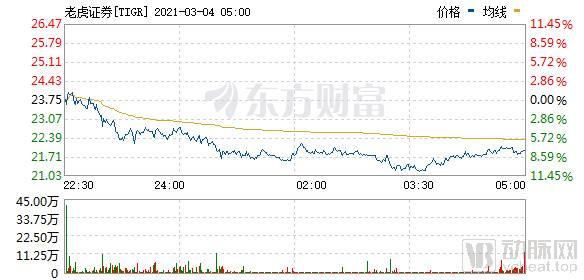
(Oscar Health First-Day Stock Price Chart Source: East Money)
Since its establishment in 2012, Oscar Health has consistently attracted strong investor interest. To date, the company has completed ten rounds of financing, raising a total of over $1.6 billion. Investors include top-tier investment firms and tech giants such as Alphabet (Google’s parent company), Tiger Global Management, and Ping An Capital. Among them,Google is a long-term investor in the company,Its parent company, Alphabet, participated in multiple funding rounds for Oscar Health. However, behind the substantial capital injections lies Oscar Health’s persistent losses.Since its inception, Oscar Health has accumulated losses exceeding $1 billion.
It is worth noting that Oscar Health’s three founders—Mario Schlosser, Josh Kushner, and Kevin Nazemi—were classmates at Harvard University. Josh Kushner is also the younger brother of Jared Kushner, former senior advisor to the White House and son-in-law of former U.S. President Donald Trump.
As an insurtech company founded on technology, Oscar Health has been building a “Internet + Insurance + Healthcare” model since its inception, with itsThe goal is to transform the health insurance industry through digital technology, just as Uber transformed the taxi industry., specifically manifested in leveraging digital technologies to streamline user decision-making processes, enable remote health management, and reduce medical costs.
In recent years, the insurtech sector has entered an acceleration phase, with companies frequently securing financing.According to a report released by Willis Towers Watson, global insurtech financing reached $7.1 billion in 2020, setting a new historical high and representing a 12% increase from 2019. The number of financing deals also hit an all-time high of 377, a year-on-year increase of 20%. Among these, there were 20 deals valued at over $100 million each (among Chinese companies, Shuidi Inc. ranked fourth globally with $380 million in annual financing). Furthermore, U.S. insurtech giant GoHealth went public on the NASDAQ last July, with an IPO size exceeding $900 million.
As a representative company in the health insurance technology sector, Oscar Health’s initial public offering is undoubtedly another landmark event for the industry. Behind its substantial losses, how has Oscar Health actually performed? What insights can its philosophy and business model offer to players in China’s health insurance industry? In today’s article, we will explore these questions.
From Inception to IPO: The Story Behind Oscar Health, Founded by Three Harvard Classmates
Oscar Health’s three co-founders are Mario Schlosser, Kevin Nazemi, and Josh Kushner, all of whom graduated from Harvard Business School. Mario Schlosser serves as Chief Executive Officer, overseeing the company’s strategy and technology; Kevin Nazemi serves as Chief Technology Officer, responsible for technology, business development, and marketing; and Josh Kushner oversees the company’s legal and financial affairs.
The division of roles among the three individuals is related to their experiences.After graduating from Harvard, Mario Schlosser ran Latin America’s largest social gaming company. As the technology lead, he co-authored ten computer science books with friends, including one of the most cited computer science papers of the past decade.
On the other hand, Kevin Nazemi served as Head of Marketing at Microsoft, bringing years of business experience, and later collaborated with friends on the development and sales of the mobile app “Dnoe.” As the son of real estate mogul Charles Kushner, Josh Kushner possesses substantial capital. He founded Thrive Capital, a venture capital firm focused on internet technology, and successfully invested in the renowned photo-sharing application Instagram. Following Facebook’s acquisition of Instagram, Thrive Capital reaped significant returns.
 (From left: Mario Schlosser, Kevin Nazemi, and Josh Kushner. Image source: Oscar Health official website)
Their decision to launch a startup in the commercial health insurance technology sector stemmed from a shared experience.In 2012, Josh Kushner was hospitalized for a sprained ankle, and Mario Schlosser also spent time in the hospital due to his wife’s pregnancy. Frustrated by the poor user experience caused by the complex hospital billing systems at the time, they decided to found a company to address this issue.
At that time, as the Affordable Care Act was rapidly advancing, Mario Schlosser believed that the market for individual health plans was entering a critical window of opportunity. After finalizing their business plan, Mario Schlosser and Josh Kushner partnered with Kevin Nazemi to co-found Oscar Health, aiming to transform the health insurance industry through telemedicine, healthcare-focused technology interfaces, and a transparent claims pricing system.
One important background to note is that the United States does not have a universal healthcare system. In its healthcare security market, the largest segment is the commercial health insurance market, which includes employer-sponsored insurance for employees and individual commercial insurance policies purchased by individuals. Although the government encourages people to buy insurance, more than 40 million Americans remain uninsured due to various reasons.
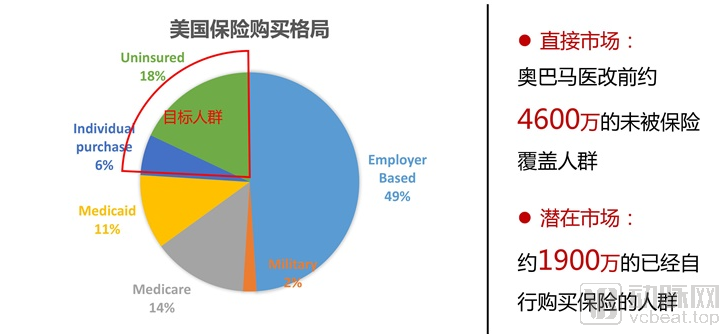
The goal of the Affordable Care Act (Obamacare) was to provide health insurance coverage to more uninsured individuals. To achieve this, the Obama administration mandated that most Americans purchase health insurance through executive measures, while low-income individuals could receive government subsidies to help cover the cost. It is against this backdrop that the growth potential of the individual insurance market has been significantly expanded.
Seizing the opportunity in this untapped market, Oscar Health was born. Thanks to the internet DNA brought by its founding team, Oscar Health is inherently different from traditional insurance companies. Its advantages, such as superior user experience and rapid technological iteration, quickly captured consumer mindshare, enabling it to secure a 10% share of the U.S. individual health insurance market.
By the third year after its founding, Google, having sensed the opportunity, participated in the investment of Oscar Health, and in the following years through its parent companyAlphabet has invested multiple times in succession, with a single investment reaching $375 million in 2018.Prior to its initial public offering, Alphabet held 18.1% of Oscar Health’s Class A shares and 2.9% of the voting rights, making it a significant shareholder in Oscar Health.
It is evident that Oscar Health has consistently been a “star” company throughout its development: its founding team boasts an impressive background, its investors are highly prestigious, and it operates in a sector with strong upward momentum. These factors have been key reasons for the industry’s attention. But beyond these advantages, what else has Oscar Health done right?
“To improve the user experience of health insurance, it is necessary to create personalized and affordable new experiences on a large scale.” Mario Schlosser, CEO of Oscar Health, has repeatedly stated in public that new technological changes will inevitably lead to changes in business models.
As a result, “technology first” has been the founding team’s creed at Oscar Health from the outset and has become its most defining hallmark.
To maintain its technological edge, Oscar Health has always placed great emphasis on its technical team, offering generous compensation and benefits packages when recruiting such employees.
It is worth mentioning that,Oscar Health has built the world’s first full-stack technology platform, which represents its most significant technological highlight.Specifically, the full-stack technology platform integrates data science with end-to-end control over user experience. This is achieved through backend programs that enable functions such as automated collection of user data and real-time intervention in users’ health behaviors. The platform covers a wide range of healthcare scenarios, including data collection from users and providers, claims management, billing and benefits administration, and user behavior research and intervention.
How Can Technology Improve the User Experience of Health Insurance?Oscar Health’s solution is to provide users with remote medical services through digital technological means and proactively intervene in the processes of medical care and health management., thereby expanding the functional scope of health insurance companies, rather than passively serving as claims-paying entities like traditional insurers.
More specifically, after users enroll as members, Oscar Health assigns them a dedicated care team, typically comprising one registered nurse and five care coordinators. When users submit a medical consultation request via the Oscar Health website or mobile app, their dedicated care team responds promptly, significantly reducing the time costs associated with in-person visits.
What’s more intriguing is that, with user authorization, Oscar Health’s system proactively retrieves users’ historical search data. When medical-related terms are detected, the care team initiates contact to provide medical advice and offers continuous support throughout the subsequent diagnosis and treatment process.
In addition, Oscar Health provides users with a review feature for doctors registered on its platform. Users can rate their impressions and service experiences, offering references for subsequent users, akin to a “Meituan” for physicians. The accumulated review data on the platform, supported by algorithms, can automatically recommend better-matched doctors based on user preferences.
From these services, it can be seen thatOscar Health’s core business logic is to build a closed loop of “health insurance + health management” empowered by technology.
As of the end of last year, Oscar Health was able to automatically operate nearly 80 health management service programs through its full-stack technology platform, providing users with a more convenient experience in medical care and health management. With the growth in membership and the accumulation of user behavior data, Oscar Health has built a proprietary database. The insights derived from this data have enabled the company to better train its algorithms and, in turn, develop the capability to leverage data externally—for example, by entering into commercial partnerships with healthcare providers and pharmacy benefit managers (PBMs) through partial authorization of such data.
From a business logic perspective, by using the platform and services provided by Oscar Health, users can enjoy more convenient health management and diagnosis and treatment experiences. The data assets generated during their use of the platform services, once authorized, allow Oscar Health to connect with more healthcare providers to offer them more extensive and precise services. This forms a virtuous cycle model; however, the issue lies in the fact that if the data accumulated by Oscar Health is not used in compliance with regulations—for instance, if it is sold privately to third-party companies—it will inevitably lead to user dissatisfaction.
Therefore, beyond technology, how Oscar Health can identify more effective and superior business models within the framework of commercial rules after its IPO will be key to determining the success or failure of its next stage of development.
Oscar Health, which entered the health insurance sector via the individual insurance market, has yet to escape the challenges posed by that segment.
Compared with markets such as group insurance, the individual insurance market is characterized by a smaller customer base and a higher tendency toward adverse selection among policyholders. These factors have historically resulted in high loss ratios, leading many large insurers to voluntarily exit this segment. Simply put, the individual insurance market is arduous, labor-intensive, and unprofitable.
Examining Oscar Health’s financial performance, the company has operated at a loss in every year since its inception, with the exception of 2017. Net losses amounted to $261 million in 2019 and reached $407 million in 2020, bringing cumulative losses since founding to over $1 billion.
In response to this trend, Oscar Health has also been actively expanding into new business areas. In 2017, Oscar Health entered the small-group insurance market, and in 2020, it launched its Medicare Advantage plans. TheseThe expansion of new businesses has helped Oscar Health grow the market pie.Financial data shows that in 2019, Oscar Health’s direct premiums were $1.326 billion, and in 2020, its direct premiums reached $2.288 billion, representing a year-on-year increase of 72.5%.
Most critically, Oscar Health delivered satisfactory results in claims settlement, which constitutes the largest portion of its costs. In 2019 and 2020, Oscar Health’s net claims amounted to RMB 408 million and RMB 309 million, respectively, representing 30.77% and 13.51% of its direct premiums. This indicates thatOscar Health’s capabilities in cost control are increasingly prominent, with its business model and technological prowess validated.
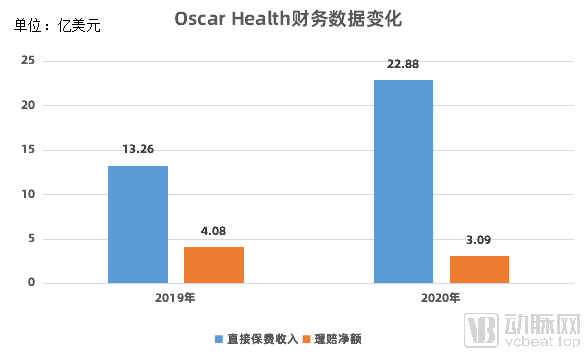
Not only that,Oscar Health’s administrative expenses are also being brought under control, with economies of scale beginning to take effect.According to the published financial data, Oscar Health’s administrative expense ratio decreased from over 50% in 2017 to 26.1% in 2020.
As can be seen from the above, although Oscar Health is still operating at a loss, its business model and technological capabilities have withstood market tests in core areas such as claims processing. With the compounding effects of scale, Oscar Health’s future development in the commercial market holds significant promise.
China's health insurance industry is also entering a phase of rapid development.
In 2020, China’s gross written premiums for health insurance exceeded RMB 800 billion. According to projections by VBInsight, the scale of health insurance premiums is expected to surpass RMB 1 trillion for the first time in 2022, and is projected to reach RMB 2.021 trillion by 2025, indicating substantial market growth potential.
At the policy level,As a key component of innovation in healthcare payment, health insurance has been frequently mentioned in policy discussions.On March 5, 2020, the “Opinions on Deepening the Reform of the Healthcare Security System” issued by the Central Committee of the Communist Party of China and the State Council stated that China would “establish a multi-tiered healthcare security system with basic medical insurance as the mainstay, medical assistance as the safety net, and coordinated development of supplementary medical insurance, commercial health insurance, charitable donations, and mutual medical aid,” thereby providing top-level design for the nation’s healthcare payment system. Driven by this policy directive, commercial health insurance is poised to play a significant role in healthcare payments in the future.
Riding the trend, a large number of enterprises and capital have flooded into the health insurance sector in recent years. Major financing events over the past year include Insurance Geek securing $25 million in its Series C round, Nanyan Insurance Technology raising RMB 250 million in its Series C round, and Nuanwa Technology obtaining RMB 100 million in its Series A round. Moreover, domestic health insurtech companies have demonstrated remarkable frequency in fundraising. For instance, Yuanxin Huibao completed three rounds of financing within two years, Medlinker Health secured five rounds in three years, Miao Health closed four rounds in four years, and Insurance Geek finalized seven rounds over five years.
The overall financing pace reveals a growing number of health insurance technology companies at Series C and D stages, indicating that China’s health insurance enterprises are on the verge of going public.However, China’s health insurance industry still faces significant challenges in closing the loop between “health management and health insurance.” Issues such as information asymmetry, low levels of specialization, high claims ratios, and weak profitability remain major obstacles for the sector.
It is certainly encouraging that health insurance technology companies in China are increasingly recognizing the role of digital technologies in enhancing industry efficiency. For instance, since 2015, Miao Jiankang, as a pioneer in digital precision health management in China, first leveraged the Internet of Things (IoT) and smart hardware to create “Miao+,” an AIoT-based IoT health big data platform. By integrating professional medical research with artificial intelligence algorithms, it subsequently developed the “H-Health Risk Stratification Management Platform” and the “M-AI Health Intervention Platform,” thereby establishing a robust digital middle office for health management.
In other words,Leveraging Digital Technology as a Core Driver Has Become the Consensus Among Leading Health Insurtech Companies in China. And this is precisely the key reason behind Oscar Health’s rapid growth.
Furthermore, beyond its emphasis on technology, Oscar Health offers another key lesson for Chinese companies: providing high-value, cost-effective services to users. This is because consumers purchase health insurance products not merely for claims reimbursement, but to access corresponding medical services and healthcare coverage, which represents their most fundamental psychological need. Therefore, in addition to leveraging technology, Chinese health insurtech companies must address the essential needs of specific user segments when building a closed-loop service ecosystem, ensuring sustainable and stable operations in channel development for “medical care” and “pharmaceuticals.”
A rising tide lifts all boats. As China’s commercial health insurance market gradually matures, leading domestic health insurtech companies are poised to experience a wave of initial public offerings in the coming years, becoming an integral component of the nation’s healthcare system.
After all, whether it is the IPO of Go Health, the listing of Oscar Health today, or the domestic health insurance technology companies that will go public in the future,Their greatest significance lies not in adding another high-quality investment target to the capital market, but in the fact that, driven by the wave of technology, a group of innovators daring to disrupt tradition has gained recognition and support from the business community in their endeavor to enhance human well-being within the broader health industry.This will inspire successive waves of innovators to continue investing in the broader health and wellness industry, injecting greater vitality into the traditional healthcare ecosystem.
The Wind Is Blowing: Who Will Be China’s Oscar Health?