

Magikare Launches Active Rehabilitation System for Home-Based Recovery with Integrated Training Guidance and Assessment
Rehabilitation is often synonymous with complete “recovery” after illness in traditional medical concepts. In reality, rehabilitation medicine refers to the use of various active interventions to help patients with diseases, injuries, or disabilities achieve maximal recovery as quickly as possible, optimize the function of remaining bodily capacities, and attain the highest possible level of independence in daily living, as well as in labor and work capabilities.
As an emerging discipline that arose in the mid-20th century, rehabilitation medicine is recognized alongside preventive medicine, healthcare medicine, and clinical medicine as one of the “Four Major Branches of Medicine”; nevertheless, its early development in China was remarkably slow.
In recent years, the state has successively issued policies related to rehabilitation medicine, vigorously promoting industry development and the construction of a rehabilitation medical service system. However, at the current stage, there is still a significant mismatch between supply and demand in the rehabilitation medical industry.
From the perspective of stroke rehabilitation, the incidence rates of ischemic and hemorrhagic stroke in China were 276.76 per 100,000 and 126.34 per 100,000, respectively, in 2016, with a year-on-year upward trend. However, the current number of rehabilitation therapists in China is insufficient to meet the substantial rehabilitation needs of patients. Relevant data indicate that the ratio of rehabilitation (assistant) physicians to the general population in China is approximately 1.1 per 100,000. Based on the international standard of eight rehabilitation therapists per 100,000 population, China faces a significant shortage of rehabilitation therapists, resulting in a severe imbalance between supply and demand.
Against this backdrop, Shanghai Lvcheng Information Technology Co., Ltd., established in 2015, launched its proprietary rehabilitation brand “Maiji Medical.” By applying technologies such as embedded systems and signal processing algorithms to the field of rehabilitation, the company has developed comprehensive home-based solutions for rehabilitation assessment and intelligent training, specifically tailored for patients with stroke, post-operative orthopedic trauma, and paraplegia.
Targeting the Out-of-Hospital Rehabilitation Market to Bring Rehabilitation Medicine into the Home
Similar to the tiered diagnosis and treatment system, the rehabilitation medical system also features a clear hierarchical structure. During the clinical rehabilitation phase, patients should seek care at tertiary hospitals. Once their condition stabilizes, they should be transferred as soon as possible to secondary hospitals or specialized rehabilitation hospitals, and eventually to long-term rehabilitation and nursing settings such as community health centers, nursing stations, and home care.
Different tiers each have their own advantages and disadvantages, representing distinct entrepreneurial opportunities. For patients, in-hospital rehabilitation yields significant clinical benefits but comes at a higher cost; out-of-hospital rehabilitation offers greater convenience and more competitive pricing, yet faces challenges with poor patient adherence.
During his doctoral studies at Eindhoven University of Technology in the Netherlands, Chen Hongyu, Founder and CEO of Maiji Medical, gained insights into the status and development trends of rehabilitation medicine abroad through a project collaboration with Philips. Due to a research partnership between his own scientific project and Fudan University, Chen returned to China during his PhD program and conducted market research on the domestic rehabilitation sector. Recognizing the shortage of rehabilitation resources in China and leveraging his background in wearable smart devices, Chen decided to focus on out-of-hospital rehabilitation as the entry point for his venture, subsequently founding Maiji Medical.
To address the high costs and insufficient resources associated with in-hospital rehabilitation, Maiji Medical has developed a patient-centric autonomous rehabilitation therapy system for active movement training. This system integrates intelligent rehabilitation devices with dedicated applications for clinicians and patients. Through this platform, physical therapists can remotely formulate customized training plans. During training sessions, the system automatically provides real-time guidance and rehabilitation assessments, eliminating the need for one-on-one, offline supervision by therapists and significantly reducing both time and labor costs.
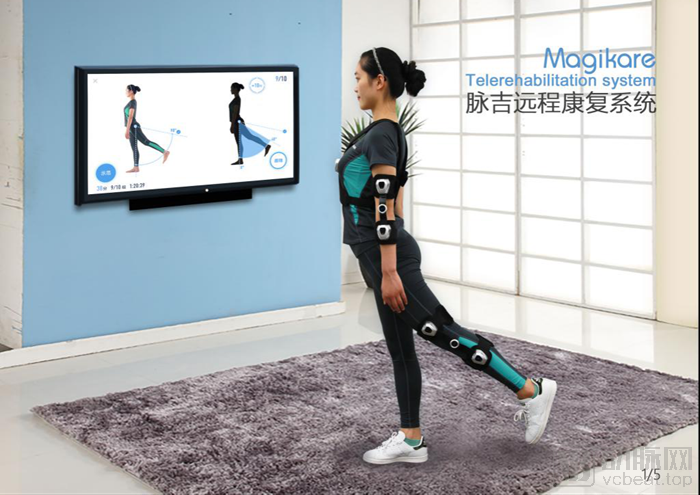
Through intelligent rehabilitation guidance and training, Maiji Medical can address the shortage of rehabilitation professionals in China. As a result, hospitals and rehabilitation institutions are more likely to adopt such products. However, since a significant proportion of patients have had limited prior exposure to these solutions, how can public perception be improved?
Leveraging patients’ trust in physicians and specialists, Maiji Medical has chosen to collaborate with hospitals, rehabilitation centers, and other institutions. Through these partnerships, physicians help reshape patients’ entrenched perceptions of rehabilitation and promote the concept of intelligent rehabilitation, thereby facilitating product adoption. Chen Hongyu stated that this represents only the first step in Maiji Medical’s market entry strategy, with the ultimate goal of enabling patients to independently purchase its products after sufficient market education has been conducted.
Furthermore, Maiji Medical can collaborate with health insurance providers and home care staffing agencies to help them introduce value-added services—such as motor function assessments and enhanced adherence support—without imposing additional burdens on these enterprises, thereby achieving a win-win outcome.
At this stage, Maiji Medical has successfully established collaborative partnerships with more than 10 hospitals. This not only facilitates the commercialization of its existing products but also supports clinical evaluation and performance optimization during the product development process.
Training Guidance + Rehabilitation Assessment, Real-Time Follow-Up on Rehabilitation Progress
To address the rehabilitation needs of diverse populations, Maiji Medical has developed a series of intelligent wearable devices for upper limb, lower limb, hand function, and balance training. Among these, the intelligent lower limb rehabilitation training device, LegKare, has already been launched into the market.
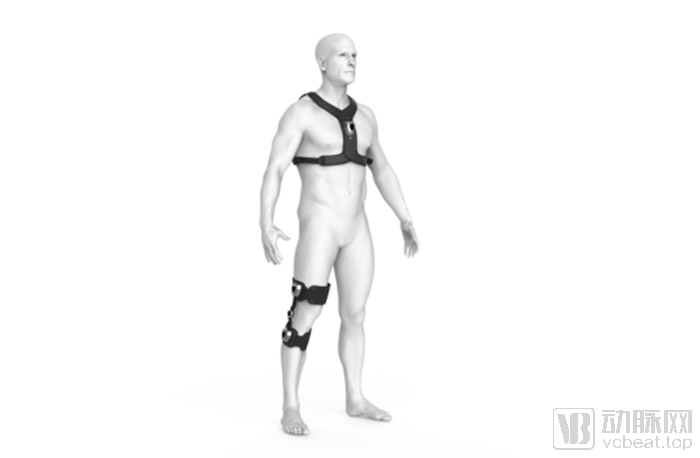
Lower Limb Rehabilitation Training Device LegKare
It is understood that Maiji Medical’s hardware products are equipped with motion capture sensor modules and flexible electrodes, enabling real-time collection of user training data. By integrating multi-sensor data fusion algorithms for action recognition, the analysis results are fed back to both the physician-side and patient-side apps in the form of quantitative metrics such as movement completion rate, compliance rate, and compensation rate.
To facilitate the development of personalized rehabilitation training programs by physicians and provide template references for patient exercises, Maiji Medical has designed over 500 rehabilitation exercises and more than 1,000 rehabilitation treatment protocols. These are based on resources such as the Orthopedic Rehabilitation Guidelines and the International Stroke Rehabilitation Guidelines, as well as interventions recommended by rehabilitation experts. Furthermore, Maiji Medical has established its exercise library as an open database, allowing physical therapists to import rehabilitation protocols that have demonstrated efficacy in daily practice into the system, thereby promoting professional exchange and learning within the industry.
During the training process, the system’s real-time motion feedback, error correction, and gamified training modules help patients quickly master standardized exercise techniques, thereby significantly enhancing the efficiency of rehabilitation training.
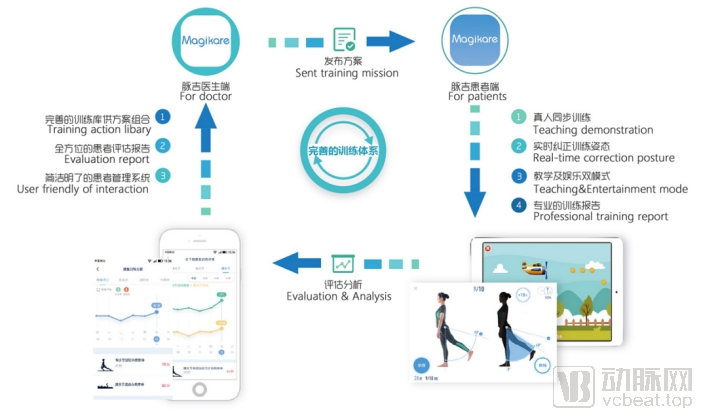
Maiji Medical Rehabilitation Training System
Leveraging the superior performance and design philosophy of its products, Maiji Medical has successfully won the German Red Dot Design Award and the Second Prize in the Finals of the China Medical Innovation and Entrepreneurship Competition. The company holds three invention patents, ten utility model patents, nine software copyrights, and three design patents.
Leveraging the holistic health and rehabilitation concept, we launch consumer-grade wellness products.
For office workers, prolonged desk work and frequent head-down postures while using mobile phones or computers can alter the physiological curvature of the cervical spine, leading to chronic cervical pain. In response, Maiji Medical has launched a thermal therapy device for cervical spine care called the “LeFu Instrument.” Equipped with a herbal heat pack and a built-in portable power bank, this device alleviates symptoms such as soreness, distending pain, and cold sensitivity in the cervical region through heat therapy.
The launch of consumer products also signifies Maiji Medical’s strategic commitment to the broader rehabilitation and wellness sector. It is understood that, in addition to its existing consumer product, the LeFu Device, Maiji Medical is currently developing equipment and systems for pediatric posture correction, and plans to continuously expand its product portfolio in response to market demand.
In the field of rehabilitation medicine, Maiji Medical is advancing the registration of medical device certificates for its existing product series, laying the foundation for large-scale market promotion in the future.
In terms of financing, Maiji Medical is currently undertaking a new round of funding, aiming to raise RMB 8 million. The proceeds will be primarily allocated to team expansion, product marketing and promotion, and advancing medical device certification. Previously, Maiji Medical secured angel-round financing from Huaying Investment.