

Top-Tier Platforms Bridge Innovation Opportunities: 2021 Digital Health Solutions Innovation Challenge Opens for Submissions
Since the dawn of the 21st century, China’s wave of technological innovation has continued to surge forward. Driven by this momentum, the digital transformation of the healthcare industry has accelerated steadily. In particular, the sudden outbreak of the COVID-19 pandemic in 2020 further hastened the digital revolution in the healthcare sector. The continuous integration of digital technologies—such as artificial intelligence (AI), big data, 3D printing, wearable devices, robotics, and virtual reality—with medical technologies is reshaping the entire industry into a new landscape.
Following this trend, local governments and industrial parks, healthcare innovation enterprises, and tech giants are leveraging their respective strengths to fuel the momentum of digital health innovation, thereby expanding the possibilities for the future landscape of healthcare. Consequently, a surge of innovative companies and solutions has emerged. Originating from the industry side, these entities deeply integrate digital technologies with disease diagnosis and treatment pathways, empowering physicians and serving patients through more profound models. By providing integrated diagnosis-and-treatment solutions, they enable both doctors and patients to achieve superior treatment efficiency and outcomes throughout the entire course of disease.
Certainly, innovation often entails significant risks. How to better provide full-chain services encompassing project cultivation, enterprise incubation, and industry development has become a focal point of concern and reflection within the industry. In response to this,Guided by the People's Government of Xiacheng District, Hangzhou, and hosted by Hangzhou International Life Science Innovation Park (Hangzhou iCampus), AstraZeneca Hangzhou Digital Healthcare Innovation Center (Hangzhou CCiC), and Microsoft Accelerator, the “2021 Digital Healthcare Solutions Innovation Challenge” is currently witnessing enthusiastic participation in its project submissions.Recruitment。
As China’s Internet Capital and the leading city in the digital economy, Hangzhou has accumulated unique foundational strengths and advantages in the digital economy sector, including technology, talent, industrial support systems, and business environment. Among its districts, Xiacheng District boasts a favorable geographic location and abundant clinical resources from Grade 3A hospitals.
Not only that, but as a top-tier pharmaceutical company, AstraZeneca has consistently been at the forefront of digital health innovation, serving as a key leader and driver in commercializing and reshaping innovations within the healthcare industry. It is worth noting that AstraZeneca’s Innovation Centers and International Life Science Innovation Park serve as vital platforms empowering medical innovation. Furthermore, its upcoming Eastern China Headquarters in Hangzhou, one of AstraZeneca China’s five regional headquarters, will integrate functions such as operations, sales, and innovation incubation. Seizing this opportunity, AstraZeneca is collaborating with the Hangzhou Municipal Government to establish the “Hangzhou International Life Science Innovation Park (Hangzhou iCampus),” adopting a new government-enterprise partnership model for industrial parks. This initiative aims to join forces with various stakeholders to transform Xiacheng District into a leading hub for the digital health industry in Hangzhou and across China.
In addition, Microsoft Accelerator is a global initiative by tech giant Microsoft, designed to support and accelerate high-tech startups, with extensive experience in project incubation and development. As of January 2021, Microsoft Accelerator had successfully accelerated more than 600 startups focused on high-tech fields such as artificial intelligence, big data, cloud computing, the Internet of Things (IoT), blockchain, robotics, and virtual reality.
Faced with such a powerful combination of resource empowerment, aren’t you tempted? Click to register now and contribute your innovative solutions to China’s digital healthcare sector! We look forward to partnering with you, leveraging cutting-edge technology, robust capital, and strong government support to propel your enterprise to new heights in the field of digital healthcare!
This competition focuses on providing digital solutions for patient disease treatment, physician empowerment, and pharmaceutical innovation (including R&D, marketing, operations, etc.).
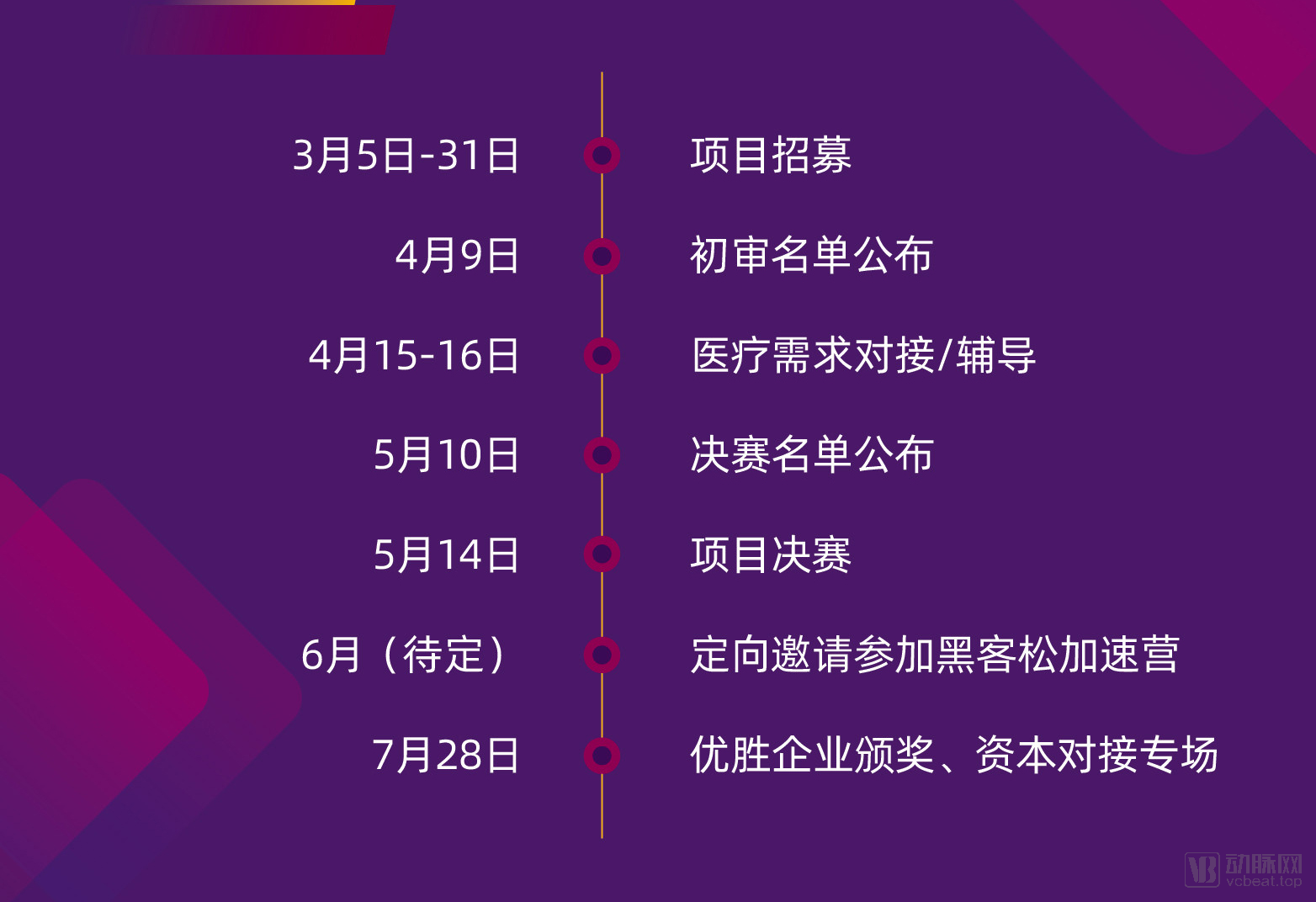
1. From now until March 31, 2021, participating entities may register by clicking the registration link below:
http://vcbeat-vb100.mikecrm.com/uHdwqQQ
2. From April 1, 2021, to April 8, 2021, the judges of this competition will evaluate and score the registered projects based on six dimensions: alignment with pain points, solution innovation, commercialization capability, technological leadership, team strength, and market potential. The selected projects will advance to the semi-finals.
Final Venue: Digital Economy Industrial Park, Xiacheng District, Hangzhou. The detailed schedule is as follows:
Participating companies must simultaneously meet the following four major conditions:
1. Good Reputation: Enterprises or projects that possess independent intellectual property rights with no disputes over such rights, operate in a standardized manner, maintain a positive social reputation, and have no adverse records;
2. Business Synergy: Primarily focused on therapeutic areas including oncology (lung cancer, breast cancer, prostate cancer, ovarian cancer, gastric cancer), respiratory, cardiovascular, diabetes, nephrology, and gastroenterology;
3. Mature Model: Possesses a relatively mature business model and a clear profit model, with the capability for commercial implementation;
4. Financing Capability: At least Pre-A and A rounds of financing completed, except for companies with strong cash flow.
The pain point identification and solution development for this competition are primarily focused on the following four areas:
Scenario 1: Enhancing Patient Experience
The patient-centered philosophy is the core principle guiding healthcare delivery. We aim to identify digital solutions that assist patients in the critical processes of scientifically guided medication use and treatment efficacy monitoring, thereby extending into a broader patient empowerment ecosystem.
Scenario Segmentation: Digital Disease Course Management, encompassing pre-consultation disease awareness and screening, in-consultation patient experience, and post-consultation digital management for patients with chronic diseases or cancer.
Scenario 2: Optimizing Physician Efficiency
As remote work and online meetings become increasingly prevalent, the management and organizational structures of the pharmaceutical industry are fully embracing digital transformation. We aim to identify solutions that help healthcare professionals enhance their productivity and achieve personal growth.
Scenario Segmentation: Digital Empowerment System for Physicians’ Professional Growth, Digital Solutions to Enhance Clinical Diagnostic and Therapeutic Capabilities, AR Tools for Physician Teaching and Demonstration, etc.
Scenario 3: Accelerating Product R&D
Big data and artificial intelligence technologies are making medical device research and development more efficient and precise. We aim to identify digital solutions that enhance efficiency and success rates across all stages of product development for pharmaceutical and medical device companies.
Scenario Segmentation: Leveraging big data solutions to shorten the R&D cycle for pharmaceuticals and medical devices, reduce R&D costs, process patient data, and simulate disease patterns, such as AI-driven new drug discovery and Real-World Evidence (RWE) studies.
Scenario 4: Enhancing Operational Efficiency
Agile operations, a strategy originating from the internet industry, has extended into the pharmaceutical sector. We aim to identify solutions that enable agile development and rapid response throughout the comprehensive operational processes of pharmaceutical and medical device enterprises.
Scenario Segmentation: Internet Healthcare Industry Matchmaking, Supply Chain and Channel Management, Internal Enterprise Process Management, etc.
1. Collaboration opportunities for AstraZeneca’s digitalization projects;
2. AstraZeneca and Microsoft for Startups provide clinical insights and technical support guidance for enterprises’ digital innovation solutions, jointly refining these innovative approaches;
3. Access AstraZeneca’s industrial ecosystem and gain opportunities for accelerated business innovation:
— Leverage the combined strengths of government, industry, academia, research institutions, healthcare providers, and investors to provide free incubation and acceleration support, including one-on-one mentorship, expedited regulatory approval, business and capital matchmaking, and industry salons.
— Innovation Space Product Showcase Bolsters Brand Influence
— Opportunities to Participate in the Digital Healthcare Innovation Lab’s Innovation Accelerator Series
— Opportunities for office space rent reductions, and support policies for corporate R&D and talent
— Access to evaluation and priority investment opportunities with partners of the industrial fund and park fund jointly established by AstraZeneca and CICC Capital
4. Participating companies that meet the selection criteria for the Microsoft Accelerator startup program will have priority for admission. Companies successfully admitted to the Microsoft Accelerator will
— Access up to $120,000 in Microsoft Cloud credits for a period of two years
— Obtain Microsoft Technical Support
— Business opportunities for collaboration with top-tier capital firms and major clients linked to it
Guiding Organizations:
Hangzhou Xiacheng District People's Government
Organizer:
Hangzhou International Life Science Innovation Park (Hangzhou iCampus)
AstraZeneca Hangzhou Digital Healthcare Innovation Center (Hangzhou CCiC)
Microsoft Accelerator
About Hangzhou International Life Science Innovation Park (Hangzhou iCampus)
Hangzhou International Life Science Innovation Park (Hangzhou iCampus) is a life science innovation incubation platform jointly established by the Hangzhou Municipal Government, the Xiacheng District Government, and AstraZeneca, a global biopharmaceutical company. Officially unveiled in November 2020, the park focuses on digital healthcare by building a 20,000-square-meter smart healthcare accelerator platform. It provides domestic and international innovative enterprises with a one-stop innovation empowerment platform covering project implementation, innovation incubation, commercial acceleration, and scaling. With support from government, industry, academia, research institutions, healthcare providers, and investors, the park will empower the development of the internet and digital healthcare industries, enhance collaborative innovation capabilities in the Yangtze River Delta region, and boost the international influence of the regional smart healthcare innovation cluster.
About the AstraZeneca Hangzhou Digital Health Innovation Center (Hangzhou CCiC)
AstraZeneca, in collaboration with cross-sector partners from government, industry, academia, research institutions, and healthcare, has jointly established the Hangzhou Digital Healthcare Innovation Center. This strategic open innovation platform aims to accelerate the incubation of health innovation projects, showcase innovative health concepts and achievements, cultivate talent in health innovation, and build an open, patient-centric health innovation ecosystem. It also demonstrates AstraZeneca’s outstanding leadership in health innovation, continuously shaping the future direction of China’s local healthcare industry.
Through the Innovation Center, we have jointly launched with over 300 partners multiple integrated, full-course diagnosis and treatment solutions covering major disease areas in China, including respiratory, cardiovascular, metabolic, oncology, and digestive diseases. These solutions encompass the Department of Respiratory and Critical Care Medicine, Intelligent Nebulization Center, Gastrointestinal Oncology Prevention and Treatment Center, China Chest Pain Center, National Standardized Metabolic Disease Management Center, Integrated Prostate Cancer Diagnosis and Treatment Center, Integrated Lung Cancer Diagnosis and Treatment Center, Smart Community Chronic Disease Management Center, Integrated Female Oncology Prevention and Treatment Center (Breast and Ovarian Cancers), Cough and Asthma Management Center, China Pharmaceutical Innovation Center, Full-Course Chronic Kidney Disease Management Center, Cardiac Rehabilitation Center, and Smart Medical Consortium. Currently, some of these solutions have been extended to countries and regions along the “Belt and Road” initiative, injecting vitality into global medical innovation and benefiting patients in China as well as in many other countries and regions.
About Microsoft Accelerator
Microsoft Accelerator, a global initiative under Microsoft, is dedicated to supporting and accelerating high-tech startups. Established in China in 2012, it leverages the local ecosystem to provide entrepreneurial services throughout the entire corporate lifecycle, with a strong focus on B2B high-tech startups from seed stage to Series C.
Microsoft Accelerator is the only organization to have been consecutively named for six years to VCBeat’s annual “Top 10 Best Incubators in China” or “Top 10 Best Co-working Spaces in China.” As of January 2021, Microsoft Accelerator had successfully accelerated more than 600 startups focused on high-tech fields such as artificial intelligence, big data, cloud computing, the Internet of Things (IoT), blockchain, robotics, and virtual reality. These startups span popular industries including retail/fast-moving consumer goods (FMCG), healthcare, manufacturing, and fintech. The total valuation of its alumni companies exceeds RMB 350 billion, with an average valuation growth rate of over 280%, and more than 93% of these companies have secured subsequent rounds of financing.