

CMDE Clarifies Clinical Validation Requirements for Early-Stage Cancer Screening Products: Spotlight on Changweiqing as the First Approved Multi-Target FIT-DNA Test
Since the approval of Changweiqing in November 2020, discussions surrounding its status as the first certified product for early cancer screening have been ongoing. In the comment section of VCBeat’s articles on Changweiqing, readers frequently ask how Changweiqing differs from other previously approved colorectal cancer diagnostic products.
Although New Horizon Health has repeatedly explained in public reports the differences in the scope of application stated on the approval documents, these explanations ultimately represent only the company’s side of the story. The only entity capable of endorsing the credibility of products approved for market launch by the National Medical Products Administration (NMPA) is the national regulatory authority itself.
On March 5, 2021, the WeChat official account of China’s Center for Medical Device Evaluation (CMDE) published an article titled “Current Status and Clinical Evaluation Requirements for Colorectal Cancer Screening Products in China and Abroad" article.The article provides a specific analysis of FIT-DNA testing technology, the product category to which Changweiqing belongs, and summarizes the clinical evaluation requirements for colorectal cancer screening products in light of clinical needs.
The CMDE has finally issued an official public announcement, so the “first cancer early screening certification” for Changweiqing is likely no longer subject to dispute.However, in discussing information related to Changweiqing, the CMDE also disclosed further details regarding the approval of early screening products. Therefore, we have written this article to analyze the CMDE’s publication, with the aim of providing guidance for the regulatory submissions of other early screening products following in Changweiqing’s wake.
(Some content in this article is directly quoted from the original text, all marked with “*Italic*” indicates.)
Some readers may not be particularly familiar with the CMDE, so a brief introduction is provided here.
CMDE, the Center for Medical Device Evaluation of the National Medical Products Administration (NMPA), is a directly affiliated institution under the NMPA. It is responsible for various tasks related to medical devices, including technical review, inspection, and standard development. Notably, one of CMDE’s key responsibilities is “the acceptance and technical review of domestically produced Class III medical device products seeking registration.” In other words, during the regulatory submission and approval process of Changweiqing, the critical technical review was conducted by CMDE, and the corresponding product technical review report has been publicly disclosed on the CMDE website.
The “China Medical Device Review” WeChat official account that published this article is operated by the CMDE, the official entity.
Why Did the CMDE Issue a Document?According to the article, this is mainly because the approval and market launch of Changweiqing has attracted widespread attention in the medical device industry, “On the one hand, the broad target audience for ‘screening’ products promises substantial market value; on the other hand, and more importantly, there is a strong clinical demand for ‘early screening and early diagnosis’ of cancer.”。
Therefore, in the materials released by the CMDE, in addition to an objective description of the early screening landscape for colorectal cancer, there is a specific analysis of the risks and benefits of FIT-DNA testing technology in colorectal cancer screening. Furthermore, drawing on approved products, the clinical evaluation requirements for colorectal cancer screening products are summarized.
How does the CMDE describe Changweiqing?
First, the text explicitly states “None of the previously approved related products have conducted prospective clinical trials in accordance with the aforementioned requirements.”,“Insufficient to support its use as a method for early disease screening”;and clearly states in the conclusion section of the full text that Changweiqing is “The First Innovative Product Approved for Market Launch in Its Category”。The uniqueness of ChangWeiqing has received clear support from regulatory authorities.
The CMDE extensively presented relevant data from the large-scale prospective clinical trial of Changweiqing in the document, and clearly stated that the clinical significance of Changweiqing lies in “Further stratify high-risk populations to improve colonoscopy adherence, facilitate timely diagnosis and treatment, prevent disease progression due to poor adherence, and optimize the allocation of limited colonoscopy resources.”。
This passage can be simply summarized as:Changweiqing is not intended to replace colonoscopy, but rather to maximize the utilization of limited colonoscopy resources.
To put it more clearly, colonoscopy remains the gold standard for colorectal cancer screening; even though Changweiqing’s clinical data are highly impressive, it still cannot replace colonoscopy in clinical practice. But “China faces a scarcity and uneven distribution of colonoscopy resources, which are currently insufficient to meet the needs of large-scale population screening.”, and given the complexity and discomfort associated with colonoscopy, a large number of high-risk individuals are unable or unwilling to undergo the procedure.
At this stage, Changweiqing can serve as the first line of defense prior to colonoscopy. Due to its exceptionally high negative predictive value (99.6%), a large proportion of individuals who test negative with Changweiqing can avoid unnecessarily consuming limited colonoscopy resources, undergoing colonoscopy only when clinically indicated.Compared with not undergoing refined screening, the high-risk population was enriched by 4.8-fold, improving colonoscopy efficiency and helping to enhance colonoscopy adherence among high-risk individuals.”。
In addition to endorsing Changweiqing, the CMDE article also uses Changweiqing and other previously approved products as examples to elaborate on the clinical evaluation standards for colorectal cancer early screening products. For specific details, please refer to the relevant descriptions in the original text; however, we have extracted and summarized below the key points of several evaluation criteria mentioned in the CMDE article.
1. Prospective enrollment;
2. The enrolled population should target the intended screening population;
3.Among evaluation metrics such as clinical sensitivity, specificity, and positive/negative predictive values,Clinical sensitivity and negative predictive value are key performance metrics of great concern for early screening products.
Specifically, the prospective enrollment and the criteria for the enrolled population are designed to align with the real-world use of the product. After all, the ultimate goal of early screening products is to detect diseases at an early stage of progression. Conducting retrospective cohort studies based on already diagnosed patients does not accurately demonstrate the product’s effectiveness in early screening.
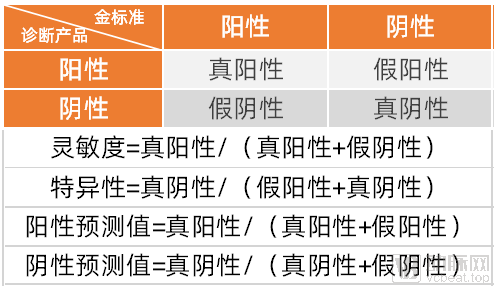
The third point we have summarized more clearly indicates the CMDE’s requirements for clinical trial results of early screening products. Among the four data dimensions shown in the figure above, the CMDE places greater emphasis on sensitivity and negative predictive value. When mapped onto the four quadrants, it becomes evident that the key factors influencing sensitivity and negative predictive value lie inFalse negatives, also known as "missed detections," refer to individuals who are classified as negative by the diagnostic product but are actually positive according to the gold standard.
If the false-negative rate is not sufficiently low, the most likely outcome in real-world product use is that a large number of patients will not undergo gold-standard diagnostic testing due to false-negative results. Consequently, although these individuals have used the early screening product, they ultimately miss the optimal window for treatment. This clearly contradicts the original intent of early screening products.
This is why physicians involved in the clinical trials of Changweiqing frequently emphasize its negative predictive value in public forums. It is not merely because the figure of 99.6% appears impressive; more importantly, for a product positioned for early screening, the ability to ensure “no missed detections” is what truly defines a high-quality product.
Therefore, based on the relevant requirements of these clinical trials, the CMDE also explained in the text why previously approved products were not approved as early screening products, corresponding to the three key points mentioned above:
1.“None of them conducted prospective clinical trials in accordance with the aforementioned requirements.”;
2.“Enrichment enrollment is conducted exclusively for patients with colorectal cancer at different stages and non-colorectal cancer patients.”;
3.“Systematic evaluation of the product's positive and negative predictive values is not feasible. Furthermore, the product's sensitivity fails to achieve an adequate level.”。
In contrast, ChangWeiqing enrolled 4,245 individuals at high risk for colorectal cancer (data from the Center for Medical Device Evaluation, CMDE) in a prospective clinical trial, achieving a sensitivity of 95.5% and a negative predictive value of 99.6% for colorectal cancer detection. Meanwhile, its sensitivity for detecting advanced adenomas reached 63.5%, effectively helping to reduce the incidence of colorectal cancer through early prevention. These data ultimately enabled ChangWeiqing to obtain the “first approval for cancer early screening.”
Of course, it is still necessary to emphasize here that although the negative predictive value of Changweiqing is already high, it has not yet reached 100%. Therefore, “A negative result does not completely rule out the risk of disease. Given that the subjects are a high-risk population, colonoscopy should still be recommended when necessary.”。
In this article, the CMDE also extensively cites the “Expert Consensus on Early Diagnosis and Screening Strategies for Colorectal Tumors in China” (hereinafter referred to as the “Consensus”), published in the Chinese Journal of Gastrointestinal Surgery, particularly referencing the colorectal cancer screening, prevention, and treatment pathway illustrated in the Consensus.
Colorectal cancer is one of the most common malignant tumors, consistently ranking among the top three in incidence. The greatest challenge in early screening for colorectal cancer lies in the fact that most patients exhibit no obvious symptoms in the early stages; consequently, they often seek medical attention only after noticing blood in their stool. By this time, the disease has already progressed, necessitating surgical intervention, and the five-year survival rate remains suboptimal.
As the gold standard for colorectal cancer screening, colonoscopy plays a crucial role in reducing the incidence and mortality of colorectal cancer. However, due to its high technical and equipment requirements, as well as the associated discomfort and risk of complications during the procedure, many countries have not adopted direct-to-colonoscopy screening. Instead, they employ preliminary screening methods to stratify patients, identify individuals at high risk for colorectal cancer, and then perform targeted colonoscopies.
Given the prevalence of colonoscopy in China, the pathway outlined in the “Consensus” also covers the pre-colonoscopy screening process. It proactively incorporates FIT-DNA testing into consideration and divides the patient stratification process into two stages: initial screening and refined screening.
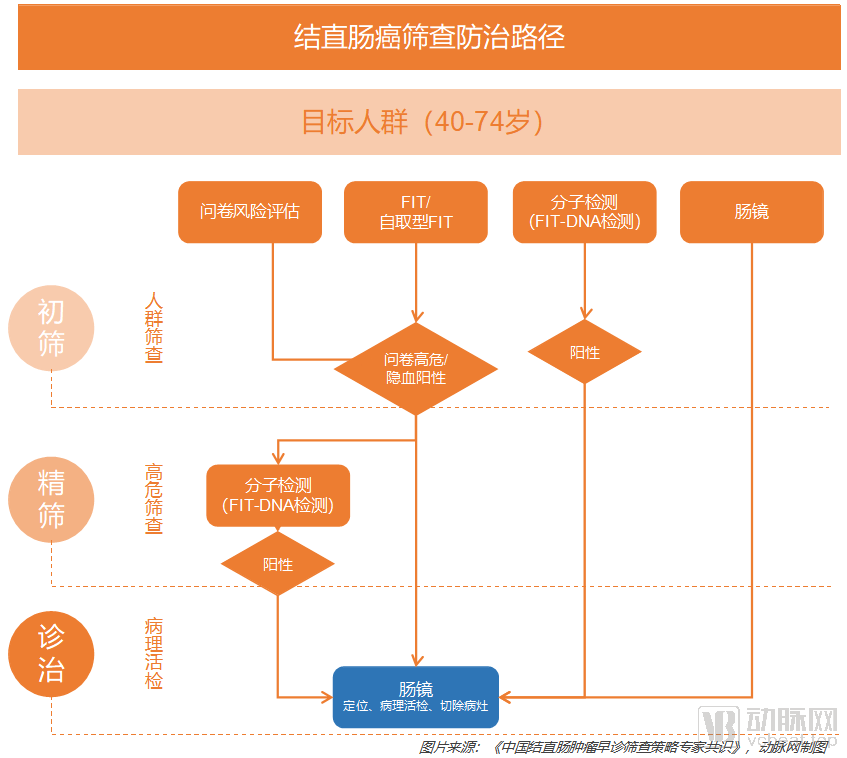
As clearly shown in the figure, questionnaire-based risk assessment, FIT, FIT-DNA testing, and colonoscopy can all serve as initial screening methods for colorectal cancer in the population.In the advanced screening phase, for high-risk populations, among existing solutions, only the FIT-DNA test corresponding to Changweiqing can achieve relatively precise population stratification prior to colonoscopy.
The importance of FIT-DNA testing has indeed gained widespread consensus in the field of early screening for colorectal cancer. The "Chinese Guidelines for Colorectal Cancer Screening, Early Diagnosis, and Early Treatment (2020, Beijing)," released in January 2021, listed "multi-target stool FIT-DNA" as the fifth method for early colorectal cancer screening, alongside colonoscopy, FIT, sigmoidoscopy, and CT colonography.
Relevant data from previous U.S. studies were cited in the introduction to multi-target stool FIT-DNA testing.Multi-target FIT-DNA testing every three years achieves 84% of the benefit of colonoscopy screening strategies, equivalent to that of flexible sigmoidoscopy screening every five years. Based on this, the Guidelines recommend multi-target stool FIT-DNA testing every three years.
Leveraging the power of official endorsements and industry consensus, New Horizon Health’s key objective for the next phase will be to prioritize the development of the clinical market. The official price of Changwei Qing is RMB 1,996. As an early-screening product that has undergone large-scale clinical trials, this is a reasonable pricing strategy. However, from the perspective of end consumers, a price point nearing RMB 2,000 is indeed not inexpensive. Furthermore, given the lack of prior market groundwork laid by other early-screening products for Changwei Qing, it may still be challenging to gain consumer acceptance and drive purchases among end users in the short term.
Therefore, New Horizon Health adopted an alternative marketing strategy, initially targeting in-hospital channels before gradually expanding to out-of-hospital settings. First, physicians have a clear understanding of the importance of early screening, and their solid foundational knowledge enables them to quickly grasp the significant value of Colotect in the early detection of colorectal cancer. Second, patients who visit hospitals for consultations or examinations represent a segment with more advanced awareness of early screening among the general population. This group is more likely to choose Colotect as a pre-colonoscopy screening option after receiving introductions and recommendations from their doctors.
Therefore, the significance of Changweiqing to the early screening market extends beyond the approval of its first certificate. On the clinical level, the clinical standards for early screening products have become clearer due to the approval of the first product; while on the market level, New Horizon Health acts as a trailblazer in the early screening market. As we previously stated, the early screening market has just begun to open up. What we look forward to is not only Changweiqing’s continued success, but even more so, the entry of more products into clinical use, ultimately making early screening a routine part of pre-diagnostic care.