

Huami Releases 2020 Women's Health Report: Better Sleep Quality Than Men, Designers and Media Professionals Sleep Latest
What trends have emerged in the overall physical activity and health status of women in China over the past year under the impact of the pandemic? Why is it important to scientifically manage BMI to maintain a healthy physique? On International Women’s Day, March 8, Huami Technology released the “2020 Report on Trends in Women’s Physical Activity and Health” (hereinafter referred to as the “Report”). Based on tens of millions of data points from Huami’s ZEPP digital health platform, the Report analyzes women’s physical activity and health in 2020 across multiple dimensions, including step count, sleep, and stress levels, and calls on all sectors of society to jointly pay attention to women’s physical and mental well-being.
The report shows that in 2020, women took an average of 7,409 steps per day, which was 1,051 steps fewer than men on a daily basis. Affected by factors such as the pandemic and the Spring Festival holiday, women’s step count reached its lowest point in February. By age group, older women tended to have higher average daily step counts; however, only women born in the 1970s or earlier exceeded 7,000 steps per day on average, while those born after 2000 had the lowest step counts.
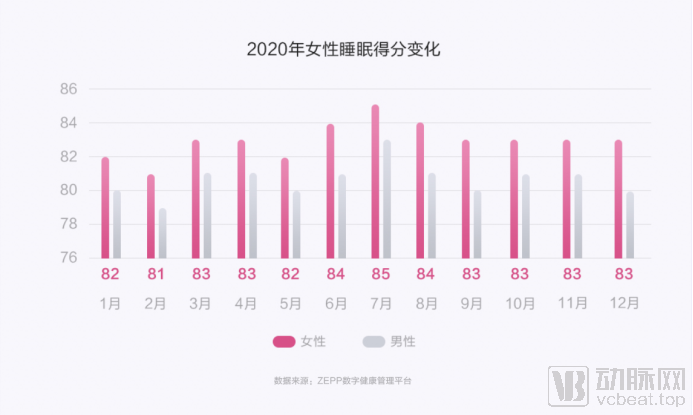
Although women take fewer daily steps on average than men, their overall sleep quality is superior. The report indicates that in 2020, women had an average sleep score of 83, which was 3 points higher than that of men. During February, increased time spent at home correlated with the longest sleep duration.
An analysis of sleep habits among women in different professions reveals that visual designers, media professionals, and product operations specialists tend to go to bed latest and wake up latest. In contrast, influenced by their occupational demands, workers in the logistics and warehousing sector as well as technical/industrial workers are accustomed to going to bed early and rising early; female drivers also constitute a group that tends to wake up earlier.
The BMI of most women falls within the normal range, with approximately 23% exceeding the standard. Women’s BMI tends to increase with age, and those with higher average BMIs are predominantly concentrated in northern China. Among all provinces, Heilongjiang, Hebei, and Shandong have the highest average BMIs for women.
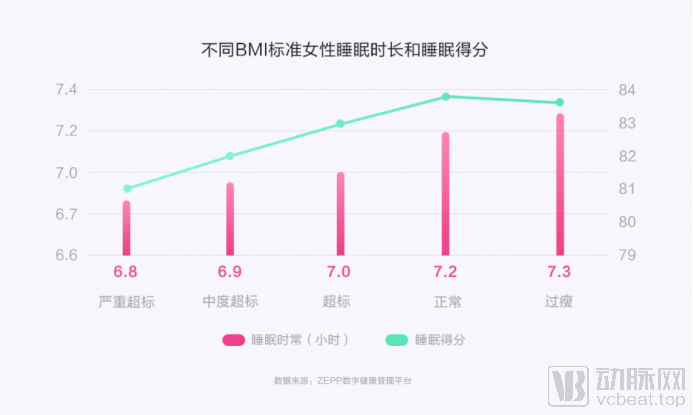
Research has found that the more severe the excess in BMI, the fewer the average daily steps; women who are underweight also do not take many steps on average. Achieving a healthy body shape requires increased physical activity. Meanwhile, sleep quality significantly impacts body composition. Women with higher BMI tend to have shorter average daily sleep duration and poorer overall sleep quality. Although underweight women (with BMI in the underweight range) have the longest sleep duration, their sleep scores remain lower than those of women with normal BMI.
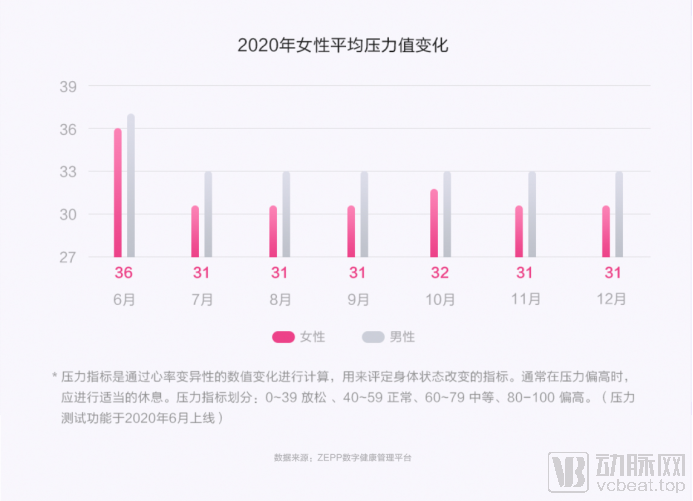
In the second half of 2020, the average stress level among women was slightly lower than that among men, with women experiencing their highest stress levels in June throughout the year. Older women tended to have higher average stress levels. Among women with elevated stress, those born in the 1990s constituted the largest proportion. Additionally, women with higher BMI excesses exhibited higher average stress levels.
Huami Technology’s PAI (Personal Activity Intelligence) index reflects users’ overall physical activity and health status. The report shows that in 2020, the average PAI score for women was lower than that for men, with women’s PAI scores peaking in May. Compared with 2019, most women experienced an increase in their PAI scores in 2020, except for women born in the 1970s, whose PAI scores declined.
Furthermore, the report also assessed women's menstrual health. The ZEPP digital health management platform categorizes menstrual pain into three levels: mild, moderate, and severe. The report found that over 30% of women experience moderate to severe pain during their menstrual periods. Moreover, women generally report average mood states for most of their menstrual cycle, and those with a lower BMI and slimmer body type tend to suffer from more severe menstrual pain.
It is understood that Huami Technology is a cloud-based health service provider with globally leading smart wearable technology. With the mission of “Technology Connects Health,” the company leverages powerful artificial intelligence algorithms and big data analytics capabilities to provide users with 24/7 health monitoring services. In the future, Huami Technology will continue to focus on women’s exercise and health conditions, calling on all sectors of society to jointly pay attention to women’s physical and mental well-being.