

Fubo Medical Submits IPO Prospectus: Pioneering Mirror-Guided Hand Rehabilitation for Post-Stroke Recovery

Fubo Medical
Upper Limb Rehabilitation Exoskeleton Robot Developer and Distributor
Stroke, also known as apoplexy or cerebrovascular accident, is characterized by high incidence, high mortality, and high disability rates. Surveys indicate that stroke has become the leading cause of death in China and the primary cause of disability among Chinese adults.
In recent years, the number of hospitals in China establishing green channels for emergency stroke care has been steadily increasing. According to the "China Stroke Prevention and Treatment Report 2019," the number of hospitals with such green channels rose from 245 in 2017 to 271 in 2018, while the number of patients benefiting from these channels increased from 304,000 person-visits in 2017 to 351,000 person-visits in 2018.
Although an increasing number of stroke patients are able to receive timely treatment, most survivors develop sequelae such as motor impairments, cognitive deficits, and speech and swallowing disorders due to neurological damage caused by the stroke. These conditions severely affect patients’ quality of life after treatment, making post-acute rehabilitation crucial for their recovery.
Furthermore, in the face of the annually rising number of new stroke cases and growing demand for patient rehabilitation, limited rehabilitation facilities and therapists are clearly insufficient to meet the increasing needs. Both hospitals and patients require a device capable of intelligently assisting patients with rehabilitation training.
Against this backdrop, Fubo (Beijing) Medical Technology Co., Ltd. (hereinafter referred to as “Fubo Medical”) has entered the field through neurological rehabilitation, leveraging task-oriented training along with visual and haptic feedback principles. The company has launched the “Mirror Hand,” an upper-limb rehabilitation exoskeleton robot designed for patients post-stroke, post-neural reconstruction, and post-spinal cord injury. Reportedly, the product has secured more than ten patents domestically and internationally, and has obtained certification from the U.S. Food and Drug Administration (FDA) and the Taiwan Food and Drug Administration (TFDA). Certification from China’s National Medical Products Administration (NMPA) is currently underway.
Launch Hand Function Rehabilitation Products Based on Clinical Needs
Dr. Chien-Chia Huang, Co-founder and Chairman of Fubo Medical, earned his degree from National Taiwan University. He previously served as a Postdoctoral Research Fellow in the Department of Rehabilitation Medicine at Chang Gung Memorial Hospital and as a Researcher in Computational Neuroscience at the Okinawa Institute of Science and Technology in Japan. Additionally, he was a Visiting Scholar at Oregon Health & Science University (OHSU) and the University of Missouri–Kansas City (UMKC). Dr. Huang has published numerous papers in international SCI-indexed journals and presented research reports at international conferences.
Kong Lingjie, Co-founder and CEO of Fubo Medical, earned his bachelor’s degree from the University of Minnesota in the United States and later obtained a master’s degree from Cornell University. After graduation, Kong chose to remain in Minnesota, known as the “Silicon Valley of medical devices,” where he joined the Boston Scientific R&D Center as the Project Lead for Artificial Intelligence, spearheading the implementation and application of multiple AI technologies.
In 2018, due to personal reasons, Kong Lingjie returned to China and joined the T3 Innovation Hub at Boston Scientific. At a medical device innovation training session in late 2019, Kong met Dr. Huang Jianjia, who was engaged in neuroscience research. After several meetings and discussions, the two reached a consensus on starting a business together and subsequently founded Fubo Medical.
At this stage, Fubo Medical has assembled a team of master’s and doctoral graduates from prestigious universities both in China and abroad, with extensive experience in the research and development of medical devices and robotics. The company’s advisory experts are all from the rehabilitation departments of Grade 3A hospitals, possessing rich clinical experience in rehabilitation therapy. While formulating effective rehabilitation plans for patients, they also actively participate in the research and development of innovative medical devices.
As one of the vital organs of the human body, the hand plays an extremely important role in perceiving the surrounding environment, and most complex activity tasks require hand participation. Therefore, Fubo Medical has chosen to focus its research efforts on the development of hand function rehabilitation devices and technologies. To ensure the successful commercialization and large-scale promotion of its products, Fubo (Suzhou) Medical Technology Co., Ltd. was officially established in March 2020 as the production base and exhibition center for these products.
Innovative Mirror Therapy Supporting Active and Passive Rehabilitation Training
From a morphological perspective, exoskeleton robots can be classified into large-scale exoskeleton robots and wearable exoskeletons. Fubo Medical’s flagship product, the “Mirror Hand,” is a wearable exoskeleton device. Due to its compact size and lightweight design, it imposes no special requirements on usage scenarios.
Overall, this device consists of an exoskeleton robotic hand, a sensing glove, and a compact control box. It does not require a fixed operating console, allowing patients to perform fine motor tasks such as grasping, gripping, and pinching with robotic assistance. During actual rehabilitation training, therapists can guide patients to freely select from various modes, including continuous passive training for individual fingers, continuous passive training for all five fingers, and mirror-guided training. In mirror-guided training, the patient’s unaffected hand and affected hand work together in coordination.
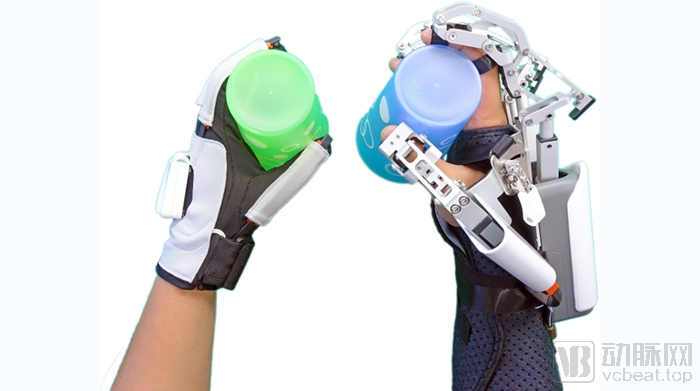
Fubo Medical’s “Mirror-Hand”
In fact, China had already conducted research on mirror therapy before 2010. However, early mirror therapy relied on the imaging principle of plane mirrors to replicate the movements of the unaffected side onto the affected side, requiring patients to imagine movement in the affected limb. This approach aimed to achieve rehabilitation goals through visual illusions, visual feedback, and virtual reality. In contrast, Fubo Medical’s “Mirror Hand” builds upon the principles of mirror therapy by incorporating device-assisted, actual movement of the affected limb, providing patients with more realistic feedback and thereby yielding superior rehabilitation outcomes.
In terms of materials, the exoskeletal robotic hand of MirrorHand employs rigid metal components, delivering greater strength to the affected hand and making it suitable for patients with high muscle tone. During actual product development, stringent requirements were placed on the dimensions and angles of the metal parts to better meet the clinical rehabilitation training needs of patients. After multiple iterations, the final design was optimized to fit the hand dimensions of the Chinese population, thereby accommodating rehabilitation training for a broader range of patients.
At present, Fubo Medical primarily sells its products to B-end clients through collaborations with hospitals, rehabilitation centers, and other institutions, providing patients with rehabilitation training in conjunction with therapies administered by professional rehabilitation therapists. It is reported that Fubo Medical’s “Mirror Hand” has successfully been adopted by more than ten medical institutions, delivering over 1,000 rehabilitation training sessions to patients cumulatively.
Continuously Expand the Market and Build an Intelligent Rehabilitation Platform
Moving forward, Fubo Medical will promote its existing products, strengthen collaborations with clinical hospitals and university research institutes, gradually expand its sales channels, and explore additional sales models.
In terms of product development, Fubo Medical will build an intelligent rehabilitation platform by integrating technologies such as brain-computer interfaces (BCI), electromyography (EMG) signals, artificial intelligence (AI), and telemedicine into its existing products, while incorporating the concept of home-based rehabilitation. To ensure that R&D objectives and timelines are met, Fubo Medical is actively expanding its research and development team and exploring additional collaboration models with universities and research institutions.
It is reported that Fubo Medical is launching a new round of financing, with the funds primarily allocated to new product research and development, production capacity expansion, and sales channel development. Previously, Fubo Medical secured an angel-round investment in January 2020, led by Shuimu Ventures.