

Phenomix Sciences Launches China's First CE-Certified MRD Assay for Hematologic Malignancies and Files IPO Prospectus
MRD (Minimal Residual Disease) refers to the presence of trace amounts of tumor cells remaining in the body after treatment for malignant tumors, serving as the root cause of cancer recurrence. Accurate MRD detection forms the foundation of personalized precision medicine for patients, enabling the prediction of clinical outcomes, risk stratification, guidance of therapeutic decisions, early prediction of tumor recurrence, and determination of the optimal timing for bone marrow or stem cell transplantation.
In recent years, the market for minimal residual disease (MRD) testing has gradually heated up both domestically and internationally, with rapid development. In 2018, the FDA approved clonoSEQ® for MRD detection and monitoring in multiple myeloma and B-cell acute lymphoblastic leukemia (ALL); in 2020, the FDA approved clonoSEQ® for MRD testing in blood or bone marrow samples from patients with chronic lymphocytic leukemia (CLL). In China, many companies, including PanGene Medicine, are also focusing on the research and development of MRD testing products.
Recently, the Chinese MRD testing market has witnessed a major breakthrough. In March 2021, developed by PanGene Medicine,China’s First MRD Testing Product for Hematologic Malignancies, NEO-MRD, Obtains EU CE Mark ApprovalNEO-MRD is built on an NGS platform and features high detection sensitivity, high accuracy, and automation. It can also monitor for the emergence of new high-frequency clones and assess immune system reconstitution, thereby significantly advancing the global development of minimal residual disease (MRD) testing in hematologic malignancies.
Currently, commonly used MRD detection techniques include fusion gene RT-PCR, flow cytometry, quantitative PCR for IgH/TCR rearrangements, and NGS. Although flow cytometry and PCR technologies have been widely applied in clinical practice, they still suffer from limitations such as insufficient sensitivity to accurately predict prognosis, lack of operational standardization, inability to monitor emerging tumor clones, and incapacity to assess immune system reconstitution.
As an emerging method for minimal residual disease (MRD) detection, next-generation sequencing (NGS) can significantly reduce patient recurrence rates and improve survival outcomes, earning recognition and recommendation from experts both domestically and internationally. The Diagnostic and Treatment Guidelines for Pediatric Acute Lymphoblastic Leukemia (2018 Edition), the Diagnostic and Treatment Guidelines for Adult Acute Lymphoblastic Leukemia (2018 Edition), and the Chinese Guidelines for the Diagnosis and Treatment of Multiple Myeloma (2020 Revision) all recommend NGS as a method for MRD detection.
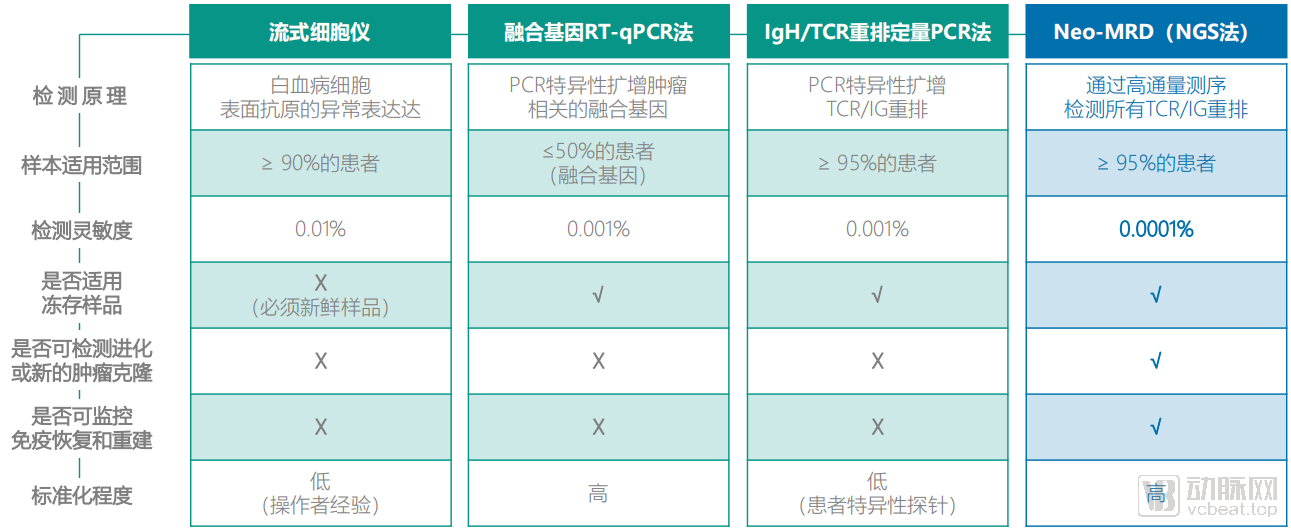
Comparison of NGS Testing Methods with Conventional Standard Detection Methods
According to Liu Xiao, founder of PanYin Medicine, the NEO-MRD product—a blood tumor minimal residual disease (MRD) detection assay developed by PanYin Medicine based on an NGS platform—effectively addresses the limitations of traditional techniques such as flow cytometry and PCR, offering multiple advantages including high accuracy, high sensitivity, and a high detection rate.
Accurate and Sensitive Laboratory System.NEO-MRD is based on accurate, unbiased multiplex amplification technology and leading bioinformatics algorithms. It targets multiple rearrangement loci, offering high sensitivity and accuracy, and is unaffected by tumor cell surface antigen drift or clonal evolution.
Easy to operate, achieving process standardization and automation.NEO-MRD achieves full automation from DNA to test report, reducing human operational errors and ensuring high reproducibility.
High detection rate: Enhancing the detection rate of tumor cells by amplifying multiple receptor chains.The NEO-MRD assay system targets the receptor chains of IGH, IGK, IGL, TRB, and TRG, enabling accurate identification of tumor-specific marker sequences. Furthermore, primers targeting different regions (FR1, FR2, and FR3) are included for each chain, effectively minimizing false negatives or inaccurate quantification caused by mutations in tumor cells. In the analysis of 58 real-world clinical samples, concordance between NGS and flow cytometry was high among the 25 samples that tested positive by both methods; 14 samples were negative by flow cytometry but positive by NGS, and 19 samples were negative by both methods.
NEO-MRD canMonitor for the emergence of new high-frequency clones, assess the risk of recurrence due to subclones or evolutionary clones derived from the primary tumor. Meanwhile, NEO-MRDIt is also possible to evaluate the status of immune system reconstitution.
Original bioinformatics analysis tool.Due to the extremely low MRD levels in some samples, strict control of sequencing errors and sequence contamination is required. PanGene Medicine utilizes proprietary data processing technologies to effectively correct sequencing errors and remove trace contamination that may occur during experimental procedures, thereby ensuring the accuracy of detection.
Currently, PanGene Medicine is conducting research and academic collaborations with a large number of clinicians to improve the detection rate of minimal residual disease (MRD) in hematologic malignancies, jointly promoting the clinical application of MRD testing products for these cancers.
Currently, the overall market for immunoassays in China is in a stage of rapid development, dominated by technology platforms such as chemiluminescence, biochemical testing, and flow cytometry. Competition is intense and the landscape is crowded in sectors like chemiluminescence and biochemical testing. However, clinical immunological testing has not yet reached saturation, with substantial unmet needs remaining.New technologies with high sensitivity and high portability have enormous market potential.
Liu Xiao stated, “Due to an insufficient understanding of the immune system, there are limited clinically actionable targets. The diagnosis, molecular subtyping, and prognostic monitoring of many immune-related diseases require more sensitive and clinically valuable detection targets. Furthermore, clinical immunological assays suffer from limitations in sensitivity, portability, and clinical interpretability, creating an urgent need for technologies such as next-generation sequencing (NGS), digital PCR, and next-generation flow cytometry to expand the detection capabilities beyond those of traditional methods.”
The core team of FanYin Medicine has over a decade of experience in technology development and scientific research in the field of high-throughput immunomics, with profound understanding and extensive expertise in basic and medical immunology, genomics, bioinformatics, and clinical needs. Dr. Liu Xiao, the Chairman, is an expert appointed by the Ministry of Science and Technology of China, an Associate Professor and Doctoral Supervisor at Tsinghua University, and has published more than 70 SCI-indexed papers. The team led by himIt is the first research team in China to study IR-seq technology.
“NGS technology, as a molecular detection platform with high sensitivity and high throughput, has broad application prospects. We believe thatThe Immunoassay Market Is the Next Breakout Point for NGS Technology.“Thus, PanYin Medicine was founded.” “We hope to leverage the PanYin Medicine team’s years of accumulated expertise in technology and science, through”Establish a high-throughput technology platform for the digital interpretation, functional validation, and engineered modification of immune cells. Leveraging big data mining, this platform enables rapid iteration in target discovery, clinical validation, and product development, facilitating the creation of immunoassay products characterized by multi-target capability, high throughput, high sensitivity, and standardization., rapidly advancing the clinical translation of immunomics.”
PanGen Medicine aims to build a globally leading enterprise in clinical immunodiagnostic platforms. Within less than a year since its establishment, PanGen Medicine has established partnerships with numerous top-tier hospitals in China and successfully builtFAIR-seq platform, big data analytics platform, and large-scale clinical immunohistochemistry database.
In terms of product portfolio, in addition to MRD testing products for hematologic malignancies, PanGene Medical is also developing other products related to cancers and infectious diseases, including those for cancer immunotherapy testing, early cancer diagnosis and prognosis, and T-cell therapy for cancer, so as to benefit more patients with cancer, infections, and other conditions.