

Can Short Video Become a New Growth Engine in the Healthcare Sector? Kuaishou's Strategic Entry
In the healthcare sector, Kuaishou is advancing step by step.
Recently, Chengdu Kuaigou Technology Co., Ltd., a wholly-owned subsidiary of Kuaishou, underwent changes in its business registration information, with “health consultation services,” “sales of Class II medical devices,” and “sales of Class I medical devices” added to its business scope. In short, it is now legally compliant to sell non-Class III medical devices on the Kuaishou platform.

(Image source: Qichacha)
As early as 2019, Kuaishou collaborated with organizations such as the Health Communication Working Committee of the Chinese Medical Doctor Association to attract medical institutions and relevant government entities to join its platform, thereby establishing a health communication matrix centered on medical science popularization and information. Notably, by aggregating these medical and health-related contents, Kuaishou created a dedicated “Kuaishou Health” section and launched features such as “Ask a Doctor” and “Symptom Checker,” providing access to online medical services.
In other words,From the dissemination of health-related short videos and online consultations to the e-commerce sales of medical devices, Kuaishou has developed a clear strategy in the healthcare sector and is gradually deepening its involvement.
It is well known that internet giants entering the healthcare sector is not a new phenomenon. Major developments this year alone include: Baidu launched the Qingzhu Health app, aiming to build a one-stop health management platform; ByteDance began recruiting bioinformatics engineers, preparing to enter the field of next-generation sequencing (NGS); Alibaba Health invested in LinkDoc Technology to jointly create a service platform covering the entire disease journey for cancer patients in China; JD Health launched the “JD Pharmacy Rare Disease Care Center,” aimed at improving access to rare disease medications; and the national new-generation artificial intelligence open innovation platform for medical imaging, constructed by Tencent, was officially launched this month...
Amidst the “Encirclement” by Tech Giants, Is Kuaishou Ready?
Kuaishou Turns Its Sights on Medical Devices.
Data from Qichacha shows that Chengdu Kuaigou Technology Co., Ltd., a wholly-owned subsidiary of Kuaishou, has recently undergone changes in its business registration information. Its scope of business has been expanded to include health consulting services, as well as the sales of Class II and Class I medical devices. Notably, Chengdu Kuaigou operates an e-commerce trading platform, with its primary product being Kuaishou Store. It provides e-commerce transaction tools for Kuaishou’s vast network of live-streaming merchants and users.
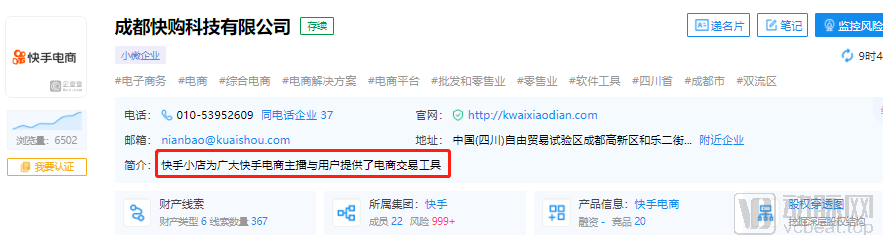
(Image source: Qichacha)
As a key monetization channel for Kuaishou’s short-video platform, Kuaishou Store operates similarly to traditional e-commerce platforms. Users can directly access Kuaishou Store via the Kuaishou app, website, or links provided by content creators in live streams, short videos, or user profile pages, where they can select and pay for relevant products and services.
According to the prospectus, the vast majority of e-commerce transactions on Kuaishou are facilitated by live streamers and short-video creators, with the live-streaming e-commerce business fully integrated into its live-streaming segment as an inseparable component. As of November 2020, Kuaishou’s e-commerce GMV had increased more than fivefold year-on-year, exceeding RMB 332.6 billion, which was 33% above its full-year target of RMB 250 billion.From a data perspective, Kuaishou has become the fourth-largest e-commerce platform after Taobao Tmall, JD.com, and Pinduoduo.
The data is encouraging, yet underlying concerns remain difficult to conceal. As the mobile internet has developed for over a decade, overall internet user traffic has peaked. According to the “2020 Mobile Internet Full Ecosystem Report” released by QuestMobile, growth in the number of mobile internet users nearly stagnated over the past year, and the ceiling for the total short-video user base has also begun to emerge. Against this backdrop,Future competition among short-video platforms will shift from vying for incremental market growth to a more brutal battle for existing users.
Therefore,How to enhance refined operational capabilities in a saturated market has become a key factor determining whether Kuaishou can safeguard its core business and achieve further expansion on that foundation.
It is important to note that in past sales, although some video accounts sold medical devices on the Kuaishou platform, they could not achieve scale due to compliance issues and faced legal risks. Therefore,Obtaining qualifications for Class I and Class II medical devices will provide significant support to Kuaishou in expanding its product categories.
More importantly,Kuaishou’s initial foray into medical device e-commerce will provide experiential support for gradually opening up its pharmaceutical e-commerce channel.. According to data released by NetEconomy Society, the transaction volume of China's pharmaceutical e-commerce market in 2020 was nearly RMB 190 billion, representing a 46.68% increase from RMB 96.43 billion in 2019. The rapidly expanding market space for pharmaceutical e-commerce will provide support for Kuaishou to identify new growth drivers in the future.
Can Kuaishou seize this opportunity?
First, let us examine Kuaishou’s advantages. As a leading short-video platform with over 300 million daily active users, Kuaishou boasts substantial traffic and a large user base, enabling it to naturally reach consumer-end (C-end) users. Furthermore, given the more vivid and intuitive presentation offered by short videos, along with the maturing consumer habit of live-stream shopping, Kuaishou’s video e-commerce conversion rate is showing a rapid upward trend.
It is important to emphasize that, as a platform-based enterprise, the data assets accumulated from user behavior will also empower Kuaishou’s future precision recommendation capabilities. This will further enhance Kuaishou’s video e-commerce conversion rates, thereby making the sale of medical devices more efficient.
Of course, the issue is that although Kuaishou deals in Class I and Class II medical devices, the sale of related products must undergo rigorous review, which will be a significant test for Kuaishou. EspeciallyOnline sales are characterized by virtuality, cross-regional reach, concealment, and ease of transfer, making refined operational management quite challenging.
Furthermore, unlike Alibaba and JD.com, Kuaishou currently lacks experience in physical e-commerce and channel capabilities, which poses challenges to its ability to sustainably and deeply cultivate the pharmaceutical e-commerce sector over the long term. Taking JD Health as an example, leveraging JD.com’s relatively comprehensive commercial infrastructure—such as logistics and supply chain systems—JD Health is able to operate customized warehousing in-house and possesses traceability and anti-counterfeiting technologies to monitor the entire circulation process of goods. This enables JD Health to maintain robust operational compliance amid the stringent regulatory environment governing pharmaceuticals.
In summary, Kuaishou’s entry into the operation and sales of medical devices presents significant market potential. It can diversify the categories in video-based e-commerce, meet users’ more varied demands, and help merchants sell products efficiently. However, Kuaishou still faces substantial challenges in areas such as safety, regulatory compliance, and supply chain management.
If the sales of medical devices are merely a supplement to Kuaishou’s existing e-commerce product categories, thenBuilding a health content matrix and launching online consultation services are the key anchors for Kuaishou’s push into healthcare.
At the end of 2019, during the inaugural Healthy China Innovation Communication Conference and the 6th China Medical Brand Construction Conference, Kuaishou partnered with the Chinese Medical Doctor Association to jointly build a new health communication ecosystem. This ecosystem spans health institutions at four levels—central, provincial, municipal, and county—and brings together health commissions, hospitals, science popularization organizations, and medical professionals. The initiative aims to disseminate authoritative, scientific health content on Kuaishou through visual communication formats and integrated communication operations.
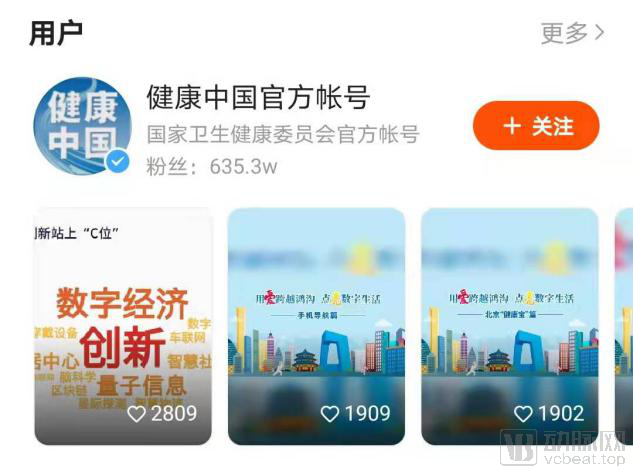
Taking the National Health Commission’s official Kuaishou account, “Healthy China,” as an example, it has posted nearly 1,000 videos and amassed over 6.3 million followers since its launch more than two years ago. This is undoubtedly a strong performance for a science popularization account.
However, most science popularization video accounts are non-profit in nature, making monetization a challenging issue for both content creators and platform operators.
Kuaishou’s solution is to first accumulate high-quality medical content to foster user stickiness, thereby cultivating a healthy community ecosystem, before considering monetization strategies. After all, the integrity and high quality of the content ecosystem are crucial to user retention.
To this end, Kuaishou has allocated hundreds of millions in traffic exposure to vigorously support the development of official health accounts, with a focus on cultivating 50 health science popularization influencers with over one million followers each. Combined with its content creator incentive program, the platform aims to attract more doctors and science communicators to join.
Data released by Kuaishou in September 2020 showed that more than 400 local health commissions, public hospitals, and industry academic associations, along with over 2,000 practicing physicians from public hospitals, had joined Kuaishou Health. Together, they published more than 70,000 short videos on health science popularization, accumulating over 15 billion views. Additionally, more than 3,000 live-streamed sessions on health education were launched, garnering over 600 million viewer impressions and surpassing 5 billion likes.
With content-driven traffic acquisition, conversion to medical services such as inquiries and consultations can be achieved.At the onset of the COVID-19 outbreak last year, to facilitate timely access to information on nearby outpatient clinics, Kuaishou collaborated with the Chinese Government Online and Healthy China to launch an in-app nationwide directory of designated fever clinics. Meanwhile, it partnered with seven third-party platforms, including WeDoctor, Haodf Online, Chunyu Doctor, Youlai Doctor, and Ping An Good Doctor, to introduce online consultation services, thereby integrating offline and online healthcare resources.

("Kuaishou Health" Column Page)
However, the issue is thatKuaishou is not strictly a content-to-service platform, where users would consult or seek medical advice from healthcare providers after watching short videos or live streams. Instead, it has integrated third-party telemedicine portals into its platform, which constitutes a tool-based integration.The result is weak user stickiness, with Kuaishou serving merely as a traffic channel for third-party platforms and thus being highly substitutable.
Upon accessing the “Ask a Doctor” feature on Kuaishou, only seven doctors currently appear in the list. Although some indicate their working hours as 8:00 AM to 12:00 PM on weekdays, all are shown as offline (queried at 9:00 AM on a weekday).
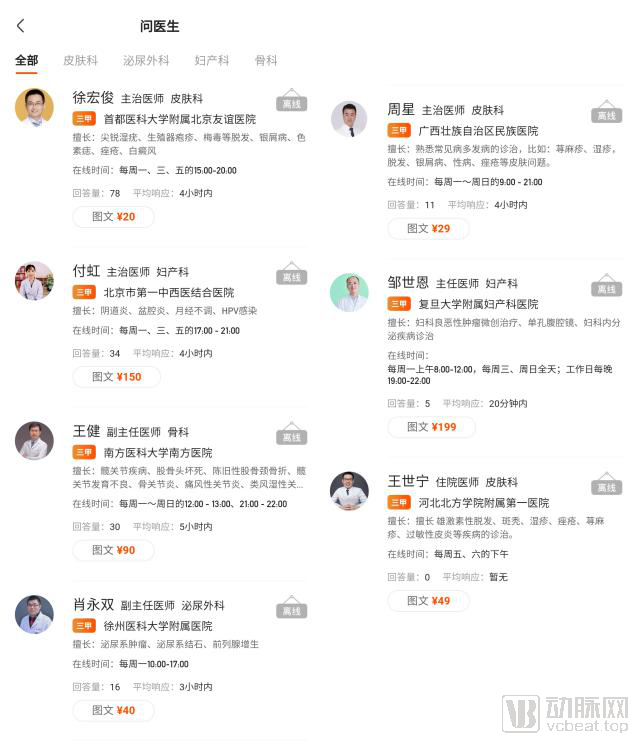
(All doctors displayed in Kuaishou’s “Ask a Doctor” channel)
A closer examination reveals that while Kuaishou boasts substantial content traffic, its traffic composition remains imperfect. Official accounts of medical-related institutions constitute a significant proportion on the platform, whereas independent healthcare influencer accounts are relatively scarce. The drawback lies in the fact that official accounts are not profit-oriented; their primary content consists of industry updates and institutional promotions. In terms of operations and user engagement, they generally underperform compared to third-party healthcare accounts. This disparity will pose significant obstacles to Kuaishou’s efforts to establish sustainable business models with relevant institutions in the future.
How should this be understood? First and foremost, the most critical element of the internet business model is attracting and retaining traffic. Therefore, Kuaishou needs to attract a sufficient number of high-quality, professional content creators to build its content ecosystem. These creators enhance user stickiness, thereby establishing a “two-way cycle”: on one hand, users can find reliable and trustworthy influencer accounts on Kuaishou; on the other hand, these influencers possess substantial medical expertise—such as physicians from top-tier tertiary hospitals—and further amplify their personal or account-based influence through the Kuaishou platform.
In other words, by leveraging both its highly sticky user base and its influential physician influencer accounts, Kuaishou can better extend from content creation to medical services such as diagnosis and consultation, thereby establishing a suitable closed-loop business model.
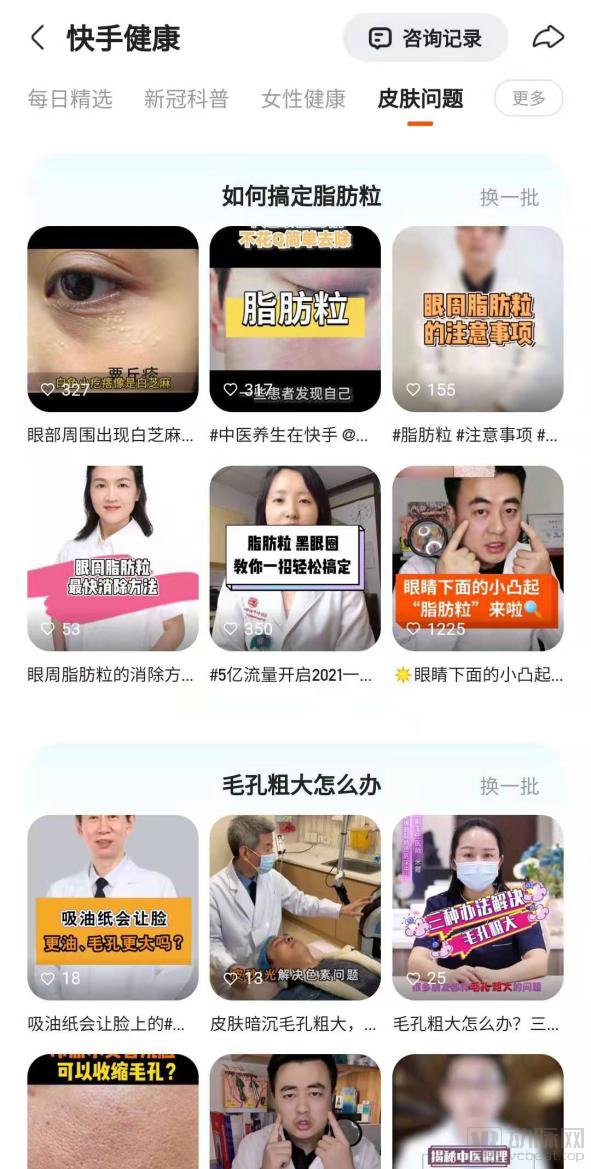
(The number of likes on third-party platform accounts for Kuaishou is generally not high)
Therefore, in its future plans, Kuaishou needs to provide greater support for high-quality third-party accounts in the healthcare sector. After all, only when the content ecosystem is sufficiently vibrant can the subsequent construction of business models become easier.
In summary, Kuaishou has made significant strides in diversifying short-form video content within its healthcare and medical content ecosystem. However, from the perspective of business model construction, Kuaishou has yet to develop a clear strategy for creating a closed loop that connects healthcare content with online consultation services.
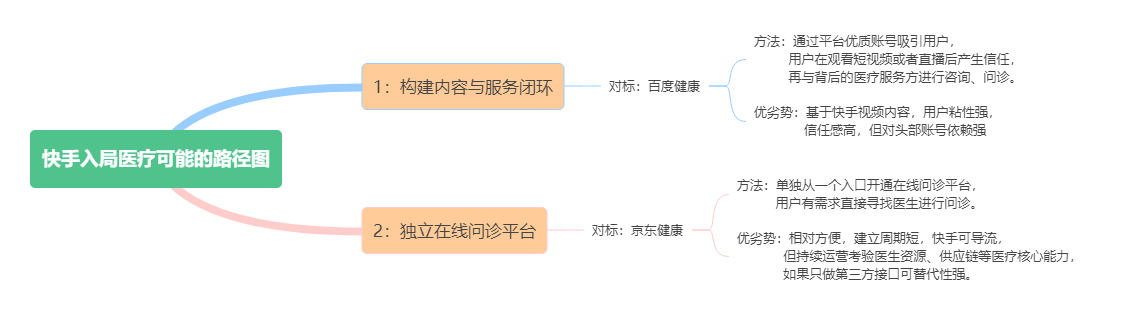
Drawing on the experience of industry pioneers, one viable path for Kuaishou is to emulate Baidu Health by establishing a dual-ecosystem strategy of “content + services.” This approach involves attracting health-conscious users through short-video content and then converting this traffic into users of consultation or medical advisory services. The advantage of this model lies in its strong user stickiness and high level of trust; however, the downside is its heavy reliance on high-quality content, necessitating Kuaishou’s continuous support for premium health and medical accounts.
The second approach is to build a standalone internet healthcare platform, similar to JD Health, and channel users from the Kuaishou app to this independent platform. The advantage lies in leveraging Kuaishou’s massive traffic to rapidly scale online consultation services. However, the downside is the significant challenge of sustaining operations, particularly given the considerable difficulties in establishing physician resources and medical device supply chains.
Short-form video is transforming the healthcare sector, just as it has reshaped traditional industries such as retail and education.
According to the “2019 Health Science Popularization Video Insights Report” released by Healthy China, over 90% of users have watched videos related to health science popularization, and more than half are willing to pay for such content. After viewing these videos, users demonstrate clear demand for services including medical information, expert consultations, and appointment registration.
Thus, starting in 2018, a large number of public hospitals, physicians, and government-affiliated institutions joined short-video platforms, sparking a surge in medical science popularization content. Taking Douyin as an example, a search for the keyword “medical” within topics reveals that related videos have accumulated a total of 1.24 billion views.
In addition, top-tier accounts named “Dr. XX” also boast substantial follower counts. To date, million-follower accounts such as Dingxiang Doctor (9.152 million followers), Dr. Wang, Cardiologist (5.553 million followers), Pediatrician Bao Xiulan (4.583 million followers), and Dr. Zhang Wenhong (2.287 million followers) are commonly seen on the Douyin platform. To continue attracting relevant content creators, Douyin allocated billions of impressions in traffic support to medical and other science popularization creators last year.
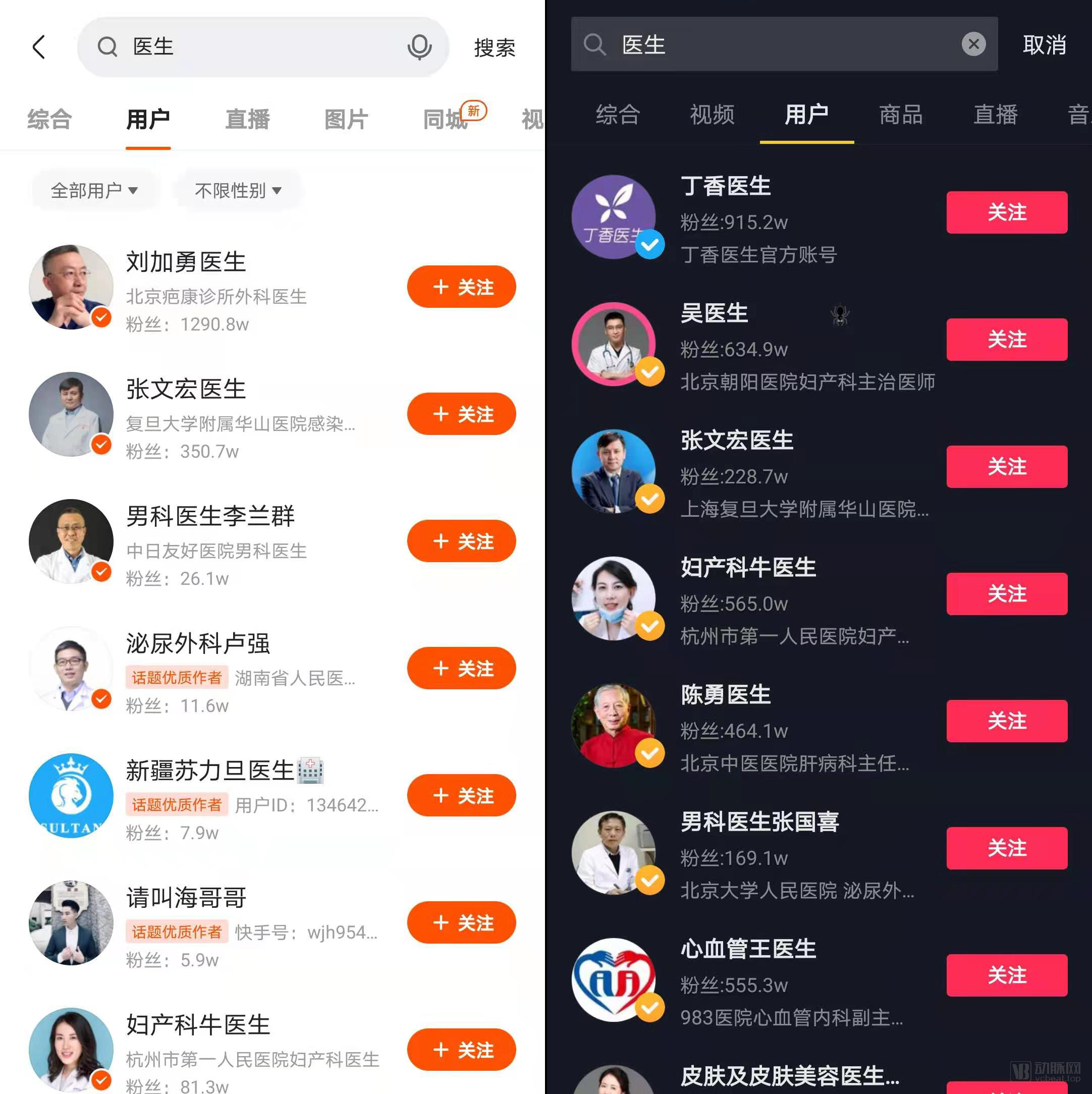
(Short-video platforms feature accounts named after doctors; left: Kuaishou, right: Douyin)
Despite impressive traffic figures, monetization remains a significant challenge. Given the serious nature of healthcare and the fact that physicians’ short-form videos initially gained traction through public-interest scientific education, the integration of pharmaceutical and medical device advertisements into such content requires extreme caution. This has compelled numerous institutions and MCN agencies that entered the healthcare short-video sector to withdraw after operating for more than six months.
The underlying issue is the difficulty in establishing a strong trust relationship between users and accounts. Therefore, in subsequent operations, short-video platforms, whether Kuaishou or Douyin, must regulate their platform ecosystems effectively, particularly by exercising strict control over misinformation and the sale of counterfeit and substandard products.Only by addressing the issue of trust can short-form video truly become a significant channel for medical and healthcare services.
Furthermore, from the current perspective, the more promising profit-making business for short-video platforms entering the healthcare sector mainly involves undertaking parts of pharmaceutical e-commerce. For Kuaishou, this path is not yet attractive due to its internal lack of capabilities such as supply chain and channels, and external strong competitors like Alibaba Health and JD Health surrounding it.
Therefore,Short-form videos will not become a new growth pole in the healthcare sector in the short to medium term.For new entrants, healthcare is primarily another means of enriching their video content and e-commerce product categories.
Kuaishou, which went public in February this year, currently has a market capitalization exceeding HK$1.2 trillion, nearly twice that of Baidu and surpassing JD.com, making it China’s fifth-largest internet company, after Tencent, Alibaba, Meituan, and Pinduoduo.
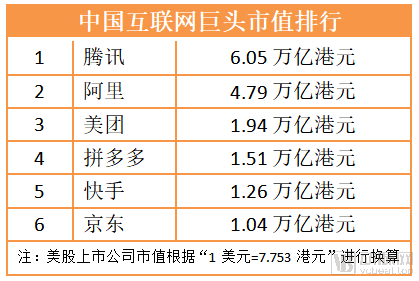
But inBehind the Spotlight of Joining the Trillion-Dollar Market Cap Club Lies Immense Pressure for Kuaishou to Find New Growth Momentum.
According to Kuaishou’s IPO prospectus, for the 11 months ended November 30, 2020, Kuaishou’s total revenue in 2020 amounted to RMB 52.5 billion, with an operating loss of RMB 9.4 billion. Its daily active users (DAU) declined to 263 million, while monthly active users (MAU) dropped to 481 million. The prospectus further emphasized that the company will continue to increase its investments in sales and marketing expenses as well as its ecosystem, and there is no guarantee that it will achieve profitability in the near future.
In other words,Kuaishou will not overly focus on fluctuations in profitability in the short to medium term, but instead prioritize expanding its business scale to raise its market ceiling and capture a larger share of the “pie.”Which sector can fulfill Kuaishou’s vision for future business growth? Healthcare may well meet this criterion. As Chen Dongsheng, founder of Taikang Insurance Group, stated at a forum in 2019, “In ten years, the big health industry will become the largest industry, surpassing real estate and automobiles.”
Beyond market potential, a more pragmatic factor is that major players in the trillion-yuan market capitalization club—such as Tencent, Alibaba, Meituan, and JD.com—have been active in the healthcare sector for years. Notably, Ali Health and JD Health have both gone public independently, with each boasting a market capitalization exceeding RMB 300 billion. This holds strong appeal for Kuaishou, which is urgently seeking new growth drivers. The above outlines the broader context behind Kuaishou’s entry into the healthcare sector.
Of course, seeking new growth points is entirely justifiable. However, the healthcare sector is a “slow industry” that concerns people’s health and safety of life, making it highly susceptible to regulatory and policy influences. Therefore, even giants such as Alibaba, Tencent, and JD.com still have a long way to go in this vast field of healthcare.
Therefore, Kuaishou needs to devote more time to gaining a deeper understanding of this sector in order to sustain its deep dive into the healthcare field.