

Tessera Therapeutics Announces Gene Writing Platform Following $230M Series B Financing

Tessera Therapeutics
Gene Therapy and Gene Editing Technology Developer
SinceWatson and CrickFindingsSince the Discovery of the DNA Double Helix, Gene Technology Has Advanced Rapidly。Gene therapy technology hasIn many complex diseasesPlay an important role, including: genetic diseases (such as hemophilia, cystic fibrosis, familial hypercholesterolemia, etc.), malignant tumors, cardiovascular diseases, and infectious diseases (such as AIDS, rheumatoid arthritis, etc.).
Early genetic engineering techniques could only randomly insert exogenous or endogenous genetic material into the host genome, whereas gene editing enables targeted modification of specific genes. The CRISPR-Cas system is the most widely used tool for gene editing.
However, CRISPR has its limitations, as it cannot effectively control the timing and sequence of editing events. Now, the startup Tessera Therapeutics has announced the invention of “Gene Writing.” Gene Writing is a novel form of genetic engineering built upon recent breakthroughs in gene therapy and gene editing. It simultaneously overcomes the limitations of gene therapy and gene editing in terms of scope, efficiency, and efficacy, enabling easier insertion of complete, functional genes.
Currently, gene writing technologies are categorized into two types. One type is RNA-based, which can "write" genetic information into the genome based on an RNA template, enabling single-base modifications, small insertions or deletions, and the integration of entire gene segments. The other type is DNA-based, which involves directly "writing" a DNA template into the genome.
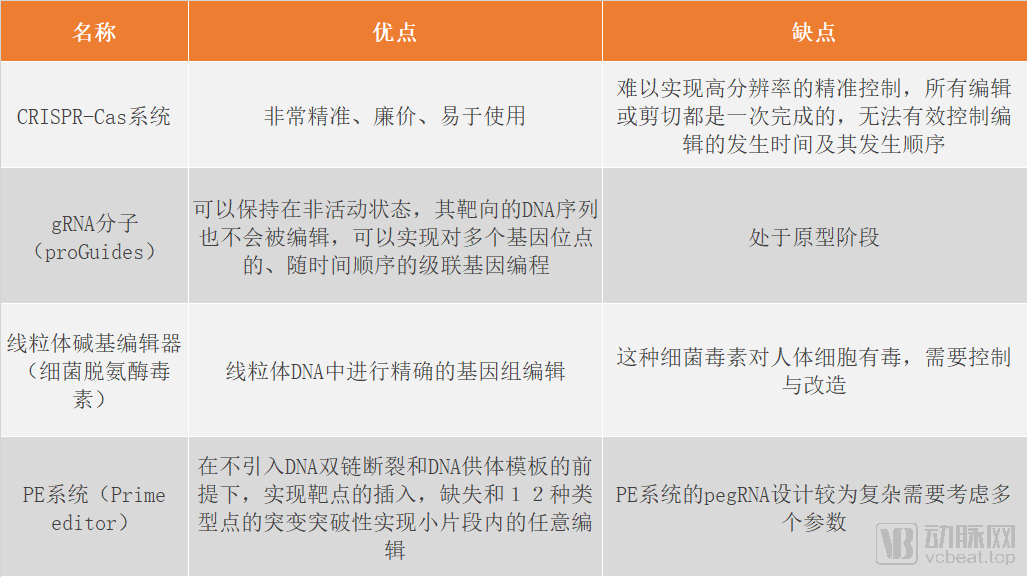
Gene Editing Tools and Their Advantages and Disadvantages
Tessera Therapeutics is an early-stage life sciences company founded by Flagship Pioneering, dedicated to pioneering gene writing. The company’s mission is to empower scientists and clinicians with the ability to write therapeutic information of varying sizes into the genome, thereby curing diseases at their source.
On January 12, 2021, Tessera Therapeutics completed a $230 million Series B financing round, which will be used to build an enhanced biological programming platform. The round was led by Alaska Permanent Fund Corporation, Altitude Life Science Ventures, and SoftBank Vision Fund 2, with participation from the Qatar Investment Authority and other undisclosed investors.
Technologists’ expertise in biological encoding has prompted venture capital firms to inject substantial cash into a new generation of startups, enabling them to commercialize their technologies and usher in the next wave of genetic innovation.
Now, Tessera Therapeutics will use its Series B funding to continue developing its gene writing technology, expand its team, and establish manufacturing and automation systems to scale up operations. The company currently has 50 employees and aims to add another 100 in the near future. While it has not yet disclosed the specific disease areas of interest, it stated that gene writing can be applied to cardiovascular diseases, neurodegenerative disorders, infectious diseases, and cancer.
Tessera Therapeutics boasts a robust scientific and management team:
Co-Founder, Chief Executive Officer, and Director Geoffrey von Maltzahn holds a Ph.D. in Biomedical Engineering and Medical Physics from the Massachusetts Institute of Technology and is a General Partner at Flagship Pioneering. He is listed as an inventor on more than 200 patent applications and patents, has co-authored over 20 peer-reviewed articles, and has received numerous other awards.
Geoffrey and his inventions have been featured in Forbes, The Economist, CNN, Scientific American, Bloomberg Businessweek, Popular Science, MIT Technology Review, and other media outlets.
He focuses on inventing technologies and founding companies to address global challenges in medicine and environmental sustainability. Geoffrey was previously a co-founder of Sana Biotechnology, Indigo Agriculture, Kaleido Biosciences (NASDAQ: KLDO), Seres Therapeutics (NASDAQ: MCRB), Axcella Health (NASDAQ: AXLA), and Generate Biomedicines.
Co-founder and Chief Scientific Officer Jake holds a Ph.D. in Microbiology from the Massachusetts Institute of Technology (MIT) and serves as a Partner at Flagship Pioneering. Jake co-founded Sana Biotechnology. Prior to his involvement with Sana Biotechnology, he was the Head of Innovation at Cobalt Biomedicine, where he invented and developed the company’s Fusosome platform.
During his studies at the Massachusetts Institute of Technology, Jake invented genetic circuits that enable engineered cells to perform novel analog, digital, and hybrid computations, thereby pioneering the emerging field of “smart” cell therapies.
Steve, Head of Quantitative Biology, joined Tessera in 2019 to lead the data science team, applying DNA assembly, molecular assays, and computational biology technologies to novel gene writing methods. Steve has over 20 years of experience in science, data, algorithms, and software.
Prior to joining Tessera, Steve spent 14 years at Novartis, where he established and led a global data science team dedicated to advancing innovative science through software, data analytics, modeling, and data systems. Before his tenure at Novartis, Steve worked at GlaxoSmithKline for several years, focusing on data mining and model building in the field of preclinical safety.

Image source: Tessera Therapeutics official website
In 2017, Cornell University laid the foundation for gene-writing technology. Joe Peters, a microbiologist at Cornell University, studies “mobile genetic elements” (MGEs), which are bacterial genes capable of inserting themselves into the genome of another cell, similar to viruses.
Peters and his collaborators discovered through their research that mobile genetic elements (MGEs) are highly proficient at recognizing, rewriting, and moving DNA. In an article published in PNAS, they suggested that MGEs could be useful for genetic engineering. After reading the paper, Jake Rubens, co-founder of Tessera Therapeutics, contacted Peters, and Tessera Therapeutics subsequently began sponsoring his laboratory’s research on MGEs. To date, scientists at Tessera Therapeutics have identified 8,000 MGEs.
After years of incubation within Flagship Pioneering laboratories, Tessera Therapeutics unveiled gene writing in July 2020. Gene writing is a novel technology capable of inscribing therapeutic instructions directly into the genome to treat diseases at their source. By enabling the conversion of any base pair to another, facilitating small insertions or deletions, and writing entire genes into the genome, gene writing holds the potential to cure genetic disorders and create life-transforming therapeutics for cardiovascular, oncologic, neurodegenerative, and infectious diseases.
Tessera Therapeutics is currently investigating genetic disorders that require the insertion of large segments of replacement DNA. The company states that its gene-writing technology can make more substantial modifications than CRISPR and can be performed ex vivo, claiming to have successfully demonstrated this in mouse models.
Geoffrey von Maltzahn, CEO of Tessera Therapeutics, told the media: “In short, we view it as a new category.”、“Gene writing can achieve perfect deletions or simple base-pair changes, but its significant role lies in making large-scale modifications to the genome.”
Tessera Therapeutics’ computational and high-throughput laboratory platforms enable the team to design, build, and test thousands of engineered and synthetic mobile genetic elements for writing and rewriting the human genome. Tessera Therapeutics’ gene writing technology overcomes the limitations of gene editing and gene therapy, and expands the range of diseases amenable to genetic treatment through the following approaches:
Unlike nuclease-based gene editing technologies, this approach enables efficient engineering of the somatic cell genome without requiring double-strand breaks and with minimal reliance on host DNA repair pathways.
Unlike AAV-based gene therapy technologies, this approach enables the substitution of any base pair, as well as small insertions or deletions, at specific genomic loci, thereby permanently integrating new DNA into dividing cells. It achieves the writing of new DNA sequences into the genome solely through RNA delivery. This is not feasible for AAV-based gene therapies, as the human body mounts an immune response against the viral vectors.
New DNA sequences can be inserted into the genome via RNA delivery.
Patients can receive multiple doses and undergo repeated treatments, a therapeutic approach that current gene therapies are unable to achieve.
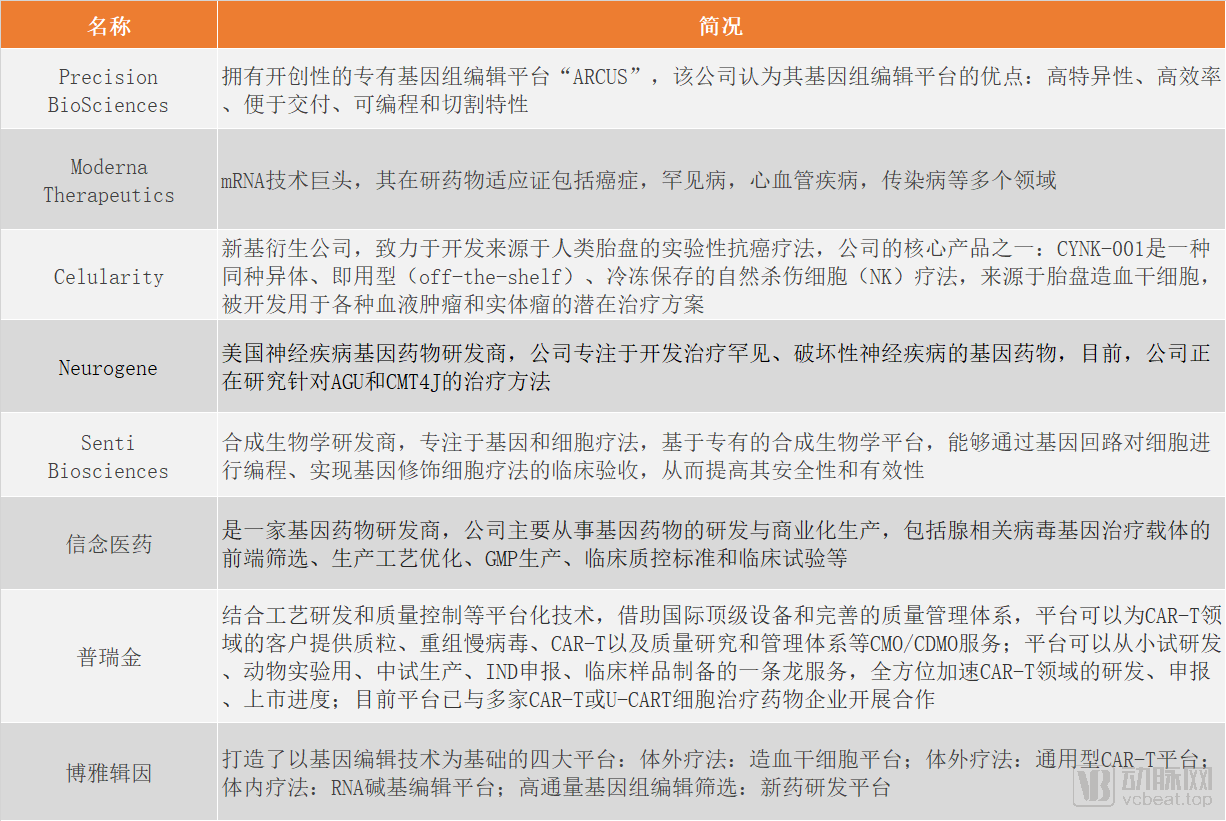
Company Profile Similar to Tessera Therapeutics
In addition to the companies listed in the table above, Novartis, Alexion Pharmaceuticals, Syros Pharmaceuticals, and JW Therapeutics have also conducted research and development in this area.
About Flagship Pioneering
FlagshipIt is a venture capital firm founded in 2000, with investment focuses primarily in biotechnology, healthcare, and information technology. Since its establishment in 2000, the firm has launched and nurtured more than 100 science-based enterprises. To date, it has secured total capital commitments exceeding $3 billion.