

Tonglu: China's Aspiring 'Tuttlingen' in the Endoscopy Industry
Introduction: Currently, from the national level to local governments, active efforts are being made to strategically position and support the development of the biopharmaceutical industry. However, how to leverage strengths, mitigate weaknesses, seize development opportunities in the biopharmaceutical sector, and inject new vitality into regional economies has become a significant and urgent challenge for China’s health industry. In response, VCBeat conducts an in-depth analysis of leading domestic and international case studies, summarizing development experiences in terms of industrial positioning, policy support, and industry services, with the aim of providing references for the development of industrial parks in China.
As is well known, Zhongguancun Science Park is hailed as “China’s Silicon Valley,” but this is not an isolated case. Around the world, there are many other types of “Silicon Valleys,” such as Tsukuba Science City (“Japan’s Silicon Valley”), Pangyo Techno Valley (“South Korea’s Silicon Valley”), Scotland’s High-Tech Region (“Europe’s Silicon Valley”), and Canada’s Carleton High-Tech Zone (“Northern Silicon Valley”), among others.
These national-level industrial parks seek to associate themselves with “Silicon Valley” because the term itself has become synonymous with high-tech industry clusters. As the world’s most successful and influential hub for economic and technological development, Silicon Valley, located in Northern California, United States, has long served as a benchmark and model that major industrial parks strive to emulate.
If Silicon Valley represents the “ceiling” for city-level industrial clusters, then Tuttlingen is undoubtedly the “pinnacle” for county-level industrial clusters., although “Tuttlingen” is far less familiar to the vast majority of people than “Silicon Valley,” it is equally formidable and serves as a typical representative of another type of industrial cluster.
Tuttlingen, a small county-level city in Baden-Württemberg, Germany, covers a planned area of 734.35 square kilometers and has a population of only 35,000. Yet this seemingly “sparsely populated and land-scarce” town is home to more than 400 medical technology companies, which produce over half of the world’s surgical instruments, with annual production and sales reaching 20 million units, earning it the reputation as"The Global Capital of Surgical Instruments," Home to the Hidden Champions of the Surgical Instrument Industry。
Excellence invariably captures market attention and shapes industry trends. Much like Silicon Valley, which has become the “benchmark” for city-level industrial clusters, Tuttlingen has garnered significant industry interest by succeeding through an alternative development path. In recent years, it has continuously exported its successful model and developmental expertise, fostering the proliferation of diverse “Tuttlingen-style” clusters worldwide. Tonglu County in China is one such example.
Tonglu County is located in the western part of Zhejiang Province, within the low-mountain and hilly region of central Hangzhou.As of now, Tonglu has gathered more than 1,000 medical device companies, including 82 manufacturers. Its supporting surgical instruments hold over 30% of the domestic market share. As an important medical device industry cluster in Zhejiang Province and the largest production base for rigid endoscopes in China, it has been awarded the title of “China Medical Endoscope Industry Base” by the China Association for Medical Devices Industry.
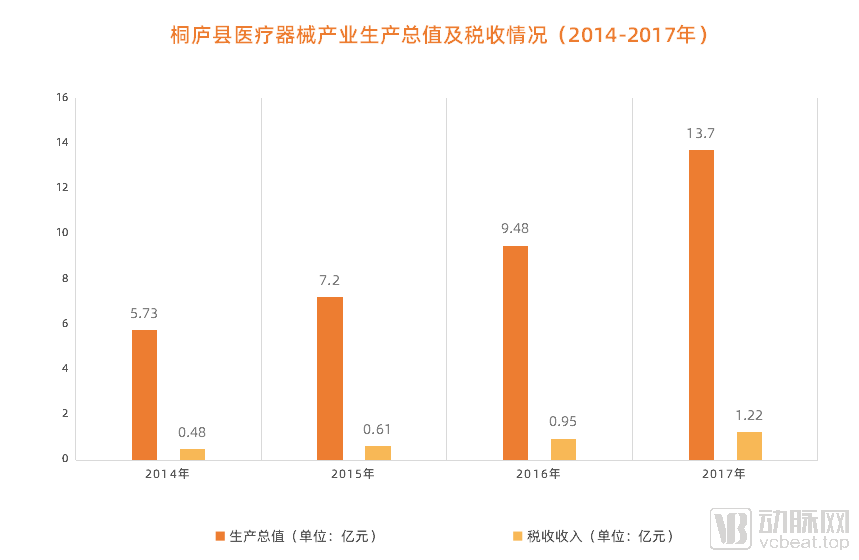
According to authoritative data,In 2017, the total output value of the medical device industry in Tonglu County reached RMB 1.37 billion, with tax revenue of RMB 122 million, a year-on-year increase of 28%., with extremely rapid growth momentum. In terms of the number of enterprises, Tonglu County has achieved a stepwise increase,In 2018 alone, Tonglu County saw a remarkable addition of over 500 new medical device manufacturing and operating enterprises, representing a year-on-year growth of more than 130%., the industrial agglomeration effect is highly significant.
No development happens overnight; it inevitably follows a gradual process and adheres to inherent operational laws. So, how did Tonglu County evolve from a small county town into the “China Medical Endoscope Industry Base”? What is the underlying logic behind its development? As county-level industrial clusters continue to emerge as new drivers of economic growth, what lessons can Tonglu’s success offer for the development of other such clusters in China? Which experiences can be directly “replicated”? Addressing these questions, VCBeat will provide detailed answers by examining Tonglu’s development trajectory.
The formation of an industrial cluster generally takes one of two forms:One approach involves enterprises emerging first, followed by the development of industrial parks—akin to “boarding the train first and buying the ticket later.”, this type of industrial agglomeration primarily occurs in the early stages of industrial park development, with Silicon Valley being the most typical example;The other approach is to establish the industrial park first and then attract enterprises, i.e., “buying the ticket before boarding the bus.”, a model that is extremely common in domestic cases; typical examples include the Shanghai Zhangjiang Hi-Tech Park, Suzhou Industrial Park, and Zhongguancun Science Park, all of which have witnessed rapid development in recent years.
For county-level industrial clusters like Tonglu, the underlying logic of their emergence is almost invariably “board first, ticket later.”
The medical device industry in Tonglu County originated in the early 1980s. At that time, there was no concept of industrial clusters; instead, a few start-up companies focusing on the research and development, manufacturing, sales, and services of medical devices were sporadically distributed. Tiansong Medical (formerly Hangzhou Tonglu Advanced Endoscope Co., Ltd.) was one of them.
Like most industrial parks in China that are currently facing development bottlenecks, the companies clustered in Tonglu lacked cutting-edge technological support and high-end talent reserves during their early stages. With extremely backward production conditions, neither the enterprises themselves nor their products could establish competitive advantages in the market.
To break through this predicament, the innovative Tiansong Medical took the lead, paving a new path for corporate development. At the turn of the new century, Xu Tiansong, the founder of Tiansong Medical,The company expanded northward to Shenyang, where it recruited a group of well-known domestic optical experts at significant cost to establish a high-tech R&D team. This team focused on overcoming technical barriers in endoscope manufacturing, thereby optimizing the overall performance of its products.
As “competitors” gradually gained a foothold in the market, other companies in the same sector, eager to find breakthroughs for development, could no longer hold back. They have been following the successful model of Zhejiang Tiansong Medical Instrument Co., Ltd., sparing no effort to recruit diverse specialized talents from around the world to address weaknesses in their corporate development and drive their transformation toward higher technological sophistication and more advanced product categories.
It is precisely thanks to this wave of imitation that"Talent Introduction Strategy", the medical device industry in Tonglu has gradually gotten on track and begun to form cluster advantages, steadily advancing along the path of corporate, standardized production and operation.
Driven by the radiating influence of pioneering enterprises such as Zhejiang Tiansong Medical Instrument Co., Ltd. and Kangji Medical, the medical device industry in Tonglu“From Zero to One”, and began to “emerge” in the national market. However, this is not the end point; to sustain the positive development momentum and form clustered advantages, the industry still needs to achieve“From Existence to Strength,” “From Strength to Excellence”a phased leap, with the core driving force for this phase coming from the government.
It is undeniable that the government is an indispensable component of any industrial cluster. If enterprises determine the direction in which an industry heads, then the government is the key factor determining how far that industry can go. This point is vividly reflected in the evolution of the medical device industry in Tonglu.
From the overall development trajectory of Tonglu’s medical device industry, comprehensive government intervention did not emerge in the early stages but rather took place primarily during the mid-term, specifically the industrial transformation phase. Despite entering at a later stage, the Tonglu County Government’s involvement yielded significant results. It not only resolved the bottleneck of sluggish enterprise growth but also established clear top-level design for the industry, driving its gradual transition toward industrialization, large-scale production, and brand development.
Specifically, how exactly does the government exert its influence?
1Prioritize Top-Level Design and Accelerate the Pace of Industrial Transformation and Upgrading
“Policy” has always been the core means for governments to remove “bottlenecks” impeding industrial development, primarily manifested in two aspects: accurately grasping the fundamental tone of industrial development and providing guiding principles for corporate growth.
Since 2015, the Tonglu County Market Supervision Administration has proposed a working principle of “equal emphasis on regulation and service” for the medical device industry. Based on the *Several Opinions of the General Office of the People’s Government of Zhejiang Province on “Precise Docking and Precise Service” to Support the Improvement and Development of the Medical Device Industry*, it has promoted the issuance by the Tonglu County Party Committee and County Government of"Several Opinions on Accelerating the Development of the Medical Device Industry in Tonglu County through 'Precise Alignment and Precise Service'", lead the county-wide initiative to standardize and upgrade medical devices.
2017, Tonglu Medical Device IndustryProactively integrate into the “Industry-Strengthened County” strategy and introduce the core concept of the “China Minimally Invasive Surgical Instrument Town.”. The overall spatial layout is designed as a provincial-level high-tech industrial base for medical devices, featuring a “one-axis, two-zone” structure. Industrial planning has been completed, attracting medical device enterprises such as Kangji Medical and Shendasiao to establish operations there. On the other hand, to proactively seize the important strategic opportunity period for the development of the medical device industry, in 2018, the People’s Government of Tonglu County issued"Implementation Plan for the Construction of China's Minimally Invasive Surgical Instrument Town (2018-2020)", focusing on the three dimensions of “new layout,” “new positioning,” and “new ecosystem” to carry out overall construction planning, form a full-service industrial support ecosystem, and further promote the transformation and upgrading of the medical device industry in Tonglu County.
Beyond medical devices, Tonglu has seized the strategic opportunities of the era in the life and health industry, vigorously developing the broader health sector. It has focused on building key industrial platforms such as the Fuchun Mountain Health City, Health Town, and Fengxi Life Port, while steadily advancing the establishment of the “China Hangzhou·Tonglu (International) Pilot Zone for the Life and Health Industry,” thereby opening up broad prospects for the development of the health industry.
withShiqiang GroupMeticulously Crafted“Tonglu Shiqiang Hospital”as an example, this is the first internet hospital in Zhejiang Province led by a pharmaceutical enterprise, which officially opened in August 2020, along with the launch of its online management platform"Huihui Health Cloud Medical". It is understood that Shiqiang GroupBy leveraging the capabilities and resources of offline medical institutions, integrating vast online big data from clinical cases, and employing visual consultation technologies along with various intelligent tools, we can effectively address the longstanding constraints of time and space that have plagued traditional healthcare providers. This approach establishes a closed-loop system encompassing medical care, patients, pharmaceuticals, and rehabilitation, thereby further strengthening doctor-patient trust and enhancing overall satisfaction with medical services.
2Prioritize Enterprise-Specific Strategies: Implement a Precision-Tailored, Differentiated Training System
Unlike large-scale industrial parks with broad coverage, such as Zhangjiang Hi-Tech Park, Suzhou Industrial Park, and Zhongguancun Science Park, Tonglu represents a typical specialized industrial cluster, primarily focusing on minimally invasive devices centered around “rigid endoscopes.” Even so, the development of an enterprise incubation system should not adopt a simplistic, one-size-fits-all approach; instead, it requires the formulation of targeted nurturing policies that are tailored to and integrated with the specific realities of enterprises at different stages of development.
Based on the development of the medical device industry across the county, as well as the implementation of intellectual property initiatives and future growth prospects among enterprises, the Tonglu County Government has categorized the 52 medical device manufacturing companies in the county into four tiers: Tier 1 comprises demonstration and leading enterprises (6 companies); Tier 2 includes innovation-driven enterprises (24 companies); Tier 3 consists of brand-building enterprises (10 companies); and Tier 4 encompasses supported and incubated enterprises (12 companies). On this basis, targeted policy interpretations and guidance services are provided to each category, specifically reflected in incentive schemes and supporting resources.
In addition, the government has adopted measures such as engaging professional experts for guidance and organizing knowledge seminars to scientifically analyze the direction of enterprises’ intellectual property (IP) development. These efforts have effectively addressed the blind and fragmented nature of corporate patent applications, shifting the paradigm from a passive approach of “filing patents for the sake of filing” to a proactive, goal-oriented, and planned strategy aligned with business development needs. This transition has significantly improved the efficiency of resource utilization in patent applications and provided tangible and effective patent support for enterprise growth. For instance, Kangji Medical has been categorized as a Tier-1 Demonstration and Leading Enterprise. In light of its leading position within the county in terms of invention patent holdings, the government provides targeted guidance on applications for National IP Advantage Demonstration Enterprises and national/provincial patent awards, striving to achieve breakthroughs in securing patents at the national, provincial, and municipal levels.
3Prioritize Resource Integration and Establish a Sound Multi-Dimensional Service System
For industrial clusters, in addition to clear policies and regulations, a reserve of high-caliber talent, and a favorable business environment, well-developed resource allocation is equally critical. This is also key to attracting leading industry players and innovative enterprises to settle in the industrial cluster.
To support the rapid development of enterprises, the Tonglu County GovernmentSystematically integrate the county’s intellectual property, financial, technological, human resource, and policy resources for medical devices, and deepen the development of the countywide Medical Device Industry Intellectual Property Alliance.To date, 49 medical device manufacturers in Tonglu County with substantial intellectual property portfolios have established patent pools. These enterprises collaborate and forge ahead in areas such as early-warning analysis, risk mitigation, institutional development, and patent maintenance, jointly building the public regional brand of Tonglu as the “Chinese Town for Minimally Invasive Surgical Instruments,” thereby further enhancing the town’s visibility.
On the other hand, the Tonglu County Government has established specialized service institutions, including the Hangzhou region’s first “People’s Mediation Committee for Intellectual Property Disputes,” the “Tonglu County Intellectual Property Protection and Assistance Workstation,” and an “Expert Pool of Mediators.” These initiatives aim to provide technical support to medical device manufacturers across the county in intellectual property protection and patent litigation response through a comprehensive service system.
It is worth noting that, to adapt to the development of emerging industries, the Tonglu County Government has established a reserve pool of resources for shareholding reform, listing on equity exchanges, and initial public offerings (IPOs), thereby supporting medical device enterprises in undertaking “shareholding reforms” and pursuing “public listings.” The government has proactively communicated and coordinated with higher-level authorities to open green channels for enterprise approval and acceptance, accelerating product market launch and enabling rapid production implementation. In line with internet development trends, it has actively explored “smart healthcare,” promoted technological innovation, and thoroughly tapped into industrial potential. Furthermore, it has carried out initiatives to enhance industry standards through a three-phase approach—“preliminary screening, concentrated rectification, and mechanism improvement”—to create a favorable environment for development.The introduction and implementation of a series of measures have created a favorable external environment for the sustained and healthy development of the medical device industry, encouraging enterprises to actively pursue entrepreneurship and innovation, continuously strengthen their endogenous growth drivers, and enhance their core competitiveness.
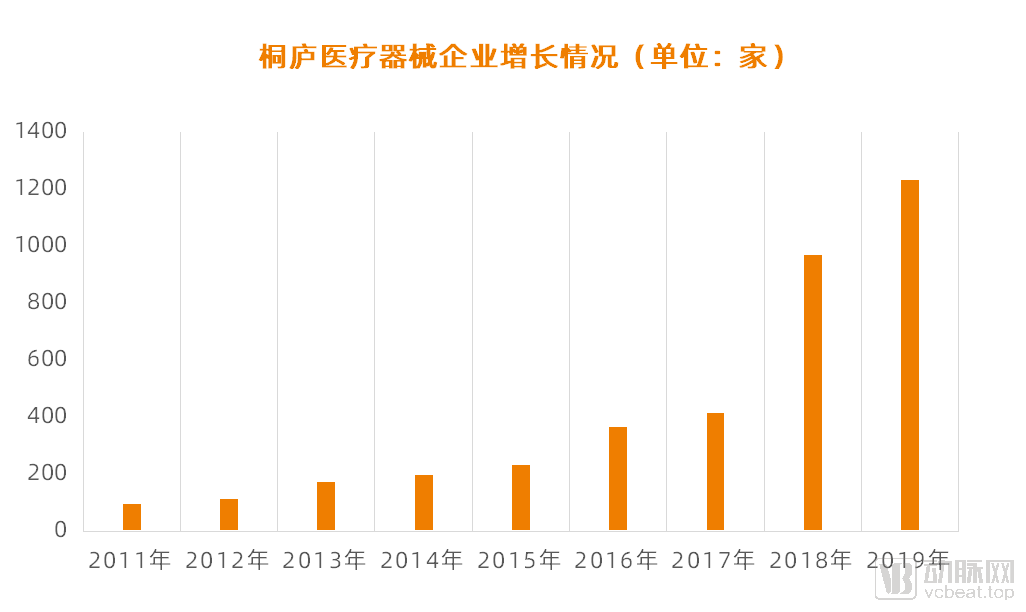
Data Source: Huoshi Chuangzao, Chart by VCBeat
After nearly 30 years of dedicated development, the medical device industry in Tonglu has delivered a satisfactory performance:First, in terms of production output value, according to authoritative data, the total output value of the medical device industry in Tonglu County reached RMB 1.37 billion in 2017, with tax revenue of RMB 122 million, representing a year-on-year increase of 28%;Second, in terms of the number of enterprises, As of now, Tonglu has gathered more than 1,000 medical device companies, while in 2011 there were fewer than one hundred; in just ten years, the number of enterprises increased by nearly 900;Third, in terms of brand value, leveraging its strong growth momentum, Tonglu County accounts for over 30% of the domestic market share for ancillary surgical instruments. It is China’s largest production base for rigid endoscopes and has been awarded the title of “China Medical Endoscope Industry Base” by the China Association for Medical Devices Industry.
From any perspective, Tonglu County has carved out a distinctive path in the medical device industry and is gradually becoming a vital link in China’s, and even the global, medical device manufacturing supply chain.What, then, is the underlying logic driving the development of the medical device industry in Tonglu?
First, at the corporate level.Enterprises have always been the core element of industrial clusters and an important driving force for their development. For Tonglu, which has evolved from individual enterprises into an industrial cluster, the value demonstrated by enterprises in the development path of the industrial cluster is even more pronounced.First, take proactive measures, without waiting, relying on others, shifting blame, or delaying; for instance, when Zhejiang Tiansong Medical Instrument Co., Ltd. encountered obstacles in its development, the company proactively explored its own path forward by recruiting technical talent from across China;Second, Emphasis on Innovation, innovation is the most critical quality in corporate operations, particularly for the medical device industry, where technological innovation is paramount. For instance, Kangji Medical has meticulously built a dedicated R&D technical team and continues to deepen its own competitive “moat.”
Second is the government level.From the perspective of the overall organizational structure of an industrial cluster, the government functions more as a service-oriented entity, or akin to a “nanny” providing comprehensive day-to-day support. This role is particularly evident in the case of Tonglu’s medical device industry. To promote the high-quality development of the medical device sector, the Tonglu County Government has, through"Top-Level Design, Categorized Implementation, and Resource Integration: The 'Trilogy'", scientifically plan the industrial development layout of medical devices across the county, continuously stimulate innovation vitality, and establish a comprehensive service system for enterprises covering “finance,” “talent,” “technology,” “intellectual property,” and “approval.” While promoting the transformation of enterprises toward high quality, high standards, and advanced levels, it has also created a development model encompassing the full life cycle of the medical device industry.
Finally, at the level of collaboration.Drawing from the successful experiences of numerous industrial clusters both domestically and internationally, enterprises and governments have always maintained a mutually beneficial cooperative relationship. For the government, the continuous growth of enterprises inevitably drives regional economic development and enhances local influence; for enterprises, greater governmental commitment invariably brings more resource advantages, facilitating further business expansion. In terms of the development path of the medical device industry in Tonglu, enterprises have actively responded to government calls and taken the initiative to cooperate, continuously refining their capabilities in line with industry trends to contribute to industrial growth. Meanwhile, the government has adhered to a “service-first” philosophy, fully considering enterprise needs and mobilizing all available resources to remove obstacles to business development, taking steady steps to help enterprises “grow bigger, stronger, and better.”
The 21st century is an era in which humanity pursues health, and likewise a time when the biopharmaceutical and broader health industries have achieved substantial development, whileThe Core of Future Urban Competition Will Inevitably Be Industrial Competition, especially in the context of the pandemic. Therefore, those who can first find a breakthrough in the biopharmaceutical and broader health industries will be able to seize the high ground in future urban competition.
In recent years, with the continuous increase in policy and financial support, China’s biopharmaceutical industry is showing a growing trend toward clustered development. From the national level to local governments, active efforts are being made to strategically position and support the growth of the biopharmaceutical sector. At the national level, the government has been consistently selecting regions with strong industrial foundations, robust innovation capabilities, favorable business environments, and high levels of openness to establish biopharmaceutical industrial parks. At the local level, regional governments are integrating local resources, strengthening top-level design, and prioritizing strategic planning. By formulating industry-specific plans and policies, they are guiding industrial agglomeration and fostering the development of distinctive biopharmaceutical industrial parks across various regions.
However, given the current state of industrial advancement, cities of different scales are following entirely distinct development paths.For major cities, the development of the biopharmaceutical industry primarily focuses on "comprehensiveness.", for instance, the well-known Zhangjiang Hi-Tech Park and Wuhan Optics Valley have both extended their business scope to cover the entire industrial chain of the biopharmaceutical sector;For smaller cities, the development of the biopharmaceutical industry hinges on "specialization."For instance, Tonglu in Zhejiang Province, known as the “National Endoscopy Production Base”; Changyuan in Henan Province, dubbed the “Capital of Medical Consumables in China”; and Jinxian in Jiangxi Province, recognized as the “No. 1 Township for Medical Devices in China,” have all chosen specific niche sectors as their entry points and key areas for development.
Currently, biopharmaceutical industrial parks anchored in major cities have moved past their initial development stage and are gradually transitioning toward high-quality, high-tech development. Amid increasingly fierce competition in industry development,The Differentiated Development Trends of Regional Industries Have Become an Important Trend in the Development of China's Biopharmaceutical Industry, giving rise to many industry clusters with distinct regional characteristics and forging a unique path for industrial development.
From these successful cases, it is evident that these county-level industrial clusters have focused on building distinctive specialties, primarily targeting specific niche sectors as their focal point to drive the formation and optimization of their industries.
The reason this path is viable is thatIndustrial development must align with regional conditions.For county-level industries, there is a significant gap in policy support and resources compared to first- and second-tier cities, making them entirely lacking the potential to become the next “Silicon Valley” or “Zhongguancun.” However, this does not mean that county-level industries cannot “chart a new course.” By entering niche segments of the industry, they may be better positioned to cultivate competitive advantages.
In summary, within the global landscape of urban competition,It is not “city size” but “industrial quality” that determines a city’s discursive power.”, county-level biomedical industry clusters also have the potential to “break out” and gain market dominance.
Therefore, for China’s county-level biomedical industry clusters that have already taken shape or are currently in the planning stages, it is essential to accurately grasp the current trends of industrial development. By adopting a specialized development path as the starting point and leveraging joint efforts from both government and enterprises, these clusters should spare no effort to capitalize on favorable policies and market opportunities, striving to become the next “Tonglu” or the next “Tuttlingen.”
References:
1. "Implementation Plan for the Construction of China's Minimally Invasive Surgical Instrument Town (2018–2020)";
2. “Tonglu County Bureau Charts a New Blueprint for the Development of the Medical Device Industry with Multiple Measures”;
3. “Data Insights into the Development Trends of China’s Healthcare Industry (IV): Characteristics of the Regional Medical Device Industry Landscape”;
4. “From End-Point Planning to Start-Point Planning: Implementation Innovations in Spatial Planning Driven by Industrial Development”