

China's Revised Medical Device Supervision and Administration Regulations Signal Strictest-Ever Oversight
On March 18, 2021, the National Medical Products Administration (NMPA) officially released the revised Regulations on the Supervision and Administration of Medical Devices. The original regulations were promulgated on January 4, 2000, and underwent their first revision in February 2014. The current revised version was adopted at the 119th Executive Meeting of the State Council on December 21, 2020.
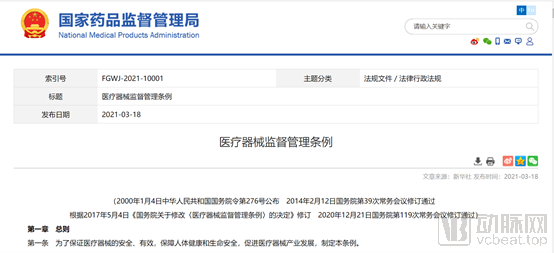
The Regulations on the Supervision and Administration of Medical Devices hold a status akin to the industry’s “constitution,” making their revision and adoption highly significant for the sector. The release of the new regulations immediately sparked widespread excitement and drew intense attention from industry stakeholders. One industry insider noted that the direction of the revisions closely aligned with prior expectations, with many policies receiving broad acceptance. A closer examination reveals that many of the directions outlined in the regulations have already been implemented through various policies in recent years, suggesting that the policy transition period will likely be short.
It has been six years since the last update. Over this period, the medical device industry has undergone earth-shaking changes: regulatory approval policies have continuously evolved; innovation has become the main driving force of the industry; cost containment under medical insurance has set the overarching tone; business models in the medical device sector have experienced transformation; and the Medical Device Registrant System has been rolled out nationwide. Against this new industrial landscape, what changes in the newly revised Regulations on the Supervision and Administration of Medical Devices have become focal points of industry attention?
Overall, this revision of the regulations aligns with the development trends of China’s medical device industry, implementing reforms in areas such as fostering innovation, streamlining processes, encouraging clinical trials, and enforcing lifecycle-wide regulatory oversight. In the wake of the COVID-19 pandemic, the regulations explicitly stipulate that drug regulatory authorities may grant conditional approval for medical devices urgently needed to respond to public health emergencies.
This update is mainly reflected in four aspects:
I. Reform measures have been implemented to encourage industry innovation and industrial development;
II. Reform of Clinical Trials for Medical Devices;
III. Emphasize lifecycle-wide regulation to enhance regulatory efficiency;
IV. Strengthened penalties, increased the cost of violations, and imposed penalties on individuals.
The most significant trend highlighted by the regulatory updates is the encouragement of innovation. In Chapter I, General Provisions, the four newly added articles are all established to promote the innovative development of medical devices. Among them, Articles 8 and 9 explicitly identify medical device innovation as a key focus area. These policies send a strong signal of support for medical device innovation, representing a major benefit for innovative medical device products.
Article 8 emphasizes that the State shall formulate industrial plans and policies for the medical device industry, prioritize innovation in medical devices as a key area of development, grant priority review and approval to innovative medical devices, support the clinical promotion and use of innovative medical devices, and promote the high-quality development of the medical device industry. The drug regulatory department under the State Council shall cooperate with relevant departments of the State Council to implement the national industrial plans and guiding policies for medical devices.
Article 9 proposes that the State shall improve the medical device innovation system, support basic and applied research on medical devices, promote the dissemination and application of new medical device technologies, and provide support in areas such as science and technology project initiation, financing, credit, tendering and procurement, and medical insurance. The State shall support enterprises in establishing or jointly forming R&D institutions, encourage collaboration between enterprises and universities, research institutes, and medical institutions to carry out research and innovation in medical devices, strengthen intellectual property protection for medical devices, and enhance independent innovation capabilities in the medical device sector.
Article 12 Entities and individuals that have made outstanding contributions to the research and innovation of medical devices shall be commended and rewarded in accordance with relevant national regulations.
Article 8 explicitly states that the drug regulatory authorities shall cooperate with other departments of the State Council to implement national medical device industry plans and guiding policies. This provision leads us to expect that the National Medical Products Administration (NMPA) will introduce additional policies to accelerate review and approval processes, thereby further promoting and encouraging innovation in the medical device sector.
Why is encouraging innovation in medical devices given such high priority? This aligns with the development trends of China’s medical device industry. In recent years, China’s innovative medical device sector has reached unprecedented heights. From 2014 to 2020, the National Medical Products Administration (NMPA) approved a total of 99 innovative medical devices. Among these, domestically produced innovative medical devices involved 78 enterprises across 14 provinces, while imported innovative medical devices involved four enterprises from two countries.
Li Wei, Senior Director of the Regulatory Affairs Department at Tigermed Jietong, told VCBeat, “In recent years, with the development of innovative medical devices, a clear trend of polarization has emerged in the industry. For mid- to low-end products facing intense competition, policies continue to compress profit margins. Meanwhile, policies are increasingly encouraging high-end innovative products. In the next phase, the transition from imitation to innovation will be a key direction of China’s healthcare reform. Therefore, fostering innovation is the underlying tone of the Regulations on the Supervision and Administration of Medical Devices.”
The Regulations encourage innovation, which is also reflected in the approval process for imported products. Article 16 stipulates that for innovative medical devices not yet marketed overseas, applicants are not required to submit certification documents from the competent authority of their country (or region) approving the marketing and sale of such medical devices.
For imported innovative medical devices, the 2014 version of the Regulations stipulates that overseas manufacturers exporting Class II and Class III medical devices into China must submit registration application materials to the National Medical Products Administration (NMPA), along with certification documents from the competent authorities in their country (or region) permitting the marketing and sale of such medical devices.The revised regulations demonstrate that innovative medical devices can be launched simultaneously, lowering the barriers for imported innovative products to enter the domestic market.
Centered on the theme of encouraging innovation, the newly revised regulations introduce numerous reform measures that benefit innovative R&D and shorten review cycles. Among these, the changes to policies concerning clinical trials for medical devices are particularly noteworthy.
VCBeat summarizes the changes in clinical trials into the following three aspects:
1. Encourage hospitals to conduct clinical trials of medical devices, and incorporate clinical trial capabilities and conditions into the accreditation system for medical institutions;
2. Removal of the concept of the “Clinical Exemption Catalog,” with changes to the criteria for determining clinical evaluation/clinical trials;
3. Refine the responsibilities for clinical trials and clarify the approval timelines for clinical trials.
In terms of encouraging hospitals to conduct clinical trials, Article 26 explicitly states that the state supports medical institutions in conducting clinical trials, incorporates the evaluation of clinical trial conditions and capabilities into the accreditation of medical institutions, and encourages medical institutions to carry out clinical trials of innovative medical devices.
According to industry insiders, “In the past, there were indeed certain difficulties in conducting clinical trials. Many hospitals were reluctant to carry out clinical trials for medical devices. The new Regulatory Measures directly incorporate clinical trial conditions and capabilities into hospital accreditation assessments, which may enhance hospitals’ willingness to conduct clinical trials for medical devices, thereby promoting the development of China’s healthcare industry, particularly that of innovative medical devices.”
In addition to encouraging hospitals to conduct clinical trials, the newly revised regulatory supervision regulations no longer include a list of clinically exempt devices. It clarifies that Class II and Class III medical devices can also be approved for market entry through clinical evaluation. This will allow certain Class II and Class III products to gain market approval without undergoing clinical trials. The revised regulations no longer impose a blanket requirement for clinical trials but instead offer two pathways: clinical evaluation and clinical trials.
Clinical evaluation refers to the process by which the safety and effectiveness of a medical device are demonstrated through the analysis and assessment of clinical literature and clinical data from equivalent medical devices, based on factors such as product characteristics, clinical risks, and existing clinical data.
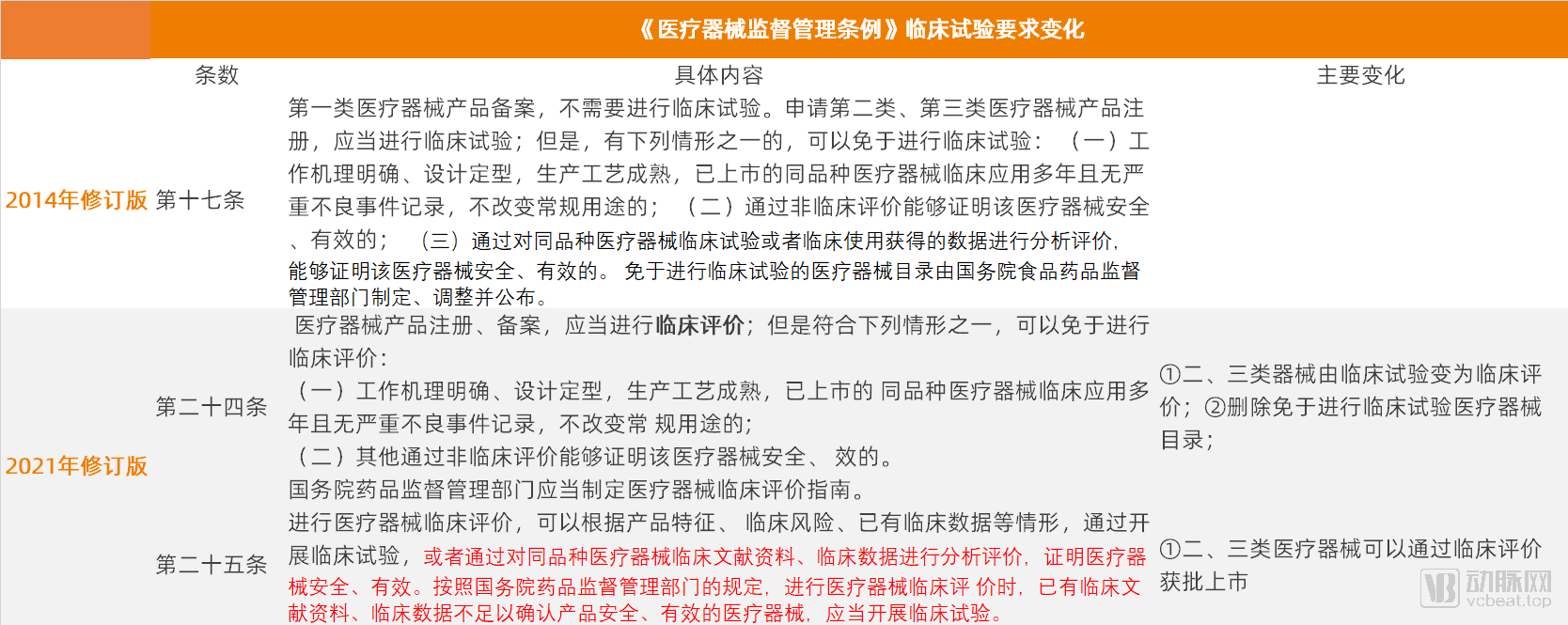
Comparison of Clinical Trial Policies in the 2021 Revised Version and the 2014 Version of the Regulations on the Supervision and Administration of Medical Devices | Graphic by VCBeat
In simple terms, clinical trials for medical devices were previously categorized into two scenarios: exemption from clinical trials and clinical trials. Under the new regulations, they are classified into three categories: exemption from clinical evaluation, clinical evaluation, and clinical trials. Following the revision, different products can adopt tiered approaches for clinical preparation based on their specific circumstances.
In response, Chen Tao, founder of Dongmai Medical, stated, “In the past, many medical devices could not undergo clinical trials due to ethical constraints, yet they also did not qualify for inclusion in the list of devices exempt from clinical trials. This created significant barriers to market entry for such products. For example, during the COVID-19 pandemic, certain isolation and protective equipment could not be subjected to clinical trials, but it was not included in the exemption list, nor were there any predicate devices available. Under the new regulations, these products can gain market approval through clinical evaluation. We highly endorse this provision, as it renders the overall regulatory framework more scientific.”
The revised regulations further delineate the responsibilities for conducting clinical trials and specify the timeframe for their approval. Article 27 explicitly states that the National Medical Products Administration (NMPA) shall make a decision on clinical trial applications and notify the sponsor within 60 working days. Failure to provide notification within this period shall be deemed as approval.
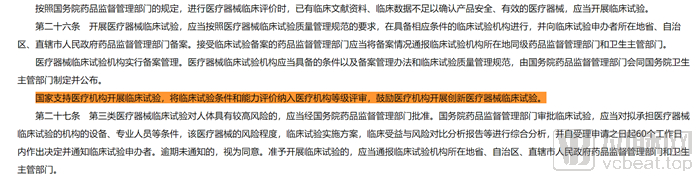
Selected Provisions of the 2021 Edition of the Regulations on the Supervision and Administration of Medical Devices
It is evident that the Regulations on the Supervision and Administration of Medical Devices have undergone significant changes regarding clinical trials for medical devices. However, these changes are fundamentally centered on streamlining the approval process and fostering innovation within the medical device industry, which can be regarded as the focal point of policy reforms aimed at encouraging innovation under the Regulations.
In the process of approving medical devices for market launch, testing is a critical step alongside clinical trials, as product filing and registration both require the submission of product test reports. The revised regulations introduce significant reforms to the testing phase, expanding the acceptance of self-conducted test reports for registration from Class I devices to include Class II and Class III devices.
In the 2014 edition, the test report for Class I medical device filing applications could be a self-test report issued by the filer. For Class II and Class III medical device registration applications, the product test reports must be issued by qualified medical device testing institutions, as enterprises did not have self-testing qualifications.
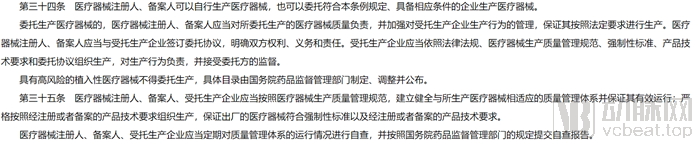
In the revised regulations, unified provisions are established for Class I, Class II, and Class III medical devices, stipulating that product testing reports shall comply with the requirements of the drug regulatory department under the State Council. Such reports may be self-testing reports prepared by the medical device registration applicants or filers, or testing reports issued by qualified medical device testing institutions entrusted to perform the tests.
From a conceptual standpoint, allowing enterprises to conduct self-inspection implements the principle that enterprises are the primary parties responsible for product quality. For certain products, this can also accelerate market entry; in particular, for companies with the capability to establish their own testing laboratories, permitting self-inspection will effectively shorten the registration cycle.
This is related to the introduction of policies allowing enterprises to conduct self-inspections, the high volume of medical device registration applications, and inspection backlogs affecting approval cycles.
In 2020, the National Medical Products Administration (NMPA) released a set of data showing that it approved a total of 9,849 medical device registrations, including initial registrations, renewal registrations, and modification registrations. This represented a 16.3% increase in the total number of registration approvals compared to 2019.
The growing number of registered medical devices has imposed high demands on testing institutions. Previously, pre-market testing had to be conducted at a limited number of inspection centers, which faced excessive workload pressure, thereby delaying product market launch.
The first half of the new regulations contains substantial content on medical device innovation, while sections covering production, distribution and use, adverse event handling and recalls, and supervisory inspections clearly signal a trend toward stringent regulation. The principle of “lenient entry with strict oversight”—encouraging innovation and lowering market access thresholds while strengthening regulatory inspections—runs throughout the Regulations on the Supervision and Administration of Medical Devices. Regarding regulatory aspects, VCBeat has summarized three key changes:
1. The State shall establish a system of professional and specialized inspectors to strengthen the supervision and inspection of medical devices;
2. Increase the penalties for intentional violations and add specific provisions for individual liability;
3. Emphasize full-lifecycle supervision, with the role of market regulation becoming increasingly prominent.
The most significant change in regulatory oversight is the substantial increase in the cost of non-compliance. Regarding penalties for the illegal operation of Class II and Class III medical devices, the 2014 version stipulated that if the value of the illegally produced or traded medical devices was less than RMB 10,000, a fine of between RMB 50,000 and RMB 100,000 would be imposed; if the value exceeded RMB 10,000, a fine of between 10 and 20 times the value would be imposed. In cases of serious violations, applications for medical device licenses submitted by the responsible individuals and the enterprise would not be accepted for a period of five years.
In the new version, where the value of illegally produced or traded medical devices is less than RMB 10,000, a fine of between RMB 50,000 and RMB 150,000 shall be imposed; where the value exceeds RMB 10,000, a fine of between 15 and 30 times the value shall be imposed. In serious cases, production and business operations shall be ordered to cease, and no application for medical device licenses submitted by the responsible individuals or the entity concerned will be accepted within ten years. The legal representative, principal officer, directly responsible supervisor, and other liable personnel of the violating entity shall have their income derived from the entity during the period of the illegal activity confiscated, and shall be fined an amount between 30% and three times such income. They shall be permanently barred from engaging in medical device production and trading activities.
The newly revised Regulations on the Supervision and Administration of Medical Devices not only significantly increase the severity of penalties but also introduce detailed provisions for holding individuals accountable. An industry insider commented, “Previously, liability for penalties was imposed on entities rather than individuals. With the amended regulations now extending penalties to individuals, deterrence will be heightened, and illegal activities will be substantially reduced.”
In terms of institutional design, the revised Regulations propose the establishment of a national system of professional and specialized inspectors to strengthen supervision and inspection of medical devices.
Increased penalties and the inspector system are concrete measures to strengthen medical regulation, while the emphasis on full-lifecycle oversight and market-based regulation represents a significant shift in regulatory philosophy in this revision of the regulations.
In the chapter on Registration and Filing of the newly revised Regulations, noteworthy is the content added in the newly introduced Article 20, which emphasizes that enterprises must strengthen post-market supervision. It explicitly stipulates that medical device registrants and filers shall fulfill the following obligations, including: (1) establishing a quality management system appropriate for their products and ensuring its effective operation; (2) formulating post-market research and risk control plans and ensuring their effective implementation; (3) conducting adverse event monitoring and re-evaluation in accordance with the law; (4) establishing and implementing product traceability and recall systems; and (5) fulfilling other obligations prescribed by the drug regulatory department under the State Council. The corporate legal entities within China designated by overseas medical device registrants and filers shall assist such registrants and filers in fulfilling the obligations stipulated in the preceding paragraph.
It is evident from the newly established regulatory provisions that multiple measures have been introduced to strengthen oversight. These include reinforcing the responsibility of enterprises and research and development institutions for the safety and efficacy of medical devices, clarifying approval and filing procedures, enhancing regulatory tools, and introducing additional regulatory measures such as unique device identification (UDI) traceability and extended inspections. Furthermore, penalties for illegal activities have been intensified, with substantially increased fines for serious violations involving quality and safety. Severe punitive actions, including license revocation and industry and market bans, will be imposed on seriously non-compliant entities and responsible individuals, and criminal liability will be pursued in accordance with the law where crimes are involved.
In addition to the four major changes mentioned above, the newly revised regulations also include the comprehensive lifting of restrictions on certain measures that were previously implemented only in local pilot policies.
First, the nationwide rollout of the Medical Device Registrant System. The newly revised regulations have fully lifted geographic restrictions on contract manufacturing and clearly defined the responsibilities and obligations of both the registrant (entrusting party) and the contract manufacturer (entrusted party). Previously piloted in various regions across China, the Medical Device Registrant System was comprehensively implemented nationwide starting in July 2020. The explicit removal of geographic barriers for production in the revised regulations will help optimize resource allocation within the industry, accelerate innovative development, and shorten product time-to-market.
Furthermore, the policy piloted in the Boao Lecheng International Medical Tourism Pilot Zone in Hainan—which allows for conditional approval of medical devices urgently needed for clinical use by healthcare institutions within the zone and for which no equivalent products have yet been approved for registration in China—has been expanded to a nationwide scope. The introduction of this regulation will help shorten the time-to-market for these products.
Article 19 of the 2021 Regulations emphasizes that for medical devices urgently needed to treat rare diseases, life-threatening conditions with no effective treatments available, and to respond to public health emergencies, the drug regulatory department accepting the registration application may grant conditional approval and specify relevant matters in the medical device registration certificate.
Another change worth highlighting is the introduction of regulations for single-use medical devices. The catalog of such devices will be formulated, adjusted, and published by the State Council’s drug regulatory authority in conjunction with its health administrative authority. This development will have a significant impact on the single-use medical device industry and will also influence the existing trend toward disposability of medical consumables.
Furthermore, regulation will move toward digitalization, and the introduction of regulations for online sales of medical devices is also a major change in the ordinance.
Overall, the revision of the Regulations on the Supervision and Administration of Medical Devices signifies that China’s medical device evaluation and approval system is reforming toward a more scientific and up-to-date approach, enabling clinical practice to benefit from the latest global medical device products. For the industry, encouraging innovation will become the overarching theme. It is hoped that under the new regulations, we will usher in a medical device industry that is innovation-driven, more open, and more scientifically grounded.