

Chengtian Technology Secures Tens of Millions in Series A Funding to Pioneer 'Rehabilitation-as-a-Service' Model

RoboCT
Exoskeleton Robot and Its Core Component R&D Provider
VCBeat has learned that Hangzhou RoboCT Technology Development Co., Ltd. (hereinafter referred to as “RoboCT”) recently announced the completion of its tens-of-millions-yuan Series A financing, exclusively invested by BlueRun Ventures. The funds from this round will be used to explore the new “Rehabilitation-as-a-Service” model for rehabilitation and elderly care, market promotion, team expansion, and preparations for mass production. Previously, RoboCT had secured Pre-Series A financing led by Naton Technology Group, a healthcare industry group.
RoboCT, founded in 2017, is an exoskeleton robotics technology company. Its founding team comprises multidisciplinary experts in mechanical engineering, automation, telecommunications, and computer science, and brings together multiple academicians, chairpersons of medical associations, specialists in brain science and neurology, bionics experts, and more than 20 rehabilitation medicine specialists, thereby establishing a competitive network of clinical experts.
Currently, RoboCT focuses on the elderly care and rehabilitation sectors, providing intelligent rehabilitation devices, assistive products, and smart rehabilitation solutions for patients with mobility impairments or disabilities, the elderly, and rehabilitation medical institutions.
As the living structures of Chinese residents change and the aging population deepens, the incidence and disability rates of various diseases continue to rise. However,The endpoint of disease is not the cessation of treatment, but the completion of recovery.
Currently,China has 250 million elderly people, including 40 million who are disabled or semi-disabled.。Data shows that,During the 14th Five-Year Plan period, China will enter a stage of moderate aging, with the population aged 65 and above exceeding 14%;The LancetLatestDataShow,ChinaYes460 millionHumans haveRehabilitation Needs.It is foreseeable that China's rehabilitation industry holds significant prospects for development.
However, it must also be acknowledged that in the face of enormous demand for elderly care and rehabilitation, China’s rehabilitation resources are relatively scarce, and the traditional model of manual caregiving is unsustainable. Compared with countries where rehabilitation medicine is well-developed, China faces significant shortages in both rehabilitation institutions and professionals. Data show that there are only 11,000 rehabilitation therapists in China, compared to over 200,000 in the United States; rehabilitation clinics in China are few and far between, whereas the United States has approximately 30,000 to 70,000 such facilities. In terms of caregiving personnel, China currently has a shortfall of as many as 7 million caregivers.
As a service-oriented industry, the rehabilitation sector faces key challenges in improving service efficiency and quality. In response, rehabilitation exoskeleton robots have emerged.
BlueRun Ventures stated, “Under the influence of policies such as healthcare cost containment and volume-based procurement, the dilemma of ‘funding hospitals through drug sales’ is poised to be resolved, thereby unleashing the true value of medical services. Commercial health insurance will rapidly emerge as a new payer, driving the adoption of high-efficiency, high-quality medical services. Consequently, rehabilitation exoskeleton robots that enhance rehabilitation efficiency and quality are set to enter a golden period of development.”
As a technology-driven enterprise,RoboCT has mastered the full-chain core technologies for exoskeleton robots, including motors, reducers, joint modules, and sensors, and has filed over 150 independent intellectual property rights.。Additionally, the exoskeleton robots developed by RoboCTObtained as an Innovative Medical DeviceleChina's First Medical Device Registration Certificate for an Exoskeleton Robot Used in Central Nervous System Disorders.
Leveraging its proprietary technologies, RoboCT has mastered core production techniques and manufacturing capabilities, thereby achieving superior cost control. Empowered by this strong cost efficiency, RoboCT has pioneered a new “Rehabilitation as a Service” model through joint operations with rehabilitation institutions.
Specifically, RoboCT integrates China’s three-tier rehabilitation system (Acute-phase rehabilitation is provided in the rehabilitation departments of tertiary hospitals, recovery-phase rehabilitation in secondary specialized rehabilitation hospitals, and maintenance-phase rehabilitation services are delivered in community or home settings.),Extend the exoskeleton robot rehabilitation system toIITiered rehabilitation specialty hospitals; maintenance-phase rehabilitation services are delivered in community or home settings, achieving a joint operational model involving home, community, and private institutions.
The core of this new model lies in addressing the professionalism gap between secondary rehabilitation specialty hospitals and community- or home-based rehabilitation, thereby achieving standardized, consistent, and reproducible rehabilitation treatment goals, and providing patients with phased, full-cycle rehabilitation services.
Currently, RoboCT’s new “Rehabilitation as a Service” model has covered more than 30 hospitals across multiple cities through a three-tier rehabilitation system, with over 20,000 trials of exoskeleton robot-assisted rehabilitation training conducted by new users.
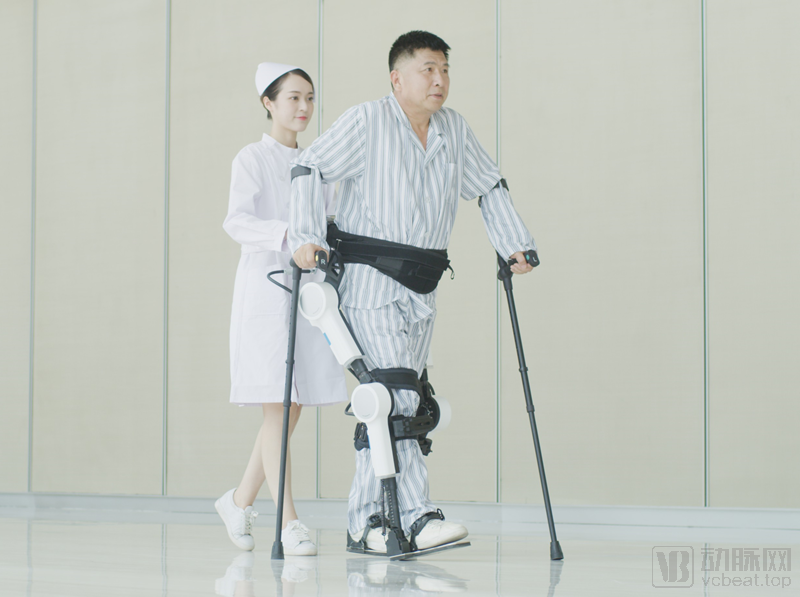
(Image provided by the company)
Zhang Jiyu, COO of RoboCT, stated, “In the future, RoboCT will leverage its differentiated service models and extensive network of core experts to deepen its presence in the health and elderly care sector, expanding into a greater number and wider range of care institutions. As technological advancements and economies of scale further reduce costs, RoboCT’s exoskeleton products for health and elderly care will enter the consumer market, while the company will also expand its R&D efforts into exoskeleton applications across industrial, entertainment, security, and transportation sectors.”