

Baidu's Secondary Listing in Hong Kong: How Is Its Healthcare Ambition Progressing?
Today, Baidu (HK: 9888) officially listed on the Hong Kong Stock Exchange, with an opening price of HK$254, up 0.79% from its issue price. As of 9:37 a.m., Baidu’s share price stood at HK$255, giving it a market capitalization of HK$721.4 billion.
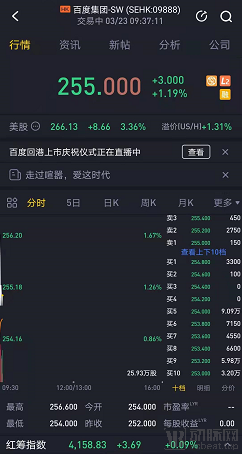
(Image source: Tiger Brokers)
In an SEC filing submitted to the U.S. Securities and Exchange Commission on March 11, Baidu disclosed that it would issue 95 million Class A shares in Hong Kong as part of its global offering, with 90.25 million shares allocated to the international offering and 4.75 million shares to the Hong Kong offering. Baidu’s stock code is “9888,” and the offering price was HK$252 per share. Through this IPO, Baidu will raise HK$23.94 billion, approximately US$3.083 billion.

As the world’s largest Chinese-language search engine and a leading platform-based enterprise, Baidu once enjoyed unparalleled prominence during the PC internet era. Its 2005 listing on the NASDAQ created a remarkable success story for Chinese stocks in the United States, with its share price surging by 354% on the first day of trading. However, hesitation in its transition to the mobile internet caused Baidu to fall behind in the mobile ecosystem, forcing it to devote substantial resources over many subsequent years to catch up. The underlying reason is that the proliferation of countless standalone apps in the mobile internet wave has created isolated information silos, gradually diminishing the role of PC-based search engines as primary gateways to information.
This Hong Kong listing marks a shift from 16 years ago, when Baidu went public under the label of “search engine company”; this time, “AI” has become the central theme of its IPO.This indicates that Baidu is redefining itself and beginning to tell a new story to the capital markets.
According to the prospectus, Baidu’s total revenue increased by 5% from RMB 102.3 billion in 2018 to RMB 107.4 billion in 2019, and stood at RMB 107.1 billion in 2020. The net profit attributable to Baidu Group Inc. was RMB 27.6 billion, RMB 2.1 billion, and RMB 22.5 billion in 2018, 2019, and 2020, respectively. The net profit for 2019 included a non-cash impairment loss of RMB 8.9 billion related to its investment in Ctrip.
It is worth noting that,In its prospectus, Baidu repeatedly highlighted healthcare-related businesses as a key vertical.Taking the 13 companies invested in by Baidu last year as an example, five were healthcare-related enterprises, ranking first among all vertical sectors. Moreover, in the planning of Baidu’s core business, healthcare-related operations such as Baidu Health are also listed as other key growth categories.
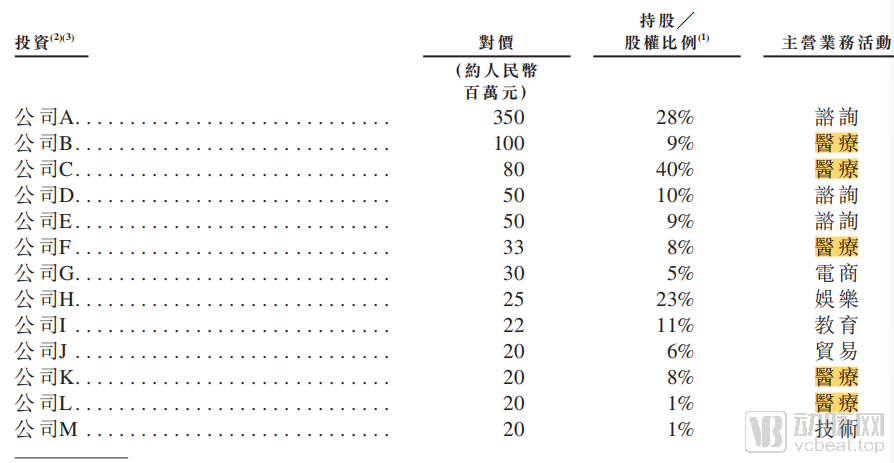
(Top Companies by Investment Amount Since 2020, Source: Baidu Prospectus)
Recently, Baidu launched an app named “Qingzhu Health.” According to the app’s description, “Qingzhu Health” is Baidu Lingyi Zhihui’s one-stop health management platform. By connecting doctors who provide health management consultations with users, the platform offers diversified and professional chronic disease management services.
It is evident that Baidu is steadily advancing its healthcare-related businesses and gradually increasing its investments. After reviewing Baidu’s strategic layout in the healthcare sector and the healthcare companies it has invested in, VCBeat found thatBaidu has primarily established “Baidu Health” to serve users and “Baidu Lingyi Zhihui” to serve the healthcare industry, while actively investing in companies focused on tech-driven healthcare.From C-end to B-end, shifting from “connecting people with information” to “connecting people, information, and services,” Baidu’s healthcare business logic has become increasingly clear.
Along these lines, a Baidu-style medical dream is gradually taking shape.
Baidu is presenting itself with a new image.
According to the prospectus, Baidu has segmented its revenue structure into “Core Business + iQIYI.” The Core Business comprises “Mobile Ecosystem,” “Intelligent Cloud,” “Intelligent Driving,” and “Other Growth Initiatives.” ThisUnlike the “online marketing + other” revenue structure used in previous financial reports, this indicates that Baidu is downplaying its “search engine” label.
It is worth noting that, under the previous revenue classification method, Baidu was predominantly perceived as a technology-driven advertising company. Taking Baidu’s 2018 financial report as an example, its annual revenue exceeded RMB 100 billion, with online marketing services accounting for approximately RMB 82 billion, or 80% of the total. This heavy reliance on advertising revenue led investors to respond lukewarmly to Baidu’s growth prospects.
andThe shift in revenue structure also indicates that Baidu is building new channels for business growth.Taking “Baidu Innovation” businesses, primarily cloud computing, as an example, revenue reached RMB 5.6 billion in 2018 and RMB 9.7 billion in 2019, a year-on-year increase of 72.7%. In 2020, revenue amounted to RMB 12.4 billion, representing a year-on-year growth of 28.8%, while its share of total revenue rose from 5.5% in 2018 to 11.6%.
Behind the evolution of its revenue structure logic lies Baidu’s reassessment of the company’s future value. As stated in its prospectus, Baidu aims to build itself into a “leading AI company with a strong internet foundation.” This strategic shift is reflected in its healthcare business, where Baidu is transforming the underlying logic of its medical operations.
As is well known, healthcare-related advertising was once a significant revenue source for Baidu, but it also precipitated a major crisis for the company. The core issue lies in the fact that the seriousness and high entry barriers of the healthcare industry require participating companies to exercise sufficient prudence and patience, rather than excessively pursuing short-term profits.
Baidu is undoubtedly aware of this issue.The prospectus repeatedly states that Baidu will provide digital solutions or products to various stakeholders in the healthcare industry, including hospitals, physicians, and patients.In other words, Baidu will no longer serve merely as a distributor of information and traffic, but will instead engage deeply in every segment of the healthcare industry to create long-term value.
Among them,The Internet healthcare sector is a key focus area for Baidu.. Data cited in Baidu’s prospectus shows that the market size of China’s internet healthcare industry was RMB 133.7 billion in 2019, is projected to exceed RMB 1 trillion by 2025, and will grow at a compound annual growth rate (CAGR) of 41.2%.
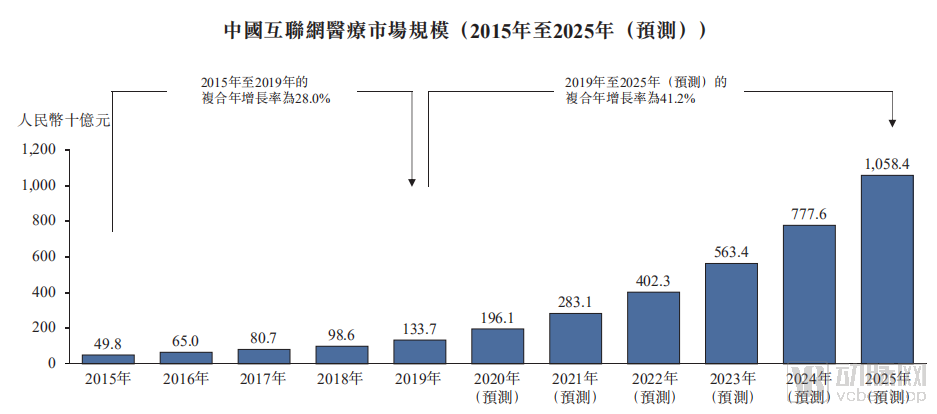
(Source: Baidu's Prospectus)
Behind the substantial market potential lies the support and impetus of digital technologies. The prospectus specifically highlights that advancements in digital technologies such as AI, big data, and blockchain will reduce labor costs for internet-based medical services, enable the development of customized patient services, and enhance mutual trust—a trajectory that aligns perfectly with Baidu’s future strategic direction.
In terms of application, Baidu’s medical AI projects are also being gradually implemented.Taking the medical AI brand Lingyi Zhihui as an example, the product offers solutions such as clinical decision support, medical big data, fundus image analysis, intelligent pre-diagnosis assistants, and chronic disease management. As of last November, Lingyi Zhihui had been deployed in more than 1,500 primary healthcare institutions across 27 provinces and municipalities, serving tens of thousands of physicians and providing AI-driven medical services to over 10 million patients.
Of course, the revenue contribution from applications related to the extension of Baidu’s AI technology remains quite limited. Meanwhile, costs continue to stay at a high level. According to the prospectus, Baidu’s R&D expenditure reached RMB 19.5 billion in 2020, representing a 24% increase from RMB 15.7 billion in 2018, and is expected to continue growing.
From the current state of the AI industry, AI commercialization is still primarily concentrated at the technical level, and there remains a window of time before large-scale practical applications can be realized. This tests Baidu’s steadiness and determination in continuing to bet on this track.
In summary, the prospectus reveals Baidu’s strategic decision to downplay its identity as a search engine provider and position itself as a leading AI enterprise. Specifically, in its healthcare business, Baidu is leveraging AI and other digital technologies as its foundation to deeply explore the fields of internet healthcare and digital health.
It is crucial not to overlook that Baidu’s mobile ecosystem business, dominated by search, remains its primary growth engine. Serving as a cash cow, it acts as the company’s “ammunition and granary.” Meanwhile, AI-driven emerging businesses constitute Baidu’s second growth curve, providing support for its medium- to long-term development.
It is evident that whether in building the foundational technologies of AI and pursuing their commercial applications, or in leveraging digital technologies to deeply penetrate the healthcare sector, they all share a common trait: they are narratives centered on long-term value.
Neville Isdell, former CEO of Coca-Cola, once stated, “Focusing on long-term corporate value growth requires the provision of effective business strategies.” This article will focus on three aspects to elaborate on how Baidu is assembling its healthcare puzzle: “Baidu Health,” which serves users; “Baidu Lingyi Zhihui,” which serves the industry; and Baidu’s investment layout in the medical sector.
“Baidu Health is a brand-new brand that we officially launched in March 2020, representing a comprehensive upgrade of the health vertical within Baidu Search. On one hand, we will adopt an industry-oriented mindset to deliver a complete service, thereby better connecting people with services and achieving online-offline integration. This also demonstrates Baidu’s firm commitment to making substantial investments in the healthcare sector,” said Yang Minglu, General Manager of Baidu Health and General Manager of Baidu Health Medical Encyclopedia, in an exclusive interview with VCBeat last year.
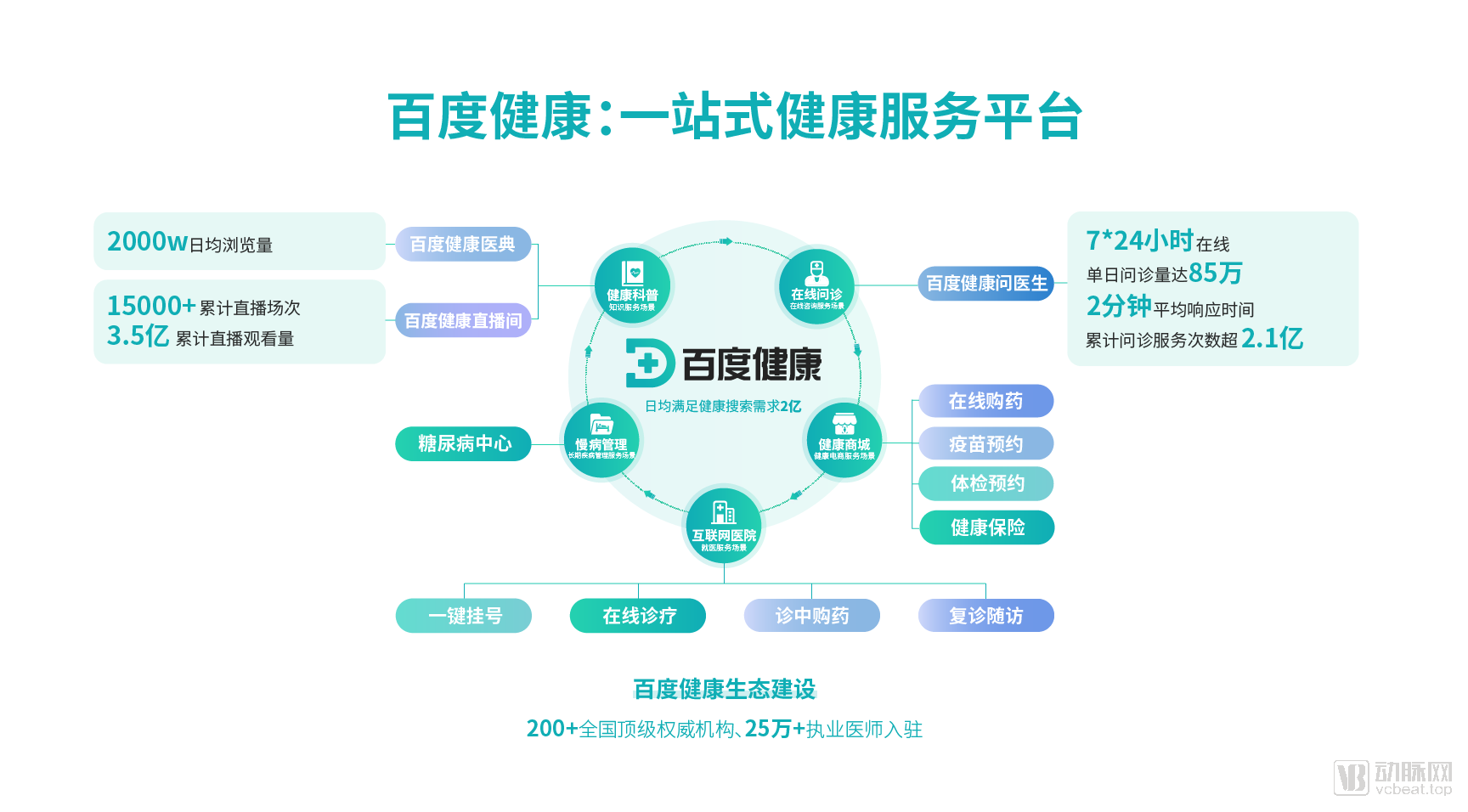
In terms of product development,Baidu Health has established a content ecosystem centered on “Baidu Health Medical Encyclopedia” and a service ecosystem anchored by “Ask a Doctor” and the “Health Mall.”
Specifically,Baidu Health Medical Encyclopedia is an authoritative public welfare project for popularizing health knowledge initiated by Baidu Health., we have joined forces with top-tier medical resources both domestically and internationally to co-establish an authoritative platform for popularizing medical and health knowledge. Leveraging big data on user needs, we deliver authoritative, accurate, comprehensive, easy-to-understand, and ad-free health education content through various formats, including articles, videos, infographics, and Q&A sessions. This content is seamlessly integrated across Baidu’s entire ecosystem, enabling users to conveniently access reliable health information.
To date, Baidu Health Medical Encyclopedia has partnered with over 1,000 top medical experts across China and more than 120 authoritative institutions. Its expert panel comprises academicians from the Chinese Academy of Sciences or the Chinese Academy of Engineering, leading academic figures, chairs of professional societies or associations, leaders of specialist groups, and principal scholars involved in developing clinical practice guidelines, thereby meeting 20 million user search requests daily.
It is worth noting that the content of Baidu Health Medical Encyclopedia is first analyzed on Baidu Search to identify the most pressing concerns users have regarding specific diseases. A framework addressing these questions is then developed and subjected to a rigorous three-round review and proofreading process with experts. Producing content based on user needs ensures it aligns more closely with their expectations. In terms of content, besides being authoritative, it must also be easy to understand and read. Following this approach, Baidu Health is continuously expanding the scope of its content production to include various formats such as videos and illustrations.
Another Flagship ProductBaidu Health Ask-a-Doctor is a 24/7 online consultation service platform launched by Baidu Health., the specific method is to search for “Ask a Doctor” on Baidu, or search for “Baidu Health” via the Baidu app, and then access the mini-program to use this service.
As of now, Baidu Health’s “Ask a Doctor” service has more than 100,000 licensed physicians from public hospitals available online to answer user inquiries. In addition to Baidu Health’s own contracted physicians, major telemedicine platforms such as Ping An Good Doctor, Haodafu, and JD Health have all been integrated into the Baidu Health platform. The platform currently serves over 300,000 physicians, and the average response time for consultations has been reduced to two minutes.
In addition to solidifying its science popularization and online consultation services, Baidu Health is also accelerating the layout of new business ventures.
In terms of content,Baidu Health Focuses on Health Live Streaming, having conducted over 15,000 live streams to date with more than 350 million views, Baidu Health also pioneered the online consultation-and-broadcasting model, providing users with a channel for selecting physicians and enabling mutual selection between doctors and patients.
In terms of service,The Health Mall is also a key focus of Baidu Health’s ongoing development., covering a full range of services including online medication purchases, nucleic acid testing, vaccinations, health check-ups, and health supplements. In addition, the development of internet hospitals and integrated specialist patient-physician platforms is underway. The first vertical diabetes center has already gone live, with over 100 authoritative experts in endocrinology currently onboarded to provide users with one-stop services.
From the perspective of business layout, the underlying logic of Baidu Health is to deliver a full-cycle health experience for users by bridging content with services and integrating online with offline channels. This strategy aims not only to expand Baidu’s content advantages but also to leverage its traffic strength, thereby creating greater commercial potential for the company.
And this will be a crucial factor in determining whether Baidu can become a major player in the internet healthcare sector.
As mentioned in the prospectus, the development of digital technologies and the rapid transformation of traditional hospitals have driven growth in both supply and demand within the internet healthcare market. Underpinning this trend is the continuous evolution of internet healthcare toward smart healthcare, whereby cutting-edge technologies such as AI and big data are increasingly penetrating core medical domains, including remote diagnosis, clinical decision support, pre-consultation intelligent assistance, and health management.
In other words,In addition to providing patients with health education and online consultation services, Baidu also aims to leverage technology to improve the work efficiency of hospitals and physicians, as well as reduce medical risks.
To this end,Baidu has developed Lingyi Zhihui, which is geared toward the healthcare industry, with its core service scenario being primary care.。
Taking Lingyi Zhihui’s “Ai Zhu Yi” (Love-Assisted Medical Care) solution as an example, this solution leverages Baidu Brain 6.0 and encompasses three major middle-platform capabilities: the Medical AI Middle Platform, the Medical Knowledge Middle Platform, and the Medical Data Middle Platform. It delivers four core applications: medical knowledge services, clinical decision support, intelligent follow-up services, and regional health dashboards.
Among these applications, Baidu’s pioneering evidence-based AI technology framework integrates both black-box and white-box AI algorithms. Driven by big data and medical knowledge, it provides scenario-specific, dynamic recommendations for various stages of the diagnosis and treatment process, such as disease diagnosis and prescription issuance. This approach assists in improving the efficiency of primary care diagnostics and reducing medical risks without disrupting physicians’ workflows.
As of last November, Lingyi Zhihui had been deployed in over 1,500 primary healthcare institutions across 27 provinces and municipalities, serving tens of thousands of physicians and providing AI-powered medical services to more than 10 million patients.
It is important to note that AI products cannot rely solely on technological leadership; their commercialization capability is the key determinant of their long-term success.How to Evaluate the Commercialization Capability of Medical AI Products? First, design products that align with hospital needs; second, ensure implementation capability after the bidding process is completed.
Specifically, during the implementation of informatics applications in hospitals, delivering these solutions is no easy feat due to issues such as poor IT infrastructure and difficulties in integrating Hospital Information Systems (HIS) with Electronic Medical Record (EMR) systems—a challenge faced by many AI healthcare companies.
To address the issue of particularly poor information infrastructure in medical institutions, Lingyi Zhihui’s solution was to act as both an IT vendor and an AI healthcare provider, delivering a comprehensive, turnkey solution in one go. Recognizing that this approach remained overly idealistic, Lingyi Zhihui instead committed to the “hard grind” of integrating interfaces on an institution-by-institution basis.
“Whether it is nationwide enterprises such as Neusoft, Haitai, Yixin, and Yihui, or smaller regional healthcare IT vendors, all have established long-term and close partnerships with us. To date, we have completed interface integration with the majority of healthcare IT vendors across China, laying a solid foundation for the hospital adoption of Lingyi Zhihui’s products,” Huang Yan, Vice President of Baidu Intelligent Cloud and General Manager of the Smart Healthcare Business Unit, told VCBeat at the end of last year.
To date, Lingyi Zhihui’s “Ai Zhuyi” product design has undergone four iterations and continues to be upgraded.
In summary, Lingyi Zhihui, Baidu’s healthcare service arm, has achieved notable success in empowering primary care with technology and demonstrated its capability for commercial implementation.
Nevertheless, it is important to note that, based on industry experience, while “AI + Healthcare” offers ample room for innovation, it currently lacks appeal in terms of commercial sustainability, particularly regarding revenue generation. This necessitates Baidu to delve deeper and find the key to unlocking large-scale commercialization in the “AI + Healthcare” sector.
Whether it is Alibaba, Tencent, or Baidu, no tech giant can personally enter every field. Thus,Investing to supplement and strengthen every link in the ecosystem has become a shared choice.
In October 2016, Baidu established Baidu Capital, a fund with a scale of RMB 20 billion, primarily investing in mid-to-late stage projects in the pan-internet sector. In September 2016, Baidu founded Baidu Ventures, which manages one U.S. dollar fund and two RMB funds, with a total size exceeding RMB 3 billion, focusing on early-stage investments in the field of artificial intelligence. Together, they have gradually built up Baidu’s investment landscape.
VCBeat has compiled an incomplete overview of Baidu’s healthcare investment landscape in 2020, based on publicly available information.
Baidu Capital Investment Events:
Weimai C+ Round Internet Healthcare Company 2020-12
Broncus Biotech Series C Developer of precision interventional treatment technologies for pulmonary diseases 2020-09
Baidu Ventures Investment Events
Huixian Medical Pre-A Round R&D and Manufacturing Company for Rapid Medical Diagnostic Products 2020-12
Yudao Biotech Pre-A Round A technology company focused on allosteric drug development 2020-12
SubtleMedical Series A Medical Imaging Software Company 2020-11
YuanYe Technology Pre-A Round Muscle Exoskeleton Company 2020-10
Enhe Bio Series A Biotechnology company based on synthetic biology concepts 2020-09
Wanzhongxing Health Series B Health Consulting Services Enterprise 2020-09
Keyjia Robotics Series B Intelligent Orthopedic Surgical Robot Company 2020-09
Series A Intelligent Orthopedic Surgical Robot Enterprise 2020-04
Atomwise Series B AI-powered small molecule discovery company 2020-08
ChenAn BioTech Series B Biotechnology Enterprise 2020-06
As can be seen from the above,Baidu's investments are primarily concentrated in technology-driven healthcare and biomedical enterprises.Notably, Baidu Ventures invested in two overseas companies last year, both of which are involved in AI-driven drug discovery.
This brings us to September of last year, when Robin Li, Founder, Chairman, and CEO of Baidu, spearheaded the establishment of Bioto Life Sciences, a life sciences platform company. According to its official introduction, Bioto Life Sciences is dedicated to accelerating the development of innovative drugs and precision life science products, such as those for early screening and diagnosis, by leveraging high-performance biological computing and multi-omics data technologies, with the aim of making more diseases predictable, controllable, and curable.
The invested companies are also actively collaborating with Baidu in the field of life sciences.For example, after completing its financing round, Yudao Bio, an investee of Baidu, announced a deep collaboration with Bioto AI to jointly build a next-generation AI design engine for allosteric drugs, thereby accumulating expertise in cutting-edge AI technologies and further enhancing the capability to design allosteric therapeutics.
In other words, Baidu and its portfolio companies have formed complementary entities within the ecosystem.
Not only that, but Baidu’s portfolio companies have also generated returns for the tech giant to some extent. For instance, healthcare firms backed by Baidu last year—including Enhe Bio, Huixian Medicine, and Wanzhongxing Health—have all secured new rounds of financing this year.
In summary, Baidu’s investment strategy in the healthcare and medical sector primarily centers on tech-driven healthcare and biomedicine, a focus largely attributable to its technology-driven business DNA and future strategic roadmap. From this perspective,Baidu’s investment strategy primarily aims to secure an early foothold in the life sciences sector and foster ecological complementarity with its portfolio companies.
Of course, investment in the frontier life sciences sector is also a business of time: results remain difficult to achieve in the short term, requiring patience and perseverance.
Just as Baidu quietly accumulated expertise in the AI sector for years before seizing the right moment to pursue a secondary listing in Hong Kong with the aim of revaluing its worth, it must now continue to deepen its engagement in the healthcare field. This requires playing the long game.
After all, nothing in this world is achieved overnight; all glorious accomplishments are the result of silent dedication and relentless effort.