

Can the 'Health Management + Pharma & Insurance' Ecosystem Become the New Moat in Healthcare?
Catalyzed by the pandemic, the growth potential of the internet healthcare industry has been further unlocked, particularly in the “health management + pharmaceuticals and insurance” sector, which has recently seen a series of major developments, with news of substantial financing rounds being announced one after another. In the secondary market,JD Health, Ping An Good Doctor and Other Stocks Surge in Price and Market Capitalization, capital is increasingly optimistic about the future market space.
Additional reports indicate that the internet insurance platformWaterdrop Inc. is in the final stages of preparing for its public listing and will conduct an initial public offering (IPO) in the United States within the next quarter., with its latest valuation reaching $10 billion. Almost at the same time, online healthcare solutions providerWeDoctor is undertaking “preparatory work” for equity sales following its Pre-IPO financing round and will apply for a listing in Hong Kong in the near future.
It is evident that the internet healthcare industry is currently at a critical stage of development, characterized by the deep integration of various business segments to form a closed loop. The “online + offline” integrated service model is becoming increasingly clear, and the industrial ecosystem chain of “health management + pharmaceuticals and insurance” is growing more robust. Driven by both policy guidance and market demand, the sector is experiencing explosive growth by leveraging digital technologies to build the “new infrastructure” for health security.
However, the emergence of every new market format follows inevitable patterns. What internal forces are driving the industry’s rapid development? Why are companies deeply entrenched in this sector choosing to collectively “accelerate” at this juncture? And what specific characteristics enable digital health enterprises represented by Ping An Health, Miao Health, and Shuidi Health to serve as industry benchmarks? These questions lie before us.
After 10 years, with“Three-Medical Linkage”The new round of healthcare reform, centered on this core, has gradually entered a phase of deep-water challenges. In February 2020, the State Council issued the “Opinions on Deepening the Reform of the Healthcare Security System,” further clarifying the need to accelerate the establishment of a multi-tiered healthcare security system and to promote reforms in payment methods and on the supply side of pharmaceutical and medical services.
Driven by strong policy support, China’s healthcare delivery, pharmaceutical usage, and payment systems are accelerating their optimization, moving toward a multi-tiered medical security system. Markets such as out-of-hospital prescriptions, online consultations, commercial health insurance, and health management are also entering a phase of rapid growth.
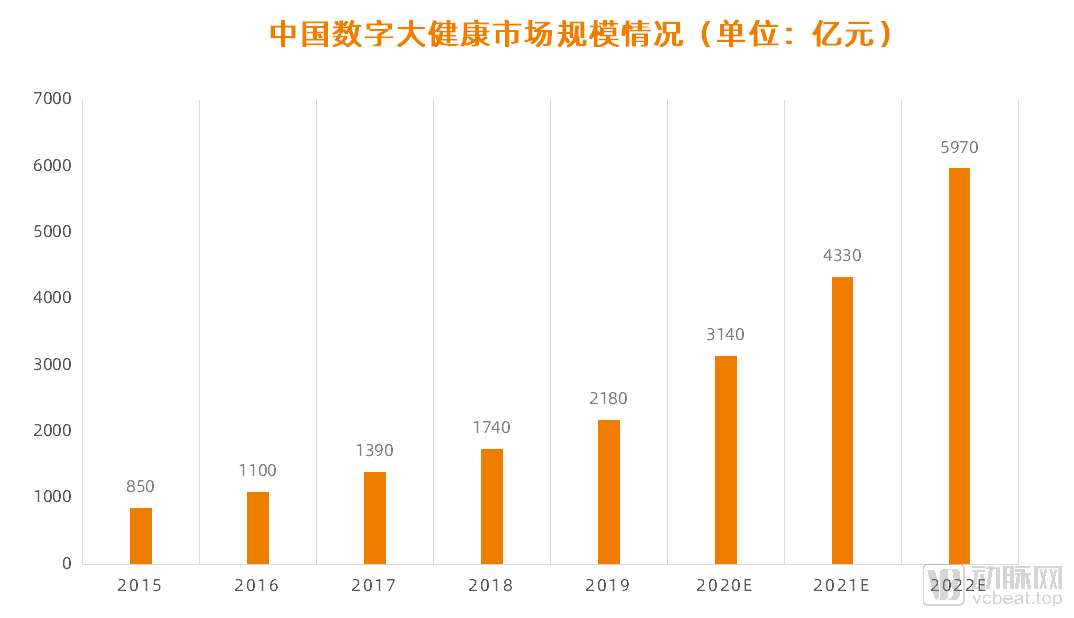
Data source: Frost & Sullivan, China Business Industry Research Institute; graphic by VCBeat
Meanwhile, advanced technologies such as artificial intelligence, the Internet of Things (IoT), and big data are rapidly penetrating the healthcare sector, reshaping a user-centric healthcare security system and beginning to translate cutting-edge technologies into clinically viable solutions. In 2018, the State Council issued the “Guiding Opinions on Promoting the Development of ‘Internet Plus Healthcare’,” explicitly stating the need to encourage the development of “Internet Plus” medical services, improve “Internet Plus” pharmaceutical supply assurance services, and advance “Internet Plus” healthcare security settlement services.
As can be seen, with the development of the times,The healthcare sector is advancing with greater resolve toward improved service quality, enhanced accessibility, and more transparent medical costs. The integration of data technologies with clinical practice has evolved from superficial applications to deep-level interaction. This new healthcare paradigm, characterized by “health management + pharmaceuticals and insurance,” has ushered in a “golden age” of development, becoming a core driver of economic growth.
Although the new market model has gradually become clear, whether it can truly succeed in the market still requires validation of its real-world effectiveness. Looking globally, the United States, thousands of miles away, has already incubated multiple successful cases.
UnitedHealth(UnitedHealth Group) was founded in 1974 and is the largest commercial health insurance company in the United States. According to its 2020 financial report, the company’s annual revenue reached $257.1 billion, a year-on-year increase of 6.2%; operating profit was $22.4 billion, up 13.8% year on year; and net income was $15.769 billion, representing a 10.7% year-on-year growth.
Behind the Glorious Data: How Did UnitedHealth Build Its Internet “Insurance Empire”?
UnitedHealth Group leverages big data, health information, and clinical expertise as its core competencies. Building on its primary insurance business, it continuously extends its industry chain to create one-stop integrated services, focusing on two core business segments—health insurance (UnitedHealthcare) and health services (Optum)—which generate strong synergies.
Overall, although UnitedHealth is a commercial health insurance company, itIt does not merely focus on insurance itself, but extends its business scope to cover all core segments of the insurance industry., such as medical activities including payment, medication purchase, and clinical consultations. The resulting end-to-end service model not only empowers UnitedHealth with robust cost-control capabilities but also further enhances the healthcare experience for a broad user base.
Beyond the insurance sector, other fields have also seen successful cases.
Kaiser Permanente(Kaiser Permanente) is currently the largest private non-profit healthcare organization in the United States. According to its 2020 financial report, Kaiser Permanente achieved annual operating revenues of $88.7 billion, representing an approximately 5% increase from the previous year’s $84.5 billion. However, this is not the most compelling aspect of Kaiser Permanente; what truly sets it apart and makes it shine is its unique “HMO” operational model.
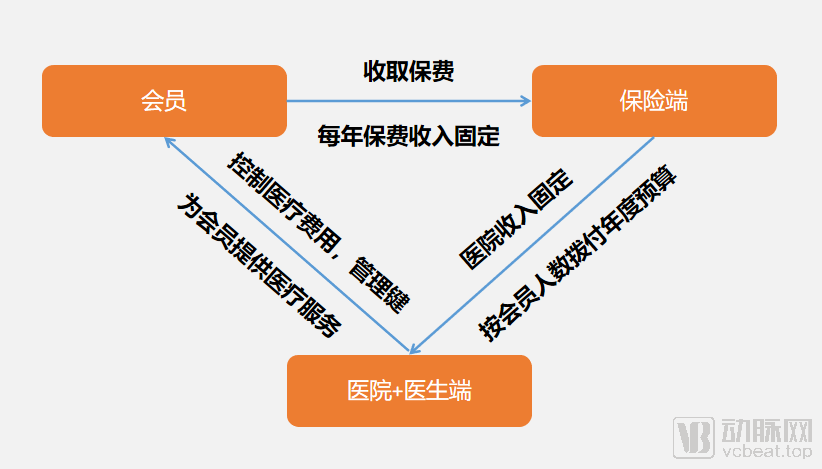 HMO Operating Model
“HMO” operating model refers to a system that provides comprehensive medical services to actively enrolled individuals in a specific region after collecting fixed prepaid fees.As the pioneer of the “HMO” operational model, Kaiser Permanente’s business model is characterized by its integrated organizational structure combining insurance and healthcare delivery, along with a capitation payment system. Within this closed loop integrating insurers, hospitals, and physician groups, Kaiser Permanente achieves efficient, self-sustaining operations, while the prepayment mechanism provides healthcare providers with incentives for cost control.
Whether it is UnitedHealth, which focuses on the insurance sector, or Kaiser Permanente, which specializes in healthcare services, theyAll have adopted a user-service-centric closed-loop ecosystem within their business frameworks, incorporating every core stage of the user experience into the service scope and establishing dedicated institutions or functional departments for direct management, thereby forming an integrated service model.
However, this is not the sole factor driving the development of internet healthcare companies.
LivongoA technology company specializing in the digital management of chronic diseases, Livongo started with diabetes solutions and took only five years from its founding to its IPO, earning it a reputation as a “growth model” in the U.S. digital health sector.
Livongo positions its solution as pioneering a new healthcare domain by introducing the concept of “Applied Health Signals” and building an “AI+AI” system to support the delivery of its solutions. Here, “AI” does not refer to the artificial intelligence currently trending in China; rather, “AI+AI” stands for Aggregate, Interpret, Apply, and Iterate.
It is not difficult to find that, although the three companies focus on different segments of digital health, they still share commonalities, namelyEmphasizing Technological Innovation and Building a Closed-Loop Service Ecosystem, these two core attributes also serve as the intrinsic driving forces for enterprises to achieve major breakthroughs and emerge as industry leaders.
The United States, by relying on a liberalized development path, has already produced numerous success stories that demonstrate the feasibility of the new operational model of “Internet + Healthcare.” However, different environments give rise to distinct health management models. Given the substantial differences in their healthcare sectors, China and the United States will inevitably adopt different approaches in advancing the development of “Internet + Healthcare.”
Amid the trend of differentiation, how are China’s leading enterprises strategizing? Ping An Health has upgraded its insurance strategy to focus on “medical care + health”; Waterdrop entered the health insurance market through critical illness mutual aid and then expanded into health management; and Miao Jiankang has leveraged health management to retroactively empower commercial health insurance. These three representative companies are gradually building closed-loop ecosystems from different perspectives and entry points.
On January 27, 2021, China’s leading internet healthcare service platform—Ping An HealthPing An Healthcare and Technology Company Limited (Stock Code: 1833.HK) announced that, in line with the comprehensive upgrade of its corporate strategy, the “Ping An Good Doctor” app has been officially renamed “Ping An Health.”
This renaming carries two primary implications: first, leveraging national policy support to focus on three key areas—channels, services, and capabilities—in order to provide users with full-lifecycle health management services covering prevention, treatment, and rehabilitation; second, strengthening synergy with Ping An Group’s healthcare ecosystem to deliver high-quality “medical + health” services to the public.
Similar to Ping An Health,Water DropIt is also fully committed to building an integrated service model. In a 2019 interview with VCBeat, Shen Peng, CEO and founder of Shuidi Inc., stated, “Shuidi will evolve into a platform-based company in the health sector, engaging in deep collaboration with supply-side stakeholders across the broader healthcare industry, enabling consumer-end users to access superior diagnosis and treatment services at lower costs.”
In 2020, Shuidi began exploring the “Internet + Healthcare” operational model. While providing users with more comprehensive and efficient insurance protection services, it also accelerated the exploration of healthcare services that could be integrated with health insurance, based on user needs. In addition, Shuidi launched a new project to explore the “Insurance + Pharmaceuticals” model, named “Shuidi Haoyaofu,” which provides pharmaceutical benefit services to both healthy individuals and those with pre-existing conditions.
Driven by market dynamics, Ping An Health and Shuidi have carved out distinctive development paths tailored to their own strengths. However, these are not the “standard answers,” as other viable pathways remain available. As a leading digital precision health management platform in China, Miao Jiankang starts with health management to integrate medical care, pharmaceuticals, and insurance, while deeply unlocking the value of big data on health behaviors and precision health management.
Miao HealthWe place great emphasis on digital technological innovation, leveraging the Internet of Things (IoT) and smart hardware to acquire user health data across multiple dimensions. By breaking down information barriers between device interfaces and data platforms, and integrating professional medical research with artificial intelligence algorithms, we intuitively present user profiles through the Health Behavior Index (M-Value) and the Comprehensive Health Score (H-Value). We conduct continuous, full-scenario data tracking and analysis for users, delivering personalized health management solutions tailored to individual needs. Furthermore, we have established a robust digital middle platform for health management, driving connectivity and applications across various industries and scenarios, including empowerment in insurance, enterprise settings, health communities, and healthy cities.
To unlock cost-control potential for insurers and facilitate seamless, end-to-end health management services, Miao Health has continued to expand its presence in the insurance sector, establishing partnerships with more than 80 domestic insurance institutions to help them address gaps in their health management service capabilities. In alignment with the “Healthy China” initiative, Miao Health also collaborates with real estate developers, hospitals, and government entities to jointly promote the rollout of upgraded AIoT-enabled Canada Health Management Center (China) locations across major cities, delivering comprehensive “on-site + off-site” scenario-based health management services. In corporate settings, it provides holistic health program solutions for employees (and served members), enhancing post-examination services and insurance coverage components.
Overall, whether it is Ping An Good Doctor, which is already listed, Waterdrop, which is preparing for its IPO, or Miao Health, which has experienced rapid growth in recent years, these three companies from different sectors are actively exploring diverse development paths for “Internet + Healthcare” and have established this as their future strategic focus, continuously making key deployments across various business segments.
Since the beginning of 2020, spurred by the COVID-19 pandemic, the digitalization of healthcare services has accelerated at an unprecedented pace. Digital health infrastructure has been elevated to a position of paramount importance. The Chinese government has intensively rolled out policies related to digitalization and “new infrastructure,” releasing a series of favorable measures that have injected new momentum into industry development.
In particular, the further opening of medical insurance policies will introduce a “super payer” to the new services and business models of “Internet + Healthcare.”In 2019, China’s total national medical insurance expenditure amounted to approximately RMB 2 trillion. A portion of these funds, allocated as payment for internet-based healthcare services, will significantly drive industry development and further exert a positive influence on patients’ choices in seeking medical care.
On another level, “accelerating the development of new infrastructure such as 5G networks and data centers” has become a strategic goal for the government. Since then, “new infrastructure” has once again become a buzzword in China’s economy.
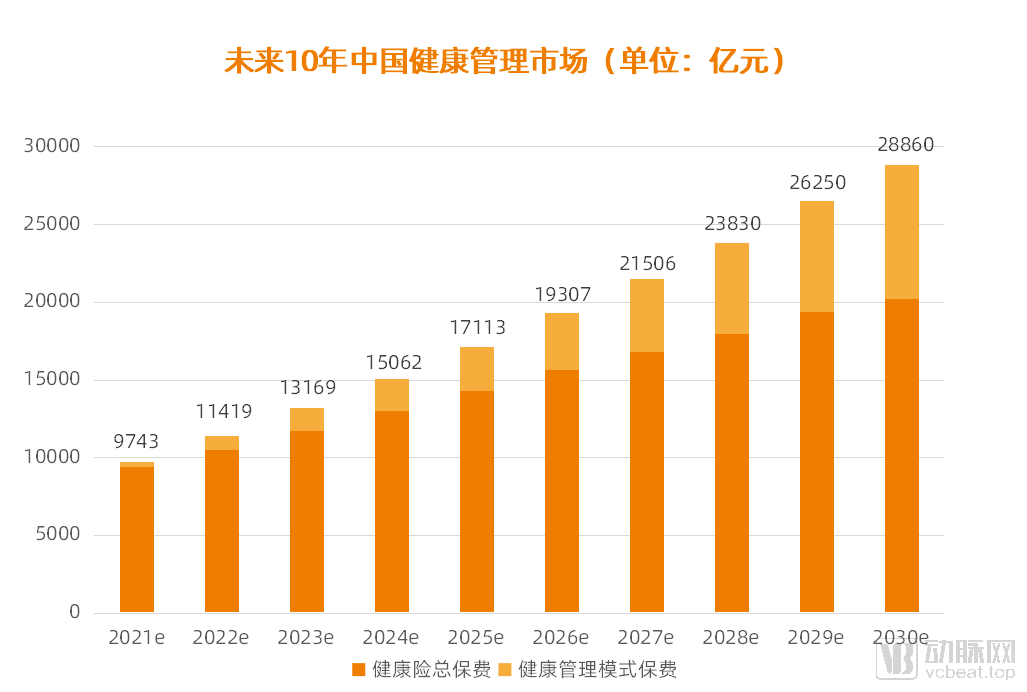
Data source: China Banking and Insurance Regulatory Commission, CICC Research Department; chart by VCBeat
Currently, authoritative experts from multiple fields have pointed out that, due to policy guidance and the deepening of market demand,The medical ecosystem closed loop based on “health management + pharmaceuticals and insurance” will become an important component of the “new infrastructure,” and is also key to whether China’s health management market can usher in a new wave of development.
“There are no successful enterprises, only enterprises of the times”“, this is a phrase often quoted by Zhang Ruimin, Chairman of the Board of Directors and CEO of Haier Group. In the healthcare sector, amid the current emergence of new business models, those who seize the opportunity and explore a development path that better integrates with their operations will gain a first-mover advantage and emerge as unicorn companies in this field.”
Therefore, under the trend of digital health management in China, the enterprises that create real value will inevitably be the pioneers that dare to seize opportunities, continuously iterate, and keep pace with the times.