

Venturing into Digital Healthcare Is Like Navigating a Fog-Shrouded Forest: An Interview with Tang Yinan of Yuan Equity Capital

SHUKUN
Provider of Intelligent Products and Innovative Solutions

MediTrust Health
Innovative Inclusive Health Medical Service and Security Platform

AnchorDx Medical
Developer, Manufacturer, and Marketer of Early Cancer Screening and Diagnosis Products

MARATHON VENTURE PARTNERS
Early-stage venture capital institution
Capital is a crucial force driving industrial development, particularly in innovative fields such as digital health, where the value generated is even more pronounced.
According to statistics from the VCBeat database,In 2020, a total of 682 investment and financing transactions occurred in China's digital health sector, with the total funding amount reaching RMB 133.5 billion, ranking second among healthcare subsectors, only behind biopharmaceuticals.
As we entered 2021, investor enthusiasm for the digital health sector intensified.According to incomplete statistics, as of March 19, a total of 56 investment and financing events occurred in China's digital healthcare sector., two mega-financing rounds each exceeding RMB 1 billion occurred successively, namely MediTrust Health’s RMB 1 billion Series B financing and Yuanxin Technology’s RMB 3 billion Series E financing.
Notably, MediTrust Health, founded in 2017, has completed four rounds of financing in just four years, demonstrating strong market potential and significant commercial value, making it a highly anticipated “dark horse” in the digital healthcare sector. The “talent scout” that helped MediTrust Health secure its angel round and has consistently participated in subsequent investments is none other than today’s “protagonist,” MARATHON VENTURE PARTNERS.
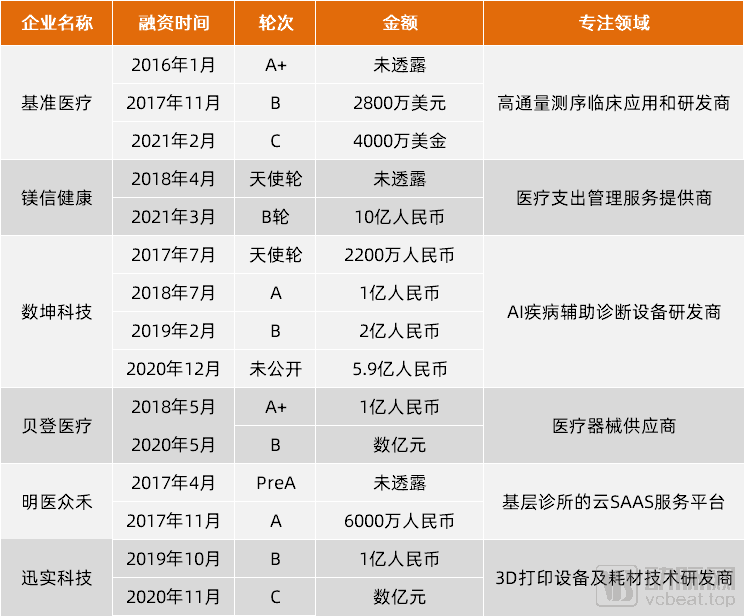
MARATHON VENTURE PARTNERS’ Key Investments in Recent Years
MARATHON VENTURE PARTNERS is one of the most professional early-stage investors in digital health technology in China. In recent years, its portfolio has included Mingyi Zhonghe, which focuses on primary care; Vedeng Medical, a B2B trading platform for medical devices; SHUKUN, an AI-based medical imaging company; SprintRay Co., a provider of digital dental solutions; MediTrust Health, a commercial medical insurance technology firm; and AnchorDx Medical, which specializes in early cancer screening based on gene sequencing.
Given MARATHON VENTURE PARTNERS’ high vertical focus and strong expertise in the digital health sector, VCBeat conducted an exclusive interview withTang Yinan, Investment Director at MARATHON VENTURE PARTNERS, aiming to gain insights into the development path and future trends of China's digital health sector from the perspective of industry investors, deeply analyze the entry strategies and underlying logic of investment institutions in the digital health field, and provide guidance for entrepreneurs and investors in the digital health track on how to respond to the new market landscape.
When asked about the qualities investors should possess in the field of digital health, Tang Yinan listed many answers, such as having sufficient understanding of the industry they are engaged in, possessing strong composite capabilities, and having keen business insight. However, in her view, these so-called "standards" will change along with the changes in the industry, andThe only constant is the need for continuous learning, akin to that of an entrepreneur.。
 Tang Yinan, Investment Director at MARATHON VENTURE PARTNERS
Tang Yinan did not initially set out to become an investor; indeed, it was never part of her original career plan. In her own words, joining a healthcare investment firm was more of a “happy accident.” Yet, if you examine her educational and professional background, you will find that this path was far from coincidental. Rather, it was the natural culmination of years of experience and personal growth.
During her undergraduate studies, Tang Yinan majored in Biochemistry at the University of Hong Kong. However, after a period of study, she realized that the field did not align well with her interests. Consequently, during her junior and senior years, she made up her mind to switch to engineering for her graduate studies.
This was not a whim. Switching to engineering allowed her to leverage her strengths in abstract thinking and logical analysis, while also aligning with her professional interest in applying science and technology to solve practical problems. Thus, after completing her undergraduate studies at the University of Hong Kong, she chose to pursue a master’s degree in Biomedical Engineering at Cornell University in the United States.
Tang Yinan is a person with boundless curiosity for the unknown. During her studies, in addition to her major courses, she minored in various science and engineering subjects of interest to her, including chemistry, physics, computer science, electronics, mechanical engineering, materials science, and chemical engineering.“I once studied chip design and quantum mechanics at university, participated in robotics competitions, designed biosensors, and built mathematical models of human organs. I had assumed that this knowledge would become obsolete after graduation. Unexpectedly, a decade later, these technologies are gradually being implemented in the healthcare industry, emerging as the most sought-after investment sector.”Tang Yinan said.
After obtaining his master’s degree, Tang Yinan enteredGE Healthcare China Team, starting as a frontline engineer, she gradually expanded her role from medical device R&D to project management and marketing management. Five years later, with new reflections on her career path and a desire to engage more deeply in the wave of medical technology innovation, she chose to “graduate” from the large platform of GE and pursue an MBA at Cheung Kong Graduate School of Business, before embarking on a career in healthcare venture capital.
From a master’s student in biomedical engineering to an R&D engineer, and from R&D management to marketing management and then to an investor, each identity shift seemed to happen inadvertently. Tang Yinan said, “I had a clear plan for my career path even during my school years.”“First, you must do what you love; second, it is best to do what you are good at. Everything else is of little importance.”
In Tang Yinan's view,China’s healthcare sector has moved beyond the entrepreneurial era dominated by “domestic substitution” under traditional business models, as the low-hanging fruit has largely been picked and only the hard nuts remain. Future opportunities will increasingly arise from interdisciplinary, innovative fields, a trend most evident in digital health.The most vibrant digital health innovators are those that can leverage both technological and business model innovations to fundamentally address the various pain points and bottlenecks inherent in the healthcare industry, thereby delivering sustained value to the sector. If we were to draw an analogy for the entire industry,It is like facing a path never before trodden, with the finish line ten kilometers away. The market potential is immense, yet we can only clearly see the first hundred meters ahead; there is still a long road to travel in the future.
This is a challenge for the new generation of entrepreneurs, and likewise for this generation of investors.In the long journey ahead, innovation serves as the core driving force that sustains continuous progress. However, innovation necessitates relentless learning, constant exploration of new value propositions for products, ongoing iteration of one’s cognitive frameworks, and persistent expansion of one’s competency boundaries. This holds true for both entrepreneurs and investors in this sector.
Although not formally trained in the field, Tang Yinan, who is thoughtful and passionate about new developments, quickly became well-versed in digital healthcare and developed his own understanding and insights into the industry.
She remarked,“In the digital health sector, all technologies and products are developed to address industry challenges, and all innovation opportunities stem from industry pain points or unmet needs. As an investor, having reviewed numerous companies, I have observed an interesting phenomenon: few enterprises fail due to technology; rather, the more common issues lie in founders’ failure to identify the right needs, or their inability to provide solutions that fundamentally resolve the underlying problems.”
Specifically, where do these so-called “problems” lie?
First, there is a shortage of interdisciplinary talent.Talent is a critical component in any field, serving as the key driving force behind its development. This value is particularly evident in innovative sectors such as digital health. According to Tang Yinan, the most significant obstacle currently hindering industry growth is the shortage of interdisciplinary talent. Digital health is a highly cross-disciplinary field that requires practitioners to possess cognitive capabilities across multiple domains. However, at present, most professionals have achieved expertise only within their specific specialties, lacking the ability to think and operate across disciplinary boundaries.
Second, insufficient technological connectivity.。In the interview, Tang Yinan did not regard “technology” itself as the core pain point, because in her view, many currently maturing digital technologies have not been widely implemented in the healthcare sector.The critical issue lies in the failure of various new technologies to achieve “deep integration” with healthcare.The Industrial Revolution brought about advancements in machinery, but it did not resolve the issue of operational efficiency across the entire value chain. Technologies of the industrial era were adept at addressing standardized problems, whereas medical processes are highly individualized. The underlying challenge for innovative products or services in the digital age lies in the need to shift the mindset from being “technology-centric” to “user-centric.”
Third, there is a lack of high-quality solutions.Bridging the gap from technology to product requires traversing multiple stages: first, assembling a team of multidisciplinary talent; second, developing systematic solutions; and finally, refining and iterating the product. Digital technologies have the potential to optimize products, user experience, and costs simultaneously across various sub-sectors of the healthcare industry. However, due to the stringent quality requirements in healthcare, high-barrier, high-quality solutions often demand more time for refinement and maturation.
From the perspective of MARATHON VENTURE PARTNERS,“Efficiency, Reach, Payment”These three major directions represent the three structural opportunities that digital technology has brought to the healthcare industry. So, how does MARATHON VENTURE PARTNERS, which focuses on early-stage investments, select innovative enterprises?
First and foremost, it is essential to have an excellent core team.For innovative enterprises, an excellent team is an indispensable and critical component. This is particularly true for MARATHON VENTURE PARTNERS, which focuses on early-stage investments, where this factor carries exceptionally high value. For MARATHON VENTURE PARTNERS,It is not alarming for a company to have “shortcomings,” as these can be gradually addressed and improved over time; however, its “strengths” must be sufficiently robust., as this constitutes the company’s core competitive barrier and is the key determinant of its ability to successfully navigate its market pathway.
Secondly, it is essential to proceed from actual needs.Venturing deep into the realm of digital health is akin to navigating a fog-shrouded forest; each step forward involves exploration and iteration. Nevertheless, advancing in the direction of market needs ensures one will never “lose their way.” For innovative enterprises,, it is essential to “choose the hammer based on the size of the nail,” that is, to build a holistic solution starting from the actual needs., rather than “looking for nails with a hammer,” which means failing to uncover the root causes of problems and instead addressing imagined needs with preconceived solutions—an approach that is inherently flawed.
Then, maintain focus, delve deep and thorough, and build barriers.In Tang Yinan’s view, the growth trajectory of digital health companies is not linear but rather resembles an airplane taking off. During the phase of refining products and services, the upward momentum may seem insufficiently pronounced or rapid, but if thisThe longer the polishing phase, the greater the accumulated kinetic energy, enabling it to fly higher and farther once airborne.However, if a company fails to adequately refine its foundational processes before rashly opting for a "jump start," it will inevitably struggle significantly in the later stages. This is an inherent pattern of industry development.
Finally, adaptability enables the continuous generation of new value.Currently, the digital health industry is still in a rapidly evolving transitional phase, and thusCognition is also undergoing continuous iteration.Whether for the iteration of product solutions or the construction of business models, there is an urgent need for continuous innovative thinking. This requires entrepreneurs to engage in sustained learning and reflection, keep pace with industry changes, and identify strategic leverage points that align with their own capabilities amidst these shifts, thereby achieving leapfrog growth.
Nowadays, the relationship between investment institutions and enterprises is no longer a simple “investor-investee” dynamic, but rather a mutually beneficial partnership characterized by “synergistic collaboration and win-win cooperation.” In layman’s terms, it is akin toInvestment firms are co-founding startups with enterprises. Particularly for early-stage investment firms like MARATHON VENTURE PARTNERS, choosing to make strategic investments during periods of industry non-consensus often requires accompanying entrepreneurs through a solitary journey in the post-investment phase. This is a process of mutual learning, and the industry insights gained by investors during the post-investment period are often more profound than those acquired prior to investment.
Tang Yinan stated,As an investment firm, our earnings should be divided into two parts. One part comes from pre-investment efforts—accurately identifying the right direction and betting on the right team, which means making precise investment choices. The other part stems from post-investment “value-added services,” namely helping portfolio companies grow more robustly and steadily during the post-investment phase, thereby increasing their likelihood of successfully reaching their end goals.
So, how do investment institutions effectively provide post-investment services to portfolio companies?
First, maintain close communication to enhance industry understanding through the exchange of ideas.Tang Yinan noted that, as an investor, he frequently engages in dynamic discussions with entrepreneurs. Whenever he gains new insights into industry developments, he shares them with portfolio companies immediately, while entrepreneurs also proactively share and discuss the challenges and growth their businesses are experiencing.
Second, focus on refinement to systematically enhance corporate management capabilities.For innovative enterprises, the most critical need is to build a highly efficient organization, which often requires professional talent support in every core segment of the business. To address this common pain point, investment institutions will strengthen their empowerment efforts in organizational development, providing systematic assistance tailored to corporate needs to enhance overall competitiveness and help companies establish efficient operational systems.
Third, build bridges to facilitate the effective alignment of resources.For digital enterprises, their business models often require connecting various stakeholders and then empowering specific business scenarios. Early-stage companies lack the capability and corresponding resources to establish partnerships with large enterprises. Meanwhile, large enterprises have clear needs in certain digital fields but struggle to find suitable partners. Therefore, investment institutions can act as “intermediaries,” helping to build this communication bridge between enterprises.
In addition to these common basic needs, investment institutions also provide targeted assistance and support within their capabilities, tailored to the specific circumstances of each enterprise.
For any investment institution, “risk” is an unavoidable term that often commands caution. This is particularly true for firms like MARATHON VENTURE PARTNERS, which primarily focus on early-stage enterprises and thus exhibit heightened sensitivity to risk. However, it is essential to recognize that in the rapidly evolving field of digital health, “risk” represents not only a challenge but also an opportunity. In light of this, how does MARATHON VENTURE PARTNERS perceive and manage risk?
In Tang Yinan's view,Investment institutions are inherently in a state of dancing with risk, a reality that remains unchanged across all time horizons.Choosing to become an early-stage venture capitalist means hoping to start at the nascent stage of innovative sectors, accompanying entrepreneurs to witness the industry’s development and growth, and gaining deeper understanding and insights into the industry through this journey.
Although, in theory, investment risk and return are positively correlated, the healthcare industry is currently undergoing structural changes that present opportunities for excess returns.Digital healthcare is a typical track,On one hand, payment reforms, volume-based procurement, and the COVID-19 pandemic have generated entirely new demands among hospitals, enterprises, and patients. On the other hand, as digital technologies continue to mature and innovative talent increasingly enters the healthcare sector, the commercial translation of innovative technologies is gradually reaching a critical tipping point.Over the past decade, the U.S. digital health sector has experienced tenfold growth. In contrast, the Chinese market starts from a lower base yet boasts a higher ceiling, presenting greater potential for significant opportunities. In recent years, MARATHON VENTURE PARTNERS has keenly observed the rapid emergence of demands and solutions in this field. By investing at the early stage of this major trend, the firm aims to leverage first-hand information, extensive industry experience, and cognitive advantages to create a data flywheel that enhances its investment decision-making.
As mentioned earlier,Current digital healthcare is akin to a marathon that has just begun; its finish line lies ten thousand meters away, yet we are still in the first hundred meters. Therefore, both entrepreneurs and investors should remain focused, strive for excellence in every endeavor, and move more resolutely toward our shared goal.
About the Stanford Medicine Futures Consortium
The Stanford Medical Future Association was co-founded by master’s students, doctoral candidates, and postdoctoral researchers from Stanford University who specialize in digital health. It aims to drive innovation in the medical industry through industry-academia-research collaboration by fostering deep cooperation and exchange between scholars, entrepreneurs, and technical experts from top-tier institutions such as Stanford, Yale, Harvard, and MIT, and Chinese medical industry entrepreneurs, investment experts, policy experts, and media professionals.
Obtain a referral from at least one existing member and send a third-person biography that fully demonstrates your long-term commitment to the digital health sector to the founder’s WeChat: leonstanford18.