

Another TCM Company Rings the Nasdaq Bell: How Far Is the Internationalization of Traditional Chinese Medicine?
VCBeat has learned that on March 23, 2021 (Eastern Time), Daziran Pharmaceutical officially listed on the NASDAQ under the stock ticker “UPC,” becoming the first Chinese proprietary Chinese medicine company to go public in the United States and the second traditional Chinese medicine enterprise to list on the NASDAQ Stock Exchange in 2021.
Since filing its prospectus in August 2020, Nature’s Medicine has attracted significant attention from stakeholders in the traditional Chinese medicine (TCM) sector. This is because its listing not only secured its status as the “first NASDAQ-listed company specializing in proprietary Chinese medicines,” but also increased the number of TCM enterprises successfully listed on U.S. stock exchanges to six.
Since 2004, more than ten traditional Chinese medicine (TCM) companies have attempted to list on U.S. stock exchanges. Why did they bypass China’s domestic capital markets and seek listings across the Pacific? What is their current status? How well is TCM recognized in overseas markets? How far along is the internationalization of TCM? To address these questions, VCBeat has compiled this report.
The exploration of overseas listings by traditional Chinese medicine (TCM) enterprises can be traced back to 2004. While some companies have yet to succeed despite years of effort, others have set successful precedents.
Pingchuan Pharmaceutical:According to reports from Xinhua News Agency and other media outlets, on August 2, 2004, Harbin Pingchuan Pharmaceutical went public on the NASDAQ through a reverse merger by acquiring a 96% stake in the U.S. company Xenicent. Pingchuan Pharmaceutical issued a total of 70 million floating shares, with nearly 2,000 shareholders. However, according to Tianyancha, the company was voluntarily deregistered on July 1, 2015, and information regarding its listing price and funds raised is unavailable.
Tian'an Pharmaceutical:Tian’an Pharmaceutical is engaged in the research, development, production, and sales of pharmaceutical products. Its core product, “Compound Xuecan Capsules,” was listed by the National Medical Products Administration (NMPA) as a Class III new drug for the treatment of prostatic diseases. On August 24, 2004, Xi’an Tian’an Pharmaceutical Co., Ltd. announced the appointment of Xu Shimin as its chief advisor for overseas listing, aiming to become the first traditional Chinese medicine company listed on the NASDAQ in the United States. On June 22, 2007, Tian’an Pharmaceutical officially conducted quotation frequency testing on the U.S. Over-the-Counter Bulletin Board (OTCBB). However, there were no further developments regarding Tian’an Pharmaceutical’s pursuit of a U.S. stock market listing thereafter.
Yunnan Southern Medicines:In October 2005, Yunnan Nanyao Jiaoxiong (a subsidiary of Yunnan Nanyao) entered into an IPO advisory agreement with Merrill Lynch Securities and CDI Investments in the United States to list on the NASDAQ; in December of the same year, Yunnan Nanyao Group signed an IPO advisory agreement with Canada’s Maglun Group, continuing its push toward the U.S. NASDAQ market; in December 2007, Nanyao Jiaoxiong executed an IPO advisory agreement with Zhongzhi Investment Bank Co., Ltd.... However, ten years later, on June 19, 2017, Nanyao Jiaoxiong had its business license revoked.
Aixin Zhonghong Biotech:On September 26, 2017, Chengdu Aixing Zhonghong Biotechnology Co., Ltd. held a press conference in Chengdu, announcing its plan to list on the NASDAQ in the United States in the near future. At that time, the company would have become the first biotech and health enterprise from Southwest China to be listed in the U.S. According to reports, Chengdu Aixing Zhonghong Biotechnology Co., Ltd. had been dedicated to the supply and sales of all-natural plant-based health products and nutritional supplements. However, the company’s attempt to list on the U.S. stock market ultimately came to nothing.
Multiple failed listing attempts have not dampened the enthusiasm of traditional Chinese medicine (TCM) companies for going public in the United States. Based on publicly available information, VCBeat has identified six TCM companies listed on U.S. stock exchanges.
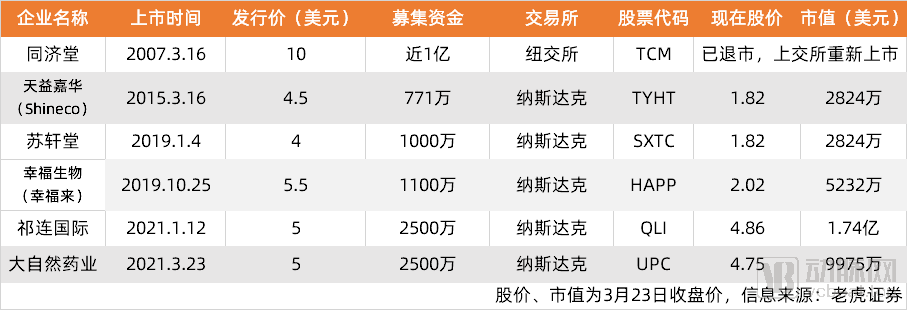
Tongjitang:On March 16, 2007, Tongjitang Chinese Medicines Company, a century-old traditional Chinese medicine (TCM) enterprise, officially began trading on the New York Stock Exchange (NYSE), becoming the first TCM company from China to be listed on the U.S. stock market. Tongjitang issued 9.865 million American Depositary Shares (ADSs), raising nearly $100 million. According to Xinhua News Agency, Wang Xiaochun, Chairman and CEO of Tongjitang, stated that the company’s successful listing in the United States represents a perfect integration of traditional Chinese medicine with modern capital markets, facilitating the introduction of TCM to investors and consumers in the U.S. and around the world.
As the first traditional Chinese medicine (TCM) pharmaceutical company to list on the U.S. stock market, Tongjitang was held in high expectations. However, this spotlight was short-lived, lasting only a year before Tongjitang itself chose to step away from it. In the spring of 2008, Tongjitang announced the repurchase of all outstanding shares to delist. It was revealed that the reason for this delisting was that “the company’s value was severely undervalued.” Unwilling to be “underestimated,” Tongjitang sought to use this move to restore the reputation of TCM.
From a market performance perspective, signs of Tongjitang’s delisting had long been evident. One year after its initial public offering (IPO), Tongjitang’s stock price peaked at $12.88 per share but remained below its IPO price of $10 for the majority of the time. On April 2, 2008, its share price fell to $8.30. Nevertheless, Tongjitang quickly adjusted its strategy following its setback on the New York Stock Exchange (NYSE) and shifted its focus to the domestic Chinese stock market. In May 2016, Tongjitang completed a backdoor listing by merging with Xinjiang Beer Flower Co., Ltd.
Tianyi Jiahua:On March 16, 2015, Tianyi Jiahua filed its initial IPO prospectus with NASDAQ. After repeated postponements of the listing date, it was finally set for September 28, 2016. The company issued 1.71319 million shares at $4.5 per share, raising $7.71 million, with the stock ticker symbol TYHT.
Tianyi Jiahua is dedicated to the research, development, and commercialization of bio-health products. In China, it has established a distinctive traditional Chinese medicine (TCM) industrial chain ecosystem, encompassing five major industrial systems: cultivation of TCM medicinal materials, comprehensive extraction of TCM medicinal materials, extension and production of derivative TCM products, marketing networks for pharmaceuticals, active pharmaceutical ingredients (APIs), and health products, as well as physician consultation and healthcare services.
Su Xuantang:On January 4, 2019, Su Xuantang officially listed on the NASDAQ capital market in the United States, with the stock ticker symbol “SXTC,” and began public trading at a price of $4 per share.
Suxuantang is an innovative traditional Chinese medicine (TCM) pharmaceutical enterprise integrating independent research and development, production, and sales. In addition to conventional TCM decoction pieces, the company has leveraged innovative technologies to develop 13 new types of modern TCM decoction pieces, such as direct-oral decoction pieces, direct-brewing decoction pieces, and refined decoction pieces.
Suxuantang’s journey in the U.S. stock market has been challenging. In the early stages after its IPO, Suxuantang’s share price initially rose, peaking at $23 per share, before entering a prolonged decline that kept it below $1 for the majority of 2020. On September 21, 2020, the stock hit its lowest point at $0.232. It was not until 2021 that Suxuantang’s share price began to recover.
Xingfu Biotech:Following Su Xuantang, Fujian Happiness Biotechnology Group also delivered good news at the end of 2019. On October 25, 2019, Happiness Biotech publicly offered 2 million ordinary shares at a price of $5.5 per share, under the stock ticker symbol “HAPP.”
Xingfu Biology is an innovative Chinese producer of nutritional foods and Ganoderma lucidum (Reishi mushroom) products, dedicated to the research, development, manufacturing, and sales of a diverse range of products formulated with traditional Chinese medicine extracts and other ingredients. Its flagship brand is the Xingfulai Ganoderma lucidum series. Xingfu Biology has established a product portfolio comprising 32 “Blue Hat” nutritional health supplements registered with the China Food and Drug Administration (CFDA), along with a series of products primarily based on Ganoderma lucidum. In 2020, the company’s stock price followed an overall downward trend but remained above $1.68. After 2021, the stock price began to recover.
Qilian International:On January 12, 2021, Qilian International Holding Group Ltd., a Chinese manufacturer of pharmaceutical and chemical products, officially listed on the Nasdaq Global Market under the ticker symbol “QLI.” In this initial public offering (IPO), Qilian International issued 5 million ordinary shares at $5 per share, raising $25 million in capital, which exceeded the $24 million initially indicated when its prospectus was first filed last year.
On its trading debut, Qilian International opened at $8.01 per share, representing a 60.2% increase over its IPO price; it closed at $10.00 per share, doubling its IPO price (a 100% increase). Based on the closing price, Qilian International’s market capitalization stood at $350 million. Founded in 2006 and headquartered in Jiuquan, Qilian International is a pharmaceutical and chemical company dedicated to the research and development, manufacturing, marketing, and sales of licorice-based products, oxytetracycline, traditional Chinese medicine derivatives, heparin products, and fertilizers.
Nature Pharmaceutical:On March 23, 2021, Daziran Pharmaceutical listed on the Nasdaq, becoming the first Chinese proprietary medicine company to go public on the exchange. Daziran Pharmaceutical opened at $5.26 per share, approximately 5.2% higher than its IPO price of $5, and reached a high of $5.72 during the session. Intraday, the stock price fell by more than 13%, triggering a five-minute trading halt due to abnormal volatility. By the market close, Daziran Pharmaceutical’s share price stood at $4.75, down 5%.
Daziran Pharmaceutical was established in Jiangxi, China, in 1988, dedicated to the manufacturing and sales of Traditional Chinese Medicine-derived (TCMD) products for the elderly. Currently, Daziran Pharmaceutical has obtained NMPA approval for 26 TCM varieties and has produced and sold 13 TCMD products.
Judging solely by stock price performance, the overseas listing journey for traditional Chinese medicine (TCM) companies has been challenging. So, why do these TCM enterprises choose to go abroad rather than list on domestic stock markets?
According to the analysis in the article “Analysis of Overseas Exchanges’ Competition for China’s Potential IPO Resources,” Chinese companies enjoy the following advantages when listing overseas:
Low listing thresholds and rapid fundraising:Listing thresholds on overseas exchanges are relatively low, particularly for small and medium-sized innovative enterprises seeking to list on overseas growth enterprise markets, where requirements are quite lenient. Furthermore, stock listings in overseas markets generally adopt a registration-based system, featuring simplified application procedures and shorter processing times. Exchanges worldwide are actively promoting “rapid capital raising” as a key advantage to attract companies. For instance, the substantial funds raised by Daziran Pharmaceutical through its IPO have helped alleviate financial pressures on its customers and suppliers, thereby facilitating the adjustment of its business structure.
Market Discipline Mechanisms Facilitate Corporate Growth:Overseas capital markets have robust mechanisms for nurturing companies, particularly innovative enterprises. By listing abroad, Chinese companies are subject to oversight by more mature international institutional investors and more standardized market mechanisms, which significantly promotes the improvement of their corporate governance structures and management standards. For instance, foreign capital markets impose stringent requirements on continuous information disclosure post-listing. Maintaining strong long-term relationships with institutional investors is crucial for companies to secure refinancing and achieve sustainable growth.
Enhancing International Reputation and Overseas Opportunities:Overseas listing enables companies to learn advanced management practices from international peers, achieving market expansion and brand image enhancement unattainable by ordinary enterprises, thereby facilitating entry into global markets. Meanwhile, overseas listing provides access to abundant international cooperation resources, while high-quality investors can further empower the company itself.
Among the collected corporate profiles, with the exception of Tongjitang, all other traditional Chinese medicine companies have chosen to list on the NASDAQ. This trend is driven by the fact that, compared to the New York Stock Exchange, NASDAQ imposes less stringent requirements on the financial status and stock liquidity of non-U.S. enterprises.
At the same time, however, due to differences in cultural backgrounds and theoretical systems, coupled with the fact that traditional Chinese medicine (TCM) is predominantly circulated in the U.S. market as dietary supplements, making drug status certification difficult, the efficacy of TCM is hard for capital markets to comprehend. As a result, the stock performance of six listed companies has been lackluster.
Although Traditional Chinese Medicine (TCM) has underperformed in the stock market, it has achieved certain results through other channels of internationalization. According to data from the white paper "Traditional Chinese Medicine in China" released in 2016, TCM has spread to 183 countries and regions worldwide. The Chinese government has signed 86 cooperation agreements on TCM with relevant countries and international organizations and supported the establishment of 10 overseas TCM centers. According to WHO statistics, TCM has been legally recognized by governments in 29 countries and regions, including Australia, Canada, Austria, Singapore, and Vietnam. Currently, 18 countries and regions around the world have included TCM in their medical insurance systems.
According to data from the China Chamber of Commerce for Import and Export of Medicines and Health Products in May 2019, Chinese traditional medicine products were exported to 193 countries and regions in 2018. Asia remained the primary market for these exports, with Vietnam, India, and Malaysia ranking as the top three destination countries. In 2018, the export value of Chinese traditional medicine to Asian countries and regions reached USD 2.211 billion, a slight year-on-year increase of 4.72%, accounting for 56.57% of China's total traditional medicine exports.
Some traditional Chinese medicine products have also obtained "drug" status internationally.
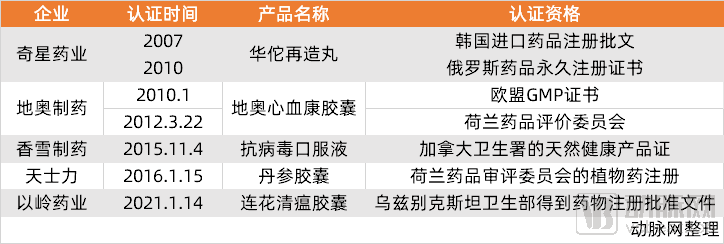
In 2007, Qixing Pharmaceutical’s Huatuo Zaizao Wan became the first Chinese proprietary medicine for stroke treatment to obtain an import drug registration approval in South Korea. Three years later, the product secured a permanent drug registration certificate in Russia, thereby entering the mainstream international market for the prevention and treatment of cardiovascular and cerebrovascular diseases.
In February 2008, Di’ao Group submitted the EU drug registration application for Di’ao Xin Xu Kang Capsules to the Dutch Medicines Evaluation Board (MEB), and filed the EU GMP certification application in March of the same year. In January 2010, Di’ao Xin Xu Kang Capsules officially obtained the EU GMP certificate. On March 14, 2012, Di’ao Xin Xu Kang Capsules were successfully approved by the Dutch MEB, becoming the first traditional Chinese medicine product from China to enter the European pharmaceutical market as a therapeutic drug.
On November 4, 2015, Xiangxue Pharmaceutical issued an announcement stating that its Antiviral Oral Liquid had received a Natural Health Product (NHP) License from Health Canada, thereby gaining market access in Canada.
Tasly has been exploring the internationalization of Traditional Chinese Medicine (TCM) for over two decades. On January 15, 2016, Tasly’s modern TCM product, Danshen Capsules, officially received herbal medicinal product registration approval from the Medicines Evaluation Board of the Netherlands. This marked the first therapeutic drug certificate obtained by a Tasly TCM product in the mainstream European pharmaceutical market. In addition to obtaining marketing authorization, Tasly has been promoting the global reach of TCM through various other means. In 2002, Tasly established a company in South Africa to foster the development of TCM in Africa. In 2013, Tasly subscribed to the Dutch Shenzhou Medical Center for €1.82 million, establishing the Netherlands Shenzhou Tasly Pharmaceutical Group, thereby pioneering overseas mergers and acquisitions in the TCM sector. In 2014, Tasly partnered with Australia’s Kangping Healthcare to launch the “Tasly Kangping Medical Center” project, which played a positive role in promoting the dissemination of TCM culture in Australia.
During the COVID-19 pandemic, Lianhua Qingwen Capsules gained significant popularity, bringing Yiling Pharmaceutical into the public spotlight. Yiling Pharmaceutical has also been actively advancing its initiatives in the internationalization of traditional Chinese medicine.
Yiling Pharmaceutical has successfully introduced multiple proprietary products into the international market. Among these, Tongxinluo Capsules were included in Vietnam’s National Health Insurance Directory, marking the first product from overseas to be listed in a national health insurance formulary. Lianhua Qingwen Capsules, a flagship product of Yiling Pharmaceutical, have played a pivotal role in advancing the company’s internationalization strategy. In March 2016, Lianhua Qingwen Capsules received approval to directly conduct Phase II clinical trials in the United States, becoming the first traditional Chinese medicine (TCM) for influenza treatment to enter FDA-regulated clinical studies in China, as well as the first large-formula TCM worldwide to do so. In September 2016, the U.S. Phase II clinical trial of Lianhua Qingwen Capsules was officially launched in Virginia. On January 14, 2021, Yiling Pharmaceutical received drug registration approval issued by the Ministry of Health of Uzbekistan, formally launching Lianhua Qingwen Capsules in the Uzbek market.
For decades, traditional Chinese medicine (TCM) has been exploring its status as a “drug” overseas, yet few products have gained recognition. In contrast to the struggles of TCM in foreign markets, Japanese Kampo medicines have found greater success.
The core journal Chinese Traditional and Herbal Drugs mentioned in a 2016 article that Japanese Kampo medicines account for 90% of the global market share in traditional Chinese medicine (TCM) sales. Tsumura & Co., as the largest Kampo pharmaceutical company in Japan and worldwide, has made significant contributions to this dominance.
Tsumura also established an early presence in overseas markets.
In 1991, Tsumura & Co. submitted an application to the U.S. Food and Drug Administration (FDA) to initiate clinical trials. Starting in 1992, Tsumura’s products entered the U.S. market and were sold as pharmaceutical drugs. In 1998, Tsumura established representative offices in New York and Los Angeles, and began marketing over-the-counter (OTC) Kampo medicines as dietary supplements to Japanese residents in the United States. In 2001, Tsumura USA, Inc. was established, serving as Tsumura’s drug development base in the United States and responsible for U.S. business operations and pharmaceutical development.
In November 2004, Tsumura’s Kampo formula Keishi-bukuryo-gan officially launched Phase II clinical trials in the United States. In May 2005, Tsumura’s Daikenchuto granules also entered clinical trials. As a warming interior-releasing agent, Daikenchuto is used as a prescription drug in Japan. Tsumura & Co. developed it into a portable granule formulation, which has been widely used and well received. To introduce Daikenchuto to the U.S. market, Tsumura & Co. conducted eight clinical trials in the United States; one was terminated due to insufficient enrollment, while seven were completed. In May 2018, after 13 years of exploration, the indication for Daikenchuto’s development and marketing in the United States was determined to be postoperative ileus. This Kampo formula was expected to gain U.S. market approval in 2021.
“Promoting the global outreach of Traditional Chinese Medicine (TCM)” is one of the six key development priorities in the TCM sector outlined in the 14th Five-Year Plan. With favorable policy tailwinds now in place, concerted efforts from market participants are required to drive progress.
Innovation is the driving force behind development. Experience from Japan demonstrates that innovations in the appearance and taste of pharmaceutical preparations facilitate broader public acceptance. Most Japanese Kampo medicines adopt dosage forms such as granules, tablets, capsules, and oral liquids, thereby moving away from the traditional method of consuming Chinese medicine through water decoction and prolonged boiling. Such innovations in dosage forms make Kampo medicines more convenient to administer and better suited to the fast-paced lifestyle of modern society.
In this regard, Suxuantang has already taken action. In June 2013, Suxuantang recruited Deng Jingzhen, a senior U.S. expert in natural products (traditional Chinese medicine), to establish an R&D department and pioneer new frontiers in the development of modern TCM decoction pieces. The company achieved significant breakthroughs in technologies such as improving the water extraction rate and the yield of active ingredients from TCM decoction pieces, as well as implementing efficient, rapid, low-temperature, residue-free sterilization methods. As a result, it developed 13 new types of modern TCM decoction pieces, including those suitable for direct oral administration, direct brewing, and refined decoction pieces.
Promoting the Standardization of Quality in Traditional Chinese Medicine. A significant barrier to the internationalization of Traditional Chinese Medicine (TCM) is the difficulty for overseas users to recognize the efficacy of TCM products within the context of Chinese culture. For instance, many TCM products provide vague information regarding indications and adverse reactions. Strengthening research into the principles of TCM, identifying its therapeutic targets and mechanisms of action, and clarifying the interactions between Chinese herbal medicines, the environment, and pathogens will facilitate greater acceptance abroad.
Reference Article:
Why Do Chinese Companies List on Nasdaq?
Accelerating Globalization of Traditional Chinese Medicine: Over a Dozen Proprietary Chinese Medicines Have Submitted Registration Applications to the U.S. FDA
Current Status of International Registration of Traditional Chinese Medicine: Which Proprietary Chinese Medicines Have Been Marketed Abroad?
Performance Swings from Profit to Loss: Time-Honored Brand Su Xuan Tang (SXTC.US) Suffers in Silence
Behind the High-Profile Delisting of Tongjitang, the First U.S.-Listed Traditional Chinese Medicine Company
Why Do Japanese Kampo Medicines Account for 90% of the Global Market Share in Traditional Chinese Medicine Sales?
Tian'an Pharmaceutical Strives to Build the Leading Chinese Herbal Medicine Concept Stock on the U.S. NASDAQ
Why Is It Difficult for Traditional Chinese Medicine to Enter the International Mainstream Market?
Over 70% of Traditional Chinese Medicine Enterprises Achieve Profitability, Signaling a Potential “Second Spring” for the TCM Industry
Zhang Boli: How Can Traditional Chinese Medicine Uphold Its Core Principles While Innovating and Going Global?
Analysis of the Competition from Overseas Exchanges for China's Potential IPO Resources