

Senda Biosciences: Pioneering Intersystems Biology for Next-Generation Drug Discovery and Delivery

Flagship Pioneering
Venture Capital Firms
In nature’s ecosystems, various organisms maintain a dynamic stance of both cooperation and competition to maximize access to survival resources, which biologically manifests as continuous bidirectional exchange at the molecular level.
Among these, plants, microbes, and humans have co-evolved for thousands of years. The interactions among the three profoundly influence human health, and this emerging network behavior is termed inter-system biology.
Systems biology, built on a decade of research in microbiomics, metagenomics, transcriptomics, metabolomics, and computational biology, goes beyond the taxonomic description of the microbiome, opening up vast opportunities for the development of novel drugs and drug delivery solutions.
Senda Biosciences (hereinafter referred to as “Senda”), founded in 2020 and headquartered in Boston, the capital of Massachusetts, USA, is the first company to conduct integrated research on inter-system biology. The company has completed an $88 million Series A financing round, with its research focused on neurology, oncology, and metabolic diseases.
Senda’s Intersystems Biology Discovery Platform is an exploratory platform built using new technologies in machine learning and computational biology. By extensively sampling human tissue cells, it clearly maps the trillions of inter-species molecular connections within the human body, thereby facilitating precision medication.
Senda has discovered that its platform can identify, quantify, and localize molecular connections. The types of connections it can detect are hundreds of times more numerous than those identifiable through traditional stool sampling. To date, Senda has identified tens of thousands of novel interspecies interactions.
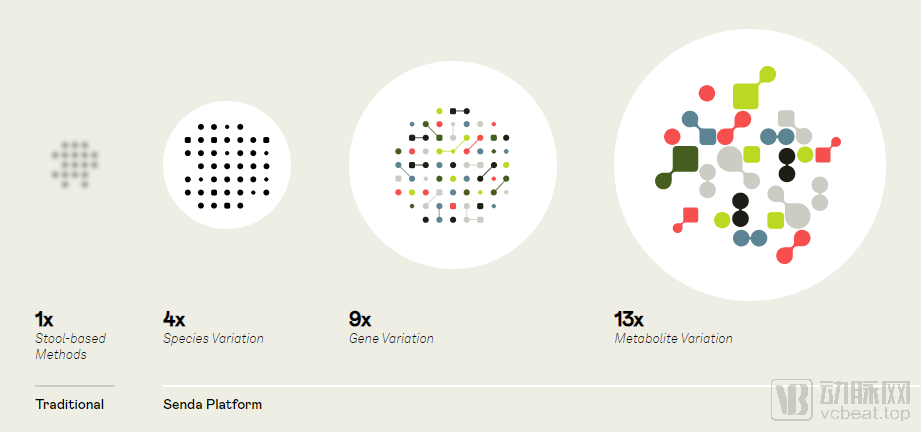
Senda Discovery Platform’s High-Resolution Molecular View | Image source: Senda official website
Furthermore, Senda has leveraged this platform to create the first-ever molecular atlas of the human digestive tract, encompassing the junctions and interactions between the gut and other body parts, along with key data.
This high-resolution view of unique interspecies interactions can help precisely identify therapeutic targets, define new bioassays and biomarkers, and reduce risks in the clinical development of drugs.
Leveraging the powerful identification capabilities of the Senda Discovery Platform, Senda is committed to developing transformative therapies across multiple disease categories. It has initially identified a set of cross-species conserved mechanisms that can serve as targets for pharmacological intervention, as demonstrated in the following four aspects.
1. Interspecies Signaling: Interspecies signaling leverages the evolutionary connections among microbes, plants, and humans to modulate immunity, neurobehavioral functions, and other processes. Pairing the identification of these molecular links with precise targeted therapies can enable safe and effective treatment and prevention of diseases.
Currently, Senda’s projects involving signal transduction include immuno-oncology research (covering cancer immunotherapy and colorectal cancer) and metabolic disease research conducted in collaboration with Nestlé Health Science.
2. Inhibition of Toxin Production: Microorganisms can convert dietary molecules into toxins; if left unchecked, this can lead to a toxic buildup and outbreak, resulting in disease. Senda is committed to blocking these pathogenic processes and has incorporated them into its chronic disease (chronic kidney disease) research program.
3. Delaying the Decline of Drug Efficacy:Many oral medications are degraded by the body’s microbiota after ingestion, compromising their efficacy. Senda is currently leveraging systems biology to develop microbial drug-degradation inhibitors aimed at preserving and prolonging therapeutic effects. The company has ongoing research projects in the field of neurology, specifically focusing on multiple sclerosis and Parkinson’s disease.
4. Interspecies Collaborative Delivery:Microbes and plants possess unique transport vehicles capable of exchanging substantial amounts of materials with human cells. Senda is leveraging these vehicles to deliver large biomolecules, such as nucleic acids, proteins, and peptides, to targeted areas within the body, thereby achieving precise drug delivery. Future applications of this technology include vaccines for infectious diseases, cancer vaccines, mRNA therapeutics, and oral biologics.
Based on this discovery platform, Senda has currently initiated six preclinical projects and plans to submit an Investigational New Drug (IND) application by the end of 2022.
Senda’s predecessor was founded in 2017 by David Berry and Ignacio Martinez, partners at the prominent venture capital firm Flagship Pioneering (hereinafter referred to as “Flagship”). However, the current Senda Biosciences has evolved through at least four exploratory iterations driven by scientists at Flagship Labs.
The earliest exploratory venture, Kintai Therapeutics, was founded in 2017 with the aim of studying molecular interactions among bacteria in the human gastrointestinal system. In 2018, Kintai merged with FL51, another Flagship Labs portfolio company exploring the gastrointestinal nervous system.
In the same year, Flagship established Senda Biosciences (the predecessor of today’s Senda), a company primarily focused on studying the interactions between humans and the fruits and vegetables they consume. It demonstrated that certain plant subcellular components are stable and safe, and capable of delivering a wide range of therapeutic drugs.
Another company, FL62, was founded in 2019 with the aim of leveraging molecular interactions among bacterial subcellular components to deliver therapeutic drugs and modulate human biology.
At the end of 2020, Flagship Pioneering invested $88 million to merge these four companies into a joint venture dedicated to researching inter-systems biology.
Guillaume Pfefer, Founder and CEO of Senda, brings 25 years of experience in the biotechnology and pharmaceutical industries. Pfefer is also a Partner and CEO at Flagship Pioneering, and previously served as Senior Vice President and Global Head of Vaccines at GSK, where he oversaw the shingles vaccine SHINGRIX.

Guillaume Pfefer Image source: Senda official website
John Casey, Co-founder and Head of Business Development at Senda, holds a Ph.D. in Biological Engineering from the Massachusetts Institute of Technology (MIT). John joined Flagship Pioneering in 2015 as an Associate. During his tenure, he consistently pursued innovation and sought new opportunities, developing critical scientific and business components that laid a solid foundation for Senda’s subsequent growth.

John Casey | Image source: Senda official website
Senda’s board of directors also includes many accomplished entrepreneurs and industry thought leaders. Reflecting on the founding of Senda, Guillaume Pfefer stated, “I am honored to have played a part in advancing sexual medicine during my career. It is a rare opportunity to establish a company and pioneer a novel approach to treating some of the most challenging conditions prevalent in society today.”
Pfefer further stated, “Fortunately, our R&D team, Board of Directors, and Scientific Advisory Board are filled with exceptional talent. With our core research platforms in place, we are confident in positioning the company as an undisputed leader in the field of systems biology and delivering revolutionary therapies to the countless patients afflicted by related diseases.”
Over the past decade, as understanding of the complexity of the microbiome has deepened, life scientists have proposed an increasing number of novel therapeutic approaches, dedicating efforts to the development of breakthrough microbiome-based drugs. For example, SER-109 from Seres Therapeutics, indicated for the treatment of Clostridioides difficile infection (CDI), is currently in Phase 3 clinical trials.
However, Flagship has identified an even broader research landscape. Building on more than a decade of pioneering work in the field of microbiome science, Flagship not only recognizes the potential of the microbiome but also sees greater possibilities in studying molecular interactions across multiple species.
Currently, foreign biopharmaceutical companies still focus primarily on the development of microbiome-based drugs, whereas domestic companies in China mainly concentrate their businesses around microbiome testing. The establishment of Senda has pioneered the research, development, and delivery of therapeutics based on inter-systems biology. What benefits will Senda bring to patients in the future, and how will it lead the advancement of inter-systems biology? Only time will tell.