

Another Trend Emerges: 55-Year-Old Female Billionaire Launches Hyaluronic Acid Drinking Water
IMEIK
Developer of Biomedical Soft Tissue Repair Materials
Bloomage Biotech
Developer of bioactive substance products, producer of hyaluronic acid raw materials
This article was first published on PEdaily, with authorization for VCBeat to republish. Authors: Zhang Jiwen, Zhou Jiali. Reporting: PEdaily. Cover image: PEdaily.
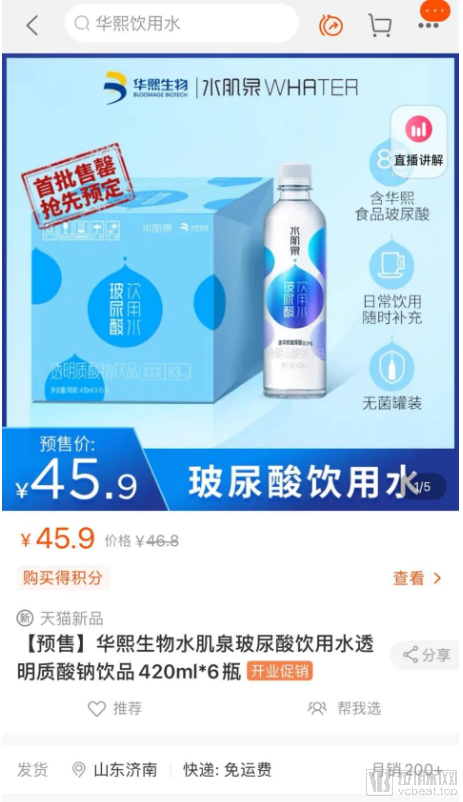
VCBeat learned that on March 22, Bloomage Biotech, a leading hyaluronic acid company, launched its first hyaluronic acid drinking water brand, “Shui Ji Quan.” The product contains only water and 66 mg of hyaluronic acid, emphasizing zero sugar, zero fat, and zero calories. Online, a six-bottle pack is priced at 45.9 yuan.
When discussing Bloomage Biotech, one cannot overlook its female founder behind the scenes—Zhao Yan. In 2000, Zhao Yan serendipitously entered the hyaluronic acid business, and years later, she captured half of China’s hyaluronic acid market, earning the title “Hyaluronic Acid Queen.” In November 2019, Bloomage Biotech successfully listed on the STAR Market, with its stock price soaring thereafter. According to the latest Forbes ranking, Zhao Yan’s net worth stands at $7.1 billion (approximately RMB 46 billion).
The Desire for Beauty Is Universal: Chinese Women Prop Up a Hundred-Billion-Yuan Medical Aesthetics Industry, Making Hyaluronic Acid the “Moutai for Women.” Now, the Three Giants of China’s Hyaluronic Acid Industry—Imeik, Bloomage Biotech, and Haohai Biological Technology—Have All Listed on Capital Markets, Creating Two Female Billionaires. As Hyaluronic Acid Is Turned into Everyday Food Products, Another Frenzy Begins to Unfold.
Another Trend Emerging?
Hyaluronic Acid Drinking Water, 6 Bottles for 46 Yuan
Bloomage Biotech Makes Another Move.
On March 22, Bloomage Biotech launched its first hyaluronic acid drinking water product, “Shui Ji Quan.” VCBeat has learned that “Shui Ji Quan” features a minimalist formula with no additives. Each 330ml bottle contains only water and 66mg of hyaluronic acid, emphasizing zero sugar, zero fat, and zero calories to meet consumers’ demand for hyaluronic acid supplementation while staying hydrated.
Currently, "Shuiji Quan" hyaluronic acid drinking water is available for purchase at the Shuiji Quan flagship stores on Tmall, Xiaohongshu (Little Red Book), and Xiaomi Youpin, with a price of 45.9 yuan for six bottles.
Can Hyaluronic Acid Be Consumed Orally? This question begins with the mechanism of action of hyaluronic acid. According to available data, hyaluronic acid, also known as hyaluronan or sodium hyaluronate, is an endogenous substance in the human body that primarily performs three key functions: moisturizing, lubrication, and viscoelasticity. As early as the late 1980s, foods containing sodium hyaluronate were first developed and gained popularity in Japan. Subsequently, countries and regions including the United States, Europe, Australia, New Zealand, South Korea, and Brazil have permitted its addition to food products or dietary supplements.
China has always been the world’s largest producer and seller of hyaluronic acid raw materials. In 2008, the Ministry of Health approved sodium hyaluronate as a new resource food for use in health supplements, opening the door to its oral consumption. Bloomage Biotech has long been actively promoting this cause. On January 7 this year, the National Health Commission officially approved Bloomage Biotech’s application to list sodium hyaluronate as a new food raw material, permitting its use in conventional foods. Approved applications include dairy and dairy products, beverages, alcoholic drinks, cocoa products, chocolate and chocolate products, confectionery, and frozen desserts.
Subsequently, Bloomage Biotech swiftly launched "Hei Ling," China's first hyaluronic acid food brand. The product line comprises six items, including hyaluronic acid chewable tablets, gummies, American ginseng drinks, skin-boosting beverages, and bird's nest drinks. All products utilize hyaluronic acid independently developed and manufactured by the company, with key benefits focused on healthy weight management, sleep aid and stress relief, liver protection and stomach care, as well as whitening and antioxidant effects.
In response to this strategic layout, Zhao Yan, the female head of Bloomage Biotech, stated, “As an industry leader, Bloomage Biotech must constantly consider how to apply its advanced technologies to product innovation in the domestic consumer sector, empowering product upgrades through science and technology. This was precisely our intention in launching ‘Shuijiquan’ hyaluronic acid drinking water—to harness hyaluronic acid, a gift from nature, to bring greater health and beauty to the public.”
Could Edible Hyaluronic Acid Become the Next Big Trend? Currently, an increasing number of consumer brands are leveraging hyaluronic acid in their marketing. For instance, the domestic brand Hankou Erchang has launched a hyaluronic acid-infused soda, and the meal-replacement brand WonderLab introduced its first oral hyaluronic acid gummy in February, attracting significant attention. Founder Securities states that oral hyaluronic acid products are expected to gain widespread adoption after market cultivation, with the terminal market size projected to reach approximately RMB 16 billion by 2024.
Nevertheless, some industry voices argue that although certain food companies cite academic papers and publications to substantiate the cosmetic benefits of oral hyaluronic acid, the hype surrounding it outweighs its actual efficacy. “One involves intradermal injection, while the other enters the digestive system; the difference is substantial.”
55-Year-Old Female Tycoon from Shandong
“The Hyaluronic Acid Queen,” With a Fortune of RMB 46 Billion
Behind Bloomage Biotech Lies the Entrepreneurial Journey of a 55-Year-Old Female Business Leader.
In 1966, Zhao Yan was born in Weihai, Shandong Province. From a young age, she was an exemplary student, gaining admission to the Department of Biology at Central China Normal University through the National College Entrance Examination. She later pursued further studies abroad, earning a degree in Business Administration. With the dual credentials of a top-tier biology graduate and a Master of Business Administration, Zhao Yan chose to embark on a career in the business world.
In 1989, Zhao Yan ventured into the garment manufacturing business and real estate investment, earning her first pot of gold. After moving to Beijing, she continued to work in the familiar real estate sector. Within a few years, her Bloomage Group made significant strides in the core area of Chang’an Avenue, creating a number of iconic landmarks in the capital in just a short period, including the headquarters building of Huaxia Bank, the CBD Central World Trade Center, and the SK Tower.
Among them, the most renowned structure is undoubtedly the Beijing Wukesong Arena. It remains the only Olympic venue to date that has been constructed and operated by a private enterprise. Moreover, this arena not only hosted key events during the 2008 Beijing Olympic Games but is also slated to play a significant role in the upcoming Winter Olympics.
At the time, Zhao Yan, already a real estate tycoon, unexpectedly discovered another hidden business—hyaluronic acid.
In 2000, Zhao Yan pursued executive MBA studies at Peking University. There, she met Guo Xueping, a researcher at the Shandong Institute of Pharmaceutical Sciences, along with a group of scientists, and subsequently entered the hyaluronic acid industry.
At that time, the Shandong Institute of Pharmaceutical Research raised RMB 8 million and established a joint venture with a foreign enterprise, Shandong Freda Biotechnology Co., Ltd., primarily to produce hyaluronic acid. Due to poor management and consecutive annual losses, Freda’s leadership found no takers despite seeking financing from various sources. Zhao Yan, who had a background in biology, decided to conduct an on-site inspection despite her limited understanding of the matter.
The simple statement that “one hyaluronic acid molecule can bind 1,000 water molecules” sparked Zhao Yan’s keen interest. Through further communication, Zhao Yan learned about hyaluronic acid and discovered that its concentration and metabolic turnover are directly linked to the maturation and aging of human skin. This insight allowed Zhao Yan, who had a background in biology, to identify a promising business opportunity.
Later, when she learned that an investor was preparing to acquire Guo Xueping’s Freda Biotechnology & Chemicals at 80% of its net asset value, she immediately secured a 50% equity stake in the company at 1.5 times its net asset value.
At the time, many people considered Zhao Yan’s move to be impulsive, but she believed that hyaluronic acid had not only applications in ophthalmology and orthopedics, but also a very promising future in the skincare sector. Facts have proven that Zhao Yan’s judgment was correct.
Subsequently, she implemented sweeping reforms, investing heavily to revamp Freda with modern corporate management systems, establishing a research and development center, and committing RMB 200 million to factory construction. In 2007, Bloomage Biotech became the world’s largest R&D and manufacturing enterprise for hyaluronic acid raw materials. By 2018, China supplied 86% of the global hyaluronic acid raw materials, with the top five suppliers all originating from Shandong Province; Bloomage Biotech ranked first. Notably, Bloomage Biotech alone accounted for 36% of the global hyaluronic acid market.
In November 2019, Bloomage Biotech, already the world’s largest producer of hyaluronic acid raw materials, was officially listed on the STAR Market. Following its IPO, the company’s stock price rose steadily, driving a corresponding surge in Zhao Yan’s net worth. According to the latest Forbes ranking, Zhao Yan’s wealth stands at $7.1 billion (approximately RMB 46 billion).
The Hyaluronic Acid Wealth Myth:
Founding Three Listed Companies, Two Queens
The hyaluronic acid business has created many wealth myths.
Today, the “big three” of China’s hyaluronic acid industry—Imeik, Bloomage Biotech, and Haohai Biological Technology—have all gone public. In the hyaluronic acid sector, besides Zhao Yan, another “Hyaluronic Acid Queen,” Jian Jun, has also staged a series of legendary tales.
In late 2003, while living abroad, Jian Jun happened to witness a striking transformation: a 70-year-old woman with prominent facial wrinkles saw a significant reduction in them after receiving hyaluronic acid injections. This experience prompted Jian Jun to make a decisive move—resigning from her job and returning to China to start a business. In 2004, the 41-year-old Jian Jun, together with her husband Yao Jing and friends, invested to establish Beijing Yingzhihuang Biotechnology Co., Ltd. The company was renamed Imeik in late 2005.
At its inception, Imeik faced a highly challenging market environment. At that time, the facial filler supplier market was dominated by companies from Europe, the United States, and South Korea, forcing China to rely entirely on imported hyaluronic acid. Moreover, the domestic medical aesthetics industry was in its infancy, with “Putian-style” plastic surgery hospitals prevalent throughout the country. After careful consideration, Jian Jun chose to devote himself fully to the research, development, and production of hyaluronic acid products.
In 2009, Imeik’s first independently developed product, Yimei, obtained a medical device registration certificate and was launched on the market, making Imeik the first domestic company to secure such certification for related products. Meanwhile, Imeik broke the monopoly of foreign brands in the Chinese market, with its sales revenue repeatedly ranking first among domestic brands.
After 16 years of operation, Imeik successfully completed its initial public offering (IPO) on September 28, 2020. Since its listing, Imeik’s stock price has surged continuously, reaching an all-time high of RMB 1,331 per share on February 18 this year. It became the third A-share company in China to break the RMB 1,000 threshold, with its market capitalization hitting RMB 159.7 billion on that day.
Although the share price of Imeik has recently declined, its helmswoman, Jian Jun, still made it onto the rich list thanks to the wealth she created. In March 2021, the Hurun Global Rich List 2021 was released, with Jian Jun ranking seventh among China’s pharmaceutical billionaires, boasting a net worth of RMB 52 billion.
The presence of Haohai Biological Technology should not be underestimated. According to available information, Haohai Biological Technology was founded in 2007 by the couple Jiang Wei and his spouse. It is a high-tech enterprise engaged in the research and development, production, and sales of innovative medical biomaterials. Mr. Jiang and his spouse hold 28.63% and 16.19% of the shares, respectively. Based on today’s market capitalization of RMB 18 billion, the couple’s net worth stands at RMB 8 billion.
Now, the once-obscure yet vast hyaluronic acid sector is becoming increasingly well-known, and with hyaluronic acid officially entering the food and beverage industry, another feast is underway.