

What Happened to China's First Medical Aesthetics Stock?
Over the past year or so, the medical aesthetics industry has undoubtedly been somewhat anxious.
Whether it is the impact of the COVID-19 pandemic, with the medical aesthetics industry constantly filled with news of institution transfers and bankruptcies, or the industry-wide involution caused by persistent chaotic phenomena such as illegal medical aesthetics institutions, unlicensed practice, and false advertising, all of these are eroding the confidence of both medical aesthetics practitioners and beauty seekers.
“The medical aesthetics industry has entered its darkest hour” has become the refrain of naysayers. Is this truly the case?
As the first publicly listed medical aesthetics company in China, So-Young Technology (SY.US, hereinafter referred to as “So-Young”) often serves as a barometer for the industry’s performance trends.Therefore, New Oxygen may offer a glimpse into the answer to this question.
Recently, So-Young released its financial report for 2020 and the fourth quarter. The data showed that in Q4 2020, So-Young’s revenue increased by 18.6% year-on-year to RMB 425 million, setting a new quarterly revenue record since the company’s listing. However, on the other hand, So-Young’s net profit in the fourth quarter decreased by 46.06% year-on-year to RMB 37.7 million.
What do the fluctuations reveal about So-Young’s operational performance and strategic layout? What truths about the medical aesthetics industry are hidden within the financial report data? We will provide a detailed analysis below.
According to Maslow's Hierarchy of Needs,As material living standards reach a certain stage of development, people’s demand for beauty, as a spiritual pursuit, becomes increasingly strong.This is the reason behind the rapid development of the medical aesthetics industry in recent years.
As can be seen, with the steady rise in China’s economic level, people’s purchasing power has continued to strengthen, and the medical aesthetics market has expanded rapidly under this trend. According to statistical data from Deloitte,The size of China's medical aesthetics market has surged from RMB 64.8 billion in 2015 to RMB 176.9 billion in 2019, representing a compound annual growth rate (CAGR) of 28.7%, which far exceeds the global average of 8.2%.
The market pie is expanding, attracting an increasing number of players. Data from Qichacha shows that since 2018, more than 8,000 companies with “medical aesthetics” in their names have been established each year.
The problem is that institutions can be rapidly established as long as there is funding and leased premises, yet core medical aesthetic physicians are extremely scarce, with slow growth in their numbers: Medical aesthetic physicians not only require a practicing physician qualification, but surgical physicians must also have more than six years of clinical experience in surgery, resulting in extremely limited market supply. This has led to an awkward situation where,Medical aesthetic institutions have become extremely numerous, but compliant physicians are very scarce.
In a race to capture market share, numerous illegal medical aesthetic institutions have engaged in reckless expansion, even without employing compliant physicians. According to the "2020 White Paper on Insights into China’s Medical Aesthetics Industry" released by iResearch Consulting, more than 80,000 lifestyle beauty establishments in China illegally conducted medical aesthetic procedures in 2019, while only approximately 13,000 institutions held proper qualifications for medical aesthetics. Among these qualified institutions, 15% still engaged in non-compliant practices by operating beyond their approved scope. Public data indicates that illegal medical aesthetics caused disability or death in approximately 100,000 individuals in 2019, with an average of 20,000 annual complaints recorded regarding disfigurement resulting from medical aesthetic procedures.
At this point, how aesthetic seekers can choose a reliable medical aesthetics institution has become a difficult issue. After all, encountering non-compliant medical aesthetics services may result in lifelong regrets.
The emergence of internet platforms can, to some extent, alleviate this situation:As a bridge connecting users and merchants, online platforms can help both supply and demand sides address the issue of information asymmetry.For example, the online platform built by Beike enables consumers to find reliable institutions and helps these institutions achieve precise customer acquisition while reducing channel costs. So does New Oxygen.
On SoYoung’s platform, one side comprises doctors and medical aesthetic institutions, while the other consists of individuals seeking aesthetic enhancements.The value provided by New Oxygen lies in helping doctors and medical aesthetic institutions with information technology infrastructure, as well as providing users with valuable informational content.What is truly being tested here is whether New Oxygen possesses the capability to steer the industry toward standardization and digitalization. In other words,New Oxygen is not merely an intermediary; it also assumes the role of building new digital infrastructure for the medical aesthetics industry.
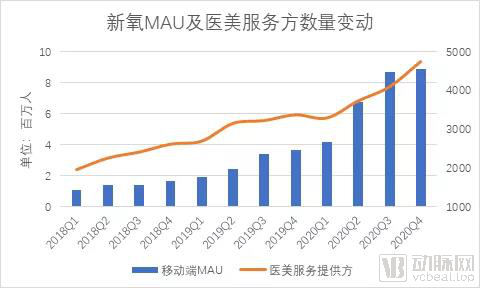
From this perspective, assessing the value of New Oxygen requires examining the actual costs incurred by both supply and demand sides on the platform (namely, the payment volume from institutions and user activity levels). Let the data speak.In the fourth quarter of last year, SoYoung’s total revenue, monthly active users, and number of partnered institutions maintained rapid growth rates of 18.6%, 142.3%, and 40.5%, respectively, while its full-year 2020 total revenue also increased by 12.4% year-on-year.As can be seen, recognition of So-Young from both the supply and demand sides continues to rise. This indicates that So-Young has achieved significant results in building new digital infrastructure within the medical aesthetics industry.
Of course, this is also closely related to the strong overall recovery of the medical aesthetics industry. Data from the New Oxygen platform shows that in the second half of 2020, the non-surgical segment of medical aesthetics experienced even greater year-on-year growth, reaching 115.6% of the 2019 level. In addition, while first- and second-tier cities saw a certain degree of contraction, demand in third- and fourth-tier cities remained relatively robust, achieving overall growth at a notable scale.
However, one data point stands out:SoYoung’s net profit plummeted by 97.24% year-on-year last year, driven by rising costs across multiple areas.
Financial report data shows that So-Young’s marketing expenses increased by 54.5% year-on-year last year, primarily allocated to brand building and marketing campaigns; general and administrative expenses rose by 14.6% due to increased costs such as equity-based compensation for senior executives; and R&D expenses grew by 29.3% year-on-year.
As is well known, aesthetic medicine consumption involves high-stakes decision-making, with a significant time lag between user acquisition and conversion; therefore, continuous consumer education is required in the early stages. From this perspective,The rise in marketing expenses indicates that New Oxygen is still actively expanding its market presence and preparing for user base growth, thereby capitalizing on the growing trend in the medical aesthetics market.After all, in the medical aesthetics market, multiple internet giants remain poised to capitalize on opportunities, resulting in fierce competition.
The rise in administrative and R&D expenses indicates SoYoung’s emphasis on talent and technology.As a core participant in the new digital infrastructure of the medical aesthetics industry, investment in information technology and data is key to building corporate core competitiveness.This expenditure must not only be spared, but also requires continuous investment.
Take JD.com as an example. Since Liu Qiangdong decided to build its own logistics network in 2007, JD has consistently made substantial investments in its supply chain, even at the cost of significant profits. Looking back, it is precisely the refinement of its supply chain that has established JD as a major pillar of the internet e-commerce landscape and enabled its seamless expansion into other sectors, as evidenced by JD Health’s market capitalization exceeding RMB 300 billion. Therefore, So-Young’s continuous investment in talent and technology reflects its emphasis on long-term value and its commitment to strengthening its core competencies.
In summary,Despite encountering numerous challenges, the medical aesthetics sector demonstrated strong self-recovery capabilities overall last year.
For New Oxygen, this indicates that it has achieved phased results in the new infrastructure of medical aesthetics and has gained recognition from medical institutions, doctors, and beauty seekers. On the other hand, New Oxygen is also forgoing short-term gains by sacrificing current profits to expand future revenue potential.It is evident that New Oxygen demonstrates its determination and confidence in heavily investing in the medical aesthetics sector, as well as its sense of responsibility and strategic focus as an industry leader.
Determining a company’s long-term value requires not only an assessment of its inherent “genetic” advantages but also an analysis of the competitive landscape within its sector.
In the niche segment of medical aesthetics platforms, internet giants such as Meituan and Alibaba have leveraged their inherent strengths in local lifestyle services and e-commerce to expand horizontally into the medical aesthetics sector. This has sparked widespread speculation about whether So-Young, which has focused on vertical deepening within the medical aesthetics track, can withstand the aggressive onslaught from these industry titans.
First, it must be acknowledged that internet giants, leveraging advantages such as massive traffic and abundant capital, can rapidly enter a specific niche sector. However, the issue lies inThe e-commerce model of industry giants is traffic-driven; that is, when these giants expand their product categories to include medical aesthetics, traffic to other categories declines, leading to internal competition for traffic.This makes it difficult for industry giants to sustainably penetrate deep into the core of niche segments.
New Oxygen has established a business model integrating “content, community, and e-commerce.” The advantage of this model is its ability to generate organic traffic: when users engage with specific types of content on the platform, they are inclined to explore additional content, resulting in strong user stickiness. Furthermore, high-quality content created by users based on their personal experiences and insights continuously attracts more readers, driving increased traffic and thereby establishing a positive feedback loop for the platform.
More importantly,Vertical platforms possess sufficient resources and time to delve deeply into niche sectors, making it easier to thoroughly identify the industry’s various pain points and challenges, thereby achieving a more profound understanding of the sector.This is particularly true for businesses in the medical aesthetics sector, which possess strong healthcare service attributes and demand greater caution and patience from participants.
However, if it merely involves building content and distributing it, the tech giants could do that as well.
SoYoung’s competitive moat lies in its ability to maintain consistently high-quality professional content, while fostering an ecosystem that is rich, multidimensional, and interactive.This tests the platform operator's capability for refined operations.
Taking New Oxygen’s development of physician Points of Interest (POIs) as an example, physician evaluations encompass multiple dimensions, including physician certification, follower count, positive rating rate, consultation methods, user reviews and comments, Location-Based Services (LBS) information of the affiliated institution, one-click calling to the institution, and physician service cases (presented as a collection of short videos). The construction of such foundational informational capabilities enables more precise content and enhances transferability.
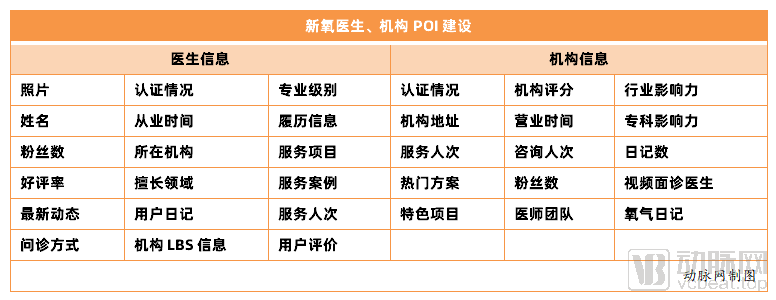
Moreover, SoYoung aggregates and presents medical aesthetic information from across the entire internet. According to official data from SoYoung, the platform features more than 11,000 medical aesthetic institutions and over 20,200 medical aesthetic doctors. Furthermore, in response to the wide array of specialized medical aesthetic procedures, SoYoung Encyclopedia provides detailed textual and video explanations covering multiple dimensions, including basic attributes, efficacy attributes, and procedural attributes. For medical aesthetic products, SoYoung has also established a comprehensive product encyclopedia, leveraging this resource to build a complete user profiling system and data management framework encompassing users, institutions, and doctors.
The results of refined operations are obvious.Financial reports indicate that in Q4 2020, the monthly peak views across SoYoung’s new media matrix exceeded 1.73 billion, representing a year-on-year increase of 53.3%. The cumulative number of “Beauty Diaries,” in which users share their medical aesthetics consumption experiences on the SoYoung platform, has surpassed 4.7 million entries.
The prosperity of content has also driven the flourishing of the entire community ecosystem and promoted the development of medical aesthetics influencers on the platform. In Q4 2020, the number of medical aesthetics influencers on the New Oxygen platform exceeded 1,000, among which 67% were cultivated by New Oxygen itself, accounting for over 75% of the total content views.
Notably, So-Young also leverages online technical services—such as AI tools, video consultations, and live streaming—to assist users in making informed consumption decisions. Throughout 2020, So-Young’s AI mini-programs recorded over 1.21 billion cumulative uses; for instance, the “Magic Mirror” facial analysis feature alone was used more than 270 million times. The total number of video consultation requests exceeded 981,000, while over 70,000 live streaming sessions were conducted, accumulating more than 300 million views.
In summary, within the increasingly competitive medical aesthetics sector, vertical platforms hold advantages in their deeper understanding of niche segments, as well as higher user quality and stickiness. Content reinforces this advantage, and when coupled with refined operational strategies, it becomes a competitive moat for vertical platforms.
“A thing of beauty is a joy forever.” This famous quote by the 19th-century British poet John Keats serves as a manifesto for humanity’s bold pursuit of beauty. However, during Keats’ lifetime, methods for enhancing one’s appearance were exceedingly limited, largely revolving around basic bodily hygiene and cleanliness.
In the contemporary era, benefiting from advances in biosciences and other technologies, individuals can enhance the aesthetic appearance of various body parts through interventions such as botulinum toxin and hyaluronic acid, thereby restoring beauty and confidence and significantly improving the well-being of those with less favorable innate physical attributes.
It is fair to say that the maturation of the medical aesthetics industry chain has marked a significant leap forward in humanity’s historical pursuit of beauty.
However, the pursuit of profit has also led to widespread chaos within the industry, a phenomenon that is not unique to China. For instance, in Gangnam, Seoul—known as the capital of plastic surgery and featured in the song “Gangnam Style”—80% of medical aesthetic clinics are small, privately operated facilities. These clinics suffer from a severe shortage of medical staff, frequent instances of non-physicians performing surgical procedures, and significant difficulties for patients seeking recourse in disputes.
The consequence has been mounting public criticism of the medical aesthetics industry. False advertising and excessive promotion have also driven some individuals toward extreme aesthetic ideals, with many young people sacrificing their health to achieve the so-called “internet celebrity face,” thereby deviating from the original intent of medical aesthetics. These issues undoubtedly hinder the healthy development of the industry.
To steer the industry onto a positive trajectory, in 2020, New Oxygen joined hands with the Chinese Association of Plastics and Aesthetics to launch the Self-Discipline Initiative for China’s Medical Aesthetics Industry. Data shows that from March 14, 2020, to February 25, 2021, New Oxygen blocked 10,902 problematic institutions, flagged 34,905 instances of physicians suspected of non-compliant or out-of-scope practice, and identified 1,141,157 cases of suspected non-compliant or illegal medical aesthetic products. In total, 1,043,313 pieces of non-compliant content were processed, including content related to black and gray market activities and violations of platform regulations, covering diaries, comments, videos, and other formats.
Additionally,Good doctors can also help aesthetic seekers develop a proper sense of aesthetics.In response, SoYoung has launched the Emerald Doctor List to help consumers identify top-tier physicians. Since last year, SoYoung has rolled out this list, inviting leading experts from China’s medical aesthetics industry and senior aesthetic specialists from the fashion industry to form an authoritative review panel. Adopting anonymous and cross-review methods, the panel evaluates and scores participating doctors across “101 dimensions” under three major criteria: aesthetics, technical expertise, and service. Benchmarking against the “Michelin” standards, SoYoung has established a high-caliber physician evaluation system to recommend quality doctors to consumers.
From the perspective of industry developments, market trends are shifting. The "2020 Report on Consumption Trends in Medical Aesthetics among Chinese Women" indicates that the structure of medical aesthetic consumption has undergone new changes. Taking skin rejuvenation as an example, this subcategory currently offers more than ten options, including sensitivity repair and barrier restoration, deep cleansing and acne treatment, skin brightening and rejuvenation, firming and anti-aging, hydration and moisturizing, and scar and acne mark removal. This demonstrates that consumers’ demands have become more segmented, allowing them to select appropriate treatments based on their individual conditions, which reflects a growing rationality in the pursuit of beauty.
Of course, nothing is achieved overnight.To truly standardize the “golden track” of medical aesthetics, it requires not only the leadership of industry pioneers like New Oxygen but also the collective efforts of regulators, upstream and downstream enterprises, and beauty seekers.
It is worth noting that data from the international research firm Frost & Sullivan shows that the medical aesthetics industry has maintained a compound annual growth rate (CAGR) of over 20% for four consecutive years, and this high-growth momentum is expected to continue, leaving considerable room for future expansion.
In this process, companies that truly prioritize the interests of aesthetic seekers will reap the greatest rewards.