

NightWare Submits IPO Prospectus: Pioneering FDA-Approved Digital Therapeutic for PTSD-Related Nightmares

NightWare
Developer of Digital Therapeutics Applications
On World Sleep Day, March 21, a report brought sleep issues to the forefront. Data from the “2021 White Paper on Exercise and Sleep,” released by organizations including the Chinese Sleep Research Society, shows that more than 300 million people in China currently experience sleep problems. Among these issues, nightmares are a major concern.
Nightmares pose numerous health risks, including sleep deprivation, insomnia, daytime somnolence, and fatigue, and may even lead to suicidal ideation. Individuals who frequently experience nightmares suffer significant impairments in their quality of life.
Statistics show that 2%–8% of the general population suffer from nightmares, whereas this figure rises to as high as 72% among patients with post-traumatic stress disorder (PTSD). Nightmares exacerbate the psychological burden on these patients and, over time, impair their social functioning.
To help patients with PTSD and the general public alleviate or even eliminate the distress caused by nightmares, NightWare, Inc. has launched an Apple Watch-based application—NightWare Digital Therapy. The program received marketing authorization from the U.S. Food and Drug Administration (FDA) in May 2019, becoming the first and only sleep disturbance medical device indicated for adult traumatic nightmares.
NightWare, Inc. was founded in 2015 and is headquartered in Minneapolis, the largest city in Minnesota, USA. The company is dedicated to helping individuals suffering from traumatic nightmares regain restful and peaceful sleep. On February 25, it successfully completed its seed financing round. Having raised funds twice, the company has secured a total of $405,000.
Digital Therapeutics on the Wrist
NightWare is a suite of digital therapeutics based on wearable devices, comprising a software application and the NightWare server. These components monitor users’ sleep behavior and employ proprietary algorithms to create personalized sleep profiles, helping users achieve better nighttime sleep.
During operation, NightWare utilizes the hardware’s heart rate sensor, accelerometer, and gyroscope to monitor the user’s heart rate and movement throughout the night, securely transmitting the monitored data to the NightWare server. When the user’s heart rate exceeds a specific stress threshold, NightWare delivers haptic vibration interventions via the Apple Watch to promptly interrupt nightmares.
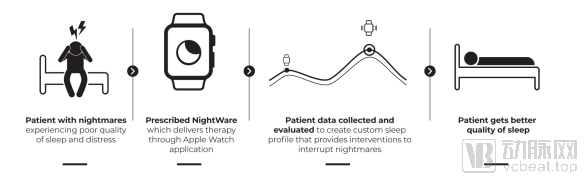
It is important to note that to ensure systematic treatment with the NightWare digital therapeutic, users must use the designated NightWare kit (iPhone and Apple Watch). During program operation, the devices must maintain sufficient battery charge and remain connected to the internet to facilitate data transmission to the NightWare server.
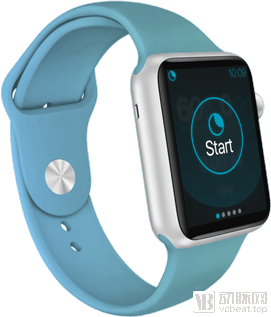
NightWare does not provide interventions during its initial operation, aiming to collect user sleep data and customize profiles.
The entire NightWare digital therapy cycle offers the following three advantages:
1. Processing Learning: After the user wears the watch for several consecutive nights, NightWare learns their sleep patterns;
2. Gentle Intervention:The learning period typically lasts less than 10 days, during which the watch becomes familiar with the wearer’s heart rate and movement patterns. When a potential nightmare is detected, it interrupts the nightmare while the wearer remains asleep.
3. Individual Adaptation: The app adjusts based on the user’s individual circumstances; if the vibration intensity wakes the wearer, it will be reduced in subsequent sessions to prevent recurrence.
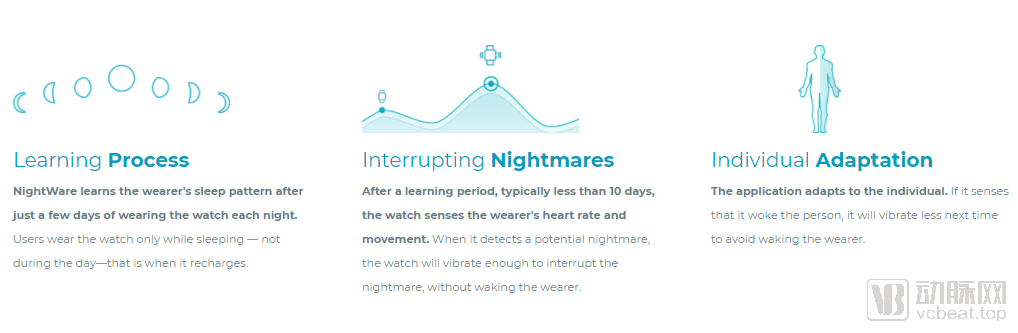
Three Major Advantages of NightWare. Image source: NightWare official website
NightWare CEO Grady Hannah has 15 years of experience in software sales and marketing, having held positions at Replay Solutions (acquired by Computer Associates), AGEIA (acquired by NVIDIA), Intrinsic Graphics (the codebase for Google Earth), and Meteor (the publisher of HAWKEN).

Grady Hannah. Image source: NightWare official website
Grady stated that NightWare was initially founded and established with a primary focus on the Veterans Health Administration (VHA) healthcare system and the Department of Defense’s Military Health System (MHS), providing support to veterans and active-duty service members. These individuals, who have selflessly dedicated themselves to safeguarding public freedom, suffer from emotional, physical, and psychological distress due to nightmares.
Peter W. Chiarelli, a retired U.S. Army general and advisor to NightWare, stated, “There has long been no consistently effective solution for nightmares caused by PTSD. Digital therapeutics like NightWare can provide the necessary brain monitoring to identify and interrupt traumatic nightmares, representing a transformative step forward in better supporting veterans and active-duty service members affected by this condition.”
Beyond the military, nightmares are in fact a common clinical manifestation of PTSD and sexual trauma. Studies indicate that approximately 80% of patients with PTSD experience recurrent traumatic nightmares, which can persist for months or even years, leading to a concomitant rise in suicide rates among these patients.
Thus, NightWare established a broader mission and vision aimed at helping individuals with traumatic nightmares achieve more restful sleep, under the slogan “We won't rest until those with PTSD can.”

To demonstrate the efficacy of the therapy, the NightWare team conducted a 30-day randomized controlled trial involving 70 patients using the NightWare treatment platform.
This controlled trial was divided into a sham surgery control group (also known as the placebo control group) and a positive control group. Patients in the sham surgery group wore the device only, but the system did not provide vibratory stimulation.
The study evaluated sleep quality in both groups using the Pittsburgh Sleep Quality Index (PSQI), a self-reported questionnaire designed to assess sleep quality, which includes a version specifically tailored for patients with PTSD. The results showed that sleep quality improved in both the sham surgery group and the positive control group, with the improvement being more pronounced in the positive control group than in the sham surgery group.
NightWare also has another large-scale randomized sham-surgery controlled trial underway across multiple sites, with a planned enrollment of 240 patients. The trial is expected to be completed in the second half of 2021, aiming to gather data for continuous improvement and to help secure reimbursement from payers such as the Department of Veterans Affairs, the Centers for Medicare & Medicaid Services (CMS), and private insurers.
Currently, the NightWare treatment platform is available only by prescription and is intended for home use. It is not a standalone treatment for PTSD and should be used in conjunction with prescription medications for PTSD and other therapies targeting PTSD-related nightmares.
In January 2019, at the 37th annual J.P. Morgan Healthcare Conference, NightWare was ranked third among the top 20 “Flying High Tech” hot health startups in VCBeat’s Top Companies list.
In January 2020, at the J.P. Morgan Healthcare Conference, NightWare was once again named a “Leapfrog Technology” hot health startup for its digital therapeutic technology for PTSD-related sleep disturbances, becoming one of the companies with the highest business volume among those in attendance.
“The Observer” magazine stated in its review of NightWare: “NightWare has received the FDA’s official ‘Breakthrough Device’ designation, a distinction reserved for therapeutic technologies that demonstrate greater efficacy than existing clinical treatments. In other words, NightWare is likely the first prescription digital therapeutic targeting the core symptoms of PTSD.”
NightWare CEO Grady stated, "We are honored to once again receive recognition from a national publication such as The Observer. We believe that NightWare has brought a truly revolutionary treatment to veterans and those seeking to improve their sleep."
“Digital therapeutics present an opportunity for individuals seeking to improve their sleep, helping them avoid the potential side effects of traditional sedative-hypnotic medications. Our mission is to leverage biometric sensing technology to provide personalized treatment for PTSD-related sleep disturbances and nightmare disorder. Our digital sleep therapy is unique, and we are thrilled to launch the NightWare therapeutic platform,” added Grady.
Currently, the domestic and international markets for wearable devices are witnessing intensifying competition: In 2020, Amazon launched its first “Halo” smart band, primarily designed for health and fitness tracking; major emerging players such as OPPO, VIVO, and Goertek have also entered the arena; global leading wearable device brands including Apple, Fitbit, and Huawei continue to upgrade their product technologies, while the NMPA and FDA have accelerated the approval process for wearable medical devices.
Over the past seven years, investment in digital therapeutics (DTx) companies in the United States has grown at an average annual rate of 40%, with DTx rapidly gaining momentum abroad. In China, however, the landscape regarding awareness, approval, and regulation of digital therapeutics remains in a state of flux. Nevertheless, the rising tide of digital therapeutics may open up broader development opportunities for the saturated wearable device market.