

Nuohai Zhiyuan Successfully Lists on STAR Market After Three IPO Attempts, Backed by Sequoia Capital
On April 13, Novogene finally achieved its goal of listing on the STAR Market of the Shanghai Stock Exchange, with the stock code 688315. It opened at 25 yuan per share and closed with a market capitalization approaching RMB 11 billion, becoming the “first NGS research service stock” in the capital markets.
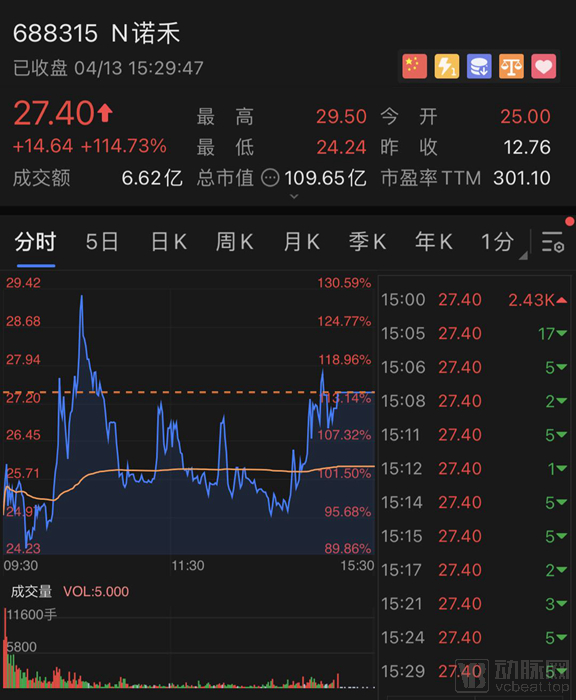
As of press time, Novogene's real-time trading price (data source: Futu Securities)
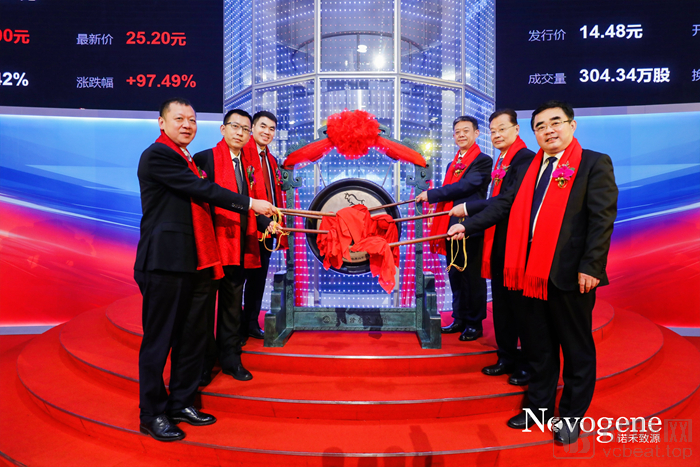
Novogene’s IPO Opening Scene (Image source: Provided by the interviewee)
Nine months have passed since Novogene made its third attempt at an initial public offering (IPO). Despite the twists and turns in Novogene’s path to going public, it is a case of good things taking time.
In 2016, after completing its Series B financing, Novogene received IPO tutoring from a securities firm but ultimately did not file its application. Two years later, after changing its tutoring institution, Novogene submitted a draft prospectus to the China Securities Regulatory Commission (CSRC). The review process lasted one year; however, on the eve of the scheduled listing committee meeting, the CSRC announced the cancellation of the next day’s review session, citing the need for further verification of certain matters pertaining to Novogene.
At the time, the focus of the controversy was Novogene’s equity structure.
In 2016, two individual shareholders, Fan Shibin and Mo Shuzhen, each acquired a portion of Novogene’s equity from its founder, Li Ruiqiang, at a price of less than RMB 2.5 per share. In a series of transactions that began six months later, the value of these shares increased by tens of times, sparking external skepticism. In response, Novogene explained that the pricing for their equity investment comprehensively considered factors such as the assistance the two individuals had provided to Li Ruiqiang’s personal career development and their close personal relationship with him.
Over the past decade of entrepreneurship, Li Ruiqiang has undergone significant changes as he transitioned from a scientist to an entrepreneur, a journey made possible in no small part by the support of senior figures in the industry. Those familiar with Li told VCBeat that, with his background in physics, Li embodies the typical reserved and analytical demeanor of a STEM professional. He is meticulous in his scientific research but appears somewhat reserved in interpersonal interactions. “He doesn’t engage much in private socializing with colleagues and rarely makes an appearance at company-organized recreational events,” said one interviewee. “Perhaps he simply doesn’t know how to liven up the atmosphere.”
In June 2020, during its third attempt at an initial public offering (IPO), Novogene adjusted its equity structure.
According to the prospectus, in April 2020, Fan Shibin and Mo Shuzhen transferred their respective shares in Novogene to Chengzhang No. 12. In May of the same year, Novogene introduced several new shareholders, including Sequoia Anchen, China Merchants Bank Investment, CIMC Capital, the China International Trade in Services Fund, Haihe Baichuan, and Jianchuang Zhongmin. As a result, among Novogene’s top ten shareholders, apart from Li Ruiqiang (59.67%) and Jiang Zhi (4.37%), the majority are institutional investors.
From the perspective of Sequoia China, Novogene is leveraging its strong advantages in existing businesses to expand into related fields and gradually enhance its position in the industrial value chain. Cao Yibo, Managing Director at Sequoia China, stated, “Over the past decade since its establishment, Novogene has achieved global leadership in scale and capabilities within R&D services represented by sequencing. Following its IPO, the company is building on its inherent strengths in the genomics sector to expand into application-oriented products and services, positioning itself for faster and higher-quality growth.”
An interlude occurred before the IPO application was submitted to the STAR Market.
In March 2020, a former employee of Novogene posted online that a large number of colleagues were dismissed by the company upon their return to work after the COVID-19 outbreak, thrusting Novogene into the spotlight.
In fact, this incident was closely related to Novogene’s aggressive business strategy adopted in 2019. According to its prospectus, in 2019, while intensively preparing for its previous IPO, Novogene made unprecedented investments in personnel, capital, and resources across its three major business segments, resulting in significant growth in performance metrics.
In 2019, Novogene expanded its workforce by hiring 676 employees. A year later, 674 employees had resigned, bringing the team size back to its 2018 level. Among the 674 departing employees, 546 left during the first half of 2020, a period marked by declining performance, accounting for 81% of the total departures.
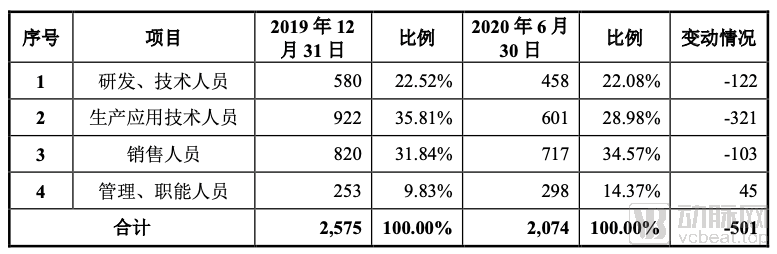
In response, Novogene cited two reasons. First, the seasonal decline in business volume during the first half of the year, coupled with an increased attrition rate due to expansion, led to some employees either not renewing their labor contracts upon expiration or voluntarily terminating their employment contracts. Second, in the first half of 2020, the launch of the flexible intelligent delivery system optimized the NGS sequencing workflow, thereby reducing the demand for corresponding R&D and production application personnel.
Also in 2019, Novogene’s cash outflows for the construction of fixed assets, intangible assets, and other long-term assets increased from RMB 81.09 million to RMB 172 million, more than doubling. Based on the newness rates of major equipment provided in the prospectus and the depreciation schedules for fixed assets in the financial statements, it is evident that Novogene’s technical platforms and the number of automated devices nearly doubled during that year. Among the 82 key technical instruments listed by Novogene, 35 were acquired in 2019, accounting for 42.6%.
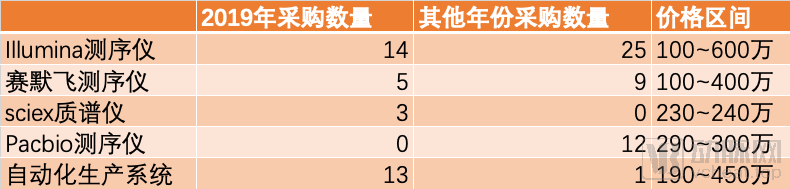
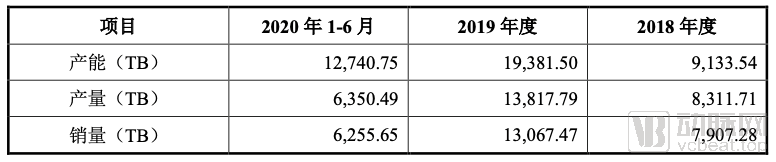
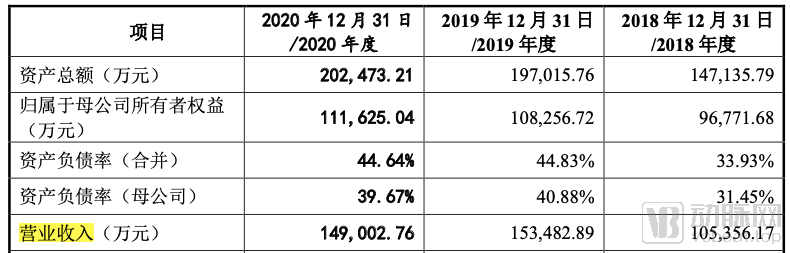
Throughout 2019, Novogene operated at full capacity following its expansion, with life science data production capacity, output, and sales volume all increasing proportionally. Despite an environment in which the average price per gigabase (GB) of sequencing had declined by more than 12% for three consecutive years, Novogene’s annual revenue rose from RMB 1.05 billion at the end of the previous year to RMB 1.53 billion by the end of 2019, representing a 45.7% increase.

However, the momentum did not last long before the COVID-19 pandemic struck.
Despite actively targeting the secondary market opportunities arising from the COVID-19 pandemic and recouping over RMB 80 million in performance losses, Novogene’s global business nearly came to a standstill during the first half of 2020, when universities and medical institutions were largely shut down. While significantly reducing its workforce, more than half of Novogene’s newly installed production capacity remained idle.
However, prior to the COVID-19 pandemic, Novogene’s newly added production capacity was already fully utilized, and the genetic testing industry continued to unlock demand driven by the ongoing iteration of application scenarios. Therefore, the outcome of its aggressive expansion in 2019 was highly likely to be favorable.
In early March 2021, with one foot already in the capital markets, Novogene held a small 10th-anniversary celebration at its headquarters in the Jiuxianqiao Electronic Industrial Park in Beijing. The festive atmosphere brought a rare sense of comfort and relaxation to the usually bustling space. Li Ruiqiang was still busy elsewhere and unable to attend, but he sent a warm-up video featuring his reassuring smile. Some long-serving employees couldn’t help but remark that setbacks indeed foster growth—not only for the company but also for its entrepreneurs.
When Novogene is mentioned, many people’s first thought is of a scientific research service provider. As its service scale has continued to expand, some have even privately joked that Novogene is the “Foxconn” of the sequencing industry. Yet few realize that Novogene’s foundation was built on a modest, small-scale business.
In the spring of 2011, Li Ruiqiang resigned from his position as Vice President of BGI and founded Novogene in Liudaokou, Beijing.
Liudaokou in Beijing is located on Xueyuan Road in Haidian District, an area densely populated with universities, and is adjacent to China Agricultural University and Beijing Forestry University. At that time, life sciences research had just entered the molecular era. Many research teams hoped to incorporate gene-level data into their studies but struggled to make sense of the analysis due to the limitations of existing technologies. Therefore, when Li Ruiqiang provided data services to surrounding university research teams using his self-developed bioinformatics analysis software, enabling them to rapidly extract insights from massive amounts of biological data, their research efficiency was significantly improved.
In the early days, Novogene did not have its own laboratories; Li Ruiqiang would lead teams into clients’ labs to work alongside their research teams.
After nine years at BGI, Li Ruiqiang had already become a highly influential figure in China’s gene sequencing field. Having joined BGI in 2002 after graduating with a degree in Applied Physics from Southeast University, he was among the first pioneers in China to engage with high-throughput genome sequencing. Rising from the position of project team leader in the Bioinformatics Department, Li achieved numerous “firsts” in the history of domestic gene sequencing during his tenure at BGI. In 2008, Li and the BGI team published the results of the first complete genome sequencing of the giant panda in Nature, garnering significant international attention.
Around 2011, BGI Genomics shifted its business focus from research services to clinical applications. However, Li Ruiqiang was unwilling to divert his attention and chose to start his own venture. It was not until the third year of Novogene’s establishment that the company began to build large-scale sequencing service capabilities.
As the volume of bioinformatics services continued to grow, Li Ruiqiang observed that data derived from different technical platforms could yield substantially divergent analytical results, thereby compromising experimental accuracy. In response, Novogene established its own genetic testing platform, extending upstream in the industry chain to deliver standardized biological data. Over the following decade, Novogene steadily expanded its business footprint through de novo sequencing technologies, reinforcing its competitive edge in basic research services and serving more than 4,000 clients worldwide.
De novo sequencing, also known as genome sequencing from scratch. The high-throughput sequencing process begins by fragmenting intact DNA into small pieces. The sequence data obtained from sequencing these fragments are then assembled and contiged using bioinformatics techniques to reconstruct the complete genome sequence. Traditional whole-genome sequencing relies on reference sequences from the same species; that is, during bioinformatic assembly and scaffolding, typical sequence information from the same species is used as a reference to reduce the complexity of assembly. In contrast, de novo sequencing for novel species lacks any reference sequence. Consequently, the strategies and algorithms for assembly and scaffolding differ entirely from those used in traditional whole-genome sequencing, placing extremely high demands on the bioinformatics expertise of analysts.
Novogene pioneered the pan-genome concept based on de novo sequencing in the industry.
In other words, the genomic information of a single biological individual is not comprehensive for a given species. Therefore, inferring a species’ pan-genome map through de novo sequencing of multiple individuals within the same species to obtain complete genomic genetic variation information has become a foundational technology for next-generation population genetics research.
Leveraging pangenome technology, Novogene has achieved a global first in constructing genome maps for species such as upland cotton, scallops, Tibetan pigs, golden snub-nosed monkeys, Gastrodia elata, and Yellow River carp, completing genome mapping for over 800 important species. In recent years, demand for whole-genome de novo sequencing has grown rapidly, with the Earth BioGenome Project aiming to sequence the genomes of all known species on Earth within a few years.
Furthermore, in response to the evolving demands of scientific research services, Novogene has successively introduced technologies such as epigenomics sequencing, single-cell sequencing, and metagenomics sequencing. Based on revenue from basic scientific research services, Novogene became the largest service provider in its niche market in China by 2019.
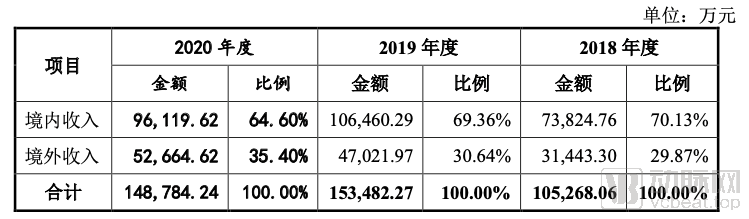
Novogene’s overseas expansion strategy commenced in its second year of establishment, with overseas laboratories formally established starting in 2016 to provide localized services to leading domestic and international research institutions, including Stanford University, Johns Hopkins University, and the Genome Institute of Singapore. Currently, Novogene’s business covers approximately 70 countries and regions worldwide. During the reporting period, revenue from main operations generated outside mainland China grew rapidly, amounting to RMB 314.433 million, RMB 470.2197 million, and RMB 526.6462 million in each respective period, accounting for 29.87%, 30.64%, and 35.40% of the total operating revenue for the corresponding periods. The compound annual growth rate (CAGR) from 2018 to 2020 was 29.42%.
Another focal point of the external controversy surrounding Novogene lies in the relatively low gross profit margin of its core business.
Taking 2020 as an example, the gross profit margins of BGI Genomics, Berry Genomics, and Da An Gene were 65.34%, 52.5%, and 67.41%, respectively, with the industry average at 62.08%. However, Novogene’s gross profit margin was only 35.11%.
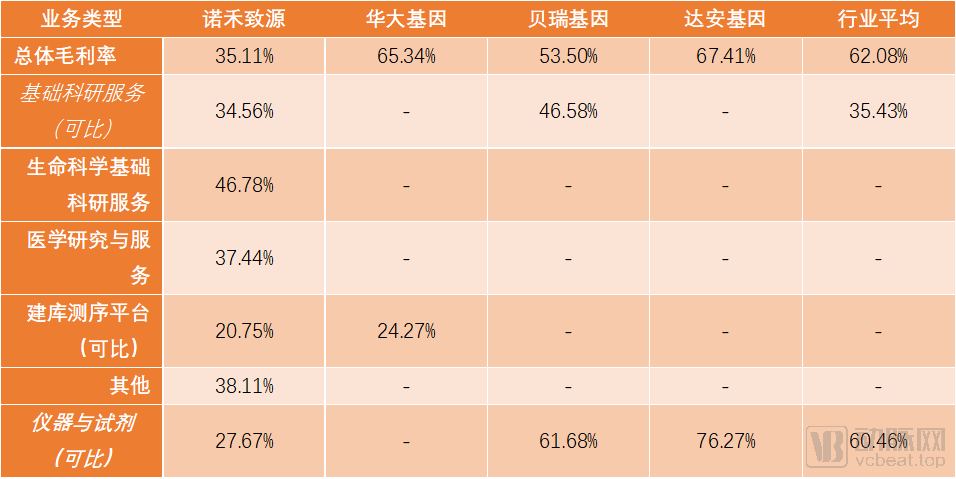
In response, Novogene explained that one reason for its lower gross profit margin is that its primary clients are universities and research institutions engaged in cutting-edge scientific research. Under relatively intense market competition, service pricing is fairly transparent. In contrast, comparable companies in the same industry mainly serve clinical application scenarios such as neonatal care, oncology, and rare diseases. Due to regulatory qualifications and technical barriers, these applications are still in an exploratory stage, allowing for more flexible pricing and consequently higher gross profit margins.
With its relatively low gross profit margin, Novogene has emerged as a slow-moving variable in the rapidly expanding gene testing industry. In recent years, the company has continuously optimized its profitability through diversified strategic initiatives.
On the one hand, we are strategically positioning ourselves in clinical application scenarios.
In August 2018, Novogene’s “Human EGFR, KRAS, BRAF, PIK3CA, ALK, and ROS1 Gene Mutation Detection Kit (Semiconductor Sequencing Method)” obtained a Class III medical device registration certificate from the National Medical Products Administration (NMPA), making it one of the first domestic manufacturers to secure regulatory approval for an oncology next-generation sequencing (NGS) product and thereby enter the tumor genetic testing market. In addition, Burning Rock Biotech, Geneseeq, and AmoyDx have also obtained registration certificates for similar products, all indicated for non-small cell lung cancer (NSCLC).
Among these, Novogene’s 6-gene test kit was designed to detect mutations at 39 gene loci, the highest number among similar products. From 2018 to 2020, the gross profit margins for this kit were 50.75%, 71.78%, and 63.57%, respectively, which are comparable to those of similar products on the market, making it one of Novogene’s business segments with higher gross profit margins. Currently, based on the number of high-throughput genetic testing reagent products that have obtained Class III registration certificates, Novogene has established a relatively leading competitive position in the field of oncology.
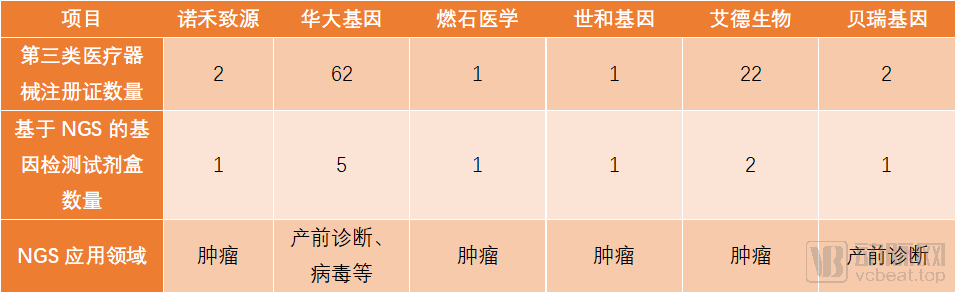
Furthermore, Novogene has also expanded into clinical application scenarios such as tumor detection kits based on the digital PCR platform, companion diagnostic kits developed in conjunction with targeted cancer therapies, newborn genetic disease screening, and infectious pathogen detection.
On the other hand, machines have partially replaced manual labor.
In 2019, Novogene invested over RMB 70 million and assembled a dedicated team of 40 professionals to build a globally leading flexible intelligent delivery system, achieving full-process automation from sample extraction to final data delivery. Starting in March 2020, the flexible intelligent delivery system underwent trial operation in the laboratory.
Specifically, Novogene’s flexible intelligent delivery system integrates dozens of precision instruments to achieve full-process automation spanning sample extraction, testing, library preparation, library quality control, library pooling, and bioinformatics analysis. Meanwhile, leveraging the intelligent solutions provided by the system’s automated task planning enables the concurrent co-production of four standardized product lines: whole-genome sequencing (WGS), whole-exome sequencing (WES), RNA sequencing (RNA-seq), and library preparation and sequencing services. Compared with manual collaboration or single-step semi-automated production lines, the flexible intelligent delivery system reduces labor input by 70%, shortens the average product delivery cycle by 60%, and increases the library preparation and quality control pass rate by 5%.
In fact, whether deploying clinical application scenarios or replacing manual labor with machines, it poses significant challenges in the genetic testing industry, which demands extremely high stability and precision. The same applies to Novogene; however, achieving this constitutes a competitive barrier.
Following Novogene’s listing, China’s genetic testing capital market has become increasingly crowded. From upstream platforms to mid- and downstream applications and services, and from research services to eugenics and tumor diagnosis and treatment, every sector now includes at least one listed company, contributing a combined market capitalization of nearly RMB 130 billion. Based on BBC Research’s estimate of a global genetic testing market size of USD 13.8 billion, genetic testing projects in the capital market are nearing saturation.
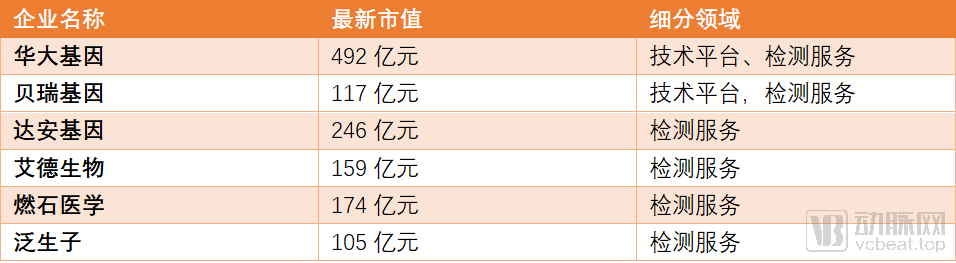
However, throughout 2020, genetic testing projects in the primary market reversed the downturn of the previous two years and secured substantial financing. Companies such as 3D Medicines, Genetron Health, Zhenhe Biotech, Coyote Bioscience, and GeneChem continuously broke records for the highest funding amounts raised by genetic testing enterprises.
So, will genetic testing remain a promising sector?
The answer is affirmative. With technological optimization on one hand and escalating demand on the other, the theoretical market size for genetic testing is sufficiently large. Furthermore, the continuous iteration of new application scenarios and the resulting incremental market space are constantly raising the ceiling of the genetic testing market.
However, it is also a fact that the genetic testing market has moved past its initial “newcomer bonus” phase. For genetic testing companies looking to the future, possessing only a technical platform and development capabilities will clearly no longer be sufficient to convince the market.
On the one hand, future genetic testing companies must possess strong capabilities to penetrate application scenarios that are highly aligned with their teams’ comprehensive strengths. As shown in the previous analysis of Novogene’s profitability, the gross margin in the genetic testing industry increases progressively from scientific research services to clinical services and then to in vitro diagnostics (IVD), with corresponding increases in technical difficulty. To achieve sustainable market competitiveness, genetic testing companies must inevitably move up this value chain toward higher-margin segments. Relatively speaking, capturing clinical application scenarios is a market-proven strategy, and many industry players are actively pursuing this approach. This trend is evident from the intense competition in tumor next-generation sequencing (NGS) over the past few years, the surge in financing for metagenomic NGS (mNGS) last year, and the explosive growth in early cancer screening this year.
On the other hand, in addition to application penetration capabilities, business resilience is also an essential capability for genetic testing companies. After nearly 20 years of development, genetic testing technology itself has gradually lost its aura of invincibility; the market will no longer pay a premium solely for its frontier status. How can companies develop cost-effective products that align with real-world needs? How can they build efficient commercial distribution networks to rapidly reach end users? And how can they continuously adjust their growth pace in a rapidly changing market? These are all critical considerations for genetic testing companies seeking to establish a solid foothold in the future.
In short, we are willing to believe in the future of genetic testing, just as we are willing to believe in the future of the genomics industry. After all, technology’s enhancement of life remains an enduring trend.
Source of operational and financial data in the text: Novogene’s Prospectus