The Great Voyage of Chinese Medical Innovation Has Begun
If we look back at today from a vantage point ten years in the future, there is more than a 90% probability that we will recognize 2020 as the turning point for medical innovation in China, with 2021 marking a new beginning.
Why so certain? Four phenomena since 2020 deserve particular attention:
First, technological innovation has become the top priority of the 14th Five-Year Plan.
Second, global healthcare financing reached a record high in 2020, with a year-on-year increase of 41%.
Third, InnoCare Pharma, a company founded by Shi Yigong, President of Westlake University, went public.
Fourth, Pinduoduo founder Colin Huang stepped down as chairman, ventured into the life sciences sector, and donated $100 million to Zhejiang University.
These four phenomena all point to one conclusion:
At the national, industrial (capital), and basic research levels, a tripartite integration is being realized, targeting primary innovation in core technologies.
2020 also saw many significant events. For instance, the COVID-19 pandemic further intensified the already booming healthcare industry, attracting a massive influx of capital from non-healthcare sectors. Nevertheless, even without this interlude, it was inevitable that China’s medical innovation would enter a new phase.
Looking back, every major transformation in history has been accompanied by certain key events.
China’s push for technological innovation is, in itself, a perfectly normal development. Any country whose per capita GDP approaches or reaches $10,000 will inevitably embark on the path of technological innovation, as this is naturally determined by social development and its economic foundation. Accordingly, China has naturally formulated its own plan for revitalizing science and technology. What was unforeseen, however, is that this has triggered a series of clashes.
Since the onset of the U.S.-China trade war, which has escalated from a commercial dispute to a technological confrontation, tensions have never eased. Even with a change in the U.S. presidency, this situation has remained unchanged. The COVID-19 pandemic also swept across the globe during this period, further intensifying global competition.
From another perspective, the series of disputes triggered by the China-U.S. trade war has, objectively speaking, strengthened China’s resolve to develop core technologies and helped forge a new consensus among the Chinese people. For instance, U.S. sanctions against Huawei have heightened public awareness of the importance of foundational technologies in the semiconductor industry, while the COVID-19 pandemic has underscored the critical role of foundational technologies in healthcare.
Of course, the most crucial factor is that China’s national strength has reached a stage where it boasts robust infrastructure and economic conditions, exerts greater appeal to top global talent, and has seen its policy mechanisms for technological innovation mature to the point of breakthrough.
Shi Yigong is a typical case.
Why Bring Up the “Shi Yigong Phenomenon”? What Have We Observed?
“Westlake University is the first new-type research university in the history of New China to be established by non-governmental forces and receive key national support.” This statement was made by Shi Yigong, President of Westlake University, in March.
Shi Yigong, who became the youngest tenured professor at Princeton University at the age of 35, chose to return to China in 2008 to teach, serving as the Dean of the School of Life Sciences at Tsinghua University, and later becoming Vice President of Tsinghua University in 2015. In 2018, he founded Westlake University and served as its founding president.
Shi Yigong is a representative figure among Chinese students who returned from abroad to advance China’s scientific and technological development. In our observation, his three most significant breakthroughs have had far-reaching impact:
First, he chose to return to China to teach at the peak of his personal career development in the United States, helping China significantly enhance its scientific research capabilities in related fields and exerting a strong driving effect; indeed, Shi Yigong has also influenced a large number of scientists to return to China for their career development.
Second, the establishment of Westlake University pioneered the initiative by non-state social forces to found a new type of research-oriented university in China. The model and evolution of Westlake University will undoubtedly have a profound impact on the development of Chinese higher education institutions.
Third, the biotech company he founded has gone public. This may represent the most significant change Shi Yigong has brought to the commercialization of scientific research. By consistently exploring the frontiers of scientific innovation, Shi Yigong has, through concrete actions, helped chart new pathways for scientific innovation and technology transfer in China.
According to VCBeat, under the exemplary influence of Shi Yigong’s entrepreneurial endeavors, a large number of scientists and clinical experts are more actively exploring improved models for translating scientific research into innovations.
At the upcoming Top 100 Future Healthcare Forum hosted by VCBeat, a forum on scientific research translation will be launched for the first time. Dozens of universities, hospitals, and investment institutions—including the Guangdong Zhong Nanshan Medical Foundation, Tsinghua University, the University of Oxford, Peking Union Medical College Hospital, and West China Hospital of Sichuan University—will participate. China’s medical research translation is ushering in a new era.
At the heart of technological innovation lies innovation in basic science, and at the core of basic scientific innovation is innovation within universities. Ren Zhengfei’s call from Huawei years ago will ultimately become a reality.
It is truly difficult for people to imagine that Pinduoduo, the new king of e-commerce, would be associated with life sciences. At the peak of his career, Colin Huang made a decisive pivot, not only dedicating himself to life sciences but also donating $100 million to Zhejiang University. This donation aims to promote fundamental research and frontier exploration at Zhejiang University in interdisciplinary fields spanning biology, healthcare, agriculture, and food science.
In fact, Colin Huang is not alone.
In November 2016, Chen Tianqiao, founder of Shanda Group and once China’s richest man, announced a $1 billion commitment to establish the Tianqiao and Chrissy Chen Institute for Neuroscience Research together with his wife, dedicated to advancing brain science research.
In November 2017, Chen Tianqiao launched a plan to invest RMB 500 million in China’s brain science research through the Tianqiao and Chrissy Chen Institute, establishing the Tianqiao and Chrissy Chen Institute Clinical Translation Center, with an initial phase of RMB 50 million allocated to Huashan Hospital.
Coincidentally, just one month before Chen Tianqiao invested in China’s brain science research, Alibaba officially announced its establishmentDAMO Academy, dedicated to research in basic sciences.
In an even more striking coincidence, two years after the establishment of DAMO Academy, the Tencent Foundation, initiated by Ma Huateng, launched the “Science Exploration Prize.” With a commitment of RMB 1 billion, the award recognizes young scientists, granting each recipient RMB 3 million in prize money that they may use at their discretion.
Less than a year later, Robin Li spearheaded the establishment of BiotoLife, building a biological computing platform based on Baidu’s underlying AI capabilities.
Wang Xing of Meituan and Zhang Yiming of ByteDance are also advancing their strategic layouts in healthcare, with undercurrents swirling beneath the surface.
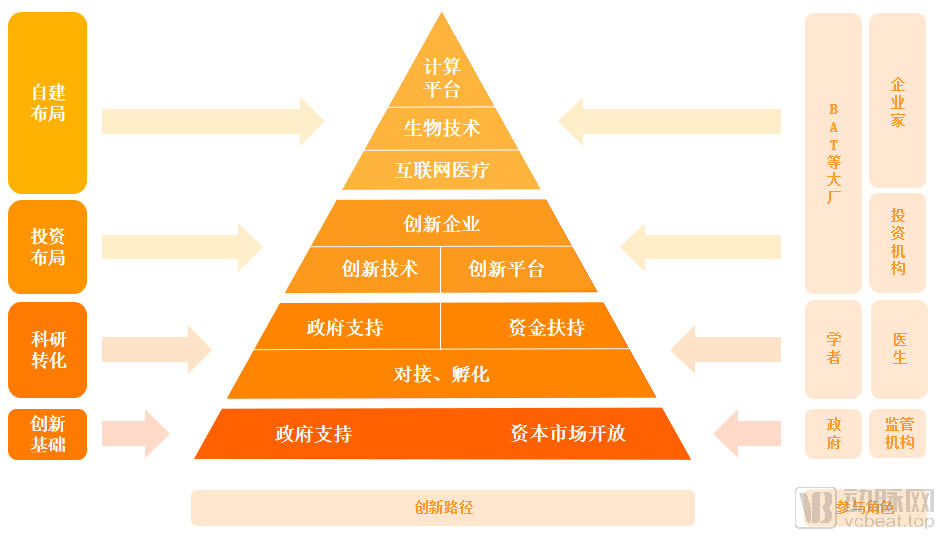
I strongly endorse the view that China is forging a new business civilization. The new generation of entrepreneurs demonstrates stronger technological drive, a global perspective, and a greater sense of responsibility.
As this article was being written, another piece went viral, in which Neil Shen of Sequoia Capital remarked in an interview: “The healthcare industry today resembles the PC internet era of two decades ago, with a cohort of outstanding companies emerging across various vertical sectors.”
This mirrors VCBeat’s close-up perspective on the industry: in addition to the aforementioned top-tier entrepreneurs making significant bets on the healthcare sector, a large number of healthcare entrepreneurs are also emerging.
Anyone who has visited VCBeat knows that when we introduce our client wall, we always mention that this company or that company is about to go public. VCBeat has been fortunate to have accompanied these startups over the past seven years, witnessing firsthand their growth from teams of three or ten people to going public and entering a new stage of corporate development.
What’s even more intriguing is that these entrepreneurs have delivered speeches at VCBeat’s Future Healthcare 100 Forum almost every year, and we have watched them turn their stories into reality step by step.
In contemporary China, the most striking manifestation of confidence is that, regardless of how tense the international situation may appear, China consistently adheres to two fundamental principles: unwavering commitment to reform and opening-up, and steadfast promotion of globalization. Even amid trade wars, China remains dedicated to advancing globalization and firmly rejects any return to isolationism.
Behind the trade war, we see even greater global attention on the Chinese market. Although the world was impacted by the COVID-19 pandemic in 2020, global exchanges never ceased. This year, VCBeat’s Future Healthcare Top 100 held its first international forum despite the adverse trends, receiving a positive response.
For instance, Kimon Angelides, founder of Livongo—a digital health pioneer initially covered by VCBeat—will also participate in this forum. Since its inception, VCBeat has been tracking digital health companies worldwide. To date, China has nurtured numerous unicorn companies, emerging as a global leader in many areas.
We have also observed that China has shifted from being a unidirectional recipient of new information to a parallel exporter. Internationalization today differs from the past; the global platform we are building aims to facilitate greater global collaboration, enabling not only the inflow of foreign enterprises into China but also the substantial outflow of Chinese companies to overseas markets.
There is no greater fortune than being a witness to the seismic shifts within an industry. I would like to conclude with some figures, as we jointly bear witness to the Age of Discovery for healthcare innovation in China:
Among the entrepreneurs served by VCBeat, more than 30 companies are expected to go public in the next two years;
Over the past five years, our Future Healthcare Top 100 list has released 13 main rankings for the healthcare industry and 30 sub-rankings for specialized medical sectors, featuring a cumulative total of 1,475 listed companies with a combined enterprise valuation of RMB 1.18177 trillion.
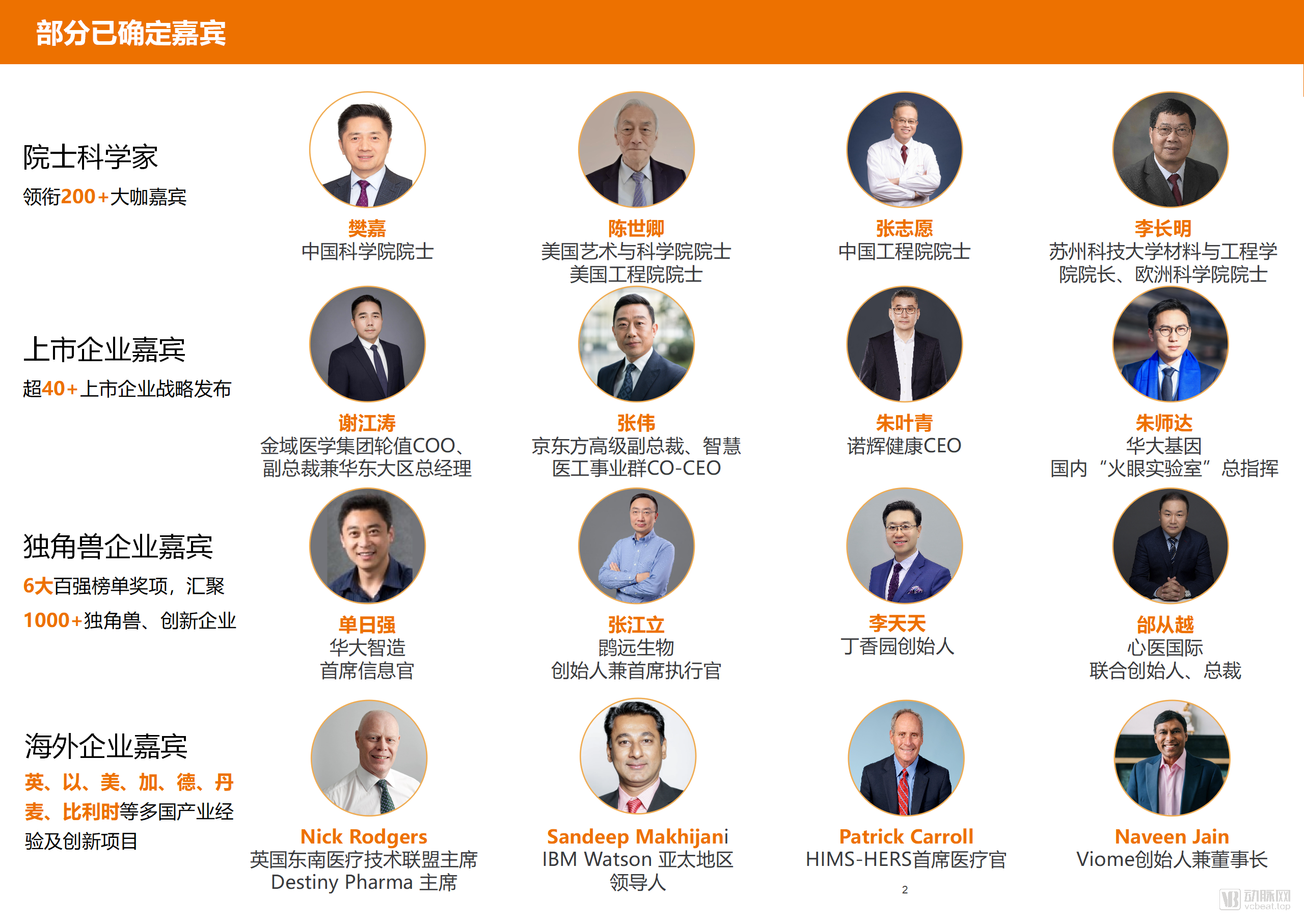
With over 300 cumulative speakers, including nearly 300 this year alone, the event has attracted approximately 10,000 attendees in total, more than 3,500 innovative companies, and over 1,000 investment institutions...
Finally, welcome everyone to attendVCBeat’s 5th Future Healthcare 100 Conference, April 16–18, Wujiang, Suzhou, be there or be square.
Scan the QR code or click below to visit the official conference website