

Breaking Physical Boundaries: The First Affiliated Hospital of Guangxi Medical University Launches Deeply Integrated Online-Offline Internet Healthcare Platform

Tencent
Internet Comprehensive Service Provider
“Chinese patients have a habit of seeking care at large public hospitals for all ailments, whether major or minor. This has led to an influx of diverse patient groups into outpatient departments, leaving hospitals overcrowded,” remarked with some emotion Chen Junqiang, President of the First Affiliated Hospital of Guangxi Medical University (hereinafter referred to as “the First Affiliated Hospital of Guangxi Medical University”).
How to Alleviate Patient Overcrowding in Large Hospitals? The First Affiliated Hospital of a Medical University analyzed outpatient data from recent years. The results showed that 56.56% of outpatients were follow-up visits, among whom 37.49% did not require examinations or treatment, and 33.67% visited solely to obtain prescription refills. In other words, more than 30% of patients do not necessarily need to seek care at large hospitals; they can address their healthcare needs through alternative channels, thereby avoiding unnecessary travel and saving time.
Internet healthcare may be one of the solutions. By transferring offline medical services to online platforms, and even decoupling them from tertiary hospitals, it may be possible to address the aforementioned challenges.
However, the concept of internet-based healthcare has been present in China for nearly two decades. Why do these issues persist? The underlying reasons are both technological and related to business models.
To truly apply the concept of Internet healthcare in hospitals and thereby provide better medical services to patients, the First Affiliated Hospital of Guangxi Medical University recently joined hands with Tencent Health and Guangxi Hezhan Technology to hold a launch event for online-offline integrated “Internet + Healthcare” services in Nanning. Themed “Integration: Making Medical Care Simpler,” the event pioneered a new model to facilitate the implementation of Internet healthcare.
“Integration” is the core of this new model.
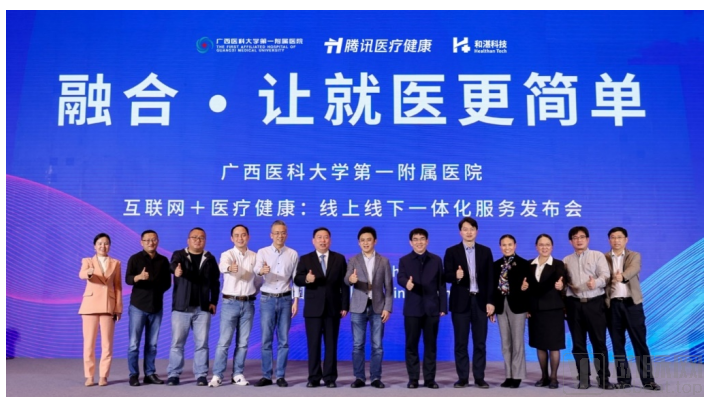 The First Affiliated Hospital of Guangxi Medical University Officially Launches Its Integrated Online-Offline “Internet+ Healthcare” Services
Generally, when hospitals establish internet hospitals, they only migrate certain easily implementable services online, such as appointment registration and lightweight consultations. While this can alleviate hospital pressure to some extent, it falls short of achieving the ultimate goal of tiered diagnosis and treatment.
In contrast, the integrated, deeply fused model jointly built by the First Affiliated Hospital of Guangxi Medical University, Tencent Health, and Guangxi Hezhan Technology aims to comprehensively replicate physical hospitals’ health records, medical services, and doctor–patient relationships into the digital world, creating a symbiotic relationship between physical hospitals and the digital realm, rather than simply treating internet-based healthcare as a supplement to offline care. This approach facilitates tiered diagnosis and treatment, thereby alleviating congestion at large hospitals.
To achieve this goal, the First Affiliated Hospital of Medical University took the lead in completing three foundational tasks.
“First, we have digitized health records. By improving electronic health records (EHRs), we enable the interoperability of medical records among hospital departments, laying the foundation for multidisciplinary consultations. Second, we have established an ‘Internet+’ medical consortium to achieve interoperability of medical records and mutual recognition of test results within the consortium, thereby facilitating two-way referrals. Finally, we have integrated online and offline consultation records, ensuring that internet-based healthcare services are supported by physical medical institutions,” explained President Chen Junqiang.
After laying the groundwork, the First Affiliated Hospital of Guangxi Medical University embarked on three transformative strides to reshape its internet-based healthcare services:
First, intelligent online outpatient services have been launched. With the support of a physical hospital, the internet healthcare services provided by the First Affiliated Hospital of Guangxi Medical University will not be disconnected from offline services.
Second, the hospital has implemented an online-offline integrated “Internet + Nursing” model. It is worth noting that the nursing services provided online do not include routine care, but rather focus on complex procedures such as PICC (peripherally inserted central catheter) management.
“We once encountered a patient from the Jingxi border region, which is over 400 kilometers away from Nanning. Each nursing visit required an eight-hour one-way journey, with a one-way fare of 160 yuan. To complete the tumor treatment, the patient needed a total of 16 round trips. When including the accompanying expenses for family members, the travel costs alone approached nearly 10,000 yuan.”
In response to this situation, the First Affiliated Hospital of Guangxi Medical University has partnered with 133 PICC nursing sites across Guangxi. Patients can directly schedule appointments through the Tencent Health mini-program; upon successful booking, medical personnel provide home-based care, eliminating the need for patients to visit the hospital. This model bridges the “last mile” in catheter maintenance for oncology patients, reducing travel burdens and complications arising from improper home care, thereby effectively improving postoperative adherence to rehabilitation protocols.
Third, building a cloud-based medical consortium. Through collaboration with Tencent and Hezhan, the First Affiliated Hospital of Guangxi Medical University has gradually achieved remote consultations, remote monitoring, remote ECG analysis, and remote imaging diagnosis among tightly integrated medical consortia. In the future, it will also establish internet-plus-based pathology and laboratory diagnostic centers. Under the cloud medical consortium framework, physicians can access patients’ treatment information via a single smartphone to make rapid diagnoses, and can initiate multi-participant online consultations to accelerate consultation efficiency.
Following the completion of the three core modules, the First Affiliated Hospital of Guangxi Medical University has established an integrated online-offline “Internet+ Healthcare” service model. Under this model, the time required for patients to progress from outpatient consultation and hospital admission to treatment has been reduced from approximately eight days to just three days. The tiered diagnosis and treatment system is beginning to show results, and the previously overcrowded outpatient building has gradually become more orderly.
The successful upgrade of the First Affiliated Hospital of Guangxi Medical University was made possible by the close collaboration between Tencent Health and Hezhan Technology, as well as by the support of innovative concepts.
President Chen Junqiang stated, “With the continuous advancement of technology and the progress of precision medicine, the development of next-generation internet hospitals not only requires contributions and suggestions from all stakeholders but also demands that managers shift their conceptual approach to construction—replacing the traditional delivery model rooted in informatization thinking with a model of collaborative development between medical institutions and enterprises.”
In this process, hospitals must clearly communicate their requirements to enterprises, while enterprises need to gain an in-depth understanding of hospitals’ clinical and management workflows in order to identify inefficiencies and address them.
Secondly, enterprises need to empower hospitals through technology. In their collaboration, Tencent provided hospitals with a platform to connect with users, leveraging its strengths in connectivity and technology as well as its accumulated insights into user needs. This support helps hospitals undergo digital transformation, unlock the value of high-quality medical resources on the supply side, and improve patients’ experience and efficiency during medical visits, thereby meeting patients’ demand for “simpler access to healthcare.”
Meanwhile, by leveraging the capabilities of Tencent Health, WeCom, and Tencent AI, Tencent’s healthcare ecosystem partners—such as Hezhan Technology—can better harness their localized strengths to integrate hospitals and develop effective healthcare informatics solutions.
Wu Zhigang, Head of Tencent Health Products, told VCBeat: “To build a successful internet hospital, it is essential to address issues related to its entry points and capabilities. Tencent’s greatest advantage lies in connectivity, empowerment, and efficiency enhancement.”
“By leveraging WeChat’s platform with 1.2 billion users, we can make access to internet hospitals lightweight and universally accessible, while Tencent’s AI capabilities help patients find suitable doctors more quickly and enable physicians to obtain patient information in advance during pre-consultation, ultimately optimizing the shared experience for both patients and doctors.”
Beneath the hospital and platform infrastructure, specific applications are required to serve as foundational pillars; Hezhan Technology has fulfilled this role. Zhang Xiaodong, CEO of Hezhan Technology, stated, “In this collaboration, Hezhan Technology developed a time-slot appointment application for the hospital, enabling patients to access it via WeChat. This application serves as the central hub of the partnership, effectively expanding the boundary capabilities of internet healthcare.”
Overall, the goal is not simply to shift patients’ tasks to physicians or vice versa, but to redistribute existing workflows. This enables patients to access medical care more easily, allows healthcare professionals to deliver high-quality medical services more efficiently and safely, and empowers hospitals to continuously unlock value by leveraging their inherent strengths.
To date, the First Affiliated Hospital of Guangxi Medical University has connected over 4,000 staff members across the entire hospital to its online platform, including more than 930 physicians, nurses, and pharmacists, with over 500 being senior-title experts. Patients can submit inquiries regarding treatment, nursing care, and medication via WeChat, while the hospital provides 24/7 online services.
The next issue to address is the incentive mechanism for online physicians. President Chen Junqiang does not want internet hospitals to be driven by sporadic demand or established as a whimsical initiative. He aims to standardize the online model to the same extent as the offline model, thereby truly realizing healthcare delivery via the internet and achieving the goal of tiered diagnosis and treatment.
Addressing user pain points with a new model requires responsibility and courage. After all, advancing the development of internet healthcare inevitably involves restructuring patient consultation behaviors and physicians’ diagnostic and treatment practices, a process fraught with setbacks and obstacles. The reach of internet healthcare is boundless, yet it still has a long way to go.