

Ring Therapeutics Files for IPO: Pioneering Gene Therapy with Anellovector Platform Based on Human Commensal Viruses

Ring Therapeutics
Gene Therapy Developer
On December 20, 2019, the renowned venture capital firmFlagship Pioneering announced a $50 million investment to launch Ring Therapeutics, a company focused on novel gene therapies, stating that its technology holds promise for overcoming the current challenges facing the gene therapy field.
Flagship Pioneering has signaled a “promising future” for Ring Therapeutics with a $50 million investment, yet we cannot help but harbor doubts—about a company founded inIn 2017, the still-young company was toWhat drives the development of novel gene therapies? And as the company’s trump card,Anellovector Therapy: What Sets It Apart from Existing Gene Therapies?
A Novel Gene Therapy Sparked by a Question
Viruses are inextricably linked to humanity. Many mysteries surrounding the virosphere remain unsolved. Naturally, where there are puzzles, there are those eager to solve them. Do human symbiotic viruses exist? If so, can they be leveraged to develop therapeutic interventions? To answer these questions, a team of entrepreneurial scientists, led by Dr. Avak Kahvejian, Founding CEO of Ring Therapeutics, and Dr. Erica Weinstein, Senior Manager at Flagship Pioneering, has embarked on a journey of exploration.
Finally, they identified a mysterious class of viruses known as Anellovirus. After studying the biological characteristics of more than 1,000 such viruses, they made a crucial discovery: these viruses are not only harmless to the human body but can also persist within cells for extended periods without triggering an immune response. This makes them a potential drug delivery system capable of administering multiple treatments.
Ring Therapeutics was thus born. By leveraging the biological properties of human common viruses, Ring Therapeutics has pioneered the first re-dosable and targetable gene therapy platform, aiming to expand the application of gene therapy beyond gene replacement and providing broader approaches and mechanisms for treating previously incurable diseases.
Ring Therapeutics’ management team comprises five industry veterans. Chief Executive Officer Tuyen Ong earned his Doctor of Medicine degree with honors from University College London and a Master of Business Administration from New York University’s Stern School of Business. In addition to serving as CEO of Ring Therapeutics, he is an internist, a biotech entrepreneur, and a CEO Partner at Flagship Pioneering.
Simon Delagrave is the Associate Director of Platform and Biology at Ring Therapeutics. He graduated from McGill University with a degree in Biochemistry and later earned his Ph.D. in Biochemistry from the Massachusetts Institute of Technology. Also featured is Roger J. Hajjar, Head of R&D at Ring Therapeutics, who obtained his M.D. from Harvard Medical School and the Harvard-MIT Division of Health Sciences and Technology.
Dr. Nathan Yozwiak is the Director of Viral Genomics at Ring Therapeutics. He earned his Ph.D. in Infectious Diseases from the University of California, Berkeley, and his B.A. in Molecular and Cell Biology from Johns Hopkins University. His graduate studies were conducted in the laboratory of Joe DeRisi at the University of California, San Francisco, where he employed viral microarrays and deep sequencing technologies to detect and discover both known and novel viruses associated with pediatric diseases, including conducting the first clinical metagenomic study.
The final speaker is Dr. Sadettin Ozturk, who serves as Senior Vice President of CMC and Manufacturing Operations at Ring Therapeutics. He earned a Master’s degree in Chemical Engineering from Ankara University in Turkey, followed by a Ph.D. from the University of Michigan in Ann Arbor. Additionally, he holds an MBA from the Haas School of Business at the University of California, Berkeley.
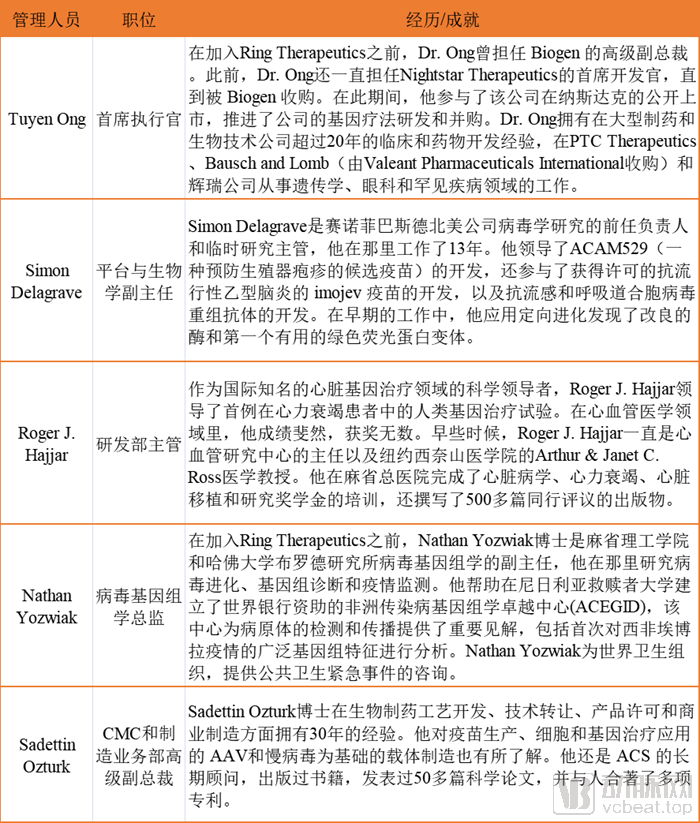
Information on Five Executives at Ring Therapeutics
Anellovector Therapy: Unlocking the Potential of Gene Therapy with a “New” Approach
The virosphere is the most abundant component of the biosphere. Scientists have clearly elucidated its complexity through sequencing technologies, advances in computational genomics, and sheer brute force. Much like Leeuwenhoek’s microscopic observations of microorganisms, our exploration reveals a vast viral galaxy in every direction we look; the symbiotic virome is merely the tip of the iceberg in this underestimated and largely unexplored viral world.
Ring Therapeutics has leveraged this seemingly insignificant yet vast tip of the iceberg to create a non-viral engineered vector composed of single-stranded DNA circles. Upon administration, these circles persist as episomes in the nucleus, offering a rare and benign potential to deliver DNA into new cells without damaging tissue or activating the immune system.
The establishment of the Anellovector platform represents a new step forward in the field of gene therapy.
Dr. Avak Kahvejian, founder of Ring Therapeutics, once stated: “We believe that Anellovector-based therapies represent the future of gene therapy and broader DNA-based medicines. The underlying biology and diversity of anelloviruses, along with the fact that they have co-evolved with humans for thousands of years, provide us with revolutionary new insights. Leveraging our proprietary platform, we can develop safer and more effective therapeutics.”
What are the specific characteristics of Anellovector therapy? Compared with existing gene therapy modalities, what are its advantages?
First, current virus-based gene therapy platforms carry the risk of disrupting important gene functions due to the random integration of viruses into the human genome, which can lead to genetic mutations, activation of proto-oncogenes, and silencing of regulatory genes. In contrast, AnellovectorMaintaining the episomal state in the nucleus does not affect the genome,This eliminates the potential risk of insertional mutations, making gene therapy safer.。
Secondly, Anellovector therapy can overcome pre-existing immune barriers, features disease targets with cell and tissue specificity, and allows for re-dosing of patients as needed. The Anellovector platform is also engineered to accommodate diverse therapeutic modalities and can be delivered via multiple routes of administration.
Furthermore, existing gene therapy modalities, such as the adeno-associated virus (AAV) vector-based gene therapies that have gained significant popularity in recent years, have a notable drawback. Each patient is afforded only one treatment opportunity in their lifetime, because once the virus enters the human body, the immune system retains a memory of its presence and will completely eliminate it upon subsequent exposure.
In other words, when patients receiving AAV gene therapy fail to achieve the expected therapeutic outcomes, they are unable to undergo retreatment. Furthermore, in some patients, this type of virus can trigger an immune response, thereby limiting the efficacy of the treatment. AndAnellovector therapy holds a distinct advantage in this regard, as it has the potential to treat patients with pre-existing immune impairments and those requiring retreatment.
In addition, Ring is developing proprietary in-house capabilities to rapidly scale up manufacturing, explore the broad therapeutic potential of various Anellovectors, and then expand production to commercial scale by implementing state-of-the-art manufacturing technologies.
For years, the promise of gene therapy to provide solutions for patients has been hindered by limited scope, irreversibility, and poor tolerability. Ring Therapeutics’ novel approach has the potential to revolutionize this field, rendering these challenges obsolete and unlocking the full potential of gene therapy and broader DNA-based medicines.
Flagship Pioneering: The “Mother Earth” of Ring Therapeutics
Ring Therapeutics is a company built from the ground up by Flagship Pioneering. Although the two entities are closely related, they do not maintain a complex “parent-subsidiary” relationship; rather, they operate with greater independence. However, it would be inaccurate to characterize their connection as merely that of an “investor and portfolio company”; their ties are significantly closer.
Flagship has a highly unique and intriguing hypothesis-driven innovation process. Each year, they propose 80 to 100 bold hypotheses, exploring the question, “What if...?” They then collaborate with experts to attempt to validate these hypotheses, a phase they call “Exploration.” Promising Explorations advance to the next stage, becoming “ProtoCos.” Eventually, when the “What if...” transforms into “It turns out that...,” it signals the imminent formation of a new company. Ring Therapeutics was born under this model.
Finally, the new company grew into “CrowthCo,” secured external investment, onboarded new partners, created its own unique value, and ultimately completed its initial public offering. This constitutes a perfect outcome.
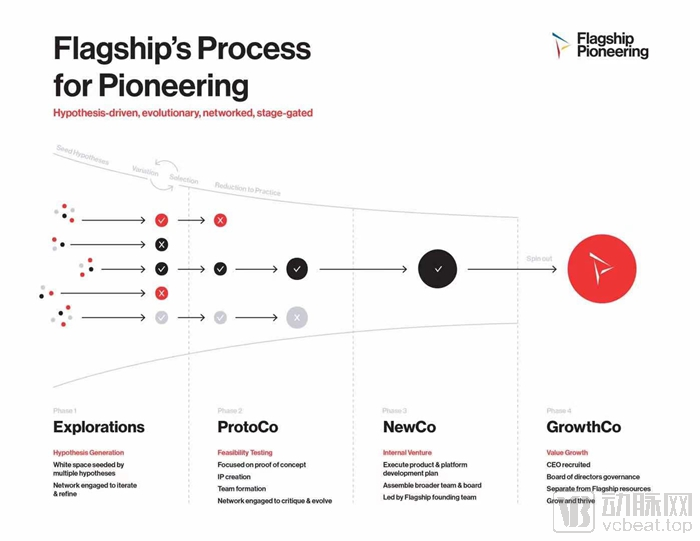
Image source: Flagship Pioneering official website
Flagship Pioneering is like a group of insurgents, transforming human health and sustainability by conceiving, creating, and developing first-class life sciences companies. It envisions conceiving and creating new solutions beyond existing markets, a bold move that far surpasses the adjacent, incremental innovations sought by incumbents.
Flagship Pioneering leverages science and entrepreneurship to envision alternative futures, starting with seemingly implausible hypotheses and guiding transformative outcomes through an evolutionary approach. The firm believes that teams are best suited to serve as pioneers, viewing this as a process that can be taught, learned, and replicated. Flagship Pioneering attracts, develops, and retains the world’s top scientific, entrepreneurial, and managerial talent, then systematically creates premier companies by integrating innovation capabilities, corporate leadership, and specialized capital management.
As the founder, primary resource provider, and principal owner of these companies, Flagship Pioneering grants them access to the full resources of its ecosystem and assumes responsibility for their long-term success. This model is innovative yet challenging; in this highly specialized field, only enterprises with proprietary platforms can consistently launch significant new products across multiple domains. By creating some of the world’s most innovative and valuable life sciences companies, Flagship Pioneering has also delivered exceptional returns to its capital partners.
This is not just an investment; it is a venture-building endeavor. Since 2000, Flagship Pioneering has employed this approach to incubate more than 100 scientific enterprises, generating a total value exceeding $30 billion. Supported by over $3.3 billion in total committed capital—including more than $1.9 billion dedicated to the founding and growth of its pioneer companies—the portfolio has also attracted over $10 billion in follow-on investments from other institutions.
The current flagship ecosystem consists of 39 transformative companies, including Axcella Health, Evelo Biosciences , Foghorn Therapeutics, Indigo Agriculture, Kaleido Biosciences, Moderna Therapeutics , Rubius Therapeutics , Seres Therapeutics, and Syros Pharmaceuticals 。
With cutting-edge technical resources and robust backing, Ring Therapeutics’ Anellovector therapy holds promising prospects. Nevertheless, we must not rest on our laurels; after all, in this marathon battle, the outcome remains uncertain until the very end. We look forward to receiving good news from Ring Therapeutics in the future.
A Brief Overview of the Current Status of Gene Therapy in China
In recent years, the field of gene therapy in China has gradually gained momentum. However, there remains a significant gap between China and international advanced levels in areas such as viral vectors and gene-editing technologies. As is well known, it is no exaggeration to describe gene therapy research as “cash-burning.” Even though we are no longer in the era of “$1 billion over 10 years,” the path of gene research remains challenging, with persistent uncertainties including long development cycles, high risks, and substantial costs.
At this juncture, the importance of capital is self-evident. In addition to capital, talent is also critical; recruiting and cultivating specialized professionals in the field of cell and gene therapy is indispensable. Finally, the rise of an industry cannot be achieved without support from national policies. Only when the public, scientists, capital-backed enterprises, and the government form a virtuous cycle can the industry thrive and achieve robust growth.