

Annual 'Small Molecule of the Year' List Unveiled Featuring Lenacapavir, PROTACs, and KRAS Inhibitors
First published on: WuXi AppTec, Author: Edited by the WuXi AppTec Content Team, authorized for republication by VCBeat.
Recently, the Drug Hunter website announced its annual list of top small molecules, selected by industry drug developers. The drug developers consulted by Drug Hunter typically have over 12 years of experience in pharmaceutical development, with nearly half having spent more than two decades in the field. Many of them are executives at major pharmaceutical and biotechnology companies. Therefore, this list reflects the assessment of investigational small-molecule drugs by industry experts. The voting results showed that lenacapavir (GS-6207), a long-acting HIV capsid inhibitor from Gilead Sciences, ranked first; PROTAC 6, a targeted protein degrader that degrades the RIPK2 protein from GlaxoSmithKline (GSK), came in second; and Bayer’s human gonadotropin-releasing hormone receptor (hGnRH-R) antagonist BAY 1214784 tied for third place with adagrasib (MRTX849), a KRAS G12C inhibitor from Mirati Therapeutics.
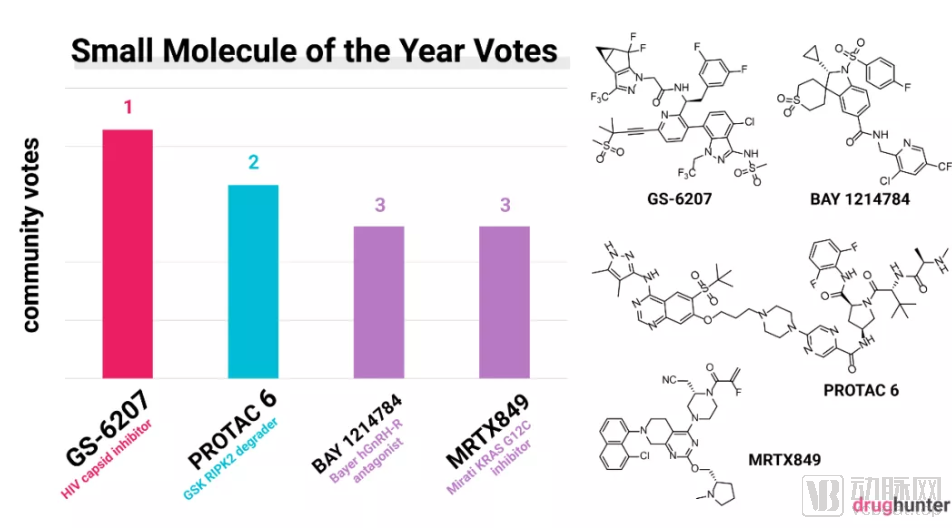
▲ Annual Small-Molecule Drug List Published by Lieyaoren Website (Image Source: Reference [1])
Lenacapavir, which tops the list, is one of the key drugs in the recent major R&D collaboration between Gilead Sciences and Merck & Co. (MSD) in the field of HIV. When combined with Merck’s innovative nucleoside reverse transcriptase translocation inhibitor (NRTTI), islatravir, it may provide HIV patients with a complete long-acting treatment regimen available in either oral or injectable form. Why has lenacapavir garnered praise from numerous drug development experts? Let us examine its unique features below.
To understand lenacapavir, we must first discuss its target: the HIV capsid protein. The HIV capsid functions like an eggshell, protecting the viral RNA and enzymes enclosed within. During HIV replication, the capsid also interacts with both host and viral proteins, thereby influencing the replication process.
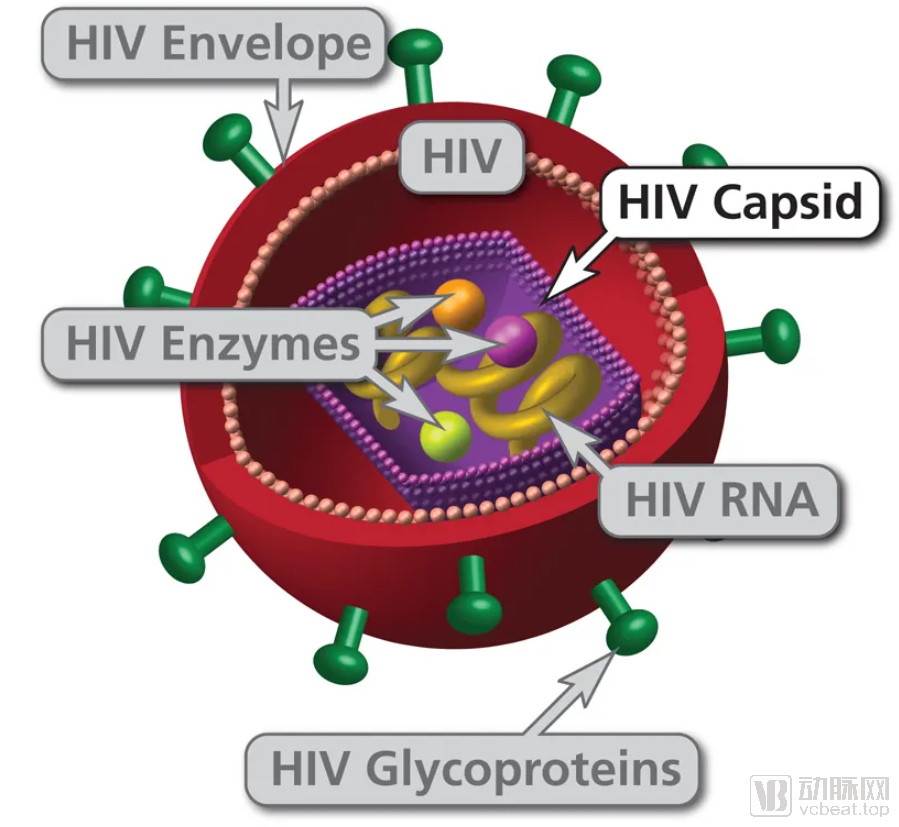
▲Basic structure of the HIV virus (Image source: Reference [4])
This capsid is formed through the self-assembly of thousands of capsid protein monomers. These monomers resemble LEGO bricks, with individual units assembling into pentamers or hexamers, which then interlock to construct the complete capsid. Given the critical role of the capsid in the HIV replication cycle, targeting it for drug development has long been a focus of research; Gilead Sciences initiated investigations in this area as early as 2006. However, unlike other HIV targets, the capsid protein is not a protease and lacks enzymatic activity. Furthermore, within the virus, capsid protein monomers are present at high levels, making it difficult for small-molecule drugs intended to inhibit their function to achieve sufficient concentrations to demonstrate significant efficacy.
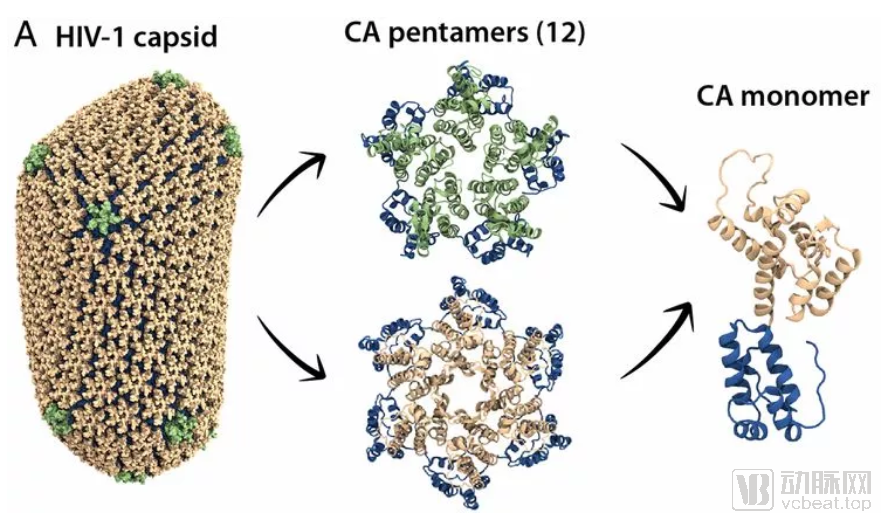
▲The HIV capsid resembles a model assembled from numerous small building blocks (capsid protein monomers) (Image source: Reference [5])
Just as a well-built LEGO model requires each small brick to be seamlessly interlocked, the normal function of the capsid relies on the precise assembly of capsid protein monomers. Therefore, if the self-assembly process of capsid protein monomers can be influenced, could this disrupt capsid function and HIV replication?
This also represents a direction for drug development. In 2010, researchers at Pfizer published a study in PLOS Pathogens, presenting a crystal structure model of the company’s developed capsid inhibitor bound to capsid protein monomers. Although this candidate compound exhibited low potency, it demonstrated the feasibility of targeting the capsid.
Gilead Sciences’ R&D team screened for drugs affecting the capsid assembly process based on this rationale. They found it difficult to identify inhibitors that suppress capsid assembly, possibly because the high concentration of capsid protein monomers within the virus hinders inhibitor efficacy. However, candidate compounds that accelerate capsid assembly demonstrated superior effects. Lenacapavir binds to capsid protein monomers, not only accelerating viral capsid assembly but also resulting in the formation of dysfunctional, “defective” capsids.
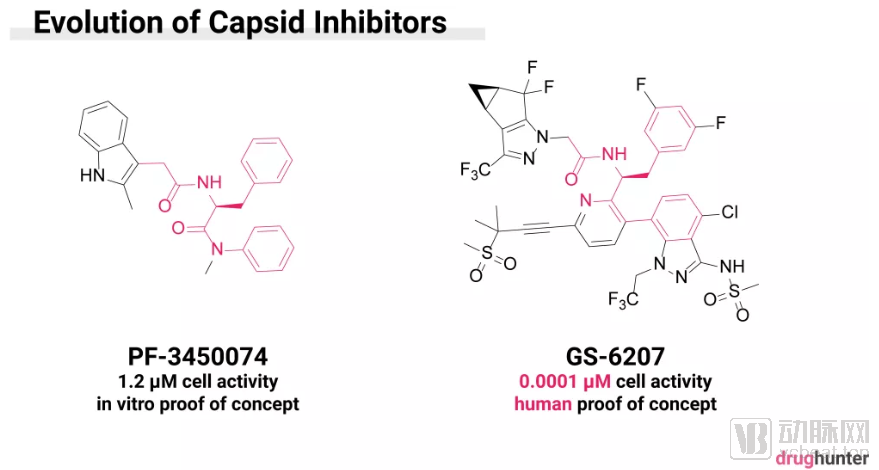
▲Lenacapavir (GS-6207) demonstrates significantly enhanced potency compared to earlier capsid inhibitors (Image source: Reference [1])
Another challenge in developing long-acting HIV therapies is avoiding hepatic clearance of the drug. Gilead Sciences’ modifications to lenacapavir have endowed it with a prolonged half-life, potentially allowing for dosing as infrequently as once every six months while maintaining antiviral efficacy. In May 2019, it received Breakthrough Therapy Designation from the U.S. Food and Drug Administration (FDA) for use in combination with other antiretroviral agents to treat individuals with multidrug-resistant HIV infection. At a medical conference held this month, lenacapavir demonstrated positive results in the Phase 2/3 CAPELLA clinical trial involving patients with multidrug-resistant HIV. When administered as a single subcutaneous injection alongside an optimized background regimen, 73% of patients maintained undetectable HIV viral loads after 26 weeks of treatment. Gilead Sciences expects to submit a regulatory application to the U.S. FDA in the second half of this year.
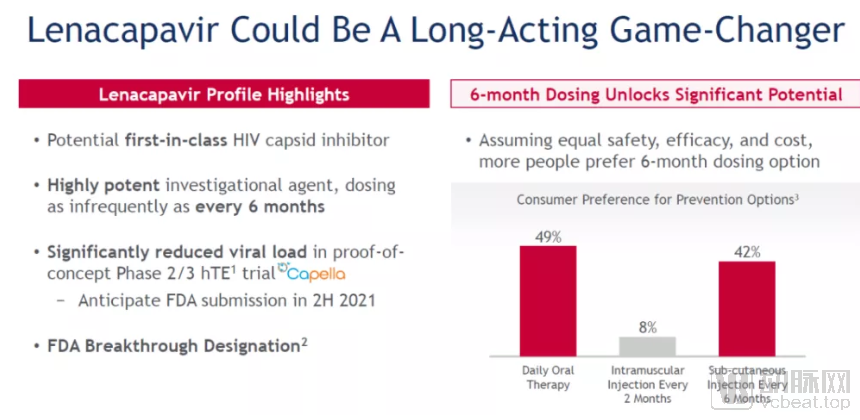
Image source: Gilead Sciences official website
In addition to serving as a long-acting treatment for individuals with HIV infection, Gilead Sciences is also conducting clinical trials to evaluate the potential of lenacapavir as pre-exposure prophylaxis (PrEP). In preclinical studies involving non-human primates, a single injection of lenacapavir at low or high doses reduced the risk of infection by 86% (p=0.0061) and 96% (p=0.0002), respectively.
The Lieyaoren website noted that lenacapavir is a classic example of small-molecule drug development and expressed its hope for more good news in its future clinical development and approval process.
References:
[1] Small Molecule of the Year – 2020. Retrieved March 28,2021, from https://drughunter.com/2020smotygs/
[2] Gilead’s Investigational Lenacapavir DemonstratesSustained Long-Acting Efficacy Through Week 26 in Data Presented at CROI.Retrieved March 28, 2021, from https://www.gilead.com/news-and-press/press-room/press-releases/2021/3/gileads-investigational-lenacapavir-demonstrates-sustained-long-acting-efficacy-through-week-26-in-data-presented-at-croi
[3] Gilead and Merck Announce Agreement to Jointly Developand Commercialize Long-Acting, Investigational Treatment Combinations ofLenacapavir and Islatravir in HIV. Retrieved March 28, 2021, from https://www.gilead.com/news-and-press/press-room/press-releases/2021/3/gilead-and-merck-announce-agreement-to-jointly-develop-and-commercialize-longacting-investigational-treatment-combinations-of-lenacapavir-and-islatr
[4] Capsid. Retrieved March 28, 2021, from https://clinicalinfo.hiv.gov/en/glossary/capsid
[5] Quinn et al., (2018). Dynamic regulation of HIV-1 capsidinteraction with the restriction factor TRIM5α identified by magic-anglespinning NMR and molecular dynamics simulations. PNAS, https://doi.org/10.1073/pnas.1800796115