

MeNo Micro-Tech Completes Pre-A+ Financing to Advance Domestic Innovation in Neurovascular Interventional Devices
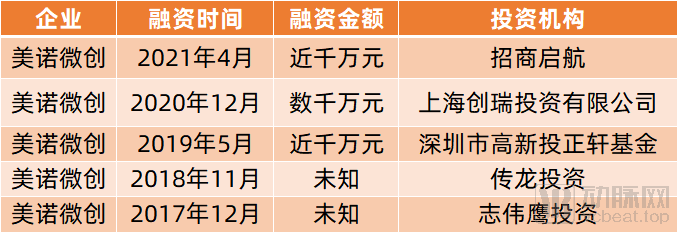
VCBeat has learned that Miele Medical, a developer of neurointerventional devices, recently announced the completion of its Pre-A+ financing round, raising nearly RMB 10 million. The investment was jointly made by two funds under China Merchants Qihang. The funds raised in this round will be used for product registration, procurement of equipment and materials, team expansion, and other purposes.
Previously, Miele Medical secured tens of millions of yuan in Pre-A round financing from Shanghai Chuangrui Investment Co., Ltd. in December 2020, and received nearly ten million yuan in investment from Shenzhen High-Tech Investment Zhengxuan Fund in May 2019.
(Chart by VCBeat)
According to available information, Miele Medical, founded in 2017, is an innovative enterprise dedicated to the research, development, and manufacturing of neurointerventional devices. The company aims to benefit more patients with cerebrovascular diseases in China through technological innovation. Its product portfolio includes microguidewires, microcatheters, coils, balloon catheters, intracranial stents, and thrombectomy devices.
Shenzhen Miele Medical Technology Co., Ltd. has attracted significant attention from investment institutions since its inception, securing funding from investors including Zhiweiying Investment, Chuanlong Investment, Shenzhen High-Tech Investment Group, Shanghai Chuangrui, and China Merchants Qihang. What accounts for the recognition it has received from investors? What is the state of its market? And what are the defining features of its core competitiveness?
Cerebrovascular diseases mainly include ischemic neurovascular diseases and hemorrhagic stroke. In developed countries overseas, neurointerventional procedures have been widely accepted by the majority of patients with cerebrovascular diseases due to their minimal invasiveness, high safety profile, and favorable clinical outcomes. In China, however, the penetration rate of neurointerventional procedures remains low; for instance, the penetration rate of mechanical thrombectomy was only 0.56% in 2017.
However, driven by multiple factors including patient prevalence, disease awareness, economic development, imaging technology, policy support, physician training, and product innovation, the neurointerventional market is poised for significant growth in the future.
From the patient perspective, cerebrovascular disease, which has a high prevalence among the elderly population, will see a further increase in both the number of cases and incidence rate as population aging intensifies. With advancements in imaging technology, the detection rate of cerebrovascular disease will rise significantly, leading to a concurrent growth in the number of patients requiring neurointerventional treatment. Additionally, as China’s economic development and living standards improve, residents’ disposable income has increased. Consequently, more individuals are prioritizing personal health and demonstrating a greater willingness to pay for healthcare services.
In terms of policy, the state supports the substitution of imported products with domestically produced high-end medical devices. Currently, approximately 93% of the neurointerventional market share is occupied by foreign brands such as Medtronic and Johnson & Johnson, indicating substantial potential for domestic substitution and strong growth prospects for Chinese neurointerventional companies. Furthermore, the government has continuously intensified its efforts in product approval, innovation promotion, and the procurement of domestically produced goods, thereby driving the rapid development of the neurointerventional industry.
Regarding physician training, China has established a comprehensive mentorship-based training system. The Interventional Physicians Branch of the Chinese Medical Doctor Association, renowned hospitals, and numerous neurointerventional companies are all making significant efforts to cultivate physicians. Meanwhile, supported by the national initiative to vigorously build stroke centers, the number of neurointerventional physicians in China continues to grow, with a rapid increase in the number of physicians qualified to perform neurointerventional procedures.
In the realm of domestically produced neurointerventional products, companies represented by Miele Medical are advancing through technological innovation and R&D, optimizing products such as microguidewires, coils, and balloon catheters. Existing clinical data indicate significant quality improvements in Chinese-made neurointerventional devices, with certain performance metrics of some products matching or even surpassing those of imported counterparts. Furthermore, the generally lower pricing of domestic neurointerventional products compared to imported ones helps promote the widespread adoption of neurointerventional procedures, thereby benefiting a larger population of patients with cerebrovascular diseases in China.
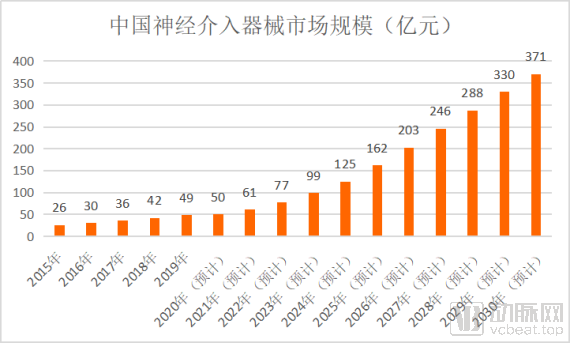
Taking the above factors into account, Frost & Sullivan believes that:By 2030, the neurointerventional device market will grow to RMB 37.1 billion, with a compound annual growth rate (CAGR) of 20.2% from 2019 to 2030.
(Graphic by VCBeat)
Faced with the monopoly of foreign brands in neurointerventional devices, Wang Disi, founder of Miele Medical, is determined to break the dominance of multinational corporations and build China’s own “Medtronic.”
To win the market, one must have high-quality products and robust technical capabilities.
For Shenzhen Miele Medical Technology Co., Ltd., its core products—including microcatheters, microwires, balloon catheters, thrombectomy devices, stents, and coils—have all achieved breakthrough progress. Among these, the microwires and microcatheters have already obtained registration certificates; other product lines are currently in the R&D phase and progressing smoothly, with 2–3 products expected to receive certification within 2021. Founder Wang Disi revealed: “The coils developed by Miele Medical are electrolytically detachable coils, which can be detached in just one second and exhibit lower push resistance compared to mechanically detachable coils.”
Miele Medical’s micro-guidewire products also feature numerous innovations. For instance, its micro-guidewires are available in four major diameters: 0.008 inches, 0.01 inches, 0.014 inches, and 0.018 inches. Wang Disi explained, “Cerebral vessels have many branches of varying calibers. In some patients, the lesion is located at the distal end of a branch vessel, where conventional guidewires often fail to meet clinicians’ needs due to limitations in diameter and pushability.”The 0.008-inch diameter micro-guidewire developed by Miele Medical can directly reach the M3 and M4 segments of the brain, demonstrating significant advantages and fillingLeA domestic gap.”
In addition, the microcatheter products developed by Miele Medical will fill a gap in the domestic market. Data shows that its microcatheters are available in three major sizes: 0.017 inches, 0.021 inches, and 0.027 inches.Among them,Enhanced microcatheters enable direct access to the M3 and M4 segments of the brain.Helps physicians more conveniently treat a larger number of patients with cerebrovascular diseases。
In terms of the technical team, Wang Disi, founder of Miele Medical, previously worked at multinational giants such as Boston Scientific, Johnson & Johnson, and Terumo in the United States, where he was engaged in the research and development of neurointerventional products including microguidewires, microcatheters, cerebral vascular stents, balloon catheters, and thrombectomy devices. He possesses in-depth knowledge of the performance, advantages, and disadvantages of various products in the neurointerventional field. The core R&D team members are all seasoned professionals from the U.S. neuro-medical device industry, having held positions at companies such as Medtronic, Terumo, Johnson & Johnson, and Boston Scientific, and have led the development of products such as coils, cerebral vascular stents, guidewires, microcatheters, and balloon-expandable stents.It is worth noting that the core R&D personnel of Miele Medical all possess over 20 years of experience in the development of neurointerventional products in the United States.
Currently, Miele Medical has established a 300-square-meter office and a 1,300-square-meter Class 10,000 cleanroom, which has passed verification by the National Medical Products Administration (NMPA), enabling large-scale product manufacturing.This also means that domestic emerging players, represented by Miele Medical, are gradually entering the market, expanding their reach with high-quality products at reasonable prices, increasing the penetration rate of neurointerventional procedures, and benefiting more patients with cerebrovascular diseases in China.
Shenzhen China Merchants Qihang Investment Management Co., Ltd. (hereinafter referred to as “China Merchants Qihang”) was established in 2015. As a national-level technology business incubator and early-stage investment platform under China Merchants Group, the company adopted a “incubation + investment + fund management” tripartite business model from its inception. Leveraging three core strengths—industrial resource matchmaking, a fully licensed financial service chain covering the entire lifecycle, and international innovation resources along the “Belt and Road”—it has gradually built an industrial investment ecosystem represented by “technology + financial services,” “technology + transportation,” “technology + urban industrial parks,” and “technology + big health.”