

Kunbo Medical's InterVapor® Demonstrates Significant Potential in Feasibility Study for Lung Cancer Treatment
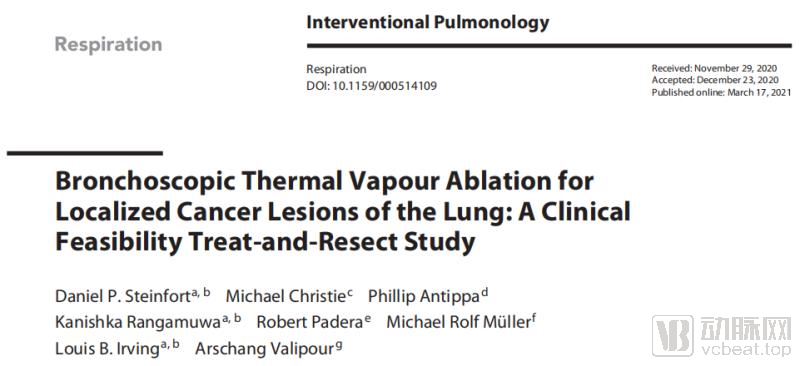
Recently, InterVapor, under Broncus Medical®Thermal Vapor Energy Ablation System (hereinafter referred to as “InterVapor”®”) published the findings of the feasibility study on lung cancer treatment (the VAPORIZE Study) in Respiration, the official journal of the European Society for Bronchology and Interventional Pulmonology, on March 17, 2021;1-11. The study results indicated that bronchoscopic thermal vapor ablation (BTVA®) The treatment of pulmonary tumors is feasible and well-tolerated, with the observed ablation effects demonstrating its significant potential for ablative therapy in lung cancer.
Lung cancer is known as the “king of cancers” due to its exceptionally high incidence and mortality rates. According to estimates from the Global Cancer Report (GLOBOCAN 2020), published by the International Agency for Research on Cancer (IARC) under the World Health Organization, there were 2.1 million new cases and 1.8 million deaths from lung cancer worldwide. Over the past four decades, the lung cancer mortality rate in China has increased fourfold. Lung cancer has surpassed gastric cancer as the leading cause of cancer-related deaths, accounting for 27.3% of all cancer deaths in China. To date, surgical resection remains the only curative treatment for lung cancer; however, 80% of lung cancer cases are not amenable to surgical removal. Furthermore, endobronchial lung tumors often lead to obstructive pneumonia and atelectasis, resulting in a poor prognosis. Conventional chemotherapy and radiotherapy do not significantly improve patient outcomes. Most patients with stage I non-small cell lung cancer (NSCLC) cannot tolerate surgery due to frailty and major or severe comorbidities. The location of lesions and tumor-specific characteristics also severely limit the efficacy of radiotherapy and other existing treatment modalities. Therefore, minimally invasive interventional therapies should be introduced into lung cancer management to improve patients’ quality of life and extend survival.
This study aims to evaluate bronchoscopic thermal vapor ablation (BVTA®) feasibility, safety, and ablation efficacy of minimally invasive treatment for pulmonary lesions. This study included a total of 6 patients with peripheral lung cancer scheduled to undergo lobectomy. During the study period, based on the patients' chest CT data, pre-procedural planning was performed using LungPro®Navigation for preoperative planning and intraoperative guidance to enable precise bronchoscopic access to the target lung segment, followed by InterVapor®Ablation therapy was performed on the target tumor and surrounding tissues via a natural orifice. All six patients successfully underwent BTVA, and five completed the planned lobectomy. The median operative time was only 12 minutes, demonstrating that the procedure is feasible, rapid, and straightforward. No major surgery-related complications occurred, and tolerance was good.
“Research indicates that effective bronchoscopic treatments for lung cancer are gradually transitioning into clinical practice,” said Associate Professor Daniel Steinfort, Department of Respiratory Medicine, The Royal Melbourne Hospital, Australia. “BTVA is a viable approach for treating whole-segment lesions, capable of inducing effective necrosis of tumor cells within the target lesion. Furthermore, compared with existing percutaneous techniques, BTVA carries a lower risk. We look forward to continuously improving the therapeutic efficacy of this technique through technical validation and optimized patient selection, and to further validating its impact on patient outcomes through larger-scale clinical studies.”
“This early study on BTVA for the treatment of lung tumors demonstrates the significant therapeutic potential of this technique, which can induce necrosis in all or the vast majority of cells within lung tumors via a bronchoscopic approach, while maintaining a favorable safety profile.” Robert F. Padera, a pathologist from Brigham and Women’s Hospital in Boston who was responsible for pathological evaluation in this study, stated: “The histopathological features of tumor cell necrosis typically appear later than the actual time of cell death. In this study, lobectomies were performed 4–5 days after BTVA; at this time point, the ablated tissue might not yet have exhibited the expected histological signs of tumor cell necrosis. Therefore, we included anticipated tissue necrosis metrics in the observational endpoints of this study to evaluate the ablation efficacy under real-world conditions.”
The research results are for InterVapor®Thermal vapor energy ablation systems have provided robust evidence for their application in lung cancer treatment. In addition to radiofrequency (RF) ablation, Broncus Medical has developed another blockbuster product in the field of lung cancer therapy, becoming the only company worldwide to offer two precise interventional treatment solutions for lung cancer. By InterVapor®The BTVA technology enables a closed-loop process from diagnosis to treatment tailored to individual patients, allowing the vast majority of lung cancer patients who are not suitable for surgical intervention to improve their quality of life through effective, minimally invasive treatment options.
2019, InterVapor®Has been granted the “Breakthrough Device” designation by the U.S. FDA. Clinical studies conducted to date have demonstrated that, via InterVapor®Bronchoscopic thermal vapor ablation with InterVapor significantly improves respiratory function and quality of life in patients with severe emphysema, with a favorable safety profile.®CE certified and approved by the Australian TGA, it is currently used in multiple countries and regions worldwide to treat patients with severe emphysema and improve their quality of life.
Broncus Medical, a global leader in precision interventional diagnosis and treatment of pulmonary diseases, provides the world’s only integrated precision solution for whole-lung navigation and therapeutic intervention with real-time image fusion. Broncus Medical has established R&D and manufacturing bases in China and the United States, with all technologies independently developed. The company has over 450 patents granted or applied for in major global markets, including China, the United States, and Europe. Leveraging its core patented products, Broncus Medical pioneered the Bronchoscopic Transparenchymal Nodule Access (BTPNA) procedure, meeting clinical demands for high-accuracy access to lesions throughout the entire lung.
Broncus Medical’s LungPro Whole-Lung Diagnostic and Therapeutic Navigation System and LungPoint Augmented Reality Navigation System have both been approved for commercial sale in China, the United States, Europe, and other regions. Its integrated diagnostic and therapeutic consumables, built on a navigation technology platform, are at the forefront of global innovation.