

WeDoctor Files for Hong Kong IPO: Decoding China's First Digital Healthcare Unicorn
Last night, WeDoctor officially submitted its listing application to the Hong Kong Stock Exchange!
Over the past two years, rumors about WeDoctor’s IPO application have circulated repeatedly within the industry, with WeDoctor offering no direct response. This time, the formal appearance of WeDoctor’s prospectus on the HKEXnews website serves as a direct response to market attention.
The prospectus provides a comprehensive disclosure of WeDoctor’s business operations, offering stakeholders a detailed opportunity to evaluate the company. According to the prospectus, WeDoctor is positioned in the digital healthcare sector, leveraging innovative technologies and service models to achieve deep integration of online and offline medical resources, establish a diversified payment system, and meet users’ diverse healthcare needs. In 2018, 2019, and 2020, WeDoctor experienced rapid performance growth, generating revenues of RMB 255 million, RMB 506 million, and RMB 1.832 billion, respectively, with a compound annual growth rate (CAGR) of 168%.
Furthermore, as disclosed in the prospectus, WeDoctor applied for listing under a Weighted Voting Rights (WVR) structure. According to the Hong Kong Stock Exchange’s definition of “innovativeness” for applicants adopting a WVR structure, only innovative industry companies that meet certain criteria are eligible to list with such a structure. Innovative industry companies must possess one or more of the following characteristics:
1. The company's success depends on its core business applying new technologies, innovative concepts, or new business models;
2. R&D contributes a significant portion of the company’s expected value, serves as its primary activity, and accounts for the majority of its expenditures;
3. The company's unique business characteristics or intellectual property contribute to its successful operations;
4. The company’s market capitalization or total intangible assets are extremely high relative to its total tangible assets.
WeDoctor established China’s first internet hospital, and launched mobile hospitals and digital chronic disease management services based on its internet hospital platform. Supported by technologies such as an intelligent medical insurance supervision system and Clinical Decision Support Systems (CDSS), the company reached a valuation of $6.7 billion after its latest round of financing, aligning with the aforementioned innovative features. Upon completion of its IPO, WeDoctor will become the first company in China’s healthcare and pharmaceutical industries to go public using a Weighted Voting Rights (WVR) structure.
WeDoctor originated from Guahao.com. In 2015, the brand was upgraded, and “WeDoctor” was officially launched. That same year, WeDoctor established China’s first internet hospital—the Wuzhen Internet Hospital.
In 2017, WeDoctor established its first Internet Hospital Service Center, namely the Hangzhou WeDoctor General Practice Center, to synergize with online services. In 2018, WeDoctor launched the “Mobile Hospital” empowered by its Internet Hospital platform and founded China’s first Internet hospital dedicated to chronic disease management—the WeDoctor Taishan Chronic Disease Internet Hospital. In 2019, WeDoctor acquired Tai’an Pharmacy and introduced China’s first city-level chronic disease management service, which gained recognition from the Tai’an Municipal Healthcare Security Administration in Shandong Province. In 2020, WeDoctor partnered with the Tianjin Municipal Government to establish a medical consortium, led by WeDoctor’s Internet Hospital, to provide digital healthcare services in Tianjin, including digital chronic disease management.
As of December 31, 2020, the WeDoctor platform had connected more than 7,800 hospitals in China, covering over 95% of the country’s Grade A tertiary hospitals; it boasted 222 million registered users and more than 270,000 registered physicians, along with an in-house medical team of 520 professionals. To date, WeDoctor has established 27 internet hospitals.
The prospectus shows that after ten years of development, WeDoctor’s core business now consists of two parts: medical services and health maintenance services.
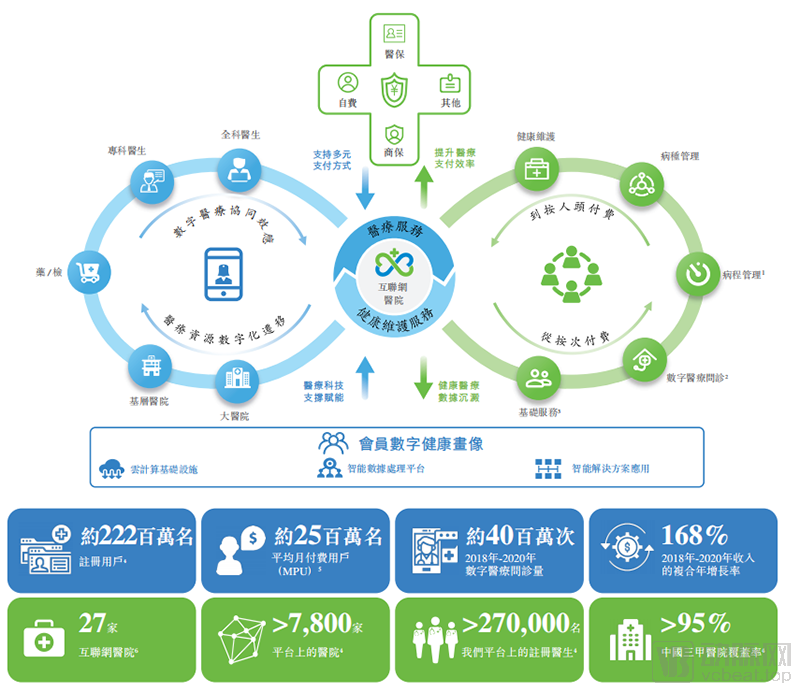 WeDoctor’s Core Business and Operational Data, Source: Prospectus
Medical services refer to the integrated online and offline consultation, diagnosis, and treatment services provided by WeDoctor.
From a service perspective, users can access services such as online appointment scheduling, initial offline consultations, medical record retrieval, online follow-up consultations, electronic prescriptions, prescription dispensing, and online settlement (covering both basic medical insurance and commercial insurance) through the WeDoctor APP and digital health terminals.
In the critical pharmaceutical segment of healthcare services, WeDoctor has partnered with pharmaceutical companies, distributors, and retail pharmacies to establish a Cloud Pharmacy. As of December 31, 2020, WeDoctor had connected approximately 33,000 pharmacies, enabling users to access a range of pharmaceutical services, including medication delivery, online follow-up consultations, health consultations, and medication guidance.
In terms of service offerings, WeDoctor’s comprehensive medical services primarily include online follow-up consultations and offline medical services, such as initial consultations, examinations, and treatments. WeDoctor also provides specialized medical services, offering specialist consultations and treatment for specific diseases.
From 2018 to 2020, the WeDoctor platform provided 40 million digital medical consultations.
Health maintenance services refer to WeDoctor’s provision of digital chronic disease management and health management services to users on a membership basis.
In the realm of digital chronic disease management services, WeDoctor has launched China’s first digital chronic disease management model empowered by an internet hospital and enabling direct online settlement with medical insurance.
In this model, WeDoctor provides integrated online and offline treatment and management services for members with chronic diseases, and offers technology-assisted solutions to local hospitals, such as clinical decision support systems and intelligent health insurance monitoring systems. Member users can access personalized treatment and rehabilitation plans, continuous follow-up consultations, prescription renewals and medication dispensing, monitoring of key health indicators, as well as professional guidance on diet, wellness, and exercise through WeDoctor’s internet hospital.
As of December 31, 2020, WeDoctor had accumulated over 145,000 members for its digital chronic disease management services. In 2020, the average annual revenue generated per member of these services was approximately RMB 3,600. For the year ended December 31, 2020, WeDoctor’s average monthly paying users reached 25.4 million.
In terms of health management services, WeDoctor provides integrated health management solutions for corporate employees and end-users, covering online consultations, referrals, health monitoring, and health guidance. As of December 31, 2020, this service had reached more than 200 corporate clients and over 19 million members.
Health insurance services are also a core component of WeDoctor’s health management offerings, with WeDoctor collaborating with insurance companies to develop innovative health insurance products.
In addition, WeDoctor has partnered with primary healthcare institutions to provide mobile medical services, including the establishment of health records, health screenings and laboratory tests, digital consultation and treatment services, specialist consultations and referrals, as well as health guidance. As of December 31, 2020, these mobile medical services had reached a population of 28 million across 69 counties in 12 provinces.
Empowered by its internet hospital, WeDoctor’s medical and health maintenance services are able to address users’ comprehensive healthcare needs, including low-frequency, high-frequency, and long-term demands.
The prospectus shows that WeDoctor’s health maintenance services generate higher revenue than its medical services.
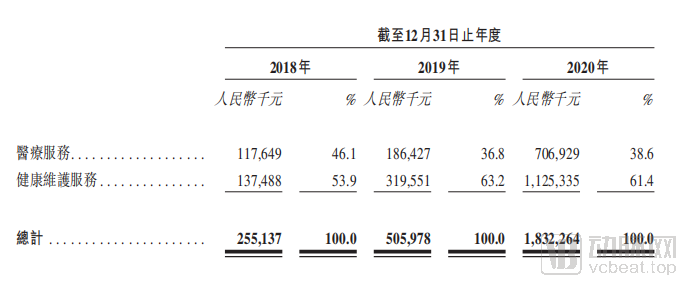 WeDoctor’s Revenue Composition, Source: Prospectus
Specifically, revenue from medical services is primarily derived from digital healthcare consultation services, comprehensive medical services, and specialized medical services (primarily ART).
Digital medical consultation services include rapid consultations, specialist consultations, and remote consultations on the WeDoctor platform; comprehensive medical services refer to medical consultations, physician referrals, physical examinations, and vaccination services provided by the Internet Hospital Service Center; ART services encompass assisted reproductive therapy services and equipment sales.
Notably, in 2018, WeDoctor acquired Genea, an Australian assisted reproductive technology (ART) service provider. Genea offers a comprehensive range of ART services and operates nine ART clinics across Australia and Thailand.
Revenue from health maintenance services is primarily derived from comprehensive health management services, mobile hospital services, digital chronic disease management services, and cloud-based testing services (i.e., sales of medical devices).
For example, after purchasing a comprehensive health management service package, members can access services such as online consultations, physician referrals, health monitoring, and health guidance.
The Mobile Hospital provides comprehensive healthcare solutions to primary care institutions, with WeDoctor delivering end-to-end services that include examination vehicles, medical equipment, healthcare IT systems, training, operations, and maintenance. Service contracts for the Mobile Hospital typically encompass multiple performance obligations.
In 2018, 2019, and 2020, WeDoctor’s revenues were RMB 255 million, RMB 506 million, and RMB 1.832 billion, respectively, reflecting rapid performance growth. During the same period, the company reported adjusted net losses of RMB 415 million, RMB 757 million, and RMB 869 million, with net loss margins of -163%, -150%, and -47%, respectively, narrowing year over year.
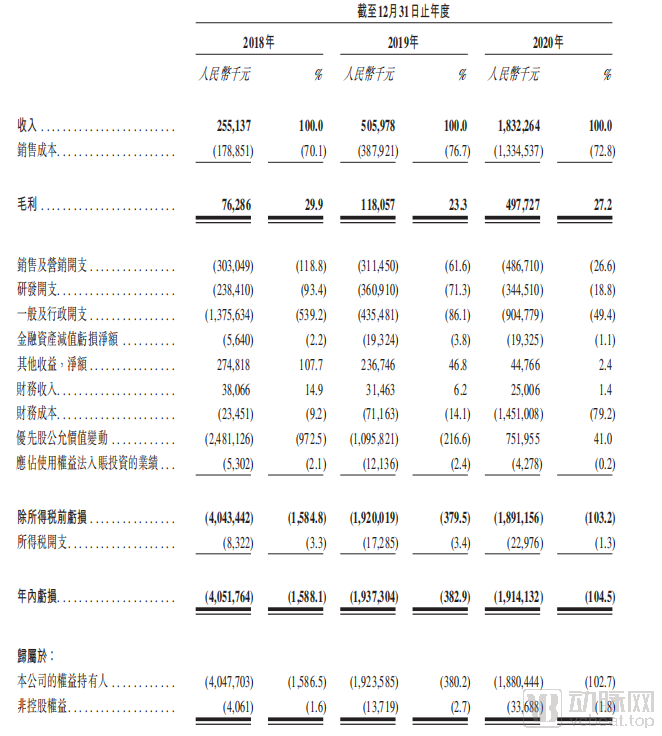
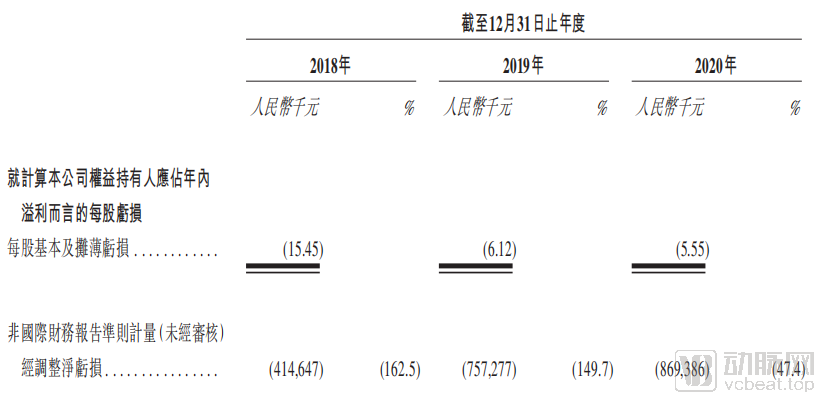 Financial Data, Source: Prospectus
It is understood that after establishing the first internet hospital in 2015, WeDoctor has been paving the way for digital healthcare. However, prior to 2018, as the industry had not yet received clear direction from national policies, WeDoctor’s development focus was primarily on building infrastructure “pipelines.” Starting in April 2018, with the successive introduction of favorable national policies such as Document No. 26, WeDoctor seized the opportunity to vigorously advance its digital healthcare strategy, leveraging its previous accumulations and launching operations in multiple provinces and municipalities, including Shandong and Tianjin. The pandemic in 2020 also accelerated the rapid development of the entire industry, prompting both users and the healthcare system to place greater emphasis on digitalization. It can be seen that WeDoctor’s development has maintained a surprising synchronicity with the industry, achieving rapid performance growth over the past three years, particularly with a year-on-year revenue increase of 262% in 2020.
On the other hand, WeDoctor Holdings, which is applying for listing in Hong Kong, is a digital healthcare platform spun off from WeDoctor and does not encompass all of WeDoctor’s business segments. Meanwhile, as WeDoctor has been rapidly advancing its digital healthcare strategy in recent years, it has also needed to invest heavily in infrastructure costs.
However, since the infrastructure invested in during the early stages is reusable, it has become part of WeDoctor’s business moat. Furthermore, current explorations indicate that the health maintenance service model, which accounts for the majority of revenue, is highly replicable. As health maintenance services are implemented on a larger scale, WeDoctor’s financial performance is expected to improve. This may well explain why, despite reporting losses, WeDoctor has seen its deficits narrow year by year.
In China, the basic medical insurance scheme is the largest single payer for healthcare expenditures, accounting for over 31% of the nation’s total healthcare spending in 2019. As challenges such as population aging intensify, the financial pressure on the medical insurance fund is gradually increasing. Meanwhile, commercial health insurance remains in an early stage of development with low penetration; in 2019, its claims payouts accounted for less than 4% of China’s total healthcare expenditures.
In the process of digitalizing healthcare services, WeDoctor has explored a diversified payment system, which not only improves the payer structure of digital healthcare but also empowers related payers.
Regarding medical insurance reimbursement, to date, 17 of WeDoctor’s 27 internet hospitals have integrated this payment option. This not only provides significant convenience for patients seeking medical care but also enhances users’ willingness to recognize and utilize digital healthcare services.
From the perspective of the medical insurance fund, WeDoctor employs artificial intelligence technology to conduct intelligent, real-time monitoring of fund utilization, significantly enhancing operational efficiency. For instance, in its digital chronic disease management services in Tai’an, Shandong Province, the average cost per prescription in 2020 decreased by approximately 12.7% compared to 2019, concurrently reducing medical insurance fund expenditures on chronic diseases.
In terms of commercial insurance payments, WeDoctor collaborates with insurance companies to develop innovative, customized commercial health insurance products. By integrating digital medical services with commercial health insurance offerings, these products better meet the needs of diverse insured groups, enhance product competitiveness, and thereby increase the penetration rate of commercial health insurance, alleviating pressure on public healthcare expenditures and reducing out-of-pocket costs for individuals.
Users who have purchased the corresponding commercial insurance can settle their medical expenses directly online when seeking care on the WeDoctor platform.
In the corporate payment model, WeDoctor provides health management services to enterprise employees, with the enterprises covering the service fees.
Driven by the complementary roles of the aforementioned payers, individuals not only enjoy greater convenience in accessing digital healthcare services but also incur lower out-of-pocket costs. Therefore, by offering diverse payment options through multi-payer coverage, WeDoctor enhances the affordability and accessibility of healthcare services for users while strengthening its own competitive edge.
Since the establishment of China’s first internet hospital in 2015, the Chinese healthcare market has been accelerating its digital transformation, a process further expedited by the pandemic in 2020. Statistics show that the number of internet hospitals across China increased from 119 at the end of 2018 to over 1,100 by March 2021. During the pandemic, the volume of online diagnosis and treatment services provided by third-party platforms surged approximately 20-fold compared to the same period in 2019. The digital healthcare sector now boasts more extensive infrastructure coverage and an increasingly large user base.
According to Frost & Sullivan, the market size of China’s digital healthcare services market was RMB 23.2 billion in 2019 and is projected to reach RMB 739.5 billion by 2030, representing a compound annual growth rate (CAGR) of 37.0%.
According to the prospectus, WeDoctor will further expand the scale of its digital healthcare services on the basis of its existing capabilities.
First, expand urban and membership coverage. For instance, establish new internet hospitals in other cities and deepen integration with local medical institutions and medical insurance authorities. In cities already covered, further strengthen membership-based digital chronic disease management services, mobile medical services, and digital diagnosis and treatment services, while exploring cooperation opportunities with more medical institutions to increase penetration rates across various cities.
Second, continue to develop innovative value-added services and products to enhance member stickiness. Leveraging big data analytics, comprehensive digital user health profiles, and an extensive service network, we will develop more innovative and customized products to continuously address members’ evolving healthcare needs, thereby increasing user retention and creating more upselling and cross-selling opportunities for various business units.
Third, continue to leverage technological and data analytics capabilities to enhance the effectiveness and efficiency of digital healthcare services. For example, attract more talent from cutting-edge technology fields such as software engineering, data science, and artificial intelligence to further strengthen internal R&D capabilities; continue to bolster technical infrastructure construction and provide enabling solutions for other participants across the healthcare value chain.
Furthermore, WeDoctor will continue to expand its business through strategic partnerships, collaborations, and investments.
Digital healthcare services must not only rely on localized internet hospitals as infrastructure but also integrate with corresponding offline services, incorporate medical insurance and commercial insurance offerings, and fully realize value propositions for all stakeholders. WeDoctor has already established a wide and deep moat across these dimensions. What innovations can be expected from the “first digital healthcare stock” following its IPO? The industry awaits with anticipation.