

Shengmei Bio Secures RMB 300 Million Series B Funding Led by SDIC Capital to Accelerate Commercialization of Liquid Biopsy-Based Early Cancer Diagnostic Products
Recently, Zhuhai Shengmei Biomedical Diagnostics Co., Ltd. (hereinafter referred to as “Shengmei Biomed”) announced that it has finalized the signing agreement with SDIC Merchants Capital, the lead investor in its Series B financing round. SDIC Merchants Capital invested RMB 300 million to accelerate the commercialization of Shengmei Biomed’s early lung cancer diagnostic technology and to support the company’s in-depth layout and innovative R&D of liquid biopsy technologies for multiple cancer types. The participation of SDIC Merchants Capital will also assist Shengmei Biomed in optimizing and integrating resources across the industry chain, thereby providing strong momentum for the company’s accelerated development.
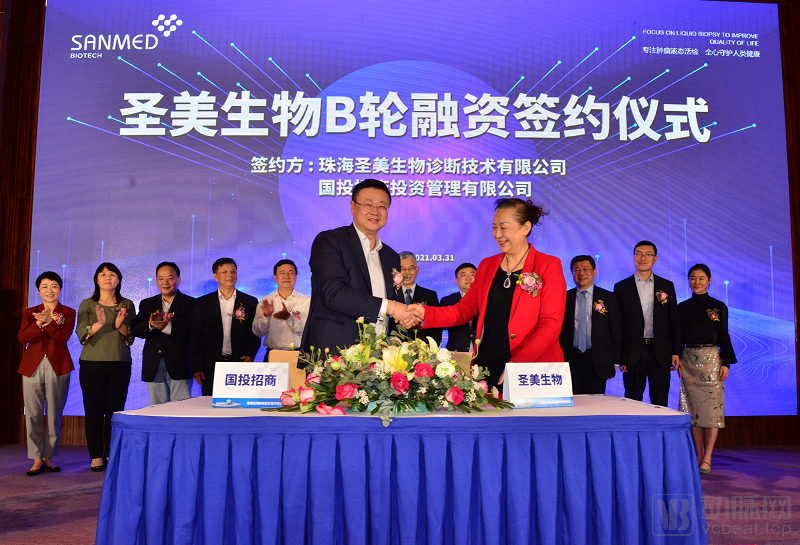
Signing Ceremony
St. Mei Biotech was jointly established in March 2016 by U.S.-based Cynvenio Biosystems Inc. and Zhuhai Livzon Diagnostics Inc., a subsidiary of Livzon Pharmaceutical Group. The company is dedicated to providing comprehensive liquid biopsy testing guidance for cancer patients through globally advanced technologies, including tumor liquid biopsy techniques, automated equipment, and AI-powered cloud computing solutions.
To date, Sanmei Biotech boasts an internationally leading liquid biopsy research center for oncology, a clinical laboratory, and an artificial intelligence data center, along with a GMP-compliant manufacturing facility for medical devices. The company covers the entire industry chain, encompassing the research and development, production, and sales of liquid biopsy-related medical diagnostic equipment, reagents, and data analysis software.
Currently, SanMed Biotech possesses two core technologies: LiquidBiopsy for the enrichment and isolation of rare cells, and Circulating Chromosome Abnormal Cell (CAC) detection. Among these, LiquidBiopsy is the world’s only circulating tumor cell (CTC) enrichment and isolation platform capable of directly interfacing with various downstream molecular assays. CAC detection is the world’s leading technology that enables the differentiation between benign and malignant pulmonary nodules through the analysis of circulating chromosome abnormal cells. This technology originated from the laboratory of Dr. Ruth Katz, former Director of the Department of Pathology at The University of Texas MD Anderson Cancer Center, and has been further optimized and clinically validated in collaboration with SanMed Biotech’s R&D team.
Regarding the successful completion of this financing agreement, Shi Jianfeng, General Manager of Saint Medicine Biotechnology, stated: “We are delighted that Saint Medicine Biotechnology has completed the initial signing for its Series B financing. This is a significant milestone and reflects the recognition we have received from several outstanding investment institutions, including SDIC Investment Promotion. In 2021, Saint Medicine Biotechnology is poised to achieve a commercial breakthrough with its first early diagnostic product for lung cancer. This round of financing will enable us to further deepen our product R&D pipeline on the liquid biopsy technology platform for oncology, advance product development and clinical research in major malignancies such as lung, colorectal, breast, and liver cancers, and lay a solid foundation for the company’s accelerated future growth.”
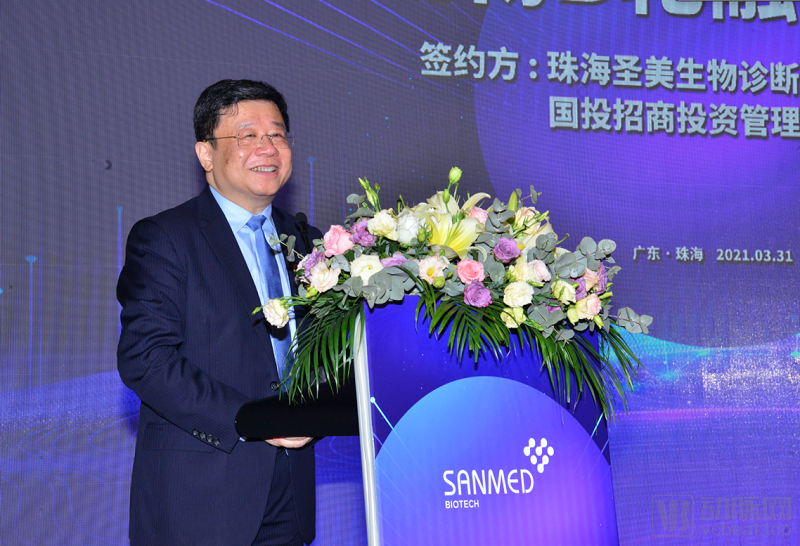
(Shi Jianfeng, General Manager of Shengmei Biotechnology)
According to data cited in the Chinese Guidelines for Lung Cancer Screening and Early Diagnosis and Treatment (2021, Beijing), there were approximately 3.929 million new cases of malignant tumors and about 2.338 million deaths from malignant tumors in China in 2015. Among all malignant tumors, lung cancer ranked first in both incidence and mortality rates. From 2000 to 2011, the total number of lung cancer cases and deaths among both men and women in China showed a continuous upward trend. Data from GLOBOCAN 2020 indicate that China accounted for 37.0% of global lung cancer cases and 39.8% of global lung cancer deaths, making the prevention and control of lung cancer a major challenge in the management of malignant tumors in China.
The survival time of lung cancer patients is closely related to the timing of diagnosis. Data cited in the “Chinese Guidelines for Lung Cancer Screening and Early Diagnosis and Treatment (2021, Beijing)” show that the 5-year survival rate for lung cancer decreases as the diagnostic stage advances. Specifically, the 5-year survival rate for patients with Stage I disease is 55.5%, whereas it is only 5.3% for those with Stage IV disease.
In China, there are nearly 800,000 new cases of lung cancer annually. Seventy-five percent of patients are diagnosed at stage III–IV, with a five-year survival rate of less than 20%. The primary reason is that early-stage lung cancer often presents as asymptomatic pulmonary nodules, while existing diagnostic and therapeutic techniques struggle to provide timely and accurate diagnoses for small pulmonary nodules (<10 mm). This leads to either overtreatment or delayed diagnosis, resulting in the loss of optimal treatment opportunities.
“To improve the prognosis of lung cancer and increase long-term survival rates, it is urgent to prioritize the prevention and control of its onset and progression. In particular, we must leverage detection and diagnostic technologies for lung cancer development to promote secondary prevention through early detection, early diagnosis, and early treatment. This is especially critical for early-stage lung cancer (carcinoma in situ and stage IA), which can achieve a 10-year survival rate of up to 90%.” Professor Bai Chunxue, Chairman of the Chinese Alliance for Lung Cancer Prevention and Control, particularly emphasized. “Based on the PNapp 5A framework designed at the top level by the Chinese Alliance for Lung Cancer Prevention and Control and its clinical application, we have proposed the ‘Smart Benefit Million Early-Stage Lung Cancer Project,’ aiming to diagnose one million cases of early-stage lung cancer within 5–10 years and achieve a 10-year survival rate of 90%.”

(Professor Bai Chunxue, Chairman of the Chinese Alliance for Lung Cancer Prevention and Control)
"How to improve prognosis and reduce lung cancer mortality through early screening, early diagnosis, and early treatment" is a significant public health issue globally. The liquid biopsy technology underlying St. Med Biotech’s Circulating Abnormal Chromosome (CAC) assay is regarded as one of the most promising techniques for early tumor diagnosis in the future. By quantifying circulating abnormal chromosome cells (CACs) in the blood of patients with pulmonary nodules, this test helps stratify the risk of early-stage lung cancer. Extensive trials have confirmed that low-dose spiral computed tomography (LDCT) screening can reduce lung cancer mortality by 20%; however, it significantly increases the false-positive rate for pulmonary nodules. Determining whether patients with pulmonary nodules require further testing remains a core challenge for clinicians. Compared with other early diagnostic modalities—such as PET-CT, fiberoptic bronchoscopy, and needle biopsy, each of which has its own limitations—CAC testing offers advantages including non-invasiveness, real-time dynamic monitoring, the ability to overcome tumor heterogeneity, and the provision of comprehensive diagnostic information. Furthermore, it demonstrates high stability, with results unaffected by tumor size, pathological type, or nodule characteristics. Thus, CAC testing can serve as an ideal auxiliary tool for the early differential diagnosis of benign versus malignant pulmonary nodules measuring 5–10 mm.
Furthermore, to address the throughput bottlenecks and standardization challenges posed by the massive volume of cell images in liquid biopsy, Shengmei Biotechnology has innovatively applied high-throughput automated image scanning and AI-based cytological analysis to the field of tumor liquid biopsy. The company has developed the “Tumor Liquid Biopsy Cell Analysis Hardware Platform + Tumor Liquid Biopsy Cell AI Analysis System,” aiming to provide physicians and patients worldwide with multidimensional clinical testing data and medical diagnostic services for tumor liquid biopsy through its “Intelligent Comprehensive Solution for Early Cancer Diagnosis.”
“As the first liquid biopsy technology from Sanmei Biotechnology to achieve commercial breakthrough, we have built a cloud platform that connects physicians, patients, and testing laboratories, empowered by artificial intelligence. Through big data analytics, it assists in clinical diagnosis or provides precise risk stratification for individuals at high risk of lung cancer, particularly after pulmonary nodules are detected via low-dose spiral CT scanning, thereby establishing appropriate follow-up intervals,” said Dr. Tang Dongjiang, Vice President of R&D at Sanmei Biotechnology.
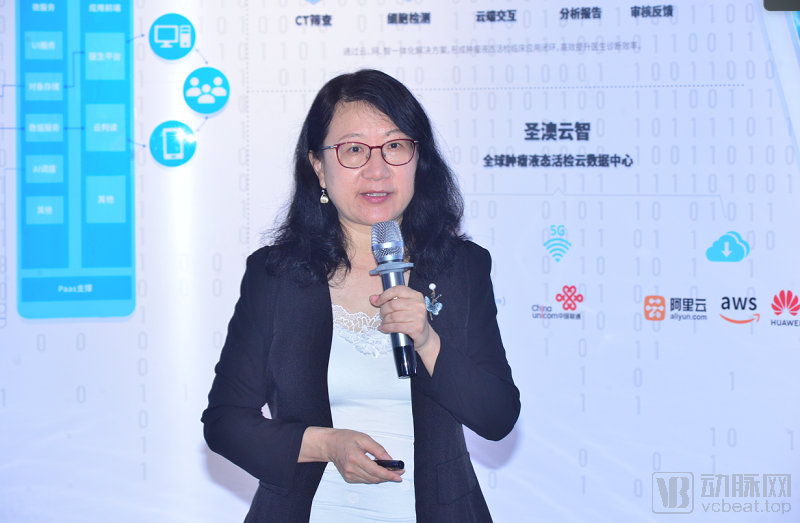
(Dr. Tang Dongjiang, Deputy General Manager of R&D at Shengmei Biotechnology)
CAC integrated with artificial intelligence enables functions such as disease detection and localization, qualitative analysis, determination of benign versus malignant nature, and postoperative follow-up, thereby assisting physicians in achieving rapid, precise, and intelligent image interpretation. Multicenter clinical data from China, led by Professor Chunxue Bai, demonstrate that the accuracy of CAC+CT.AI in the diagnosis of pulmonary nodules can reach 85–90%*.
Professor Bai Chunxue stated, “The widespread adoption of liquid biopsy and artificial intelligence will significantly enhance the diagnostic capability for small pulmonary nodules, making it feasible to provide holistic healthcare solutions. In the future, with the establishment of standardized pathways for lung cancer screening and early diagnosis, we can further shift the focus of lung cancer prevention and control in China toward earlier stages, thereby greatly optimizing the utilization of medical resources. By substantially improving lung cancer survival rates, and leveraging the PNapp5A system—developed based on the top-level design of the Chinese Alliance for Lung Cancer Prevention and Control—and its clinical application, we have proposed the ‘Smart Benefit Million Early-Stage Lung Cancer Project.’ This initiative aims to diagnose one million cases of early-stage lung cancer within 5–10 years, achieving a 10-year survival rate of 90%.”
SDIC Merchants stated, “As a platform enterprise in the field of tumor liquid biopsy, Shengmei Biotechnology operates in a sector we have long been bullish on, as it delivers greater benefits to both cancer patients and clinicians. The approach is simple, highly reproducible, suitable for all patients, and yields results without the need for tissue biopsy. In 2021, Shengmei Biotechnology’s flagship product, the CAC test, achieved commercialization and attained a leading position within the industry. This round of financing will accelerate the development and commercialization of additional tumor liquid biopsy products from Shengmei Biotechnology, bringing new hope to more patients with malignant tumors.”Lu Hai, Managing Director at SDIC Merchants, remarked, “Addressing unmet clinical needs and improving diagnostic and therapeutic outcomes constitute the enduring central theme of healthcare investment; no investment should deviate from this core principle.”
Shengmei Biotech specializes in the development and industrialization of liquid biopsy reagents, automated equipment, and AI-powered cloud computing solutions for major malignant tumors. The company possesses two core technologies: LiquidBiopsy and Circulating Abnormal Chromosome Cell (CAC) detection. LiquidBiopsy is currently the world’s only circulating tumor cell (CTC) enrichment and isolation platform capable of directly interfacing with various downstream molecular assays. The CAC detection technology is the world’s leading and only technology that differentiates between benign and malignant pulmonary nodules by analyzing circulating abnormal cells (CACs). The company has been recognized as a “National High-Tech Enterprise,” “National Technology-Based SME,” “National Industrial Enterprise Above Designated Size,” and “Zhuhai Unicorn Potential Enterprise.”
SDIC Merchants focuses on investments in the advanced manufacturing industry, emphasizing technological innovation and the value of outstanding entrepreneurs and teams. It prioritizes investments in sectors such as intelligent manufacturing, new energy intelligent vehicles, life sciences, and information and communications technology (ICT), striving to promote the green, digital, and service-oriented development of the manufacturing sector. The team manages cumulative assets exceeding RMB 100 billion, with investors including financial institutions, the National Social Security Fund, and both state-owned and private capital.