

Cellarity Secures $123M Series B Financing to Pioneer a Novel Cell Behavior-Based Drug Discovery Platform

Cellarity
Drug Developer
Recently, Cellarity, a life sciences company founded by Flagship Pioneering, announced the completion of $123 million in Series B financing. Established in 2017, Cellarity is headquartered in Massachusetts, USA.Cambridge, Massachusetts. It is a company dedicated to discovering and developing drugs by researching and modulating cellular behavior.
Cellarity has moved away from the traditional drug development model focused on single molecular targets, instead pioneering a novel approach to drug discovery by targeting “cellular behavior.” This unprecedented paradigm inevitably sparks curiosity about how Cellarity will disrupt tradition and innovate in diverse ways.
Cellarity was founded following a brainstorming session among Noubar Afeyan, Founder and CEO of Flagship Pioneering; partner Avak Kahvejian; and senior associate Nick Plugis.
It is well known that the purpose of drug discovery is to identify medications capable of addressing diseases, all of which originate from cellular-level dysregulation. However, traditional drug discovery has often been two-dimensional. Over the past few decades, most drug discovery efforts have still relied on single molecular targets. While this approach has successfully delivered many drugs, it has also limited therapeutic options for diseases and overlooked the robust network characteristics of disease biology. This has led to the failure of many promising preclinical assets during human trials, with only one in ten candidate drugs ultimately reaching patients.
Based on this current situation,Cellarity’s story is gradually taking center stage. Globally, companies aiming to “discover and develop new approaches to drug discovery” are not uncommon, but Cellarity isThe first therapeutic company to discover and develop drugs by researching and modulating cell behavior.
At that time,Cellarity’s founders recognize that cells are the fundamental units of life and dynamic systems of evolution, possessing diverse and interconnected networks that are critical to human health.Dr. Avak Kahvejian and Dr. Nick PlugisUnder the leadership of a group of entrepreneurial scientists, leveraging cutting-edge, fit-for-purpose data and novel machine learning algorithms, it has been revealed that individual cells exhibit diverse, interconnected, and dynamic behaviors that drive health and disease.
By elucidating the molecular networks that govern these behaviors, scientists can rapidly design novel therapeutics to modulate them. This new paradigm successfully breaks with tradition, shifting the reference framework for therapeutic discovery from single target proteins or pathways to those characterized simultaneously by molecular, cellular, phenotypic, organismal, and clinical features.
LikeAs Dr. Kahvejian, Cellarity’s founding CEO and Flagship Pioneering partner, once stated, they do not reduce dimensions to a single drug or target; instead, they study the N-dimensional networks of cellular behavior to understand disease and health, using these insights to determine which drugs to develop and how to develop them.
For many years, the focus has been on single molecular targets, with a lack of network-level analysis of drug targets, leading to a consistently high failure rate in new drug development.
To enhance the success rate and speed of drug discovery, Cellarity has developed computational models based on cellular behavior. By comprehensively integrating systems and network biology across multiple domains—including molecular, cellular, phenotypic, organismal, and clinical levels—it facilitates the discovery of therapeutics for a wide range of diseases.
What Is Network Biology? Network biology is the science that studies the structure, function, design, regulation, and applications of various biological networks. It is an interdisciplinary field grounded in life sciences (biology, medicine, ecology, etc.), mathematics and computational science, systems science, and statistics.
Within cells, there are countless biological networks, such as metabolic regulatory networks, cell cycle networks, and networks formed by various protein–protein interactions. The concept of network biology is not limited solely to cellular-level networks. In recent years, network biology has been applied to multiple areas, including metabolic networks, novel drug discovery, and species introduction.
Cellarity leverages technologies such as single-cell analysis and artificial intelligence to study cellular behavior concurrently, developing a platform capable of modulating such behavior. “Cellarium” is Cellarity’s digital biology platform that transforms data from physical laboratories into a digital laboratory environment. Therein, Cellarity employs artificial intelligence to generate Cellarity Maps.
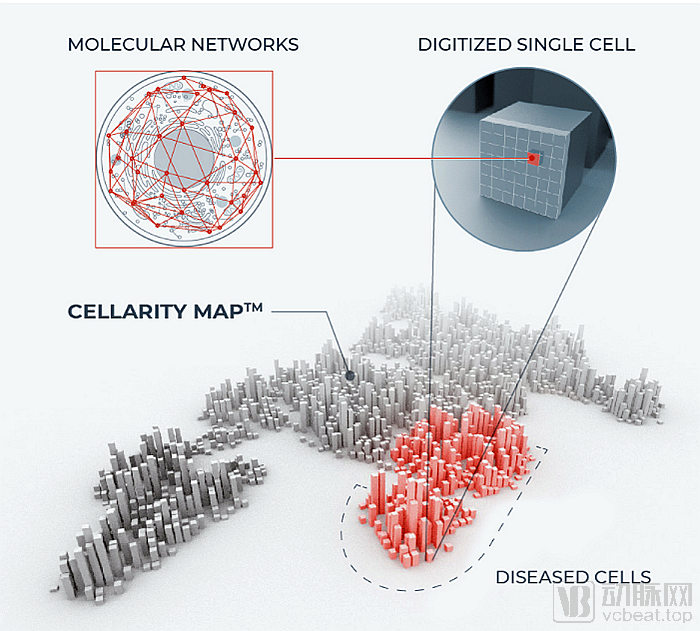
Image source: Cellarity official website
Cellarity Maps acquires various types of single-cell data from individual cells. It converts high-dimensional data into a machine-interpretable format, thereby digitizing individual cells. True to its name, Cellarity Maps is a powerful navigation tool. It enables scientists to observe the complexity of biology with unprecedented resolution, providing insights into the cellular changes that occur during the transition from health to disease. It not only maps cellular behaviors but also identifies methods to modify these behaviors, facilitating transitions from one network state to another.
At this point, the core framework of the Cellarity platform has been established. So, how does Cellarity leverage this platform to identify cell-behavior-targeted drugs?
First, use Cellarity Maps to identify cell behaviors that can be targeted to address diseases; then, translate changes in cell behavior into a set of digitally addressable actions and discover a multi-thousand-dimensional blueprint for altering cell behavior; finally, employ proprietary machine learning algorithms and AI-enhanced drug design to predict and create molecules capable of modifying cell behavior.
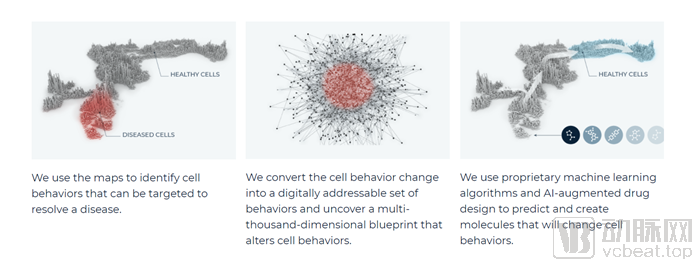
Image source: Cellarity official website
Cellarity has now developed Cellarity Maps for various disease conditions to understand how cellular behavior changes in disease states compared to healthy states. As these maps continue to be refined and reveal insights into alterations in cellular behavior, Cellarity gains a clearer biological picture through its cell-centric lens. Based on this, Cellarity can design novel drugs targeting cellular behaviors across a range of diseases.
To date, Cellarity has demonstrated its precise capability to alter disease mechanisms across 10 distinct therapeutic areas. The company has generated compounds capable of inducing such changes and confirmed their activity through in vitro and ex vivo disease models. Reportedly, Cellarity is advancing multiple validation programs in four high-value disease areas—hematology, immuno-oncology, metabolism, and respiratory diseases—to develop breakthrough therapies for patients in need.
Cellarity’s cell-centric drug design approach is a generalizable process.Through this process,Cellarity Maps can guide and predict, thereby altering cell behavior to treat various diseases.People no longer need to reduce the biology of disease to a single causal target in order to develop drugs. Instead,Cellarity leverages the complexity of biology to transform cellular behavior through digital predictions.
In this way, Cellarity’s algorithms can identify drug candidates that might otherwise go undetected. Since cellular behavior reflects disease pathology more accurately than individual proteins, this approach is more likely to yield breakthrough therapies with superior clinical predictability.
Faster Discovery: Compressing the time required to identify candidate drugs through rapid digital predictions, thereby eliminating lengthy screening processes.
Predictable Clinical Success: Cellular behavior represents disease more accurately than individual molecular targets, leading to greater predictability of patient outcomes in clinical treatment.
Breakthrough Therapy: Through a cell-centric approach, Cellarity can target diseases for which no targets have currently been identified, or complex diseases whose biological complexity is not adequately captured by molecularly targeted approaches.
Unlimited Potential: Since cellular behavior underlies all diseases, Cellarity can broadly apply this approach across any disease area, such as oncology, neuro-oncology, neurology, neuromuscular disorders, and infectious diseases.
The Cellarity platform holds immense potential and breadth, leveraging its unique expertise in network biology, high-resolution data, and machine learning to provide a more comprehensive understanding of cell-centric biological changes. Cellarity’s platform can predict molecules that precisely modulate disease-related alterations in cellular behavior.
This approach has yielded drug candidates that more effectively address the specific biological underpinnings of diseases. It also enhances Cellarity’s ability to identify therapies for complex, latent, and previously intractable biological challenges. Consequently, the platform generates candidates targeting cellular behaviors with higher clinical efficacy.
On December 10, 2019, Flagship invested $50 million to fund the development of the Cellarity platform and animal studies, beginning to validate their preliminary hypotheses from the previous two years.
During this period, senior talent from various fields has continued to join Cellarity. These include Chad Nusbaum, founder of Broad Technology Labs, who leads the technology division responsible for large-scale data production; Milind Kamkolkar, former Chief Digital and Data Officer at Sanofi, who spearheaded the Joint Enterprise Data Initiative (JEDI), a cornerstone of Sanofi’s digital strategy; and Cristina Rondinone, former Head of Cardiovascular, Renal, and Metabolism at AstraZeneca. Their arrivals have bolstered the company’s growth and propelled it into its next phase, thereby accelerating downstream clinical development.
On November 5, 2020, Cellarity and the world’s leading data science and data analytics companyExcelraAnnounced an agreement under which Excelra will provide Cellarity with access to the Global Online Structure-Activity Relationship (GOSTAR) database. By leveraging millions of high-quality, annotated GOSTAR small-molecule data points alongside Cellarity’s proprietary AI/ML modules, the company generates predictive drug molecules, ultimately guiding the design of novel therapies that target cellular behavior.
GOSTARIt is the world’s largest intelligent platform for small-molecule medicinal chemistry, encompassing over 8 million compounds and linking chemical structures to biological, pharmacological, and therapeutic activities. GOSTAR also boasts a vast knowledge base of 28 million SAR data points, providing data support for researchers in the early stages of drug discovery and optimization.
On February 25, 2021, Cellarity secured $123 million in Series B financing. Investors in this round included Flagship Pioneering, BlackRock, The Baupost Group, Banque Pictet, and eight other investors.
With this round of funding, Cellarity plans to advance multiple R&D programs targeting cellular behaviors and continuously enhance the technology underlying these assets. Meanwhile, the company will also leverage these funds to further develop its platform and expand its application to a broader range of disease areas.
On February 25, 2021, biochemist Gary Kleiger from the University of Nevada, Las Vegas, and his collaborators published a paper titled “Ubiquitin ligation to F-box protein targets by SCF–RBR E3–E3 super-assembly” in the journal Nature. The paper stated that they had discovered a new approach to drug discovery: developing novel drugs based on human ubiquitin ligases.
This is welcome news. The pharmaceutical market has begun to reach a state of saturation under traditional drug discovery methods, making it imperative to pioneer new approaches. In addition to Cellarity, many scientists are continuously exploring this field; some have achieved success, while others, like Cellarity, are still midway through their journey. We look forward to receiving more good news from Cellarity in the future.