

Evelo Biosciences: Pioneering the Era of Microbial Immunotherapy with Over $150M Raised and a Nasdaq Listing Within Four Years — Flagship Pioneering Case Study

Evelo Biosciences
Clinical-stage biopharmaceutical R&D company
Recently, Evelo Biosciences announced a strategic partnership with Abdul Latif Jameel Health. The two companies will jointly develop and commercialize Evelo’s leading inflammatory disease candidate, EDP1815, in the Middle East, Turkey, and Africa, addressing a broad spectrum of inflammatory conditions for a population of 1.7 billion.
Evelo is dedicated to improving the lives of patients worldwide by developing a novel class of therapeutics known as monoclonal microbes. Headquartered in Cambridge, Massachusetts, the company was founded in 2015 and went public in 2018. It has raised a total of $150 million, garnering significant interest from prominent investors such as GV (formerly Google Ventures), Celgene, and the Mayo Clinic.
From “No Record Found” to “On the List”: In Just Four Short Years, What Kind of Company Is Evelo? Let’s Explore Together Today.
Evelo Biosciences, a Company Specializing in Microbiome Immunotherapy
“What Does ‘Evelo’ Mean?”—Remodeling, Disruption, and Eradication.
Evolution has positioned the small intestine at the center of biology, with its cells playing a critical role in regulating the immune, metabolic, and nervous systems. Evelo Biosciences aims to leverage the small intestine as a strategic entry point to decipher the complete mechanisms underlying the interactions between the microbiome and the human immune system.
Evelo is the world’s first company to treat cancer, autoimmune, and inflammatory diseases by researching microbial immunotherapies.
In 2015, the renowned venture capital firm Flagship Pioneering founded Evelo Biosciences. Evelo is a company that treats cancer, inflammatory diseases, and other conditions by identifying specific monoclonal bacterial strains targeting small intestinal immune cells to modulate systemic immune responses. The combination of cancer immunotherapy and the microbiome drew significant attention to the company from its inception.
A year later, Evelo merged with Epiva Biosciences, a company dedicated to researching treatments for allergies, inflammation, and autoimmune diseases. The combined entity retained the Evelo name and continued to focus on the microbiome and immunotherapy.
Dr. Simba Gill is the CEO of Evelo Biosciences and a Senior Partner at Flagship Pioneering. He holds an MBA from INSEAD and a Ph.D. from King’s College London. His expertise spans antibodies, stem cells, directed molecular evolution, gene therapy, and immunodiagnostics.
Prior to joining Evelo Biosciences, Dr. Simba Gill served as President and Chief Executive Officer of moksha8 Pharmaceuticals. From 2016 to 2019, he also served as a Director of Realm Therapeutics PLC. In addition, he has held senior positions at Maxygen, Systemix, Verdia, Avidia, and Valentis.
Beyond his stature in the biopharmaceutical field, Dr. Simba Gill is also a kind-hearted individual. In 2019, Dr. Gill joined a 27-member team dedicated to fighting cancer on an expedition to summit Mount Kilimanjaro, Africa’s highest peak. He stated that his drive to continuously develop new therapies stems from a desire to help more people around the world.
SINTAX: The Underestimated Gut Network
The small intestine is a crucial site for food digestion and absorption in the human body, as well as an important component of the immune system. The "small intestine axis" refers to the connection between the small intestine and all other organs and tissues; its existence enables the small intestine to exert significant regulatory control over the human biological system.
In earlier periods, the importance of SINTAX in combating disease was often overlooked by modern medicine; its significance has only gained attention in recent years. The small intestine serves as the central hub of the human body’s lymphatic network, where immune cells from throughout the body circulate through lymphatic vessels within the intestinal tissue. Within this tissue, these cells are influenced by antigens and immunomodulators. These immune cells exert a profound impact on health and disease across various parts of the body.
Microorganisms have the ability to modulate immune cells in the small intestine. Evelo aims to harness unexplored SINTAX biology to develop novel therapies, thereby transforming the treatment of inflammatory diseases and cancer.
To achieve this goal, Evelo Biosciences fully leverages the potential of SINTAX to build a broad and diverse product portfolio. To improve outcomes across different stages of disease, Evelo has also developed best-in-class therapies, industrialized them, and advanced and expanded its platform. Meanwhile, Evelo holds multiple issued patents and has numerous patent applications pending, covering its product candidates and platform technologies, thereby providing robust protection.
Identifying Single Strains to Advance Microbial Immunotherapy
Evelo is developing a single-strain therapeutic and characterizing its pharmacological properties. Evelo has observed that these strains exert systemic, dose-dependent effects that modulate multiple clinically validated pathways. Furthermore, specific microbes can attenuate or enhance systemic immune responses by targeting SINTAX.
Evelo’s therapies work by engaging immune cells in the host’s small intestine. In a clinical study conducted by Evelo, they were observed to be well tolerated, with limited systemic exposure and no colonization. Evelo believes that its candidate products can exert comprehensive effects through multiple pathways via oral administration, thereby influencing disease in ways that single-target therapies cannot address.
Evelo is not merely a microbiome company, but a research platform and product development company based on the immunomicrobiome. Leveraging the critical role of cells in the small intestine, Evelo has developed an integrated platform to identify individual microbial strains and develop them into therapeutics targeting small intestinal cells, which often exhibit well-defined pharmacological properties.
The platform's workflow consists of four steps:
1. Convincingly characterize microbial strains through microbiological analysis, in vitro human testing, and animal model identification;
II. Determine the single strain and product form based on the screened strains;
3. Determine the drug's target site, appropriate dosage form, and correct dosage;
IV. Develop drugs through internal company processes and partners to ensure product activity and quality.
Dual-Pronged Approach to Combat Cancer and Inflammatory Diseases
Leveraging this platform, Evelo has developed a series of product candidates, including its lead candidate EDP1503 for the treatment of cancer and its lead candidate EDP1815 for inflammatory diseases.
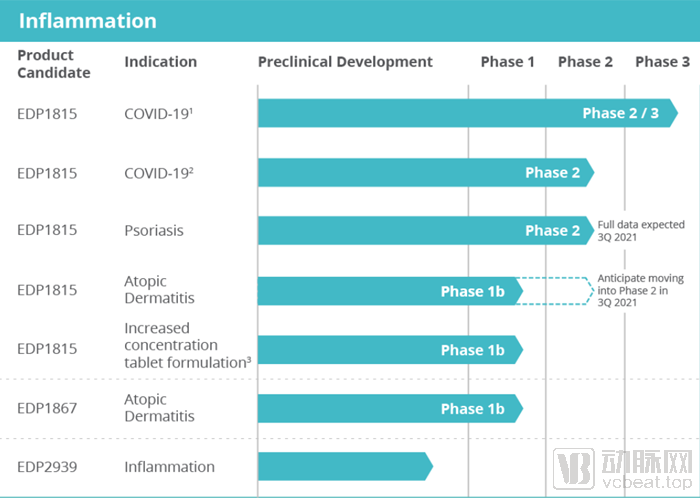
Image source: Evelo Biosciences official website
In 2018, Evelo initiated dosing in the Phase 1b clinical trial of EDP1815 for the treatment of psoriasis and atopic dermatitis.This trial included 96 healthy volunteers, patients with mild-to-moderate psoriasis, and patients with atopic dermatitis, primarily to validateSafety and tolerability of EDP1815. Subsequently, Evelo Biosciences initiated successive studies on EDP1815.
In the Phase 1b clinical study for the treatment of psoriasis, scientists found that EDP1815 can limit the production of multiple inflammatory cytokines, including IL-6, IL-8, TNF, and IL-1β. In preclinical models, EDP1815 resolved inflammation via the Th1, Th2, and Th17 pathways, effectively reducing various cytokines such as TNF, IL-4, IL-5, IL-6, IL-13, IL-17, and IL-12p40.
Scientists have also found that some of these cytokines are closely related to the cytokine storm that causes severe complications in COVID-19.
In May 2020, Evelo’s EDP1815 underwent a Phase II double-blind, placebo-controlled trial at Rutgers University to evaluate its safety and efficacy in treating COVID-19. One month later, Evelo announced that EDP1815 had been included in the TACTIC-E clinical study, advancing to Phase 2/3 clinical trials for the treatment of COVID-19.
This clinical study was conducted at Addenbrooke’s Hospital in Cambridge, UK, as well as at several other major clinical centers across the United Kingdom. It primarily targeted patients hospitalized early in the course of COVID-19 and those at risk of death due to the potential development of severe complications.
Research into EDP1815 for the treatment of inflammatory diseases is in full swing, and Evelo has not fallen behind in its oncology research. EDP1503 is currently Evelo’s lead oncology candidate. It is an oral monoclonal microbial therapeutic candidate for the treatment of cancer.
In 2018, Evelo entered into an agreement with Merck to collaboratively evaluate the efficacy of combining Evelo’s EDP1503 with Merck’s Keytruda across multiple cancer indications, including microsatellite-stable colorectal cancer, triple-negative breast cancer, and recurrent cases of various tumor types.
In addition to EDP1503 and EDP1815, Evelo has many other products, some of which are already under investigation, while others are still in their early stages.
These include EDP1066 and EDP1867 for the treatment of psoriasis or atopic dermatitis; the EDP2939 project, scheduled to launch in 2022, which targets clinical research on inflammatory microbial extracellular vesicles; and EDP1908, Evelo’s leading clinical-stage candidate targeting microbial extracellular vesicles in oncology. In preclinical studies, treatment with EDP1908 demonstrated superior control of tumor growth compared to the parent microbial strain or PD-1 therapy, with tumor growth reduction showing dose dependence.
In addition to the pipelines currently under active development, Evelo Biosciences is continuously identifying other potential single-strain candidates for further research and development.
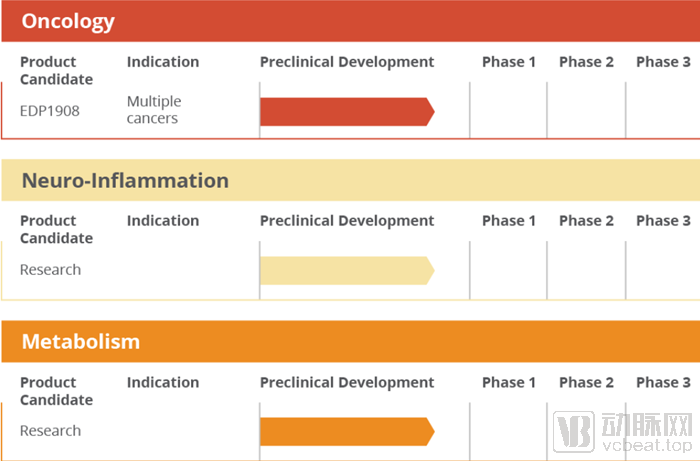
Image source: Evelo Biosciences official website
Evelo’s “Long March”
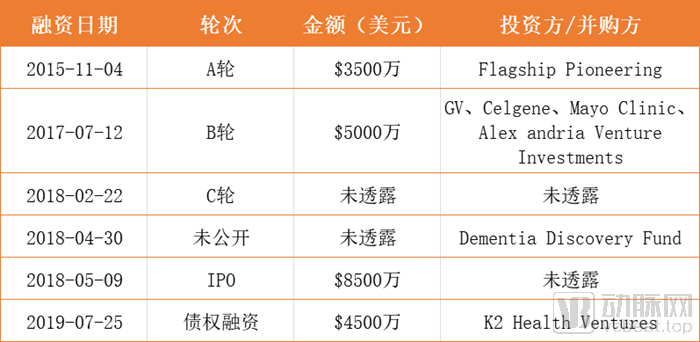
From its founding to its IPO, Evelo took only four short years. During this period, Evelo completed a total of four funding rounds.
In November 2015, Evelo completed a $35 million Series A financing round; in July 2017, Evelo announced the completion of a $50 million Series B financing round; subsequently, it completed its Series C financing in 2018, successfully listed on the Nasdaq, and completed its initial public offering (IPO), raising a total of $85 million.
Evelo’s success was not achieved overnight. During this period, Evelo established collaborations with multiple companies and institutions.
In November 2015, Evelo Biosciences partnered with the University of Chicago to jointly advance microbiome-based cancer immunotherapy. Shortly thereafter, in August 2016, Evelo entered into a collaboration with the Mayo Clinic, ranked as the number one hospital in the United States, focusing on immuno-microbiome cancer therapy—leveraging bacteria to activate the body’s immune system for tumor treatment. Under this partnership, Evelo will utilize the Mayo Clinic’s proprietary technology to establish a tumor-associated bacterial library and subsequently identify bacterial strains within this library that can help combat tumors.
Following the highly successful and pleasant collaboration, Evelo Biosciences and Mayo Clinic joined forces again one year later to conduct research on inflammatory and neuroinflammatory diseases.
In November 2018, Evelo and Merck & Co. entered into a clinical trial collaboration agreement to conduct research on monoclonal microbial therapy for cancer. Additionally, Evelo has recently collaborated with Abdul Latif Jameel Health on inflammatory diseases, among other initiatives.
The Microbiome: A Broad Highway or a Narrow Path?
“Today’s antibodies are tomorrow’s microbiome therapies.”This is an industry insider’s assessment of microbiome therapeutics that I came across in a report. The high praise underscores its significant importance in the pharmaceutical sector.
In recent years, the microbiome field has emerged as another hot area of development following precision medicine. In addition to Evelo Biosciences, countless biotechnology companies researching microbiome-based therapies have ridden this wave. Naturally, beneath the surge, outcomes have been mixed.
For example, Enterome is a drug development company focused on researching the gut microbiome genome, primarily targeting Crohn's disease, an inflammatory bowel disease. It possesses an extensive genomic database containing the complete genes of all fecal microbes.
Another example is Seres Therapeutics, hailed as the “most advanced microbial drug company” in the industry. When discussing this company, its “orphan drug” status deserves particular attention. In 2015, Seres’ microbiome-based therapeutic SER-109 received the FDA’s “Breakthrough Therapy” designation and was also granted orphan drug status by the FDA for the treatment of Clostridioides difficile infection.
Unfortunately, the highly anticipated SER-19 encountered a bottleneck during its Phase II clinical trials in 2016 and was declared a failure.
This incident has had a negative impact on the development of microbiome science. Although Seres has not yet abandoned its research on SER-19, whether it can stage a comeback remains uncertain; we can only wait and see.
Although the prospects for the microbiome remain somewhat uncertain, we hope that Evelo can realize Dr. Simba Gill’s ambitious vision: developing therapeutics for the global population of 7 billion. Even as the world’s population grows to 10 billion, the drugs developed by Evelo will continue to benefit all of humanity.