

AKASA Files IPO Prospectus to Tackle 75% Medical Billing Error Rate in the U.S. with Unified Automation™
AKASA
Medical Expense Reimbursement Service Provider
Headquartered in San Francisco, AKASA (formerly Alpha Health) is a company that leverages automation technology to manage medical billing. It offers healthcare systems a novel solution—Unified Automation™—to address revenue cycle management (RCM) challenges with greater efficiency and accuracy.
Among them, the Healthcare Business Management Association (HBMA) defines Revenue Cycle Management (RCM) as the process of managing reimbursement, payments, and revenue.
On March 23, 2021, AKASA secured $60 million in Series B financing. The round was led by BOND, with participation from existing investors such as Andreessen Horowitz and Costanoa Ventures. Since its inception in 2018, the company has raised over $80 million in just three years, a testament to its strong growth potential.
So, let’s take a look: what is the true development potential of AKASA?
Malinka Walaliyadde is the co-founder and CEO of AKASA, holding a Bachelor of Arts and Sciences degree from Cornell University. In 2014, he joined the Silicon Valley venture capital firm Andreessen Horowitz, where he collaborated with Vijay Pande to establish the firm’s bio fund. By 2015, the fund’s assets under management had reached $200 million, primarily investing in biotechnology companies, healthcare organizations, and medical supply vendors.
It was also through this role that Malinka Walaliyadde gained exposure to the U.S. healthcare system and developed a deep understanding of the chaos surrounding medical billing, laying the groundwork for the eventual founding of AKASA.
Another co-founder of AKASA is Varun Ganapathi. He holds a Ph.D. in Computer Science and a B.S. in Physics from Stanford University, with his primary research focusing on machine learning and computer vision analysis. After graduation, he founded two companies dedicated to the development of AI-related products, which were later acquired by Google and Udacity, respectively.
At AKASA, you will find not only outstanding investors and technical engineers but also seasoned experts from the healthcare industry. For example, Amy Raymond is an expert with over 20 years of experience in the healthcare sector, providing the team with extensive professional insights into medical matters.
AKASA believes that every dollar spent on healthcare should be valued and accurately recorded. However, the complex medical billing system in the United States makes it difficult to verify and reimburse medical bills accurately, often leading to errors.
According to statistics from the American Medical Billing Association, approximately 75% of medical bills generated annually contain erroneous charges. Even when patients dispute these incorrect bills, the success rate for reversal is only around 50%. These significant issues with medical billing not only cause substantial financial losses for patients but also erode their trust in the U.S. healthcare system.
The emergence of the aforementioned medical billing issues is not due to a lack of increased financial investment by the U.S. government. On the contrary, according to data from the Centers for Medicare & Medicaid Services (CMS), U.S. healthcare spending reached $3.6 trillion in 2019. What does this figure signify? Globally, per capita healthcare spending in the United States exceeded $11,000, approximately twice that of other developed countries.
An examination of expenditure reveals that approximately $500 billion is spent solely on medical billing and insurance administration. However, the software products purchased with this substantial investment have still failed to resolve the issues plaguing the U.S. medical billing system.
AKASA has identified two key issues with existing products: first, they increase the learning curve for healthcare professionals, thereby adding to their workload; second, current software solutions primarily focus on executing repetitive and fragmented data tasks, failing to effectively handle the dynamic data within healthcare systems. Ultimately, a novel and effective solution is required.
Therefore, after gaining an in-depth understanding of the current state of the U.S. healthcare industry, the AKASA team recognized that the complex medical billing system presents both a significant challenge and a substantial business opportunity. By studying automation solutions across various global sectors and understanding their core principles, the team developed a novel solution tailored specifically to the U.S. healthcare system.
Unified Automation™ operates within the electronic health record (EHR) and revenue cycle management (RCM) infrastructures of healthcare systems. It comprises three interdependent components—Observe, Learn, and Perform—that work in coordination, with each being indispensable.
The first part is Observe. With data authorization, it comprehensively records the entire Revenue Cycle Management (RCM) process from a holistic perspective, capturing documents and data within workflows in real time, and storing the captured data in encrypted form. The Observe process typically takes no more than 90 days on average, yet the volume of data recorded far exceeds that of manual documentation.
The next phase involves performing the Learn operation using data captured by Observe. Learn processes the data in a distributed manner, conducts self-training via machine learning algorithms, and automatically generates highly complex executable scripts that would be extremely difficult to craft manually. During the Learn process, the machine learning algorithms also correct erroneous data in real time while eliminating redundant and irrelevant information.
The final component is the Perform operation. Perform automatically handles various tasks across all time periods and processes newly generated tasks in sequence. When encountering tasks that cannot be immediately resolved, Perform sends notifications to the AKASA expert team for manual intervention. Furthermore, Perform leverages machine learning algorithms to learn from the handling of these complex tasks, enabling continuous self-evolution.
By adopting the Unified Automation™ solution, healthcare professionals are not required to undergo additional training or perform complex operations. Instead, by continuously learning from diverse data, processing various tasks, and evolving iteratively, the system can fully resolve revenue cycle management (RCM) challenges within healthcare systems.
AKASA was designed with data security in mind from the outset of its Unified Automation™ technology. It is a software solution that operates within the user’s ecosystem, granting users full control over the software. Additionally, all data access pathways are logged for user review.
AKASA’s software security features are comprehensive. They cover security capabilities such as risk assessment, automated deployment, vigilant detection, strict access control, incident response protocols, and regular audits. These features continuously help users safeguard data security.
Regarding cloud service security protocols, AKASA adheres to the security requirements set by the National Institute of Standards and Technology (NIST), employing HIPAA and HITRUST frameworks. It uses TLS 1.2 (Transport Layer Security) to encrypt data in transit and AES-256 (Advanced Encryption Standard) to encrypt data at rest.
AKASA Security Technology Summary is as follows:
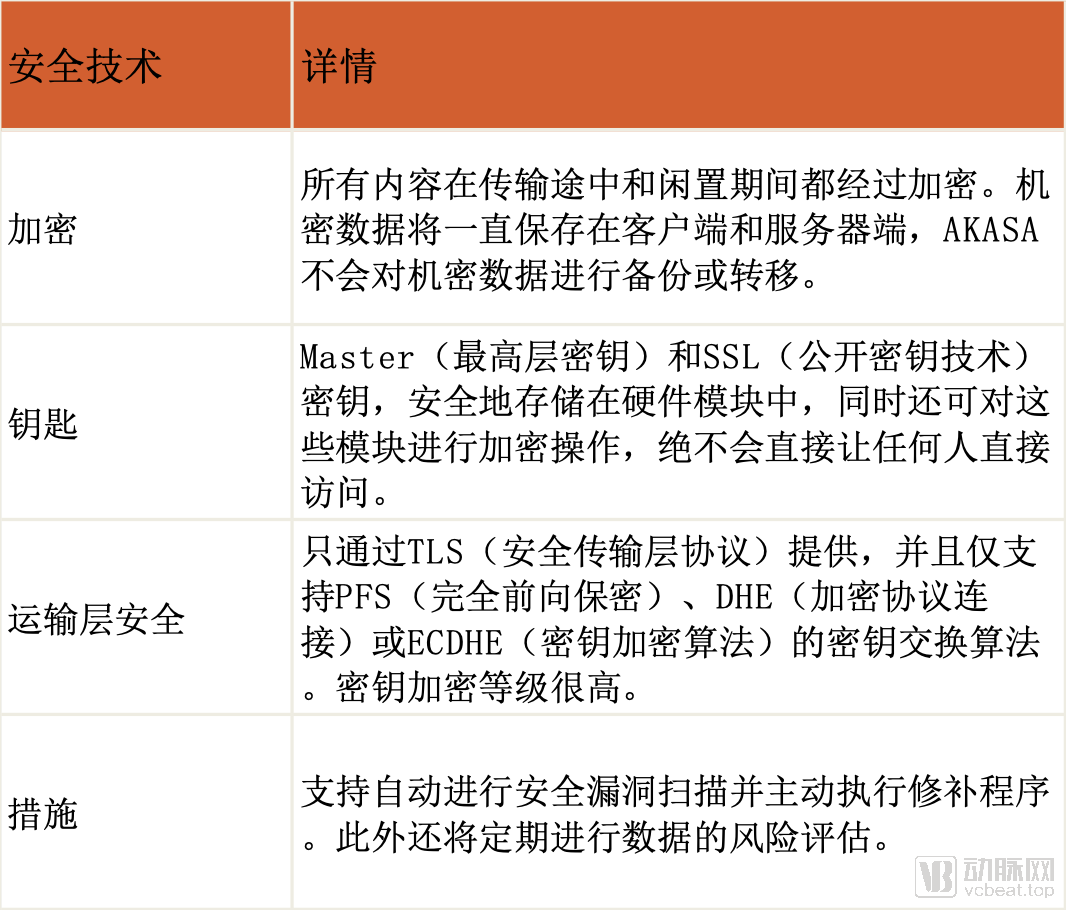
Figure 1. AKASA’s Security Technology
While ensuring the security of its own software, AKASA also provides anti-intrusion measures to further safeguard user data security.
First, layered security group technology is employed, involving the deployment of multiple security devices within the network, each equipped with its own defense mechanisms to provide multi-level network protection. Second, network- and host-based firewalls are implemented, supplemented by multi-factor authentication for enhanced security. This comprehensive anti-intrusion strategy ensures robust protection of user data security.
Since its establishment in 2018, the company has secured over $80 million in cumulative financing. Its initial Series A funding round was completed in June 2020, led by Andreessen Horowitz. The proceeds were aimed at intensifying R&D efforts for its Unified Automation™ products, accelerating product deployment, expanding sales channels, increasing market share, and enhancing brand influence.
In the same year, AKASA partnered with Sutter Health, providing the latter with its Unified Automation™ technology to automate medical workflows, enhance the accuracy of medical billing and claims processing, and effectively safeguard patient rights. Commenting on the partnership, Sutter Health’s Chief Digital Officer stated, “Our collaboration with AKASA helps prevent patients from receiving incorrect bills and incurring unnecessary medical expenses, thereby strengthening their trust in us.”
Subsequently, in March 2021, AKASA announced the completion of its Series B financing round, raising $60 million. The funds will be used to accelerate product delivery and meet customers’ personalized customization needs. Meanwhile, the company will continue to expand its sales channels to increase its market share.
“Over the past few months, we have been impressed by the AKASA team’s expertise in revenue cycle operations. Their Unified Automation™ technology has significantly improved revenue cycle management (RCM) for many companies,” said Jeff Frays, Vice President and Chief Financial Officer of Methodist Health System (MHD).
We believe that these positive developments will bring new momentum and opportunities to AKASA.
# Future Trends in the Revenue Cycle Management (RCM) MarketAccording to a report by Future Market Insights, the global market size for healthcare revenue cycle management software is projected to reach $43.3 billion by the end of 2022, with the market expected to maintain a positive growth trajectory in the future. Furthermore, driven by the continuous rise in cumulative patient medical expenditures and improved settlement efficiency, the resulting profits are substantial.
Different Countries, Different Markets: Due to differences in healthcare systems and policies, the Chinese government has adopted a universal health coverage system comprising Basic Medical Insurance for Urban Employees, Basic Medical Insurance for Urban Residents, and the New Rural Cooperative Medical Scheme. This system is primarily social security-based and operates on a pay-as-you-go model. China’s rapid development in mobile health will help build a more robust healthcare system.