

FUXI Smart Infusion Robot Achieves 'First-Stick Success': Fuxi Jiuzhen Aims to Disrupt the Global Puncture Robotics Market
FUXI Robot
Developer and Manufacturer of Intelligent Infusion Robots
Several failed attempts; the child’s wailing, the elderly patient’s groans, the family members’ reproaches, and the sweat in the nurse’s palms.
Such scenarios are all too familiar. Family members, patients, and nurses are on the same side, all hoping for successful cannulation on the first attempt to ensure the patient receives timely treatment. However, things do not always go as planned, leaving one with a profound sense of helplessness.
Meanwhile, the uneven distribution of medical resources across regions, coupled with a significant shortage of nurses and their excessive workloads, remains a major pain point for hospitals.
As medical institutions continue to expand in scale and patient volumes keep rising, how can we address these challenges? Fuxi Nine Needles offers the following solution.
Prior to the establishment of Fuxi Nine Needles, founder Yang Fan was consistently engaged in industrial research and planning related to information technology, industrialization, robotics, and biopharmaceuticals. However, through conversations with friends and family members working as healthcare professionals, he identified numerous issues associated with the puncture procedures performed by hospital nurses.
First, the most primary and technically demanding task for nurses is performing venipuncture for intravenous infusion. Proficient venipuncture skills are an essential competency for nurses, representing a specialized expertise not possessed by physicians, nursing assistants, or other healthcare personnel.
However, extensive data indicate that approximately 27% of patients have poorly visible veins, and in 40% of patients, veins are not visually identifiable. This underscores the considerable difficulty of venipuncture in children, the elderly, and critically ill patients.
"Factors such as nurses' psychological state, clinical operational skills, patient cooperation, and individual patient differences can lead to nurses 'failing to visualize clearly, missing the target during puncture, and lacking stability in handling.'"
For patients with difficult venous access, compounded by varying levels of nurse anxiety during cannulation, it often takes 2–3 attempts to achieve successful puncture. According to statistics from internationally recognized authoritative organizations, the overall success rate for nurse-performed venipuncture typically ranges from 85% to 95%.
For patients, repeated failures in venipuncture increase the likelihood of phlebitis, thrombosis, and infection, which can easily lead to dissatisfaction among patients and their families and contribute to doctor-patient conflicts.
Furthermore, approximately 20% of nurses suffer needlestick injuries during vascular access procedures each year. During the COVID-19 pandemic and major infectious disease outbreaks, there is a high risk of cross-infection between healthcare workers and patients due to the puncture process.
In response to the aforementioned challenges, Fuxi Jiuzhen has pooled its R&D resources, with a primary focus on“Accurate Needle Insertion”, leveraging two pioneering innovations in technology and functionality to empower the FUXI Intelligent Puncture Robot, boldly positioning it as a game-changer in the puncture robot market.
Pioneering Functionality: Applications Break Through Single-Mode Limitations
The Fuxi Nine-Needle Intelligent Puncture Robot featuresVBInsightIntravenous infusion, intelligent blood transfusion, vital signs monitoring, preoperative regional anesthesiasuch features can effectively address the challenges of rapid emergency treatment, difficult puncture procedures, and shortages of professional medical personnel.
A typical scenario is in the emergency resuscitation room, where the FUXI intelligent puncture robot can rapidly perform vessel identification, puncture, and catheter placement to establish intravenous access for fluid infusion and blood transfusion, thereby seizing the "Platinum 10 Minutes" critical for life-saving interventions. It then immediately initiates monitoring of vital signs such as blood pressure and conducts blood gas and hematological analysis, while autonomously performing regional anesthesia to facilitate surgical procedures by physicians.
In time-critical emergency resuscitation, the intelligent puncture robot performs multiple roles, saving manpower while, more importantly, significantly shortening treatment time and improving survival rates.
Globally, most competing products on the market primarily focus on blood collection for laboratory testing, catering mainly to routine diagnostics in healthcare institutions, with relatively limited application scenarios.
andFUXI Intelligent Puncture Robot: In addition to its application in smart hospitals, it can be widely used in the future in medical resource-scarce areas such as infusion rooms in community hospitals, infectious disease wards, county-level health institutions, remote mountainous regions, border outposts, long-voyage ships, scientific research stations, space stations, and battlefields.
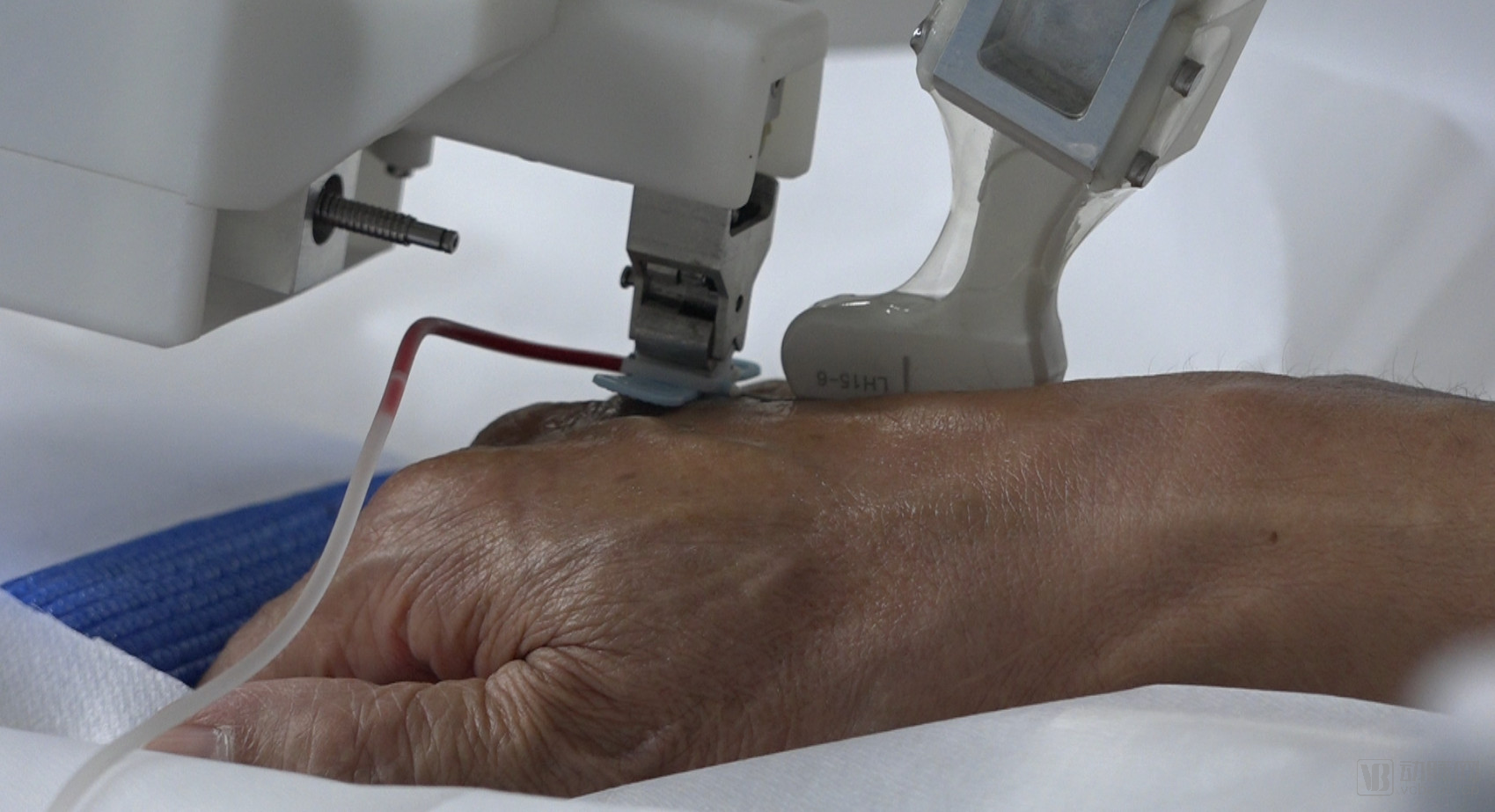
FUXI Intelligent Puncture Robot Performing Human Venous Puncture. Photo provided by Fuxi Jiuzhen
Pioneering Technology: "Infrared Recognition + Ultrasound Guidance + Force-Sensing Follow-Up" Puncture Technique Breaks Through Traditional Puncture Challenges
FUXI Intelligent Puncture Robot, grounded in clinical puncture protocols and integrated with deep learning, cloud-edge collaboration, and big data technologies, enables precise multi-site punctures and needle placement. It accurately identifies and localizes puncture targets, addressing vessels with varying characteristics across different anatomical regions, thereby achieving three major disruptive innovations in the industry:
1. Paradigm Shift: To replace or even surpass the complex technical operational capabilities of medical personnel with intelligent devices;
2. Theoretical Disruption: Disruptive Application of Theories for Precision and Safety Control in Intelligent Puncture;
3. Technological Disruption: Research and Application of Cloud-Edge Collaboration and Interaction Mechanisms.
FUXI Intelligent Puncture Robot enables real-time, precise control of the force-sensing servo puncture process.
This process encompasses numerous models and technical components, including real-time ultrasound-guided needle path navigation, mathematical modeling of the mechanical properties of vascular tissues, high-constraint needle insertion control under multimodal sensory feedback, and mechanisms for precise and safe manipulation during vascular puncture.
Comparison Perspective | Fuxi Nine Needles | Veebot、 Rutgers University Mindray, Pangkece, Tongji University, etc. |
Puncture Site and Angle | Designed for arteriovenous vascular and nerve blocks at multiple sites, including the dorsum of the hand, wrist, and elbow, with future expandability to other regions and tissues; features intelligent adjustment of needle insertion angle. | Forearm Venous Vessels, Single-Angle Puncture |
Purpose | Infusion, Blood Sampling, Blood Pressure Monitoring, Blood Gas and Hematology Analysis, Nerve Block Anesthesia – Comprehensive Functionality | Blood Collection, Single-Function |
Target Identification Difficulty | The blood vessels on the dorsal aspect of the hand are relatively thin, with complex morphology and high variability; nerve ultrasound imaging presentations vary significantly, greatly increasing the difficulty of identification and machine learning. | The forearm vessels are relatively thick, straight, and simple in morphology, making them easy to identify intelligently. |
Difficulty of Puncture | Puncture of multiple sites with varying anatomical structures significantly increases procedural difficulty, which is further exacerbated in cases of massive hemorrhage. | The forearm vessels are well-filled, elastic, and easy to stabilize, resulting in low puncture difficulty. |
Technical Features | Combining clinical puncture protocols with deep learning, and edge intelligence with data center intelligence. Higher accuracy, safety, and reliability. | Infrared + pressure detection and other traditional control technologies offer low safety. |
Application Scenarios | Hospital emergency halls, general surgery departments, gastroenterology departments, oncology departments, operating rooms, infectious disease wards, community hospitals, nursing homes, health examination institutions, county-level health facilities, remote mountainous areas, border defense outposts, long-distance voyage ships, scientific research stations, space stations, battlefields, etc. | Blood Testing Departments and Institutions: Relatively Limited Application Scenarios |
Technical Advantages of the FUXI Intelligent Puncture Robot | Image courtesy of Fuxi Jiuzhen
Fuxi Jiuzhen’s existing smart infusion robot product has achieved a breakthrough in autonomous dorsal hand vein cannulation through multimodal fusion technology, freeing nurses from high-volume infusion tasks and enabling them to create greater professional value.
Yang Fan, founder of Fuxi Nine Needles, told VCBeat that for the general population aged 20–40, nurses achieve an average venipuncture success rate of approximately 85%, whereas the FUXI intelligent venipuncture robot achieves a success rate of 95%, directly increasing the success rate by 10 percentage points.
For special populations, the advantages of intelligent puncture robots are particularly pronounced. Children are naturally active and have veins that are difficult to visualize, while older adults often have reduced vascular elasticity. These factors make venipuncture significantly more challenging for nurses, with successful punctures often taking up to an hour.
For populations with greater puncture difficulty, such as the elderly and children, the FUXI intelligent puncture robot can increase the puncture success rate by approximately 40%.The three-step procedure of infrared recognition, ultrasound-guided navigation, and force-sensing assisted puncture can be completed within 30 seconds. The puncture process is “fast, accurate, and gentle,” significantly improving puncture efficiency and enhancing the patient experience.
The development of the FUXI intelligent puncture robot adopts"Clinical Leadership + Technical Support"Model, featuring not only the in-depth involvement of numerous medical and nursing experts, but also strong endorsement from multiple academicians, industry luminaries, and leading technology experts.
The FUXI Intelligent Puncture Robot’s rapid development is largely attributable to the full-process collaborative R&D efforts of a multidisciplinary team comprising medical professionals alongside experts in artificial intelligence, mechanics, materials science, and big data. This approach seamlessly integrates clinicians’ practical knowledge, clinical needs, and core product technologies into the development process.
The core team members possess extensive experience and technical expertise in corporate management, product development, customer and partner acquisition, and product supply chain management.
Fuxi Jiuzhen emphasizes that this R&D model ensures improvements in R&D efficiency, product-requirement fit, as well as product safety and practicality.
Furthermore, the Fuxi Nine-Needle system possesses fully independent intellectual property rights. To date, more than 10 invention patents have been filed, and over 5,000 animal trials, 20,000 dorsal hand vein ultrasound images from the target population, and more than 100 human clinical trials have been conducted.
Its efficiency, accuracy, and safety have all been validated. Next-generation products are currently undergoing accelerated research and development trials and will be launched in the near future, advancing toward a 100% puncture success rate.
With its advanced technological capabilities, application features, and R&D model, the FUXI Intelligent Puncture Robot holds immense potential for clinical application.
Yang Fan, founder of Fuxi Nine Needles, stated that from the demand side, there is substantial need for robotic puncture and infusion in scenarios such as hospital emergency departments, general surgery, gastroenterology, oncology, operating rooms, infectious disease wards, community hospitals, nursing homes, and health examination centers.
Taking intravenous infusion as an example, according to 2019 statistics, there were 34,354 hospitals in China, including 1,516 Grade III Class A hospitals, with an average daily infusion volume of 1,000–1,500 administrations.
Founder Yang Fan introduced that if these hospitals adopt puncture robots for infusion in the future, not only will the sales scale of the equipment reach 500 billion yuan, but the annual revenue from consumables alone could reach tens of billions of yuan.
With 957,000 primary healthcare institutions across China, if the FUXI Intelligent Puncture Robot achieves a penetration rate comparable to that of the da Vinci Surgical System, the Fuxi Jiuzhen will unlock a medical robotics market valued in the trillions.
According to a report co-authored by the World Health Organization (WHO) and the International Council of Nurses, the global nursing workforce currently numbers fewer than 28 million, with a shortfall of 5.9 million. The most significant shortages are found in Africa, Southeast Asia, parts of South America, and the Middle East. This underscores the substantial global market potential for intelligent puncture robots.
“Shennong Tasted a Hundred Herbs, Fuxi Created the Nine Needles” is not only the origin of the name “Fuxi’s Nine Needles,” but also a vision for a brighter future.
Founder Yang Fan stated that the intelligence of smart hospitals is reflected in multiple dimensions, including “smart healthcare,” “smart management,” and “intelligent services.”Intelligent puncture is a key step in the realization of smart hospitals,In clinical practice, rapid establishment of arteriovenous access and prompt performance of nerve block punctures are essential to meet the prerequisites for surgery and other treatments.
Furthermore, intelligent needle insertion is a critical technology for biopsy and treatment of lesions in soft tissue organs via percutaneous puncture. The application of intelligent needle-insertion robots will become one of the most important functions and platforms for future smart diagnostic and therapeutic services.
FUXI Intelligent Puncture Robot has initiated applications for the Class III Medical Device Registration Certificate and Production License. Meanwhile, Fuxi Jiuzhen is actively expanding its portfolio of various puncture robots, striving to become a unicorn in the field of puncture robotics.
Currently, the research and development projects of Fuxi Nine Needles include:NeuroanesthesiaPuncture Robot,Traditional Chinese Medicine AcupunctureRobots andTumor Ablationpuncture robots, etc.
Fuxi Nine Needles has also established collaborations with research institutions such as the Chinese Academy of Sciences, Jiangnan University, and China University of Petroleum, as well as with medical big data enterprises like CEC Data.
To accelerate the continuous R&D and upgrading of its products, Fuxi Jiuzhen is currently undertaking fundraising efforts, with the aim of establishing production lines, building a related industrial ecosystem, and facilitating product commercialization in the future.
In recent years, the scale of China’s medical robotics industry has maintained a growth rate of approximately 30%. Driven by the pandemic, the annual growth rate of its output value is projected to exceed 50% over a considerable period in the future.
The blue-ocean market in the field of puncture robots has just opened up, with promising prospects.