

2020 Global Top 20 Pharmaceutical Companies Revenue Analysis: Pfizer Drops After Upjohn Spin-off, AbbVie Rises into Top 5 Following Allergan Acquisition
This article firstPublished by: Sina Medicine, Author:newborn,Authorized for republication by VCBeat.
Fierce Pharma recently released its list of the “Top 20 Pharmaceutical Companies by Global Revenue in 2020.”
Below is a summary of this ranking, along with a review of the top ten companies in 2020.
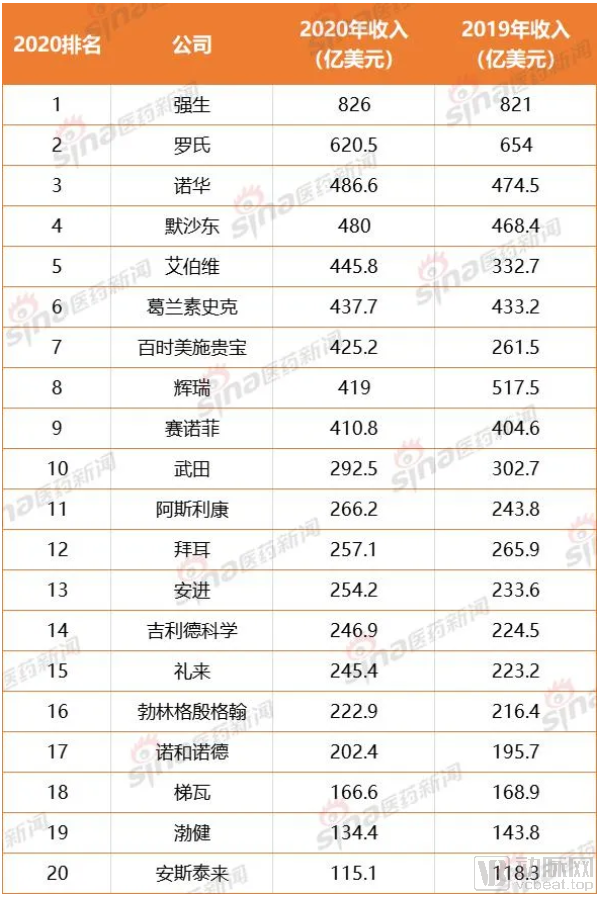
Rankings
01
Johnson & Johnson
Although COVID-19 vaccines were successfully developed, the pandemic led to flat sales for Johnson & Johnson. Total revenue increased by only 0.6%, reaching $82.6 billion.
Buoyed by strong performance in its pharmaceuticals business, Johnson & Johnson avoided a decline, with sales in this segment rising 8% to $45.6 billion, outpacing its Consumer Health and MedTech divisions among the company’s three major business units. Revenue from its Consumer Health business grew by 1.1%, while its MedTech business saw an 11.6% decline. Johnson & Johnson attributed the drop in MedTech revenue to the COVID-19 pandemic, as potential patients postponed medical procedures, weighing down the company’s surgery, orthopedics, and vision care operations. Although sales in these areas rebounded in the second half of the year, the recovery was insufficient to offset the deficit incurred in the first half.
Leading the growth in pharmaceutical sales was the anti-inflammatory drug Stelara, Johnson & Johnson’s top-selling medicine, which generated $7.7 billion in revenue, a 21% increase. However, in terms of percentage growth, it was outpaced by several other drugs. For instance, sales of the anti-inflammatory Tremfya rose 33% to $1.35 billion, while sales of the anticancer drug Darzalex jumped 40% to $4.2 billion. Imbruvica, another highlight in Johnson & Johnson’s pharmaceutical portfolio, saw a 21% sales increase, reaching $4.12 billion.
Among drugs with declining sales, Remicade continued to drop by 14% to $3.75 billion, as competition from biosimilars persisted into its third year. The prostate cancer drug Zytiga also fell by 11.6%, continuing to be replaced by cheaper generics.
2021 is set to be a particularly strong year for Johnson & Johnson, as the company’s commitment to delivering 1 billion doses of its COVID-19 vaccine will generate substantial revenue.
Johnson & Johnson projects total revenue of $88.8 billion for 2021, excluding vaccine sales. Based on an estimated average cost of $10 per dose under its agreement with the U.S. government, the vaccine could ultimately add $10 billion to Johnson & Johnson’s sales in 2021.
02
Roche
In 2020, Roche’s three blockbuster anticancer drugs—Herceptin, Avastin, and Rituxan—officially faced their first full-year competition from biosimilars in the United States.
In early 2020, Roche projected that biosimilars would erode approximately CHF 4 billion from its franchise. However, by year-end, global losses reached CHF 5.7 billion, including CHF 5.05 billion in the United States, the European Union, and Japan.
Roche CEO Bill Anderson stated during the Q4 earnings call in February that the company expects to be hit by CHF 4.6 billion by 2021.
Ocrevus, a multiple sclerosis drug, has been Roche’s best-selling new product since the third quarter of 2020. However, its full-year sales amounted to CHF 4.48 billion, falling short of expectations. On a constant-currency basis, its 24% year-on-year growth was significantly lower than the 57% recorded in 2019.
PD-L1 inhibitor Tecentriq is another key growth engine for Roche, with a 55% increase at constant exchange rates and sales of CHF 2.74 billion in 2020.
In terms of new drugs, Roche added three FDA approvals to its U.S. portfolio. In July 2020, Roche paid an upfront fee of $775 million to secure exclusive rights to the RET inhibitor pralsetinib in markets outside the United States (excluding Greater China), as well as co-commercialization rights in the U.S. market; the drug was approved in September 2020. Evrysdi gained approval and entered the increasingly crowded spinal muscular atrophy (SMA) market. Industry analysts believe that the drug may capture a significant share from Biogen’s Spinraza, the current market leader in SMA. Meanwhile, Enspryng, another product in Roche’s neuroscience portfolio, also received U.S. FDA approval for the treatment of neuromyelitis optica spectrum disorder (NMOSD).
In its R&D pipeline, faricimab, a VEGF/Ang-2 bispecific antibody and successor to Lucentis, recently demonstrated efficacy comparable to that of Regeneron’s blockbuster drug Eylea in two Phase 3 trials. Additionally, Roche acquired the rights to UCB0107, an anti-tau antibody for the treatment of Alzheimer’s disease, from UCB for $120 million. Roche also has gantenerumab, an anti-β-amyloid antibody, which previously failed but is currently being evaluated in two Phase 3 studies.
Regarding COVID-19, early signs indicated that Roche’s IL-6 anti-inflammatory drug Actemra could suppress a life-threatening immune overreaction known as cytokine release syndrome (CRS); consequently, Actemra’s sales grew by 32% in 2020, reaching $2.86 billion.
Other COVID-19 products drove growth in Roche’s Diagnostics division, delivering a 14% increase at constant currency last year, despite a decline in some routine tests. In 2020, Roche launched a total of 15 COVID diagnostic products. By contrast, sales in the larger Pharmaceuticals division fell by 8% (or 2% at constant currency) to CHF 44.53 billion.
03
Novartis
Novartis officially acquired The Medicines Company (TMC) for $9.7 billion in early 2020. The next step was originally to secure FDA approval for inclisiran, the core PCSK9 cholesterol-lowering drug asset included in the acquisition, but the COVID-19 pandemic disrupted this plan. Although inclisiran received European Union approval last December, its U.S. market launch timeline remains uncertain due to the pandemic.
Inclisiran was not Novartis’ only regulatory setback last year. The company also aimed to apply in 2021 for intrathecal, rather than intravenous, administration of the gene therapy Zolgensma. However, the FDA stated that it would require a standalone pivotal Phase 3 trial, building on the existing Phase 1/2 studies, before considering Novartis’ application.
As Zolgensma’s intrathecal formulation faced challenges, Roche launched a new oral formulation, Evrysdi, for SMA patients aged two months and older. However, analysts predict that Evrysdi will primarily capture market share from Biogen’s Spinraza among older patients.
Driven by EU approval and Japan’s reimbursement decision in May, Zolgensma achieved $920 million in sales in 2020, representing a year-on-year increase of approximately 150% despite the COVID-19 pandemic.
Novartis scored several victories in 2020, transforming the anticancer drug ofatumumab into an FDA-approved treatment for multiple sclerosis, now marketed under the brand name Kesimpta. The drug is regarded as a head-to-head competitor to Roche’s rapidly growing Ocrevus.
To date, the market launch of Kesimpta has been slow, while the growth of Ocrevus is also decelerating. The company stated that physicians have been hesitant to switch treatments, concerned that the B-cell-targeting mechanisms of these two drugs might reduce protection against COVID-19 or impair vaccine responses.
In addition to Kesimpta, in May 2020, Novartis also received U.S. FDA approval for Tabrecta to treat patients with non-small cell lung cancer (NSCLC) harboring MET exon 14 skipping mutations, a population that accounts for 3%–4% of newly diagnosed NSCLC cases. This approval preceded Merck’s competing product, Tepmetko, by nine months for the same indication in the United States.
Cosentyx is currently Novartis’ best-selling drug, with sales of $4 billion in 2020. In that year, the drug added radiographic-negative axial spondyloarthritis (nr-axSpA) to its label, roughly around the same time as Taltz, Eli Lilly’s competing IL-17 product.
Entresto is another key growth engine for Novartis, having recently received U.S. FDA approval to expand its indication to include heart failure with preserved ejection fraction (HFpEF). Novartis estimates that the drug’s sales will increase by 44% year-on-year to reach $2.5 billion. With the new indication, Novartis projects that the drug’s peak annual sales will rise by $1 billion, reaching approximately $4–5 billion.
04
Merck & Co.
Despite the ravages of COVID-19 in 2020, Merck & Co. still achieved revenue of $48 billion, representing a 2.5% increase in sales; however, this marks a significant deviation from the upward trend observed in 2019, when revenue grew by 11%.
By late October 2020, Merck & Co. had adjusted its estimated COVID-19 pandemic-related risk from $1.9 billion to $2.5 billion. Adding this portion of lost revenue to the 2020 sales figures would yield a healthy 8% growth.
Merck & Co.’s strong performance was driven by its immuno-oncology blockbuster, Keytruda, which posted $14.4 billion in sales in 2020, a 30% increase, positioning it to become the world’s best-selling drug in the coming years. Sales of the diabetes medication Januvia totaled $5.3 billion, down 4% from 2019. Sales of the combination diabetes drug Janumet also declined slightly, reaching $2 billion.
Gardasil, the HPV vaccine, generated $3.9 billion in sales, a 5% increase from 2019, compared with a 19% growth rate in 2019.
Merck’s other high-revenue products include the varicella vaccine Varivax ($1.9 billion), Bridion ($1.2 billion), and Pneumovax ($1.1 billion).
Currently, Merck & Co. is continuing to intensify its efforts to reduce reliance on Keytruda and achieve diversification. Last November, the company acquired VelosBio, which is developing therapies targeting ROR1. Merck also hopes to achieve better outcomes than those seen with its acquisition of Themis. In May last year, Merck acquired Themis, officially entering the race for COVID-19 vaccine development. However, in January this year, it halted the development of two vaccine candidates, V590 and V591, due to suboptimal antibody titers.
05
AbbVie
AbbVie achieved 38% growth over the past year. There is only one simple explanation for its strong growth figures: the completion of its acquisition of Allergan, which propelled AbbVie into the top five pharmaceutical companies globally. In this transaction, AbbVie paid $63 billion, with the deal closing in May 2020. Through this acquisition, AbbVie inherited a robust product portfolio from Allergan, which accounted for a substantial share of its $12.53 billion revenue increase.
However, the COVID-19 pandemic made for a difficult year for Allergan’s medical aesthetics business. For instance, sales of the botulinum toxin product Botox fell by 43% from the second quarter of 2019 to the same period last year. Yet under AbbVie’s leadership, the wrinkle-reducing formulation rebounded in less than eight months, generating $2.5 billion in revenue. Annualized over a 12-month period, this performance is comparable to the $3.8 billion in revenue that Botox generated for Allergan in 2019.
Allergan’s portfolio has demonstrated strong performance, led by Vraylar. This antidepressant generated $951 million in revenue for AbbVie in less than eight months, surpassing its full-year 2019 revenue of $858 million. Annualized projections indicate that Restasis ($787 million) and Linzess ($667 million) have also outperformed their 2019 results under Allergan’s leadership.
Immunology remains AbbVie’s primary revenue source. Its flagship product, Humira ($19.8 billion), may experience a notable decline, yet it has rebounded with a 3.5% growth compared to the 4% decrease observed in 2019. Meanwhile, the novel anti-inflammatory agents Skyrizi ($1.6 billion) for plaque psoriasis and Rinvoq ($730 million) for rheumatoid arthritis are demonstrating potential as ultimate successors.
Sales of the blood cancer drugs Imbruvica ($5.3 billion) and Venclexta ($1.3 billion) were strong, with the latter’s figure representing a 69% increase from 2019.
Mavyret ($1.8 billion) and Creon ($1.1 billion) also surpassed the $1 billion mark. Mavyret was once an emerging superstar, but it is now declining rapidly, like most other hepatitis C drugs.
AbbVie’s acquisition of Allergan certainly played a role in the surge in valuation, but the immense potential of its rising immunology stars, Skyrizi and Rinvoq, also contributed significantly. AbbVie estimates that annual revenue from these two products will reach $15 billion by 2025.
The company also has several promising drugs in development, including ABBV-951 for Parkinson’s disease, elezanumab for spinal cord injury, and several oncology candidates.
06
GlaxoSmithKline
GSK played a supporting role in the early race to develop an effective COVID-19 vaccine, providing adjuvants to enhance the efficacy of other companies’ candidate vaccines rather than developing its own.
Unfortunately, GSK’s existing vaccines and its COVID-19 vaccine efforts were both impacted during the pandemic, resulting in flat year-over-year sales.
The most prominent adjuvant collaboration agreement between GSK and Sanofi is for a recombinant protein-based COVID-19 vaccine. Last December, after the vaccine failed to elicit a sufficiently strong immune response in Phase 1/2 studies conducted in individuals aged 50 years and older, the partners were compelled to reformulate it. A new Phase 2 study was launched a few weeks ago, and a Phase 3 trial may commence in the second quarter.
Meanwhile, GSK’s existing vaccines took a heavy hit as consumers deferred routine vaccinations during the pandemic. Its vaccine growth engine—the shingles vaccine Shingrix—achieved 10% growth in 2020, with sales reaching £1.99 billion. However, this was disappointing given that demand for the vaccine had outstripped supply prior to the COVID-19 pandemic. Moreover, this growth was insufficient to offset the 15% decline in total sales of its legacy vaccines, which generated £3.23 billion in revenue in 2020.
With COVID-19 vaccination currently being prioritized, GSK expects the slowdown in Shingrix to persist at least through the first half of 2021, with a genuine rebound not occurring until 2022.
GSK did have some highlights in 2020, including its respiratory product portfolio. The triple-therapy inhaler Trelegy generated £819 million in revenue, representing a 58% year-on-year increase.
Another driver of GSK’s respiratory growth, Nucala, generated revenues of £994 million, a 29% year-on-year increase. Last year, Nucala received FDA approval for the treatment of hypereosinophilic syndrome, a rare disease. GSK has also submitted an application to the FDA for approval of Nucala as a treatment for chronic rhinosinusitis with nasal polyps.
HIV is another pillar of GSK’s pharmaceutical franchise. In 2020, HIV business sales remained flat at £4.88 billion.
GSK has also aggressively advanced its oncology R&D, but this effort has not yielded high returns. The PARP inhibitor Zejula saw a 48% year-on-year increase in sales in 2020, reaching £339 million.
In the consumer healthcare sector, GSK has been busy integrating its portfolio with Pfizer and executing divestment plans to prepare for the spin-off scheduled for 2022. In 2020, sales of the vitamins and dietary supplements franchise within the consumer healthcare business grew by more than 10%.
07
Bristol Myers Squibb
In 2020, Bristol Myers Squibb (BMS) saw its sales surge by $16 billion compared to 2019. This was the result of a transformation that began in November 2019, when BMS acquired Celgene in a $74 billion merger.
Celgene’s full-year sales drove a 63% increase in BMS’s revenue, with its best-selling product being the anticancer drug Revlimid, which generated $12.1 billion in sales, a 12% year-over-year increase.
Other top performers were Orencia ($3.2 billion), Sprycel ($2.1 billion), Yervoy ($1.7 billion), and Abraxane ($1.2 billion). Eliquis sales rose 16% to $9.2 billion, driven by data showing that this blood thinner can reduce the risk of stroke and heart attack in patients with COVID-19.
However, some of BMS’s drugs struggled last year. As PD-1 inhibitors continued to face fierce competition from Merck’s Keytruda, Opdivo’s sales declined by 3% to $7 billion. There were also disappointing research outcomes, including a study showing that combination chemotherapy was less effective than chemotherapy alone in treating non-squamous non-small cell lung cancer.
BMS investors know that the company cannot rely on Revlimid, its multiple myeloma drug, in the long term, as it will face generic competition in early 2022.
Despite Revlimid’s impending loss of exclusivity, some analysts remain bullish on BMS’s future. Evaluate Pharma predicts that by 2026, Eliquis will be the second best-selling drug globally, and Opdivo will rank third.
Last year, BMS also received FDA approval for the multiple sclerosis drug Zeposia, which is set to launch post-pandemic.
Competing with Merck’s Keytruda will be a daunting task. However, analysts say that Opdivo has room for growth, thanks to two FDA approvals last year for its combination therapy with Yervoy.
08
Pfizer
Although Pfizer earned acclaim for successfully developing and launching the first COVID-19 vaccine in partnership with BioNTech in 2020, its performance has been influenced by a series of other events and products.
Following the spin-off of its generics business, Upjohn, Pfizer fell from third place in last year’s top 20 to eighth this year. The merger of Upjohn and Mylan to form the new company Viatris officially received FTC approval in November 2020, marking the point at which Upjohn’s revenue was removed from Pfizer’s books.
In 2020, Pfizer’s total revenue amounted to $41.9 billion, representing a 2% year-over-year increase when excluding the performance of Upjohn.
Pfizer reported an 8% increase in operating revenue for 2020, driven by strong growth across multiple drugs, including Vyndaqel, Eliquis, Ibrance, Xeljanz, and Xtandi. This robust performance helped offset sales declines for Enbrel, Prevnar 13, and Chantix.
Xtandi, a prostate cancer drug, saw the largest increase, rising 22% to $1.02 billion in sales and entering the blockbuster product tier. Eliquis grew 17% to $4.95 billion, while Ibrance increased 9%, with full-year sales reaching $5.39 billion.
Among the underperforming drugs, Enbrel’s sales fell 21% to $1.35 billion, while Chantix’s sales dropped 17% to $919 million.
Pfizer’s blockbuster vaccine, Prevnar 13, saw flat year-over-year sales but still contributed $5.85 billion. The COVID-19 vaccine, Comirnaty, generated $154 million in sales after receiving emergency use authorization last December.
Pfizer recently adjusted its projected 2021 sales to $59.4–$61.4 billion, with COVID-19 vaccine sales expected to reach approximately $15 billion this year.
Following the merger of Viatris’s generics business and the earlier combination with GSK’s consumer healthcare division, Pfizer plans to leverage its mRNA expertise for future discovery efforts.
09
Sanofi
Last year, amid the challenges posed by the COVID-19 pandemic, Sanofi’s new “Play to Win” strategy—which calls for a focused emphasis on the company’s successful products and therapeutic areas, including immunology with its blockbuster drug Dupixent and vaccines—began to yield results. For instance, in the third quarter alone, Dupixent drove over $1 billion in sales, representing a 69% increase year-over-year.
Flu vaccines delivered record sales for Pfizer, reaching €1.07 billion in the third quarter, as the COVID-19 pandemic made influenza vaccination a top priority for people worldwide.
Overall, Sanofi’s sales grew by 3.3% in 2020, reaching €36 billion. Dupixent alone generated total revenues of €3.5 billion, while oncology sales surged 27% to €798 million, driven by the launches of Sarclisa and Libtayo as well as growth from established products.
On the other hand, sales of Sanofi’s diabetes and cardiovascular drugs, which had previously shown strong performance, declined again. At constant exchange rates, the company’s diabetes sales fell by 4.8% to €4.7 billion. Revenue from cardiovascular and mature products decreased by 8.8% to €10 billion.
Sanofi’s new strategy also includes cost-cutting measures. In February this year, when the company announced its full-year 2020 results, executives stated that Sanofi had already eliminated €1.7 billion in costs, approaching its target of reducing costs by €2 billion by 2022. The company has reinvested 60% of the savings achieved. Given the substantial level of savings already realized, Sanofi has raised its 2022 target by an additional €500 million.
10
Takeda
In 2020, Takeda achieved its previously set target of divesting $10 billion worth of products, thereby alleviating the debt burden incurred from the acquisition of Shire.
As a result of these transactions, Takeda reduced its net debt-to-adjusted EBITDA ratio to 3.6x by the end of 2020, moving closer to its deleveraging target of 2x before the fiscal year 2023 (ending in March 2024). Entering 2021, the divestiture boom appeared highly active.
Takeda is focused on identifying new growth opportunities for its prescription drugs, with a particular emphasis on Entyvio, its blockbuster inflammatory bowel disease (IBD) medication. In 2020, Entyvio generated revenue of ¥403 billion (approximately $3.77 billion), representing a year-on-year increase of 21.5%.
Takeda’s oncology portfolio saw both triumphs and setbacks in 2020. Alunbrig received U.S. FDA approval for the treatment of patients with previously untreated ALK-positive non-small cell lung cancer (NSCLC). However, sales for the 2020 calendar year amounted to only ¥8.6 billion ($80 million).
Sales of the leukemia drug Velcade continued to decline as it lost market exclusivity. Its sales from April to December amounted to JPY 75.9 billion (USD 720 million), representing a 16.4% decrease compared to the same period in 2019.
The company hopes that some newer cancer drugs, such as Ninlaro (a successor to Velcade), Seagen-licensed antibody-drug conjugate Adcetris, the leukemia drug Iclusig, and the ALK-positive lung cancer drug Alunbrig, will fill this gap.
In terms of COVID-19 therapeutics, Takeda’s efforts are focused on CoVIg-19, a hyperimmune globulin product manufactured by concentrating plasma donated by patients who have recovered from COVID-19.
In addition, Takeda is testing intravenous formulations of its hereditary angioedema drugs Firazyr and its successor, Takhyzro, in two Phase 3 platform trials. The hope is that one of these two drugs will help control the dangerous inflammatory response in some COVID-19 patients.
More importantly, Takeda has signed agreements to help vaccine developers bring their vaccines to Japan. It will assist in distributing Moderna’s mRNA vaccine and will develop, manufacture, and market Novavax’s nanoparticle vaccine NVX-CoV2373 in Japan.
In the vaccine sector, Takeda plans to seek approval for its dengue vaccine, TAK-003, in the near future. Among more than a dozen new drugs scheduled for launch by fiscal year 2024, Takeda stated that one could achieve peak sales exceeding $10 billion.
11
AstraZeneca
Amid the COVID-19 pandemic, AstraZeneca achieved double-digit sales growth, partly because only two of its top ten best-selling drugs are administered in healthcare settings. The company was also one of the few to secure authorization for a COVID-19 vaccine and, in 2020, closed the largest merger and acquisition deal in the global biopharmaceutical industry.
Imfinzi, a PD-L1 inhibitor, is one of the two top-performing drugs in AstraZeneca’s portfolio used in healthcare settings, delivering stable revenue growth. First approved in 2017, the drug saw a 39% increase in revenue, reaching $2.04 billion, with the majority of its revenue and growth potential stemming from its application in stage III non-small cell lung cancer (NSCLC).
Within AZ’s product portfolio, Pulmicort (inhaled budesonide), a long-established asthma brand, is another top-performing drug used in healthcare settings. In 2019, the drug still achieved double-digit percentage growth; however, the COVID-19 pandemic led to a sharp decline in patient visits to nebulization centers. This resulted in a steep drop in Pulmicort’s revenue last year, with sales falling 32% to $996 million.
In addition to Imfinzi, the lung cancer targeted therapy Tagrisso and Lynparza, a PARP inhibitor developed in collaboration with Merck & Co., were key drivers behind AstraZeneca’s 10% year-on-year growth in product sales last year, reaching $25.89 billion. Tagrisso’s sales rose by 36% to $4.33 billion, while Lynparza’s increased by 48% to $1.78 billion.
These drugs form the backbone of AZ’s business, but public attention on the company has recently focused on its COVID-19 vaccine, AZD1222. Recently, concerns over rare cases of venous thrombosis in vaccinated individuals have led several European countries to temporarily suspend the use of the AZ vaccine.
Amid the turmoil surrounding COVID-19 vaccines, AstraZeneca (AZ) announced the largest global biopharmaceutical acquisition of 2020, planning to acquire the rare disease company Alexion for $39 billion. This deal provided AZ with several marketed drugs, primarily the complement inhibitors Soliris and Ultomiris. In 2020, Alexion achieved sales of $6.07 billion, representing a 21.6% increase from 2019.
12
Bayer
FiercePharma’s annual pharmaceutical ranking does not cover Bayer’s Crop Science division. In its pharmaceutical segment, the best-selling drugs Eylea and Xarelto are facing patent cliffs. In January this year, the company released new data showing that treatment with Nubeqa for prostate cancer, in combination with androgen deprivation therapy (ADT), can extend patient survival.
In the same month, some less favorable news tempered this positive interpretation, as cost-effectiveness agencies in the United Kingdom and Germany rejected Bayer’s “tumor-agnostic” anticancer drug Vitrakvi due to pricing and data limitations.
Like many pharmaceutical manufacturers, Bayer’s performance in the first quarter of 2020 exceeded expectations, largely thanks to increased inventory of Xarelto.
While Bayer delivered a strong first-quarter performance, it experienced a slowdown in the second quarter—a pattern familiar to many companies during the COVID-19 pandemic. Nevertheless, the ophthalmic drug Eylea remained resilient, with sales declining by only 6%, a much smaller drop compared to the 25% plunge recorded for Lucentis, the competing product from Roche and Novartis. Also in the second quarter, Xarelto saw a 5% increase in sales, driven by growth in China, Russia, and Germany.
Excluding Bayer’s Crop Science division, the company reported revenue of €22.56 billion ($25.71 billion) in 2020, slightly down from €23.71 billion ($26.59 billion) in 2019. Total pharmaceutical sales declined by 1.5% to €17.24 billion. Bayer stated that COVID-19 restrictions adversely affected its ophthalmology and women’s health businesses, particularly in the first half of 2020.
Meanwhile, Bayer attempted to join the fight against COVID-19 in 2020, although its donation of 3 million tablets of the antimalarial drug hydroxychloroquine proved ill-fated. Earlier this year, the company announced it would assist its German counterpart, CureVac, in bringing its developed mRNA vaccine to market.
In other respects, Bayer has remained committed to the restructuring plan announced in 2018. In July 2020, the company received antitrust approval for its $7.6 billion acquisition of animal health firm Elanco. In October, Bayer stated that pressures from the COVID-19 pandemic would necessitate additional cost cuts exceeding €1.5 billion ($1.8 billion) by 2024.
13
Amgen
Amgen’s core products, Neulasta, Neupogen, and Sensipar, all lost market exclusivity in 2019, but the company has made several forays into the biosimilars space, which paid off last year. Additionally, Amgen has recently launched several strong new products and is poised for success with its pipeline.
Driven by substantial sales growth in key products, Amgen achieved a 7% revenue increase in 2020. For instance, Aimovig, the new migraine medication, saw a 21% volume growth in the fourth quarter alone, with sales rising 24% year-over-year to $378 million; sales of Evenity, an osteoporosis drug, surged 85% to $191 million.
The biosimilar business also performed strongly. Amgevita, a biosimilar to AbbVie’s blockbuster immunology drug Humira, saw its sales increase by 54% year-over-year to reach $331 million, making it the most prescribed biosimilar in Europe. As more markets adopt biosimilars this year, Amgen expects growth to continue.
In other respects, Amgen’s oral anti-inflammatory drug Otezla performed strongly in 2020. Despite a significant slowdown in physician visits due to the COVID-19 pandemic, prescriptions for the drug increased by 13% during the year.
Amgen’s pipeline includes two high-profile first-in-class drugs, which could help drive its future growth. The KRAS-targeted inhibitor sotorasib is currently under FDA review for the treatment of non-small cell lung cancer. Additionally, tezepelumab, a TSLP inhibitor developed in collaboration with AstraZeneca, recently released positive data in asthma treatment.
Regarding COVID-19, in September 2020, Amgen partnered with Eli Lilly to scale up production of antibody candidates for the treatment of COVID-19. In December 2020, the company collaborated with Takeda and UCB to conduct a clinical trial aimed at determining whether three existing drugs, including Otezla, could suppress the dangerous inflammatory responses experienced by some COVID-19 patients.
14
Gilead Sciences
Since hitting a record $32.6 billion in 2015, Gilead’s sales have plummeted in recent years, shocking the company and its investors. However, with 2020 revenue reaching $24.69 billion—a 10% increase from 2019—the company’s freefall may finally be in the rearview mirror, at least for now.
Last year’s surge was largely attributable to the sudden success of COVID-19 therapeutics. Gilead’s drug remdesivir (Veklury) achieved $2.8 billion in sales.
Although Gilead’s good fortune in pharmaceuticals has been unexpected, the performance of its anti-HIV drugs is hardly surprising. Despite challenges from GSK, Gilead continues to dominate the HIV market, with its blockbuster drug Biktarvy generating $7.3 billion in sales, a 53% increase from 2019. Partly due to Biktarvy’s dominance, sales of some of the company’s other HIV medications have declined, including Genvoya ($3.3 billion) and various Truvada-based products ($2.3 billion), which face new generic competition. However, Descovy ($1.9 billion) and Odefsey ($1.7 billion) have achieved growth and hold potential for further expansion.
All of this combined brought $16.9 billion in sales to Gilead’s HIV business, accounting for 69% of the company’s total revenue. Meanwhile, as expected, Gilead’s hepatitis C sales declined by 30% to $2.1 billion, reflecting the trend observed for these drugs over the past several years.
In 2020, Gilead Sciences made substantial biotechnology investments totaling over $27 billion, spanning deals of various sizes. The $21 billion acquisition of Immunomedics marked the second-largest merger and acquisition transaction in the company’s history, bringing with it Trodelvy, a promising drug for breast cancer. Additionally, the $4.9 billion acquisition of Forty Seven secured magrolimab, an antibody therapy for hematologic malignancies, which is expected to hit the market next year.
15
Eli Lilly
Last year, Eli Lilly’s sales reached $24.54 billion, a 10% increase from $22.32 billion in 2019. The company’s COVID-19 antibody, bamlanivimab, generated $871 million in the fourth quarter. A significant portion of the company’s growth was driven by efforts to boost sales volume. Overall, the company’s sales volume increased by 15% last year, while actual prices declined by 5%.
Apart from bamlanivimab, drugs launched by Eli Lilly since 2014 have continued to drive growth for the company, accounting for approximately half of its total sales last year. These medications include Trulicity, its best-selling drug for type 2 diabetes, as well as the immunology blockbuster Taltz and Emgality, a medication for migraine prevention. Excluding Eli Lilly’s COVID-19 antibody therapy, the company’s global revenue increased by 6% last year.
Meanwhile, the company delivered outstanding stock market performance in 2020. Last year, Eli Lilly was among the pharmaceutical companies with the largest gains in market capitalization, as investors boosted its market value by 28% in 2020, reaching $161.5 billion.
Lilly quickly began researching drugs to help combat COVID-19. This effort paid off: bamlanivimab received FDA approval last year and generated substantial revenue. The combination of bamlanivimab with another antibody, etesevimab, has recently provided the strongest COVID-19 treatment data to date, reducing the risk of hospitalization and death by 87%.
Olumiant, a drug previously approved for the treatment of rheumatoid arthritis, has also shown promising results in the treatment of COVID-19. In hospitalized patients requiring supplemental oxygen or mechanical ventilation, this drug, when used in combination with Gilead’s antiviral medication, received emergency use authorization from the FDA.
In addition to the current performance of its portfolio, the company has also released positive pipeline updates in recent months. Its Alzheimer’s disease candidate, donanemab, announced positive top-line results from its Phase 2 trial in January this year, but the full data released in March disappointed investors. Eli Lilly’s diabetes candidate, tirzepatide, demonstrated superior efficacy in lowering blood glucose and reducing body weight compared to Novo Nordisk’s Ozempic; however, analysts believe that Novo Nordisk’s drug remains competitive in the market.
16
Boehringer Ingelheim
Despite the COVID-19 pandemic causing a significant decline in sales for countless drugs last year, BI not only successfully maintained stability but also achieved a 3% increase in revenue, reaching $22.29 billion. According to the company’s annual report, net sales increased by 5.6% year-on-year after excluding foreign exchange effects.
This performance was largely attributable to its type 2 diabetes portfolio, particularly the blockbuster product Jardiance, whose sales increased by 15% in 2020 to reach $2.82 billion, up from approximately $2.4 billion in 2019. Over the year, Jardiance made significant strides in the treatment of heart failure, closely following the path of AstraZeneca’s competing product Farxiga, despite encountering some setbacks in the diabetes segment.
Another drug that drove BI’s strong performance in 2020 was Ofev, a treatment for idiopathic pulmonary fibrosis, whose sales rose 38% to $2.34 billion. The company has sought to expand Ofev’s market into a range of ultra-rare lung diseases, and in February secured expanded FDA approval for treating patients with chronic fibrosing interstitial lung diseases (ILD) with a progressive phenotype. At the time, BI stated that the approval covered 18%–32% of all ILD patients, including approximately 200 conditions that can cause irreversible scarring of lung tissue.
Meanwhile, Boehringer Ingelheim’s bet on China paid off in early 2020. Last January, the company’s biopharmaceutical manufacturing site in China became the first contract development and manufacturing organization (CDMO) to produce an approved drug—BeiGene’s anti-PD-1 checkpoint inhibitor tislelizumab—under the Marketing Authorization Holder (MAH) system.
In 2017, BI commenced operations at the first phase of its $77 million manufacturing facility in China, which is equipped with a single-use bioreactor capable of handling 2,000 liters for clinical supply or commercial production. The BI facility is designed to allow for the addition of extra 2,000-liter single-use bioreactors and fill-finish capabilities as needed.
17
Novo Nordisk
In early 2020, Novo Nordisk focused on launching its highly anticipated oral antidiabetic drug, Rybelsus. Although the drug received FDA approval in September 2019, the company did not immediately deploy its full marketing force to support the product launch while negotiating with payers. Shortly after the drug’s market entry, the COVID-19 pandemic struck. Nevertheless, Rybelsus generated $300 million in revenue during its first full year on the market.
Meanwhile, sales of Novo Nordisk’s injectable GLP-1 drug Ozempic surged in 2020. The drug generated approximately $3.4 billion in revenue last year, surpassing the company’s older GLP-1 medication, Victoza, which brought in around $3 billion. In 2019, Victoza’s sales were nearly twice those of Ozempic.
Beyond its core GLP-1 franchise, Novo Nordisk’s insulin sales declined by 3% at constant exchange rates, partly due to lower realized prices and new U.S. legislation requiring the company to offer larger discounts to Medicare. The pandemic also dampened growth of Novo Nordisk’s weight-loss drug Saxenda, as fewer patients initiated treatment.
Looking ahead, Novo Nordisk recently announced robust data on Ozempic for the treatment of obesity, setting the stage for intense competition with Eli Lilly. In Novo Nordisk’s Phase 3 trial, one-third of patients achieved more than 20% weight loss after 68 weeks of continuous Ozempic treatment. Although Eli Lilly has also released impressive data for tirzepatide, analysts believe that Novo Nordisk’s Ozempic will still secure a significant share of the market.
18
Teva
In 2020, Teva generated $16.7 billion in revenue, slightly down from $16.8 billion in 2019. The company attributed the shortfall to the continued decline of its multiple sclerosis blockbuster drug Copaxone, as well as decreased revenue from certain oncology and respiratory products. Additionally, COVID-19 also impacted sales, which comes as no surprise.
However, the COVID-19 pandemic was not entirely detrimental to Teva. The company benefited from its portfolio of generic and over-the-counter (OTC) products, reporting $100 million in sales for the first quarter. In March, Teva committed to supplying hydroxychloroquine to the United States, delivering approximately 16 million doses to hospitals across the country.
Teva focused on expansion plans for two internal assets during the pandemic. After implementing significant cost-cutting measures, Teva positioned its migraine medication Ajovy and its Huntington’s disease treatment Austedo as potential sales drivers for 2020. In February of that year, the projected sales for these drugs were estimated to reach $250 million and $650 million, respectively.
In January 2020, the Ajovy autoinjector received U.S. FDA approval for market entry. Teva reported a 50% surge in North American sales of Ajovy in the second quarter. Overall, Ajovy generated $183 million in revenue in 2020. In its annual earnings report, Teva projected that the drug’s sales could reach $300 million in 2021.
Austedo generated annual revenue of $638 million, in line with expectations. In 2021, the drug’s sales could reach $950 million. However, in February 2020, Teva’s plans to expand the drug’s indications were set back after Austedo failed in a Phase 2/3 study and a separate Phase 3 trial in pediatric patients with Tourette syndrome.
19
Biogen
Biogen’s Alzheimer’s drug, aducanumab, could become its future blockbuster product. The drug failed in a 2019 trial but was revived after an in-depth analysis of the data. Biogen has submitted aducanumab for FDA review, with a decision deadline in June. This could represent either a major victory or another significant setback for Biogen, which is already grappling with competitive pressures.
Meanwhile, on the commercial front, Biogen struggled in 2020. The company’s global sales amounted to $13.44 billion, representing a 6.5% decline from $14.38 billion in 2019.
Amid the competition between Roche and Novartis, sales of Biogen’s spinal muscular atrophy drug Spinraza edged down slightly from $2.1 billion to $2.05 billion.
But in the long run, Biogen is counting on its pipeline to continuously yield new drugs. In addition to aducanumab, the company is developing biosimilars and candidate therapies for choroideremia and stroke. Last year, the company signed several development agreements aimed at strengthening its pipeline, including a multi-billion-dollar deal with Sage.
Biogen is also active in the biosimilars space: its biosimilars generated nearly $800 million in revenue last year, and the company may launch a biosimilar to Lucentis later this year.
20
Astellas
Benefiting from industry consolidation in recent years, Astellas ranked 20th in 2020 with sales exceeding $11 billion.
In the first quarter of 2020, Astellas generated ¥312.3 billion (approximately $2.87 billion) in revenue. For the remainder of 2020, the company’s sales reached ¥940.9 billion ($8.63 billion). Combined, global sales for 2020 totaled $11.5 billion.
Although COVID-19 posed challenges to the company in 2020, Astellas achieved some notable successes. In February 2020, the antibody-drug conjugate Padcev, developed by Astellas and Seattle Genetics (Seagen), demonstrated impressive efficacy in treating advanced bladder cancer, prompting SVB Leerink analyst Andrew Berens to raise its peak sales forecast to $5.8 billion.
Source: The top 20 pharma companies by 2020 revenue