

Can Oral Hyaluronic Acid Become the Second Growth Engine for Aesthetic Giants?
A New Trend Has Emerged, Led by a Female Billionaire.
Early this year,The National Health Commission Has Officially Approved the Use of Sodium Hyaluronate (Commonly Known as "Hyaluronic Acid") as a New Food IngredientAs a result, numerous companies have rushed to enter the market, aiming to capture a share of the oral hyaluronic acid segment. The company that has recently obtained approval is Bloomage Biotech (SH: 688363), the leading hyaluronic acid producer listed on China’s A-share market.
As one of the “Big Three” hyaluronic acid companies in China (the other two being Imeik and Haohai Biological Technology), Bloomage Biotechnology was founded in 2000, primarily engaging in the production of hyaluronic acid raw materials, and officially listed on the STAR Market in 2019. Its founder, Ms. Zhao Yan, graduated from the Department of Biology at Central China Normal University. According to the 2021 Forbes list, Zhao Yan’s net worth exceeded RMB 45 billion, ranking her 309th worldwide.
After receiving approval, Bloomage Biotech launched the “Shuiji Quan” hyaluronic acid beverage.According to Taobao’s official website, the product’s ingredient list includes water and hyaluronic acid, aiming to meet consumers’ demand for hyaluronic acid supplementation while drinking water. Priced at 124.5 yuan for 15 bottles, each bottle costs less than 9 yuan.
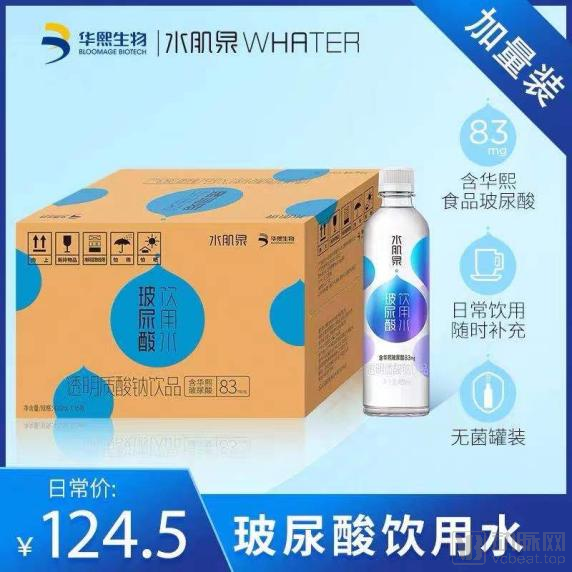
(Image source: “Shuiji Quan” Taobao Flagship Store)
Other companies have also begun to actively position themselves in the market.For instance, the internet-famous brand Hankou No. 2 Factory has also launched a hyaluronic acid sparkling water called “Ha Shui,” emphasizing in its product promotions that it “contains an amount of hyaluronic acid equivalent to four facial masks and three beauty serums, with benefits such as enhancing skin hydration, achieving supple and radiant skin, and improving complexion.”
Behind the Market Frenzy: Is Oral Hyaluronic Acid Truly Effective, or Just a Scam to Exploit Consumers? Where Do the Industry Opportunities Lie, and What Challenges Does It Face? Additionally, How Long Will This Trend Last?
As a natural substance in the human body,A single hyaluronic acid molecule can bind more than 500 times its weight in water, delivering powerful moisturizing efficacy., which is widely present in tissues such as the joint cavities and skin of the human body. Unfortunately, as people age, the level of hyaluronic acid in the body gradually declines, leading to a series of aging issues such as skin laxity and wrinkles.
Thus, relevant companies help people combat aging by extracting hyaluronic acid.The primary mode of application involves topical administration or injection of hyaluronic acid products onto the face.Later, with technological advancements, orally administered hyaluronic acid gained regulatory approval and surged in popularity overseas. For instance, food products containing hyaluronic acid have been launched in countries such as Japan, South Korea, the United States, the United Kingdom, New Zealand, and Canada. To access oral hyaluronic acid supplements, consumers in China have primarily relied on cross-border e-commerce channels, including purchases through social commerce platforms.
This situation has undergone a significant change this year.In January this year, the National Health Commission approved Bloomage Biotech’s application to recognize hyaluronic acid as a new food raw material.Since then, the new blue-ocean market for oral hyaluronic acid has been opened.
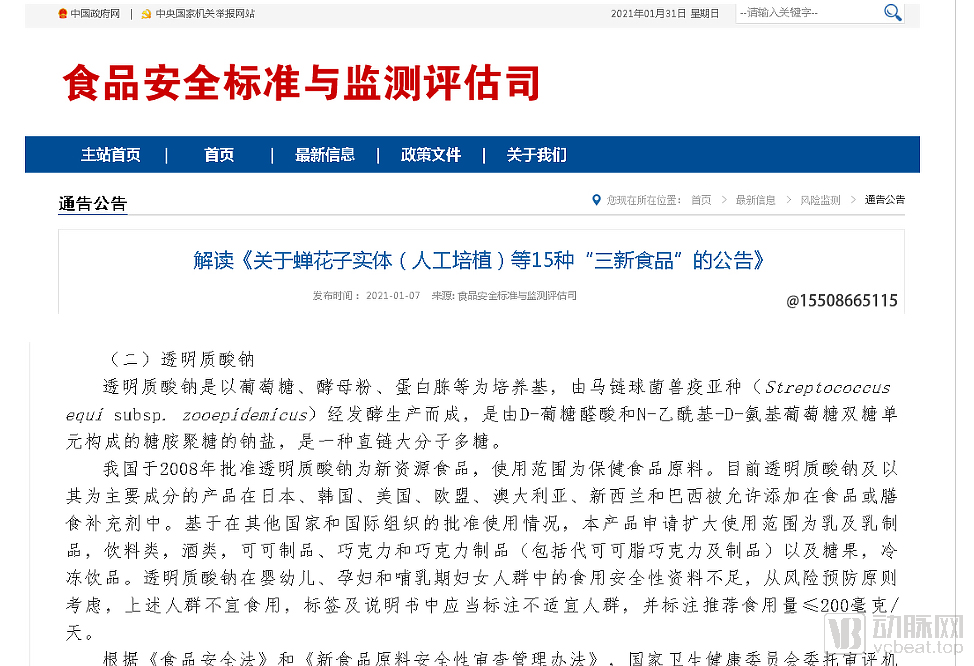
It should be noted that,China is the world's largest producer and seller of hyaluronic acid raw materials., according to Frost & Sullivan data, China’s total sales volume of hyaluronic acid raw materials accounted for 81% of the global total in 2019. However, due to previous regulatory restrictions, Chinese consumers seeking to consume hyaluronic acid-containing food products had no option but to purchase them through cross-border e-commerce channels.
Hyaluronic acid has long been regarded as a star sector. One reason isMedical Aesthetic Hyaluronic Acid Injection Products Have Gross Margins as High as 90%, which has earned hyaluronic acid the nickname “the Moutai of medical aesthetics.” Another, more important reason is that,Hyaluronic acid raw materials can be applied to high-growth sectors such as medical aesthetics, cosmetics, and food.
Taking the medical aesthetics sector as an example, according to data and forecasts from Frost & Sullivan, China will become the world’s largest market for medical aesthetic services in 2021, with a market size expected to exceed RMB 900 billion and a compound annual growth rate (CAGR) of over 20%. This implies that demand for hyaluronic acid in the market will continue to grow rapidly.
The first to benefit was Bloomage Biotech. According to data from Sina Finance, as of now, Bloomage Biotech holds a 70% market share in China and over 47% globally. The key reason behind such a high market share lies inBloomage Biotechnology does not limit its positioning to upstream raw materials and the medical sector; it also covers niche segments such as consumer skincare.
Notably, Bloomage Biotechnology initiated the regulatory application process for adding hyaluronic acid to food products in China as early as 2004—a first in the country. After 17 years, Bloomage has finally realized its ambition. In the face of this opportunity, how will other hyaluronic acid giants follow suit? Can functional foods containing oral hyaluronic acid make for a compelling business narrative?
Bloomage Biotech has been continuously expanding its boundaries.
According to the latest financial report released by Bloomage Biotech, its operating revenue in 2020 reached RMB 2.633 billion, a year-on-year increase of 39.63%; net profit amounted to RMB 646 million, representing a year-on-year growth of 10.29%.
Notably,In its revenue structure, Bloomage Biotech’s “functional skincare” segment generated RMB 1.346 billion in revenue, surpassing for the first time the RMB 703 million from product raw materials and the RMB 576 million from medical end-products.
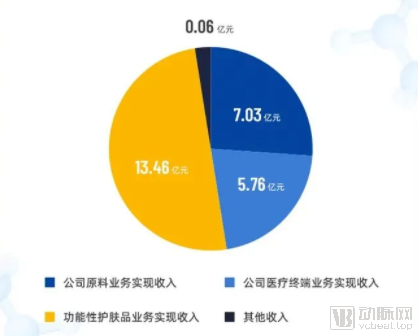
(Image source: Bloomage Biotech’s official Tencent Penguin account)
It is worth noting that functional skincare was not an area Bloomage Biotechnology engaged in from the outset; its entry into this sector dates back to 2014, when it launched its first product, Biohyalux’s “Honeycomb Hyaluronic Acid Hydrating Disposable Serum.” This product has been frequently featured in the live-streaming sessions of Li Jiaqi and Viya, with official promotions claiming that its sales consistently exceeded 10,000 units per session.
In other words, within just seven years, Bloomage Biotech has firmly established its position in the functional skincare sector. In addition to Biohyalux, the company has successively launched brands such as QuadHA, Medrepair, and BM Bioactive. This segment has become one of the key growth drivers for Bloomage Biotech’s revenue. For instance, Biohyalux generated RMB 565 million in revenue in 2020, representing a year-on-year increase of over 60%, while QuadHA contributed RMB 391 million in revenue in 2020, marking a more than fivefold year-on-year growth. The sales volumes of these two brands have already reached levels comparable to those of certain top-tier skincare brands.
From this perspective, the functional food sector to which oral hyaluronic acid belongs is undoubtedly the business area that Bloomage Biotech hopes will become its next growth engine, following the skincare segment., which is also why Bloomage Biotech has been actively expanding its strategic footprint.And will this attract other hyaluronic acid giants to compete for a share of the market?
A glimpse into the matter may be gained by examining the financial reports of two other hyaluronic acid giants.
First, the recently released financial report by Imeik shows that its operating revenue in 2020 reached RMB 709 million, a year-on-year increase of 27.18%, with net profit attributable to shareholders amounting to RMB 440 million, up 43.93% year on year. Notably, hyaluronic acid injection products accounted for over 98% of the company’s revenue, while cosmetics contributed only 1.11%. It is particularly worth noting that Imeik’s net cash flow last year was RMB 426 million, with the cash content of net profit reaching nearly 100%, indicating the company’s exceptionally strong profitability. In other words,Imeik currently enjoys near-effortless profitability in its core business, resulting in relatively weak momentum to rapidly scale up new ventures.
On the other hand, Haohai Biological Technology’s latest financial report shows that its operating revenue in 2020 was RMB 1.332 billion, a year-on-year decrease of 16.95%. This was mainly due to the decline in its business in the field of high-value medical consumables, such as ophthalmic products and orthopedic products.To reverse the downward trend, Haohai Biological Technology is gradually shifting its focus toward the consumer healthcare sector. This year, Haohai acquired a 63.64% equity stake in Ouhua Meike, thereby expanding into the home-use medical device market.
As can be seen from the above, Imeik and Haohai Biological Technology have not yet entered the field of oral hyaluronic acid. However, as they transition toward the consumer healthcare market, Haohai Biological Technology is more likely to enter this segment. In addition, given that medical aesthetic products have a certain lifecycle, the iteration speed of Imeik’s current core products (such as Hi-Ti, Yvoire, and Bonita) and changes in the market growth rate of injectable hyaluronic acid products will influence Imeik’s future strategic planning, leaving open the possibility that it may increase its investment in new business areas.
Therefore, in the short term, the three domestic hyaluronic acid giants will not engage in head-to-head competition in the oral hyaluronic acid sector. However, in the medium to long term, it will become a trend for companies to expand into new business lines to enlarge the overall market size, making competition inevitable.
“How Sexy Is the ‘Hyaluronic Acid + Food’ Business Story? Bloomage Biotech’s Diversified Bets May Well Be the Answer.”
In the very month when regulations were relaxed, Bloomage Biotech launched “Hei Ling,” a line of hyaluronic acid-infused snacks, including chewable tablets, gummies, American ginseng drinks, skin-hydration beverages, bird’s nest drinks, and potato chips.Not only that, but Bloomage Biotech also sells hyaluronic acid to other manufacturers, such as Hankou Erchang and Wonderlab, even though these companies compete with Bloomage Biotech to some extent.
Undoubtedly, what Bloomage Biotechnology values is the entire niche segment of “hyaluronic acid + food” functional foods, rather than merely selling some related products itself. It is worth noting that since taurine was permitted as a food additive, consumer brands such as Red Bull and Dongpeng Special Drink have rapidly risen, driving the prosperity of the “taurine + food” niche market. According to the Global Taurine Market Report released by the market research firm MarketStudyReport, the global taurine market size was $235.4 million in 2019, with an expected growth rate of 6.93% from 2020 to 2026, and the market is projected to exceed $337.3 million by 2026.
However,Although the story is sexy, the process may be rather bare-bones.
There are two main reasons:First, from the perspective of internal operations, the functional food sector represents the first market segment that Bloomage Biotech has entered., and still requires gradual exploration.Second, from the perspective of external competition, the functional food sector is fraught with formidable rivals., for example, traditional giants such as Coca-Cola, Nongfu Spring, and Wahaha have accumulated decades of experience in distribution channels, branding, and marketing.
Specifically,As a consumer-facing business, functional foods directly target end consumers, placing significant emphasis on marketing and promotion.Bloomage Biotech has gained firsthand experience in the skincare sector: according to its financial reports, the company’s total selling expenses in 2020 amounted to nearly RMB 1.1 billion, accounting for approximately 40% of its total operating revenue, representing a year-on-year increase of about 111%, with online promotional services alone costing nearly RMB 500 million. As oral hyaluronic acid food products are rapidly rolled out in the subsequent period, marketing expenses are bound to continue growing at an accelerated pace.
Additionally,In terms of competition, the rapid strategic positioning by multiple traditional food and beverage giants will inevitably exert significant pressure on Bloomage Biotech.Not to mention that Coca-Cola has already launched its own hyaluronic acid beverage; Nongfu Spring’s majority shareholder, “Yangshengtang,” is also actively expanding into healthcare, skincare, and food sectors. The two companies are likely to clash in the oral hyaluronic acid market.
However, given the experience accumulated in the to-C skincare sector and the early-stage expansion of the oral hyaluronic acid market, Bloomage Biotech’s opportunities outweigh its challenges. The only uncertainty lies in whether consumer acceptance of such products on the demand side will be high or low in the future.
As soon as the news about oral hyaluronic acid broke, many netizens began questioning whether it was a “snake oil” product.
From a safety perspective, hyaluronic acid food products that have obtained regulatory approval and are manufactured in strict compliance with regulations are safe., and the approval announcement also provides clear guidance on consumption, recommending a daily intake of no more than 200 milligrams.
The key question is whether ingested hyaluronic acid can truly deliver effects comparable to injectable formulations. If not, is this merely a gimmick leveraging beauty and skincare claims to exploit consumers?
By searching for research on hyaluronic acid,There is currently no consensus on the efficacy of oral hyaluronic acid.For example, Jiang Zhuoqin, a professor in the Department of Nutrition at the School of Public Health, Sun Yat-sen University, and deputy director of the Institute of Preventive Medicine, previously stated in an interview with the media that hyaluronic acid is not a major nutrient required by the human body, and its supplementation through functional foods holds limited significance.
On the other hand, according to relevant data, research findings from Europe’s A&G Laboratory indicate that oral hyaluronic acid can enhance skin elasticity; after six months of continuous supplementation, participants experienced a 7% increase in overall skin elasticity. Additionally, a 12-week double-blind, placebo-controlled trial jointly conducted by Japan’s Kewpie Corporation and Toho University also demonstrated that dietary intake of hyaluronic acid yielded certain improvements in facial appearance.
“However, one thing is certain: at present, hyaluronic acid delivers the best results when administered via injection. After oral ingestion and gastrointestinal absorption, hyaluronic acid is broken down into small molecular units of sugars and amino acids, which must then undergo complex processes such as endogenous synthesis to be incorporated into the skin and connective tissues; consequently, its actual efficacy is significantly diminished,” an investor close to Bloomage Biotechnology told VCBeat.The amount of hyaluronic acid added to food products is also quite limited, serving more as a marketing gimmick.
Therefore, it remains difficult to achieve ideal cosmetic and skincare results through oral administration alone. After all, it is questionable whether products costing only a few yuan can deliver effects that typically require expenditures of thousands or even tens of thousands of yuan.
What kind of market segment does the functional food category of oral hyaluronic acid belong to?
According to a report released in 2019 by the U.S. consulting firm Grand View Research, the global market size for functional foods is projected to exceed $270 billion by 2025, with a compound annual growth rate (CAGR) of approximately 7.9% during the forecast period. Thus, it represents a rapidly growing blue-ocean market.
Unlike overseas markets, where the business model has long been proven viable,Functional foods in China are still in the early stages of development.According to data from Qianzhan Industry Research Institute, the penetration rate of functional foods in the United States currently exceeds 50%, with 60% of functional food consumers being loyal users; the penetration rate in Japan is approximately 40%; while in China, it stands at only 20%, with loyal users accounting for merely 10%. Therefore, China presents greater opportunities in the functional food sector.
However,The technological barriers in the functional food industry are not high; beyond product development, effective marketing and promotion have become key to whether a brand can capture consumers’ mindshare.In this context, new brands often focus their marketing efforts on differentiation to rapidly expand their market share and secure a first-mover advantage.
Consequently, following the relaxation of domestic policies in China, marketing strategies centered on hyaluronic acid as a key differentiator will become the focal point of intense competition among numerous brands. As a leading giant in the hyaluronic acid industry with a strong direct-to-consumer (To C) presence, Bloomage Biotech is certainly poised to capitalize on this emerging opportunity.
So how long will this trend last?
This issue must ultimately be verified from the demand side. In recent years, a large number of young people have begun to embrace “punk wellness,” driving increasingly robust demand for functional foods or services that promote beauty and skincare.Data from CBNData shows that more than half of individuals born in the 2000s and late 1990s are troubled by poor skin conditions, with this figure reaching 45% among those born in the 1990s.And this segment of the population will be the potential audience for hyaluronic acid-based functional foods.
With demand established, what about profit margins? According to Haitong Securities’ “2019 Annual Report on the Food Industry,” the average gross profit margin for China’s food and beverage industry was approximately 48% in 2019, while that of traditional health products stood at around 70%. The gross profit margin for functional foods falls between those of conventional foods and health supplements, making it quite substantial.
However, the challenge lies inConsumers are always eager for the new and quick to discard the old, making it difficult to anticipate shifts in their demands.This, undoubtedly, presents significant challenges to market entrants, and the continuous investment required in marketing costs exerts considerable operational pressure.
Thus, the current hype around oral hyaluronic acid may fade by next year, or it could remain popular for several years. What is certain, however, is that only after the speculation in this sector subsides and consumer education is completed will oral hyaluronic acid truly enter a phase of stable development.