

Rise of Pharma's 'Pick-and-Shovel' Players: CDMO Giants Like WuXi Biologics, Asymchem, Pharmaron, and Bottero Eye Opportunities in a $100B+ Market
This article firstPublished on: Yaozhi.com, byAuthor: Duxing,Reprinted with authorization from VCBeat.
Recently, Asymchem stated on its investor relations platform that the company has established a core team for its biologics CDMO business segment, built R&D platform technologies for biopharmaceuticals, developed analytical platform methods and a relatively comprehensive quality system, and completed qualification of facilities and major equipment. It now operates pilot-scale production workshops compliant with GMP requirements, including 200L and 500L single-use reactor production lines, as well as vial filling lines capable of producing injections and lyophilized powders in various specifications, thereby creating a customized service system spanning from amino acid molecular sequences to commercial protein drug manufacturing.
Previously, WuXi Biologics reached an agreement with Pfizer China to acquire Pfizer’s advanced biologics manufacturing facility in Hangzhou. This acquisition is expected to rapidly expand WuXi Biologics’ capacity for drug substance and drug product manufacturing. In a similar move, on March 18, WuXi Biologics acquired more than 90% of the shares of Suzhou BioVentures (Suqiao Biologics). Upon completion of the acquisition, WuXi Biologics will add 21 new biologics drug substance manufacturing suites and 11 drug product manufacturing facilities.
WuXi Biologics and Asymchem are both leading enterprises in China’s CDMO industry, having frequently engaged in mergers and acquisitions as well as facility expansions to boost production capacity in recent years. These moves reflect tight production capacity at these companies, driven by the deeper underlying factor of sustained strong demand for orders. As Chen Zhisheng, CEO of WuXi Biologics, stated, “Our capacity was somewhat constrained in the first half of last year, but after acquiring several facilities—particularly those from Pfizer Hangzhou and Suqiao Biologics—the capacity shortage has been alleviated. We can now guarantee that any new project will be launched within one month.”
As the “water sellers” of the pharmaceutical industry, CDMOs are rapidly building unique competitive advantages by leveraging China’s robust chemical industrial system and the demographic dividend of low-cost, high-caliber talent, holding immense promise for future development.
Global CDMO High-Prosperity Logic Diagram
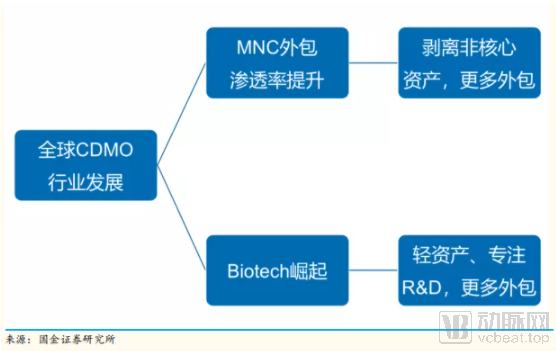
Image source: Guojin Securities report
CDMO is the abbreviation for Contract Development and Manufacturing Organization, known in Chinese as a pharmaceutical contract custom R&D and manufacturing enterprise. It is positioned as an institution that provides customized R&D and manufacturing services to pharmaceutical and biotechnology companies, particularly in the areas of process development and preparation, process optimization, scale-up production, registration and validation batch production, and commercial production of pharmaceuticals, especially innovative drugs.
CMO stands for Contract Manufacturing Organization in the pharmaceutical industry. Compared with CDMOs, CMOs lack the "Development" component, meaning they do not engage in R&D enhancement. In other words, CMO companies generally do not involve independent technological innovation; instead, they rely on the manufacturing processes and technical support developed by pharmaceutical companies, utilizing their own production facilities to implement these processes and provide scaled-up production services to clients.
Meanwhile, CDMOs provide customized manufacturing services ranging from kilogram to ton scale, while conducting trials to confirm chemical structures or components, as well as quality research and process development and optimization. They offer pharmaceutical companies innovative process R&D and scaled-up production services, replacing mere capacity output with high-value-added technical expertise, thereby driving the upgrade of the pharmaceutical CMO industry from capital-intensive to a hybrid model intensive in both technology and capital. Currently, CDMO enterprises are rapidly replacing traditional CMOs.
From a segmented perspective, the CDMO industry can be divided into small-molecule drug (chemical drug) CDMOs and large-molecule drug (biologic drug) CDMOs. Small-molecule CDMOs focus on R&D and manufacturing services for chemical drugs, intermediates, and active pharmaceutical ingredients (APIs), while large-molecule CDMOs are primarily responsible for the production and R&D of raw materials, protein and antibody preparation, stable cell line and process development, and biologics.
Currently, the CDMO industry is still dominated by small-molecule CDMO companies, but the large-molecule CDMO sector is experiencing strong growth momentum.
Globally, the CDMO market reached $92 billion in 2019, with small-molecule CDMOs accounting for approximately 80% and large-molecule CDMOs for about 20%. Despite its smaller size, the large-molecule CDMO sector is growing at a significantly faster rate than the small-molecule segment, with growth rates of 27.45% and 12%, respectively.
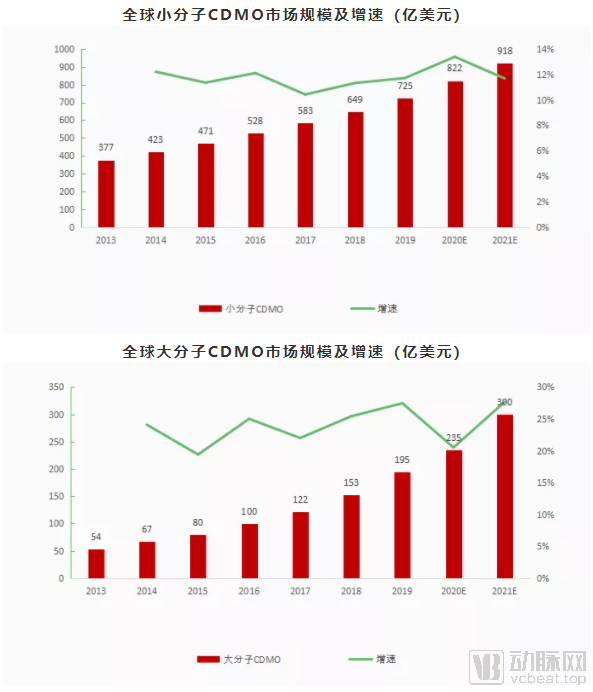
Data Source: China Industry Information Network
Focusing on the domestic market, in 2019, China's small-molecule CDMO market reached RMB 43.7 billion, with a growth rate of 18%; while the large-molecule CDMO sector was still in its nascent stage, with a market size of only RMB 7.6 billion and a growth rate exceeding 40%.
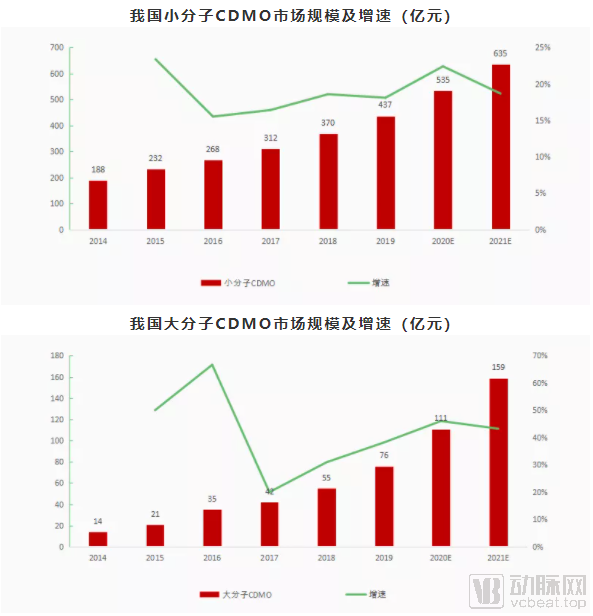
Data Source: Frost & Sullivan
The development of the large-molecule CDMO industry is gaining momentum, closely tied to the complexities of large-molecule drug manufacturing and the booming landscape of large-molecule drug R&D.
On one hand, due to their higher molecular weight and more complex structures, macromolecular drugs are more difficult to produce and prepare than small-molecule drugs. Minor variations in any stage—including the construction of high-efficiency expression cell lines and bacterial strains, large-scale cultivation and purification processes, storage, and packaging—can significantly affect the quality, purity, biological properties, and clinical efficacy of macromolecular drugs, thereby posing greater challenges to their manufacturing.
On the other hand, in recent years, a global surge in the research and development of large-molecule drugs has emerged, with rapid advancements in antibody-drug conjugates (ADCs), bispecific antibodies, and CAR-T therapies. According to Frost & Sullivan’s projections, the global market for large-molecule drugs will reach $326 billion in 2022, with biologics accounting for eight of the top ten best-selling drugs worldwide.
Benefiting from the sustained boom in pharmaceutical R&D and cost advantages, China’s CDMO industry is poised for exceptionally high prosperity in the future. According to publicly available data, the market size of China’s CDMO industry is projected to reach RMB 104.88 billion by 2024, with a compound annual growth rate (CAGR) of 26.5% from 2019 to 2024.
Chart of the High-Prosperity Logic of China's CDMO Industry
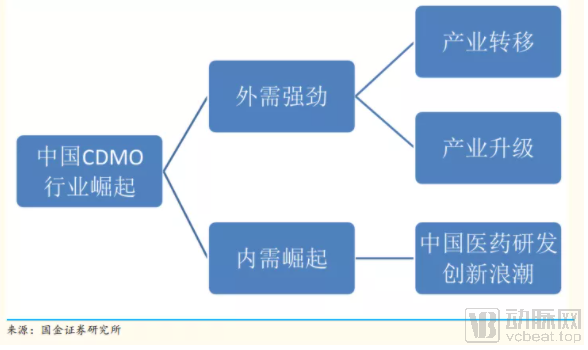
Image source: Guojin Securities report
On the one hand, the wave of domestic innovation is driving the expansion of the outsourced services market. Small and medium-sized pharmaceutical enterprises are currently the main force in drug research and development; however, due to a general lack of production facilities and equipment, these companies have a strong willingness to collaborate with CDMOs.
On the other hand, China’s CDMO sector boasts significant cost advantages, and the global shift of pharmaceutical CDMO activities to China is highly pronounced. In its 2020 semi-annual report, Asymchem stated that in the first half of 2020, the proportion of innovative drug projects it served for the top five U.S. pharmaceutical companies, relative to the late-stage clinical development pipelines disclosed by these companies, further increased to 27%.
From a corporate perspective, China’s small-molecule CDMO companies include Pharmaron, Asymchem, and Porton Pharma Solutions; in the large-molecule CDMO sector, WuXi Biologics dominates with a market share approaching 80%.
Small Molecule CDMO
Pharmaron:On March 28, Pharmaron released its 2020 annual report. In 2020, the company achieved operating revenue of RMB 5.134 billion, a year-on-year increase of 36.64%; and realized net profit attributable to shareholders after deducting non-recurring gains and losses of RMB 801 million, a year-on-year increase of 58.51%. Among these, the CMC (small-molecule CDMO) segment generated revenue of RMB 1.222 billion, representing a year-on-year growth of 35.54%. The significant growth was primarily driven by continuous increases in business volume and ongoing expansion of production capacity. In terms of capacity, the Shaoxing facility, covering an area of 81,000 square meters, is currently under full-speed construction. Upon completion, the project is expected to add 600 cubic meters of chemical reactor capacity.
Asymchem:As a one-stop CDMO service provider dedicated to new drug R&D and manufacturing, Asymchem masters core technologies such as continuous flow chemistry and biocatalysis. In recent years, the company has continuously strengthened its stickiness in collaborations with international large pharmaceutical companies; from the first half of 2018 to the first half of 2020, the compound annual growth rate (CAGR) of revenue derived from drugs belonging to overseas large pharmaceutical companies reached 24.51%. Regarding cooperation with domestic pharmaceutical enterprises, the commercial manufacturing of Zai Lab’s niraparib is progressing smoothly, with domestic order volumes continuing to rise.
Asymchem Project Pipeline (Count)
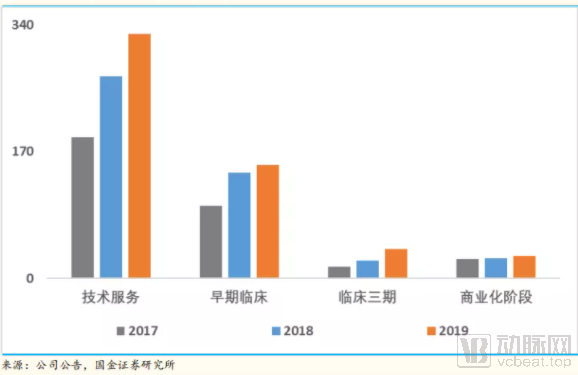
Image source: Guojin Securities report
Porton Pharma Solutions Ltd.:On March 13, Porton Pharma Solutions released its 2020 annual report. In 2020, the company achieved operating revenue of RMB 2.072 billion, a year-on-year increase of 33.56%; and net profit of RMB 324 million, a year-on-year increase of 74.84%. In 2020, the company’s CDMO business generated revenue of RMB 1.449 billion, accounting for 70% of total revenue. Sales growth was driven by the rapid development of the CDMO industry, increased demand for commercialized products, and the addition of new late-stage clinical projects.
Macromolecule CDMO
WuXi Biologics:WuXi Biologics is the undisputed leader in China’s large-molecule CDMO sector, commanding a domestic market share of over 80%. In the global market, WuXi Biologics competes on par with leading international players. In 2019, its global market share reached 5.1%, ranking just behind Lonza, Boehringer Ingelheim Biologics, and Samsung Biologics. In March, WuXi Biologics released its 2020 annual report, showing that the company achieved operating revenue of RMB 5.612 billion in 2020, a year-on-year increase of 41%; net profit amounted to RMB 1.692 billion, representing a year-on-year growth of 67.54%. The company’s performance in 2020 was remarkable. According to the annual report, the total number of comprehensive projects increased by 103 to reach 334, while late-stage clinical projects rose from 16 to 28. The number of WuXiBody and ADC projects grew to 29 and 40, respectively. The vaccine CDMO business secured four agreements in total, establishing a full-industry-chain technology platform for mRNA vaccines. With continuously strengthening customer stickiness, WuXi Biologics is leading the industry’s development trend.