

NVIDIA and Schrödinger Partner to Accelerate AI-Powered Drug Discovery at Supercomputing Scale
NVIDIA
Artificial Intelligence Computing Service Provider
On April 12, 2021, VCBeat (WeChat ID: Vcbeat) learned that NVIDIA announced a strategic partnership with Schrödinger, a company specializing in computational drug discovery platforms. This collaboration will leverage NVIDIA DGX A100 systems to further enhance the speed and accuracy of Schrödinger’s computational drug discovery platform, enabling rapid and precise evaluation of billions of molecules and accelerating the development of new therapies.
The two companies will optimize Schrödinger’s software platform for the NVIDIA DGX SuperPOD, which is built using NVIDIA DGX A100 systems and NVIDIA InfiniBand HDR networking. The platform is specifically designed for modeling and predicting the properties of novel molecules.
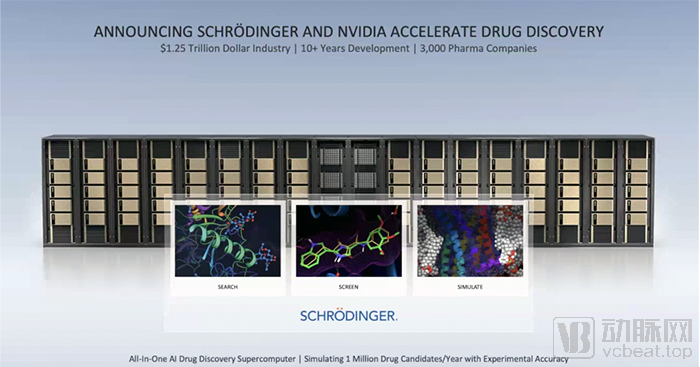
NVIDIA’s Partnership with Schrödinger Will Transform the Pharmaceutical Industry (Image from Video Screenshot)
This work encompasses physics-based modeling within the Schrödinger product suite, as well as support for NVIDIA Clara Discovery. NVIDIA Clara Discovery is a collection of high-performance AI frameworks, applications, and pre-trained models designed for advanced computational drug discovery and development. Furthermore, the two companies will collaborate on scientific breakthroughs to further advance the development of physics-based computations and machine learning required for drug discovery.
For each candidate drug, Schrödinger routinely evaluates tens of thousands of molecules using the most computationally intensive physics-based methods. Even with GPUs on high-performance computers, these tasks require hundreds of thousands of hours to complete.
Through this collaboration, the entire pharmaceutical industry—comprising more than 3,000 companies ranging from startups to multinational corporations—will be able to leverage supercomputing scale to further accelerate drug discovery and development. This partnership enables both large pharmaceutical companies and biotechnology startups to access Schrödinger’s computational drug discovery platform, empowering organizations of all sizes to apply physics-based and AI-driven simulations of molecular combinations to identify and optimize the most promising therapeutic compounds.
Pharmaceutical companies can conduct this research using the Schrödinger platform running on NVIDIA DGX SuperPOD, deployed on an easy-to-deploy private cloud. This joint solution, which can be installed on-premises or in colocation facilities, leverages NVIDIA DGX SuperPOD and the NVIDIA Clara Discovery software library to significantly enhance the platform’s performance.
Patrick Lorton, Chief Technology Officer at Schrödinger, stated, “The predictive modeling capabilities built into the Schrödinger platform will significantly expand and accelerate the search for high-quality therapeutic molecules, with NVIDIA serving as a key technology partner in this effort. Compared to traditional methods, Schrödinger’s advanced computational software enables global large pharmaceutical companies to explore a broader range of chemical compositions and identify high-quality drug candidates more rapidly at substantially lower computational costs. We are honored to collaborate with NVIDIA to streamline this process.”
NVIDIA’s research and engineering teams are working to advance and optimize the Schrödinger suite, enabling it to leverage the NVIDIA Ampere architecture and its Multi-Instance GPU (MIG) technology. Customers can easily deploy the Schrödinger software on a single DGX system or on clusters comprising more than 20 DGX systems to create a DGX SuperPOD, thereby scaling the Schrödinger platform to support dozens of drug discovery projects and screen and evaluate billions of molecules per week.
Kimberly Powell, Vice President of Healthcare at NVIDIA, stated, “Schrödinger’s advanced combination of simulation and machine learning technologies will continue to enhance the accuracy of computational drug discovery. Together, NVIDIA and Schrödinger are providing the pharmaceutical industry with scientific tools that feature ultra-high-throughput capabilities for screening potential drugs, thereby facilitating and accelerating the successful development of candidate therapeutics.”