

Adagio Medical Secures $42.5M Series E Financing to Disrupt Cryoablation Market with Proprietary iCLAS Catheter Platform

Adagio Medical
Cardiovascular Disease Treatment Device Developer
As early as October 1, 2018, Adagio Medical announced that its new One Shot+ cryoablation catheter had successfully treated the first batch of patients with atrial fibrillation. Shortly thereafter, according to GlobalData, Medtronic’s dominance in the cryoablation market was being threatened by other smaller companies, with Adagio Medical emerging as one of the disruptors.
In November 2020, Adagio Medical announced the completion of a $42.5 million Series E equity financing.
How did Adagio Medical challenge Medtronic’s dominance and secure a $42.5 million Series E financing round? The answer lies in Adagio Medical’s iCLAS, the Continuous Lesion Ablation System.
Adagio Medical is a private medical device company based in Laguna Hills, California. The company is developing a cryoablation technology that treats arrhythmias—including paroxysmal and persistent atrial fibrillation, atrial flutter, and ventricular tachycardia—by creating continuous transmural lesions.
Adagio Medical was founded in 2011 by Dr. James Cox and Mr. Olav Bergheim. Their initial vision for establishing the company was to provide a suite of tools that could assist electrophysiologists in performing continuous, transmural endocardial lesions anywhere within the heart. In addition to not being restricted by cardiac location, endocardial ablation using this toolset does not impede blood flow; however, it must be performed on a continuously beating heart.
To understand Adagio Medical in a single sentence: the company is dedicated to developing a cryoablation technology platform that provides electrophysiologists with a tool to treat arrhythmias anywhere in the heart by delivering safe, continuous transmural lesions without restricting blood flow. This technology, known as iCLAS (Continuous Lesion Ablation System), is Adagio Medical’s core asset.
In addition to completing a $7 million equity financing round on March 13, 2019, Adagio Medical announced on November 12, 2020, the completion of a $42.5 million Series E equity financing. The proceeds will be used to support the ongoing Investigational Device Exemption (IDE) trial for iCLAS, accelerate CE marking, drive the commercialization of the iCLAS system, and continue the development and clinical validation of Adagio’s Pulsed Field Cryoablation (PFCA) technology. This milestone further demonstrates Adagio Medical’s promising prospects in the cryoablation market.
Adagio Medical’s iCLAS incorporates two proprietary technologies: its platform technology and Near-Critical Nitrogen (NCN) technology. Adagio Medical has developed a novel platform technology that enables the manufacturing of ultra-low temperature cryoablation catheters with a diameter of less than 2 millimeters. These catheters allow electrophysiologists to create continuous, transmural endocardial lesions anywhere in the heart while maintaining blood flow.
The term “cryoablation” in the ultra-low temperature cryoablation catheter highlights the advantage of this technology: it enables therapeutic endocardial catheter-based cryotherapy on any tissue, eliminating the need for traditional open-chest surgery with large-diameter cryoprobes.
Near-critical nitrogen (NCN) cryoablation is a technology that Dr. Alex Babkin, Chief Technology Officer of Adagio Medical, has been developing since 2004. Cryoablation works by creating continuous lesions; however, the formation of such lesions requires a practical energy source, which currently is exclusively liquid nitrogen.
Liquid nitrogen is currently the most powerful cryogen used in medical devices; however, its volume expands approximately 200-fold when transitioning from liquid to gas. Due to this drawback, liquid nitrogen cannot be employed as an endocardial cryogen. Adagio Medical’s Near-Critical Nitrogen (NCN) cryoablation technology provides a solution to address the issue of liquid nitrogen’s volumetric expansion, thereby enabling its use for endocardial applications. Furthermore, while resolving the expansion problem, NCN ensures the energy source required to create continuous lesions.
An ideal refrigerant must meet four criteria: no volume change during phase transition, liquid density, gaseous viscosity, and high-temperature capability. NCN possesses these attributes.
Meanwhile, these characteristics of NCN can lead to several favorable outcomes: low temperatures enable rapid lesion formation; continuous energy delivery produces uniform, contiguous lesions; high cooling capacity supports scalable technology; the absence of vapor lock ensures reliable start-up and shutdown; and low viscosity allows for smaller catheter sizes.
Collectively, these unique features of NCN enable the creation of long, continuous, fully transmural lesions anywhere in the heart, achievable via a transendocardial approach using small catheters (≤9 Fr).
In addition, we can gain insight into some of the innovations of NCN by making certain comparisons. Cryoablation is a novel technology for treating arrhythmias, developed after radiofrequency ablation. Compared with heat-based ablation techniques, cryoablation offers several clinical safety benefits, such as visualization of the treatment zone or ice ball, minimization of discomfort in most outpatient procedures, acceleration of tissue healing, and reduction of unnecessary ablation.
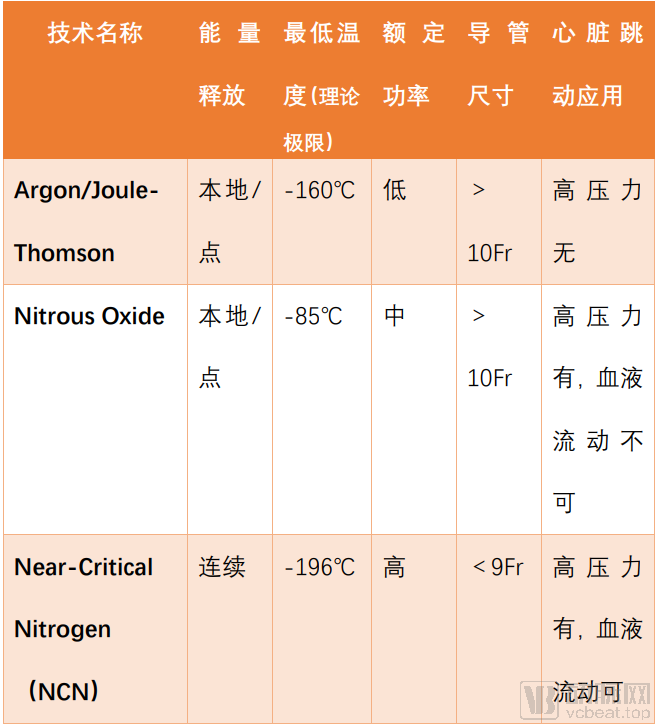
The above outlines the advantages of cryoablation technology over traditional radiofrequency ablation. Among comparable cryoablation technologies, Adagio Medical’s NCN offers distinct advantages over other current cryoablation solutions. The following table presents the benefits of NCN relative to other cryoablation technologies.
Based on the aforementioned technology, Adagio Medical has introduced three products: first, a catheter for atrial fibrillation and atrial flutter, which features high cooling capacity and ultra-low temperature cryoablation, enabling the creation of prolonged, continuous transmural lesions in endocardial applications.
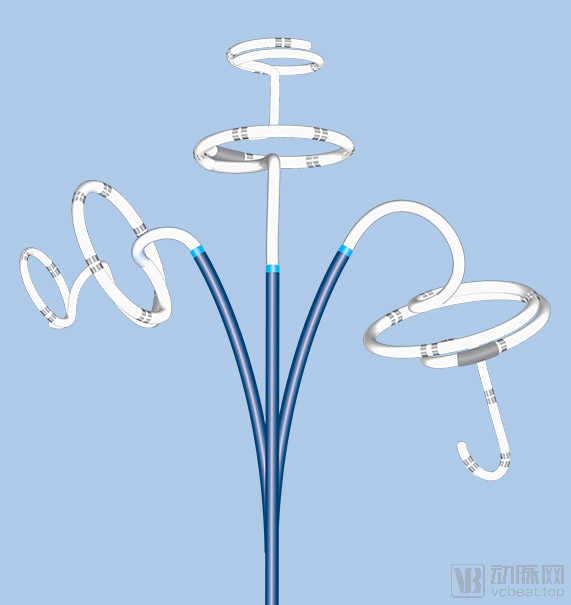
Catheter
Next is the esophageal balloon, which functions to maintain esophageal temperature by continuously circulating warm saline through a compliant intra-esophageal balloon.
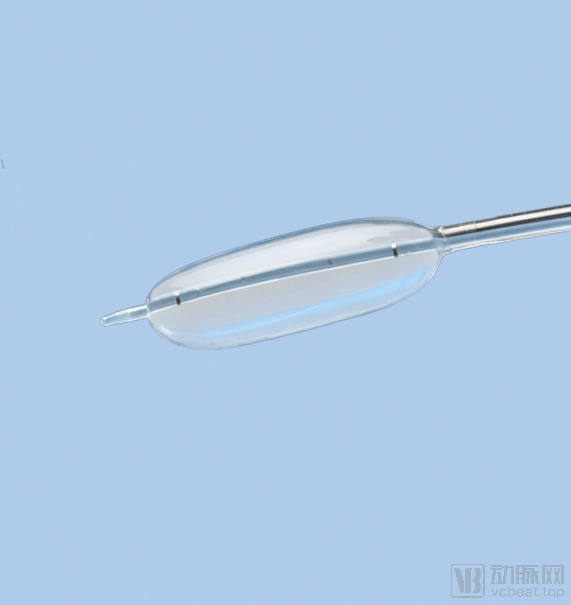
Esophageal Balloon
Finally, the console: The iCLAS (Continuous Lesion Ablation System) is powered by a cryoablation console and can be used with all FlexCath catheters for the treatment of atrial fibrillation, atrial flutter, and ventricular tachycardia.
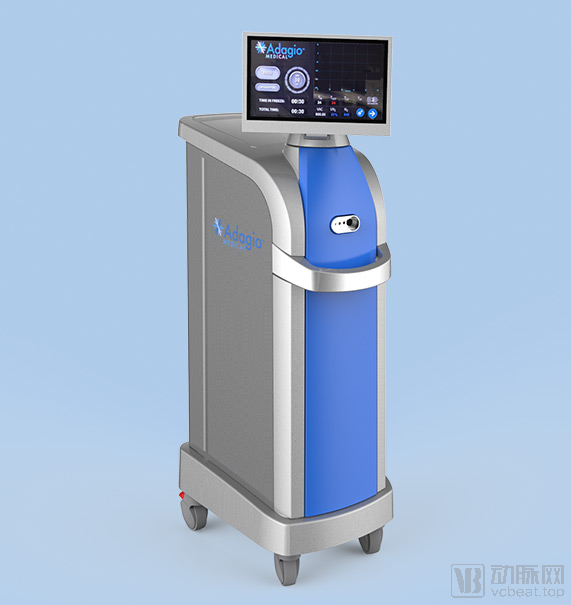
Console
On August 19, 2019, Adagio Medical announced that it had received an Investigational Device Exemption (IDE) from the U.S. FDA to conduct a conditional clinical study using its ultra-low temperature cryoablation system for the treatment of persistent atrial fibrillation. The study will utilize Adagio Medical’s cryoablation console and the One Shot+ Cryoablation Catheter, each uniquely designed to effectively create continuous, transmural linear and focal lesions in both the left and right atria.
Patients will undergo ablation using one of two catheters, followed by a 12-month follow-up to monitor for arrhythmia recurrence. Previously, in a similar clinical study conducted in Europe, patients with persistent atrial fibrillation achieved a 90% efficacy rate at one year post-treatment, as measured by standard atrial fibrillation ablation endpoints.
The Entrepreneurial Journey of Combining Management and Technical Talent
Olav Bergheim, CEO and President of Adagio Medical. He has extensive experience in the healthcare industry and management, having served as President of Global Immunotherapy, President of European Biotechnology, President of Baxter Germany, and General Manager for the Nordic region.
He subsequently served for 18 years as Group Vice President and President of the Baxter Cardiovascular Group (now Edwards Lifesciences) at Baxter Healthcare Corporation. In 1995, he became a General Partner at Domain Associates, where he established new life sciences companies and implemented an actively managed charter for these ventures.
During his tenure at Domain, Mr. Bergheim pioneered the company creation program, which led to the establishment of multiple companies, including Chimeric Therapies, VenPro, 3F Therapeutics, Orqis Medical, and Vessix Vascular, followed by the founding of Adagio Medical.

CEO Olav Bergheim
Adagio Medical’s Chief Technology Officer, Dr. Alex Babkin (PhD). His core contribution lies in providing a technical solution to address the issue that liquid nitrogen cannot be used as an endocardial cryogen due to its volumetric expansion. This technology is the near-critical nitrogen (NCN) cryoablation technology that Dr. Alex Babkin has been developing since 2004. NCN resolves the volumetric expansion problem of liquid nitrogen while ensuring the energy source required to create continuous lesions.
Dr. Babkin is an internationally renowned cryophysicist and engineer who joined Adagio Medical as Chief Technology Officer in 2012. Prior to this, he served as General Manager at Cryodynamics, a company based in Albuquerque, New Mexico, specializing in the development of cryoablation technologies.
Prior to this, Dr. Babkin was a Research Professor at the University of New Mexico, working on NASA’s “Fundamental Space Biology” flight program.
Dr. Babkin has published more than 50 articles in leading peer-reviewed journals, authored multiple books, and held numerous patents. These accomplishments underscore Dr. Babkin’s expertise and strong capabilities in the field of cryotechnology, providing robust technical support to Adagio Medical.

Chief Technology Officer Alex Babkin
Regarding the application of cryoablation surgery in China, it is reported that on September 12, 2012, China performed its first cryoablation procedure for atrial fibrillation. A novel technique known as “cryoballoon catheter ablation therapy” was successfully applied for the first time at Fuwai Hospital, National Center for Cardiovascular Diseases. Two patients with atrial fibrillation underwent the cryoablation procedure, which proceeded smoothly. This pioneering practice has also ushered in broad prospects for the clinical application of cryoablation in China.