

Bolik Medical's Coronary CT-QFR Receives CE Mark; Four Innovative Products in Pan-Vascular Precision Diagnosis Portfolio Fully Launched
On April 9, 2021, Pulse Medical Imaging Technology (Shanghai) Co., Ltd. (hereinafter referred to as “Pulse Medical”) independently developed an innovative product for non-invasive functional precision screening of coronary CTA—CT-QFR®Having obtained EU CE certification and officially launched in the European market, the world’s first non-invasive FFR system based on intravascular ultrasound (IVUS)—UFR—also received EU CE certification during the same period. Pulse Medical is strategically expanding its interventional precision diagnostics product portfolio, with all four of its coronary functional diagnostics product lines now approved for market entry, thereby consolidating its leading position in the field of pan-vascular interventional precision diagnostics. Currently, Pulse Medical has two products that have obtained Class III registration certificates from China’s NMPA, four products with EU CE certification, and one product with US FDA clearance.
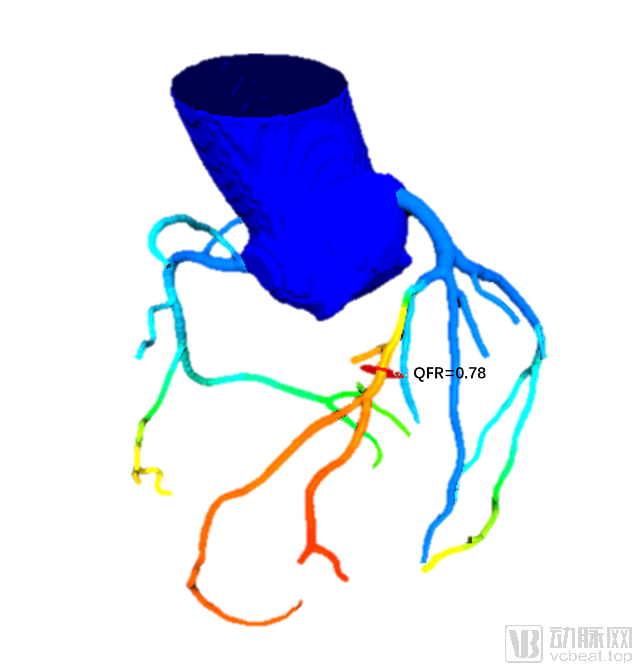
Figure: Rapid Non-invasive FFR Assessment Based on Coronary CTA
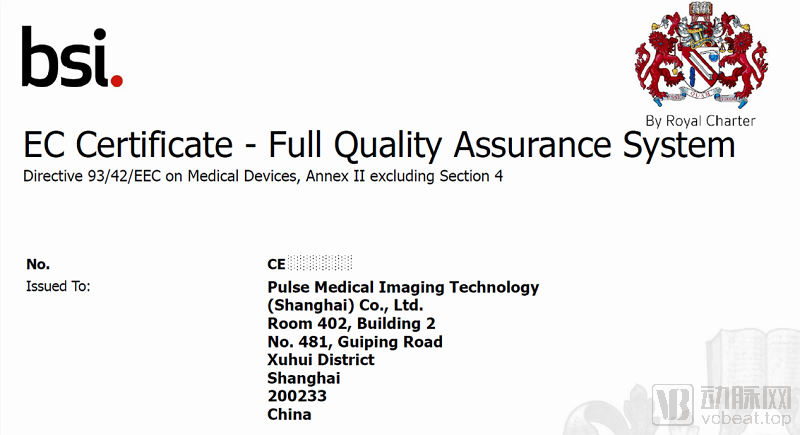
Figure: CE Certificate
Coronary computed tomography angiography (CCTA) is a commonly used non-invasive imaging modality for the initial diagnosis and screening of coronary artery disease (CAD). However, its diagnostic accuracy remains below 70% due to factors such as limited image resolution, multiple artifacts including calcification, and low levels of analytical automation. Consequently, CCTA is not highly effective for CAD screening, leading to relatively limited adoption in China. In recent years, with the publication of extensive clinical validation studies, imaging-based fractional flow reserve (FFR) methods derived from CCTA—such as FFRCT and CT-QFR—have been proven to significantly enhance the diagnostic accuracy of CCTA. These technologies are now widely used for preoperative diagnosis of CAD in the United States, Europe, and Japan. Notably, FFRCT examinations are reimbursable under U.S. Medicare at approximately $1,450 per test, and HeartFlow has achieved substantial revenue, underscoring the significant market potential of this technology.
BoDong Medical’s CT-QFR is characterized by its rapid speed and high accuracy. First, image reconstruction is fast, with intelligent, fully automated coronary tree reconstruction completed in just 1–2 minutes, significantly improving analysis efficiency. Second, the analysis is swift; once reconstruction is complete, fully automated CT-QFR analysis is achieved in only 5 seconds. Third, diagnostic accuracy is high: using fractional flow reserve (FFR), the “gold standard” for functional assessment of coronary artery disease recommended by domestic and international guidelines, as the reference, CT-QFR achieves a diagnostic accuracy of up to 87%. Furthermore, CT-QFR features the world’s only intelligent calcium artifact recognition technology, which substantially reduces the impact of hardening artifacts from calcified plaques on lumen segmentation, offering high diagnostic precision and reproducibility, and effectively enhancing diagnostic accuracy for complex lesions. This system is primarily suitable for health screening in large populations. Serving as a “gatekeeper” for the catheterization laboratory, its high specificity helps clinicians more effectively screen positive patients for further invasive coronary angiography, thereby avoiding unnecessary procedures to some extent. It can also be used for pre-procedural planning prior to percutaneous coronary intervention (PCI). CT-QFR is poised to become a common tool for precise screening of coronary artery disease, while reducing patient costs.
In addition to completing regulatory registration, product development requires extensive clinical validation and patient outcome studies to demonstrate patient benefits, thereby promoting physician awareness, acceptance, and clinical adoption.
In 2019, a study jointly conducted by Beijing Anzhen Hospital and Shanghai Sixth People’s Hospital was published in JACC: Cardiovascular Interventions, a top-tier international journal in coronary intervention (Impact Factor = 12). The study demonstrated that, using invasive pressure wire-derived FFR as the reference standard, the diagnostic accuracy of Pulse Medical’s CT-QFR product reached 87%, significantly higher than that of anatomical CTA alone. To date, this remains the highest-level clinical evidence for CTA-FFR validation published in China.
Recently, an international multicenter clinical study led by Johns Hopkins Hospital in the United States demonstrated that CT-QFR can be used to assess the long-term probabilities of all-cause mortality, myocardial infarction, and repeat revascularization, thereby confirming that Pulsenmore’s CT-QFR effectively predicts long-term prognosis in patients with coronary artery disease. The manuscript is currently under submission and will be published soon. Pulsenmore’s CT-QFR is the first CT image-based computational FFR product in China supported by clinical evidence for prognostic outcomes.
In a review article titled “Impact of Coronary Physiological Assessment on Clinical Decision-Making,” co-authored by Professor Patrick Serruys of Imperial College London, a renowned international expert in precise diagnostic technologies for percutaneous coronary intervention, together with several other distinguished international experts, and published in the top-tier journal JACC: Cardiovascular Interventions in 2020, the major image-based wire-free FFR technologies worldwide were summarized. Among the products included in the international expert comparison list, in addition to HeartFlow (USA), Toshiba (Japan), and Siemens (Germany), PulsiMed’s CT-QFR was the only Chinese-originated product to gain recognition from international experts. Furthermore, as shown in the comparative figures, PulsiMed’s CT-QFR technology demonstrated the highest diagnostic accuracy, with superior accuracy, sensitivity, and specificity compared to other mainstream products.
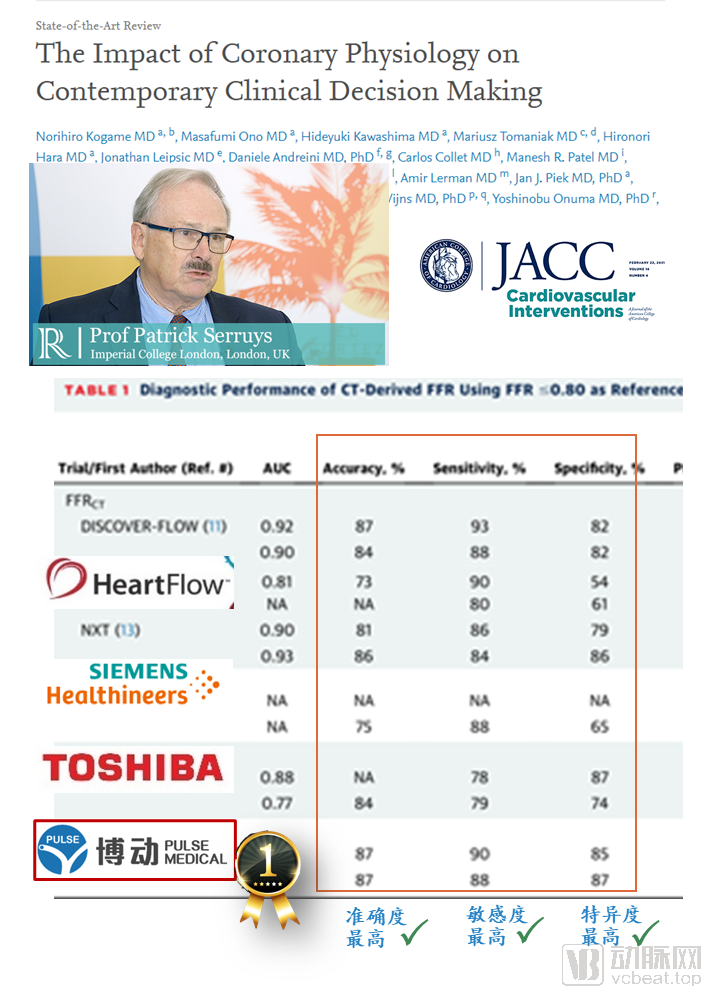
Over the past five years, the company has completed two domestic and international multicenter clinical validations and one international multicenter patient prognosis study. In 2019, it entered the Innovative Medical Device Special Examination Program of China’s National Medical Products Administration (NMPA). Backed by robust clinical evidence and international recognition, Pulse Medical’s CT-QFR product has gained widespread industry acclaim and is poised to rapidly penetrate the market for coronary artery disease screening and diagnosis upon commercial launch. With a foothold in China, the company is leveraging solid clinical evidence to prepare for the global expansion of its homegrown technology.
Intravascular imaging modalities, such as intravascular ultrasound (IVUS), can clearly visualize the intricate structures within coronary arteries with lesions and assess the condition of the vessel wall and plaque vulnerability. They hold significant clinical value, particularly for the diagnosis and risk stratification of complex lesions. However, due to the steep learning curve associated with IVUS image interpretation and its inability to provide functional assessment, its adoption in lower-tier markets remains challenging. The combination of intravascular imaging and functional assessment currently represents the gold standard for percutaneous coronary intervention (PCI) planning. Nevertheless, existing clinical approaches typically require two separate sets of equipment and consumables, substantially increasing costs and procedural complexity, which makes widespread clinical implementation difficult.
Bodong Medical’s independently developed UFR, an innovative technology combining IVUS with functional assessment, is expected to enhance the market penetration of IVUS consumables and provide clinicians with more options for coronary functional testing.
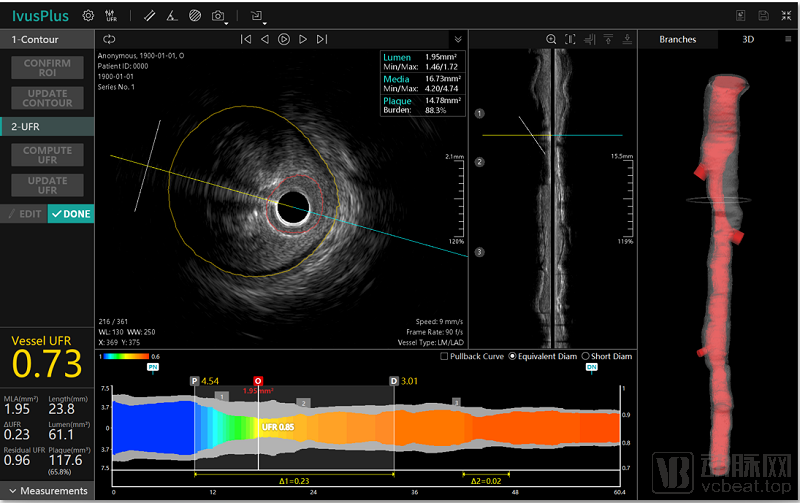
Figure: UFR system interface, featuring IVUS-based intelligent fully automated segmentation, quantification, and FFR calculation
The UFR (Ultrasound Flow Ratio) system, developed by Bodong Medical, is based on fully automated intelligent 3D reconstruction from IVUS and computational FFR technology. It is the world’s first and only commercially available wire-free FFR calculation system for coronary functional assessment and PCI procedural planning based on IVUS. With just two steps completed within one minute, the system enables simultaneous acquisition of precise intracoronary imaging and computational functional parameters from a single “IVUS pullback.” Furthermore, it facilitates the selection of optimal stent sizing and interventional treatment strategies through lesion morphological analysis and virtual stenting techniques. By achieving rapid, synchronized, and accurate assessments of both anatomical structure and physiological function, the system significantly reduces procedural complexity and lowers healthcare costs for patients.
The UFR system can serve as a complement to the functional assessment method based on coronary angiography (QFR product), applied in complex coronary intervention diagnosis and surgery, expanding the application scenarios of coronary functional assessment to meet broader actual clinical needs.
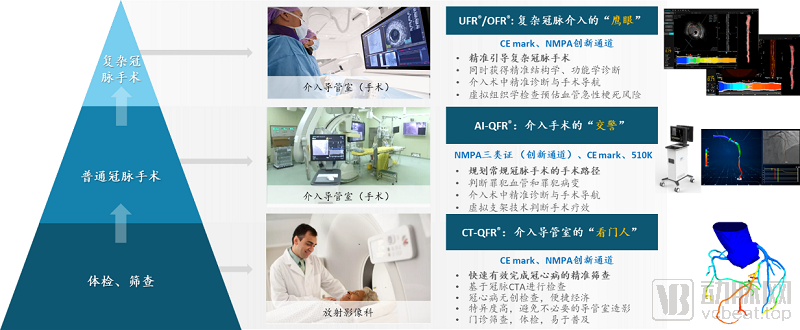
Figure: Product Line Layout for Precision Diagnosis in Pan-Vascular Intervention by BoDong Medical
Pulse Medical is dedicated to independent innovation in the field of precision diagnostic devices for pan-vascular interventions. In the realm of coronary intervention, its marketed products include non-invasive CT-QFR solutions (CTA-based FFR calculation) for outpatient and health screening; QFR/AI-QFR solutions (DSA-based computational FFR and PCI navigation) for intra-procedural coronary diagnosis and PCI navigation; OFR (OCT-based computational FFR and surgical planning) and UFR (IVUS-based computational FFR and surgical planning) for the diagnosis and navigation of complex coronary interventions. Related consumables and devices are currently under development and will be launched sequentially. Furthermore, Pulse Medical is gradually expanding into neuro-intervention, peripheral intervention, electrophysiology, and other fields, striving to cover the entire industrial chain of precision diagnostics for pan-vascular interventions.