

Nature Predicts Global ADC Market to Exceed $16.4 Billion by 2026 Amid Surge in Approved Therapies and Clinical Pipeline Expansion
Apr 15, 2021 14:48
CST Updated
14:48
This article was first published on PharmaCube Pro, authored by Shi Bei, and republished with authorization by VCBeat.
In recent years, antibody-drug conjugates (ADCs) have emerged as a prominent force in the field of oncology. To date, 11 ADC drugs have received regulatory approval for marketing worldwide, with six of them approved since 2019. Most ADCs consist of a monoclonal antibody (mAb) targeting specific tumor-associated antigens and a cytotoxic drug conjugated to the antibody. By combining the targeted delivery advantages of monoclonal antibodies with the tumor-killing effects of potent cytotoxic payloads, ADCs overcome the limitations of conventional cytotoxic drugs, which are often too toxic for systemic administration.
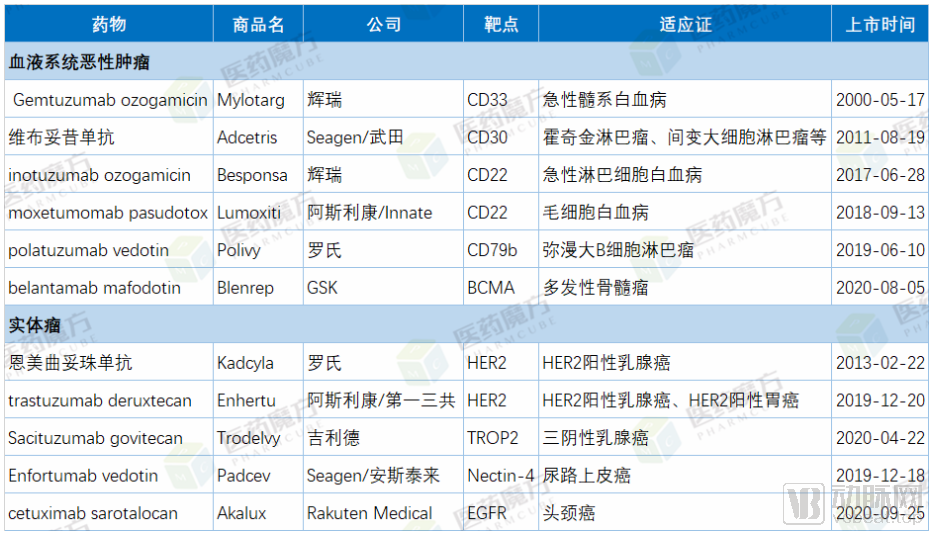
Gemtuzumab ozogamicin (brand name: Mylotarg), developed by Pfizer, is an anti-CD33 monoclonal antibody–calicheamicin conjugate. It received accelerated approval in 2000 for the treatment of relapsed CD33-positive acute myeloid leukemia (AML), becoming the first antibody-drug conjugate (ADC) approved in oncology. The drug was withdrawn from the market in 2010 due to toxicity and lack of efficacy observed in a Phase III clinical trial. In 2017, the FDA re-approved it at a lower, fractionated dosing regimen, and it has since also been approved in Europe and Japan. Brentuximab vedotin (brand name: Adcetris), developed by Seagen/Takeda, is an anti-CD30 monoclonal antibody–monomethyl auristatin E (MMAE) conjugate.
It has been approved in the United States, Europe, and Japan for the treatment of Hodgkin lymphoma and anaplastic large cell lymphoma. Two additional CD22-targeting antibody-drug conjugates (ADCs) have been approved: Pfizer’s inotuzumab ozogamicin (brand name: Besponsa) and moxetumomab pasudotox (brand name: Lumoxiti), jointly developed by AstraZeneca and Innate Pharma. Besponsa is approved for the treatment of relapsed/refractory (R/R) acute lymphoblastic leukemia, while Lumoxiti is approved for the treatment of R/R hairy cell leukemia. Over the past two years, two ADCs targeting novel antigens have been approved: Roche’s polatuzumab vedotin (brand name: Polivy) and GlaxoSmithKline’s belantamab mafodotin (brand name: Blenrep). Polivy delivers the cytotoxic agent MMAE specifically to CD79b-expressing B cells and is indicated for the treatment of R/R diffuse large B-cell lymphoma (DLBCL). Blenrep targets BCMA (also known as TNFRSF17) and is indicated for the treatment of R/R multiple myeloma.
Trastuzumab emtansine (brand name: Kadcyla), developed by Roche, is the first antibody-drug conjugate (ADC) approved for the treatment of solid tumors, specifically indicated for early metastatic HER2-positive breast cancer. The second HER2-targeted ADC is trastuzumab deruxtecan (Enhertu), jointly developed by AstraZeneca and Daiichi Sankyo, which is indicated for patients with previously treated metastatic HER2-positive breast cancer. Kadcyla and Enhertu differ in their cytotoxic payloads (a microtubule inhibitor and a topoisomerase I inhibitor, respectively). Enhertu has also been approved for patients with previously treated metastatic HER2-positive gastric cancer. Sacituzumab govitecan (brand name: Trodelvy), developed by Gilead Sciences, is an anti-TROP2 monoclonal antibody–SN-38 conjugate approved for patients with previously treated metastatic triple-negative breast cancer; SN-38 is the active metabolite of irinotecan.
Enfortumab vedotin (brand name: Padcev), jointly developed by Seagen and Astellas, is an antibody-drug conjugate (ADC) comprising a monoclonal antibody targeting Nectin-4 linked to monomethyl auristatin E (MMAE). It is also the first ADC to enter the market for urothelial carcinoma. The most recently approved ADC is cetuximab sarotalocan (brand name: Akalux), developed by Rakuten Medical. Akalux consists of a monoclonal antibody targeting the epidermal growth factor receptor (EGFR) conjugated to a photosensitizing dye that induces tumor cell death upon light activation. This drug received conditional approval in Japan in September 2020 for the treatment of head and neck cancer.
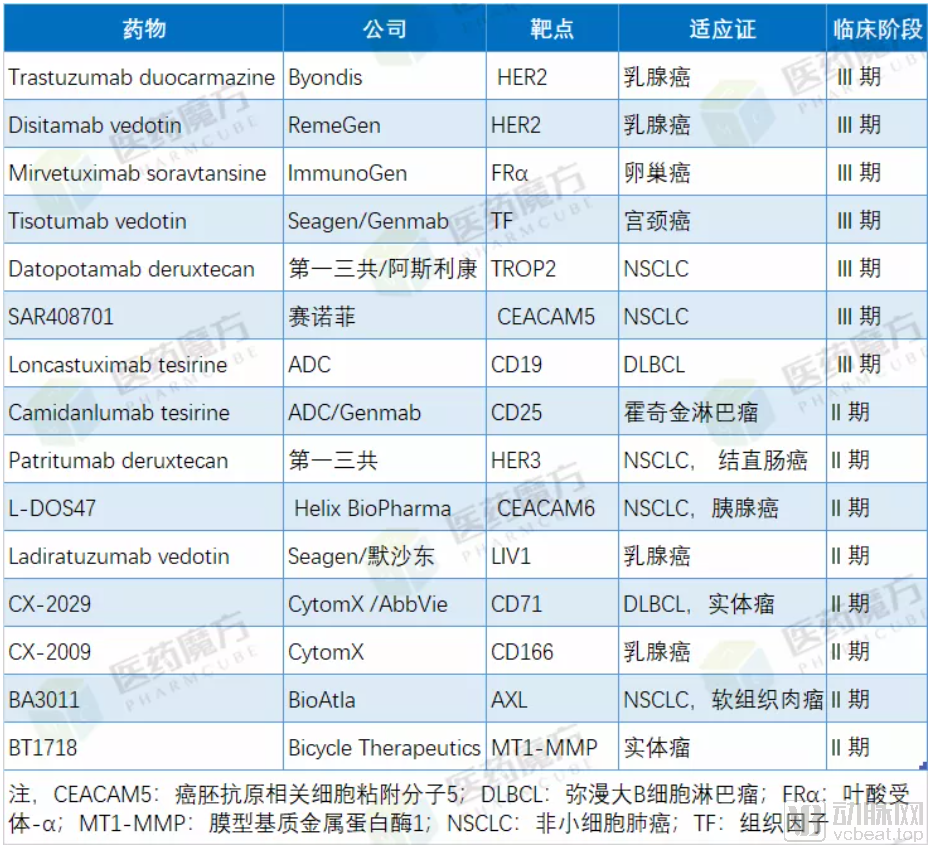
Trastuzumab duocarmazine, an HER2-targeting antibody-drug conjugate (ADC) developed by Byondis, is currently undergoing Phase III clinical trials for the treatment of HER2-positive metastatic breast cancer. In January 2018, the U.S. Food and Drug Administration (FDA) granted it Fast Track designation based on Phase I clinical data from heavily pretreated patients with HER2-positive breast cancer. The results of the Phase III TULIP trial are expected to be released this year. Disitamab vedotin, another anti-HER2 ADC developed by RemeGen, is currently in Phase III clinical trials for breast cancer in China. Its indication for HER2-positive gastric cancer has been submitted for marketing approval in China, while its registrational Phase II clinical trial for urothelial carcinoma is ongoing. Patritumab deruxtecan, an anti-HER3 ADC developed by Daiichi Sankyo, is being developed for the treatment of colorectal cancer and non-small cell lung cancer (NSCLC) and is currently in Phase II clinical development.
ImmunoGen’s mirvetuximab soravtansine is an antibody-drug conjugate (ADC) comprising a monoclonal antibody targeting folate receptor alpha (FRα) linked to the highly cytotoxic maytansinoid DM4. Two Phase III clinical trials are underway to evaluate its efficacy in patients with FRα-high, platinum-resistant ovarian cancer. Tisotumab vedotin, jointly developed by Seagen and Genmab, is an anti-tissue factor ADC being developed for the treatment of recurrent or metastatic cervical cancer and is currently in Phase III clinical development. Based on data from the pivotal Phase II study innovaTV 204, Seagen and Genmab submitted a marketing application to the FDA in February 2021.
Datopotamab deruxtecan (Daiichi Sankyo/AstraZeneca) and SAR408701 (Sanofi) are both in Phase III clinical trials, developed for the treatment of previously treated metastatic NSCLC. Datopotamab deruxtecan targets TROP2 and is intended for patients without actionable genetic mutations. SAR408701 targets CEACAM5 and is conjugated to the maytansinoid DM4 via a cleavable linker, primarily targeting patients with CEACAM5 overexpression (accounting for approximately 20% of lung adenocarcinoma cases).
Helix BioPharma’s L-DOS47 targets CEACAM6, which is overexpressed in various epithelial malignancies, and is currently undergoing Phase II clinical trials for the treatment of NSCLC and pancreatic cancer. Loncastuximab tesirine, developed by ADC Therapeutics, is an anti-CD19 antibody-drug conjugate (ADC) linked to a pyrrolobenzodiazepine dimer. The PDUFA target action date for its monotherapy in relapsed/refractory diffuse large B-cell lymphoma (R/R DLBCL) was May 21, 2021. Meanwhile, a Phase III clinical trial is underway evaluating the combination therapy of loncastuximab tesirine and rituximab (Roche/Genentech).
Camidanlumab tesirine, an anti-CD25 antibody-drug conjugate (ADC) co-developed by ADC Therapeutics and Genmab, is currently undergoing a pivotal Phase II clinical study to evaluate its efficacy in patients with relapsed/refractory (R/R) Hodgkin lymphoma. Probody drug conjugates (PDCs) represent a novel class of ADCs that are activated by proteases specifically expressed in the tumor microenvironment. The potential advantages of this technology include sparing normal tissues expressing the target antigen from ADC-mediated effects and enabling higher payload delivery.
CX-2029 (CytomX Therapeutics/AbbVie) and CX-2009 (CytomX Therapeutics) are both PDCs targeting CD71 and CD166, respectively, and are currently in Phase II clinical development. Many new-target ADC drugs, including those targeting LIV1 (ladiratuzumab vedotin), AXL (BA3011), and MT1-MMP (membrane type 1-matrix metalloprotease; BT1718), are also in Phase II clinical development.
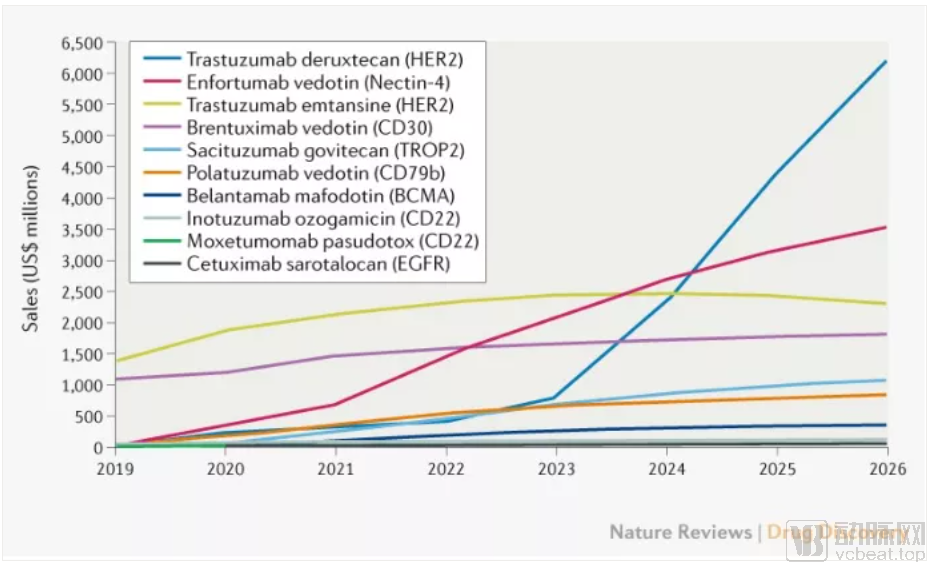
The global market size of approved ADC drugs is projected to exceed $16.4 billion by 2026. Trastuzumab deruxtecan (AstraZeneca/Daiichi Sankyo) is expected to rank first with $6.2 billion in sales, as it has been approved for multiple breast cancer subpopulations (HER2+, HR+/HER2-, and triple-negative) and involves prolonged treatment duration. T-DM1 (Roche), limited to the treatment of HER2+ breast cancer and facing biosimilar competition in the United States, is anticipated to generate $2.3 billion in sales in 2026. Enfortumab vedotin (Seagen/Astellas), approved for previously treated metastatic urothelial carcinoma, is expected to expand its indications to broader patient populations at earlier disease stages, driving its global sales to $3.5 billion in 2026. Sacituzumab govitecan (Gilead) is projected to achieve $1.1 billion in sales through its application in patients with breast cancer and urothelial carcinoma.
Brentuximab vedotin (Seagen/Takeda) covers several subpopulations of Hodgkin lymphoma as well as patients with other hematologic malignancies, with global sales projected to reach $1.8 billion in 2026. Benefiting from limited competition in the relapsed/refractory diffuse large B-cell lymphoma (R/R DLBCL) indication and expanded indications for previously untreated DLBCL patients, polatuzumab vedotin is expected to generate $850 million in sales. In multiple myeloma, belantamab mafodotin (GSK) is anticipated to expand its eligible population to earlier stages of the disease but may face intense competition from existing therapies; its 2026 sales are forecast to approach $400 million. Due to small target populations (previously treated acute lymphoblastic leukemia and hairy cell leukemia), inotuzumab ozogamicin and moxetumomab pasudotox are expected to have lower sales figures. As novel agents continue to enter the oncology landscape, the market for antibody-drug conjugates (ADCs) is poised for further growth beyond 2026.
References:
1# Nature Reviews Drug Discovery. The oncology market for antibody-drug conjugates.