

Keya Medical's AI-powered CT-FFR Solution 'DeepVessel FFR' Demonstrated to Reduce Unnecessary Invasive Angiographies by 72%, Highlighted in Prospectus
Keya Medical
International AI Medical Technology Service Provider
Professor Shi Changzheng’s research group from the First Affiliated Hospital of Jinan University published a paper titled “A 2-year investigation of the impact of the computed tomography–derived fractional flow reserve calculated using a deep learning algorithm on routine decision-making for coronary artery disease management” in European Radiology, a top-tier international academic journal in radiology.
This study validated the safety and efficacy of the “DeepVessel FFR (DVFFR)” technology, which is based on deep learning algorithms. It reflects clinical recognition of the product’s application value and further confirms the positive role of “DeepVessel FFR (DVFFR)” in revascularization therapy.
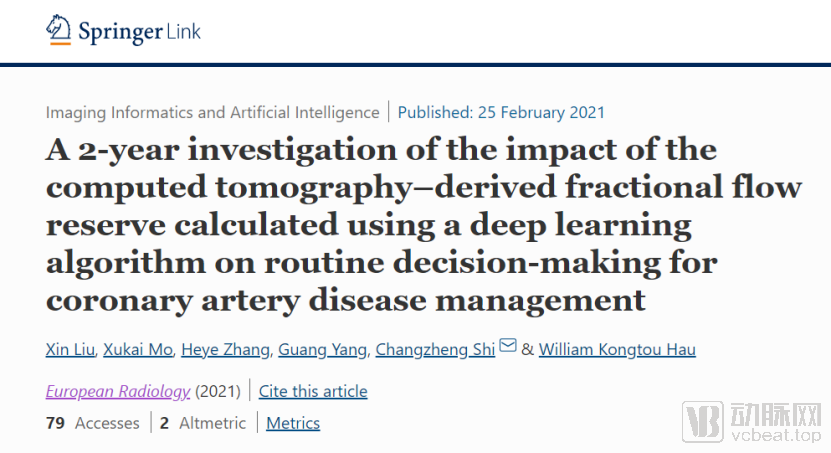
The study utilized Keya Medical’s self-developed “DeepVessel FFR” software, the world’s first product to employ deep learning technology for assessing coronary physiological function, and China’s first Class III innovative medical device to receive authoritative certification from the National Medical Products Administration (NMPA).
It is understood that the “DeepPulse Score DVFFR” software integrates key technologies from interdisciplinary fields such as artificial intelligence, medical imaging, and biomedical engineering. It incorporates multiple proprietary, cutting-edge deep learning algorithms independently developed by Keya Medical, enabling intelligent optimization across all stages—from medical image processing and model reconstruction to FFR calculation. This allows for one-stop, precise anatomical and functional diagnosis of coronary arteries. Previous studies published in top-tier international journals have demonstrated its accuracy to be 92%.
Currently, “DeepVessel FFR” has collaborated with Beijing Anzhen Hospital, Fuwai Hospital of the Chinese Academy of Medical Sciences, West China Hospital, and the Chinese PLA General Hospital to complete 19 clinical studies, enrolling a total of 14,170 participants. Nine additional clinical studies are currently underway, with an expected enrollment of 10,633 participants.
This single-center retrospective study included 243 symptomatic patients with coronary artery disease (CAD) who had stenosis severity greater than 50% as confirmed by coronary computed tomography angiography (CTA). Following admission, these patients underwent invasive coronary angiography (ICA)-guided interventions, and the Deep Vessel Fractional Flow Reserve (DVFFR) was retrospectively analyzed.
During the 2-year follow-up period, the impact of DeepVessel FFR (DVFFR) on clinical decision-making and clinical outcomes will be compared with those guided by invasive coronary angiography (ICA).
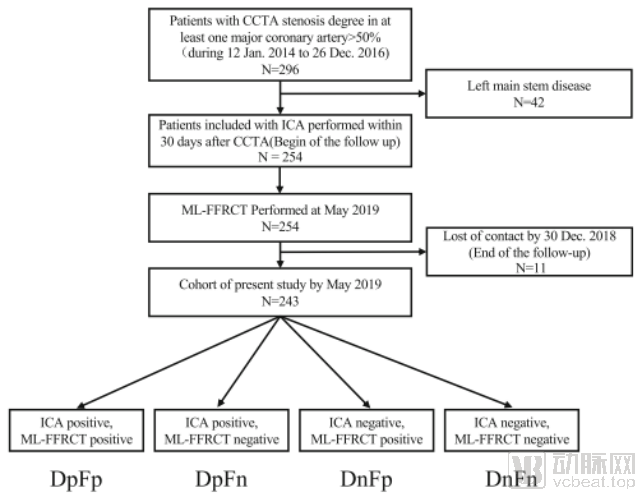
Validation Process
The results indicate that,“DeepVessel FFR,” developed based on artificial intelligence deep learning algorithms, can reduce unnecessary coronary angiography by 72% without increasing MACE events.Previously, Heartflow in the United States demonstrated in the PLATFORM study that FFRCT, developed based on fluid dynamics, can reduce unnecessary coronary angiography by approximately 60%. This indicates that “DeepVessel FFR (DVFFR),” developed using artificial intelligence deep learning algorithms, can more accurately identify patients who are suitable candidates for coronary angiography.
Notably, by learning anatomical features extracted from coronary CTA to calculate pressure gradients along the coronary artery tree, “DeepVessel FFR (DVFFR)” can provide more objective and reproducible results, thereby improving the accuracy of FFRCT calculations.
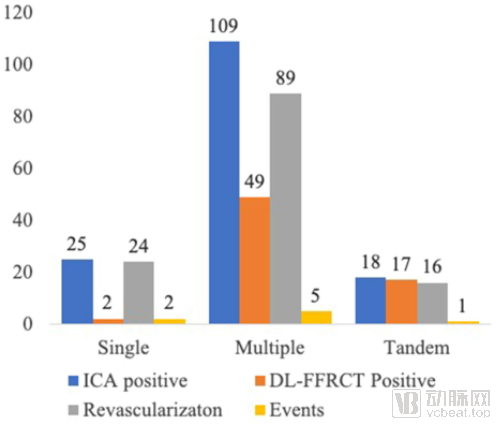
Furthermore, the value and safety of “DeepVessel FFR” in tandem lesions have been confirmed. Assessment of tandem lesions using “DeepVessel FFR” demonstrates high concordance with angiographic evaluation. With improved time efficiency in the use of “DeepVessel FFR,” it is expected to reduce procedural time for evaluating tandem lesions and lower overall medical costs.
Professor Shi Changzheng, the project leader from the First Affiliated Hospital of Jinan University, stated that a two-year investigation and study demonstrated that “DeepVessel FFR (DVFFR),” based on deep learning algorithms, can positively influence routine decision-making in coronary artery disease management. This approach enables more than 72% of patients to avoid unnecessary invasive coronary angiography, along with the associated surgical risks and costs, while achieving clinical outcomes non-inferior to those of invasive angiography.
Compared with other currently available mainstream diagnostic methods for coronary artery disease (CAD), “DeepVessel FFR,” a solution based on deep learning algorithms, offers the most cost-effective diagnostic approach with significant potential for widespread adoption. Consequently, it has received high acclaim from the National Medical Products Administration (NMPA) as having “substantial economic benefits and social value, with performance indicators leading internationally compared to similar domestic and international products.” It has thus become the first Class III artificial intelligence medical device approved by the NMPA for commercialization in China.
This also positions “DeepVessel FFR,” which delivers high-efficiency, comprehensive, and accurate diagnostic performance, as a non-invasive alternative to invasive coronary angiography (ICA), offering a new pathway for evaluating whether patients require coronary intervention.